Branding vs Marketing: 10 Things Most People Get Wrong
They're not the same thing. And confusing them is costing you more than you think.

I’ve been posting about this on LinkedIn for a while now, and the response has been pretty consistent: people either nod along like they already knew it, or they message me saying “okay wait, can you explain that more?”
So this is the longer version. For the people who want to actually sit with it.
Most businesses use the words “branding” and “marketing” interchangeably. And I get it. They’re both about getting customers, right? Both involve creative work, budgets, campaigns. They seem like cousins at worst.
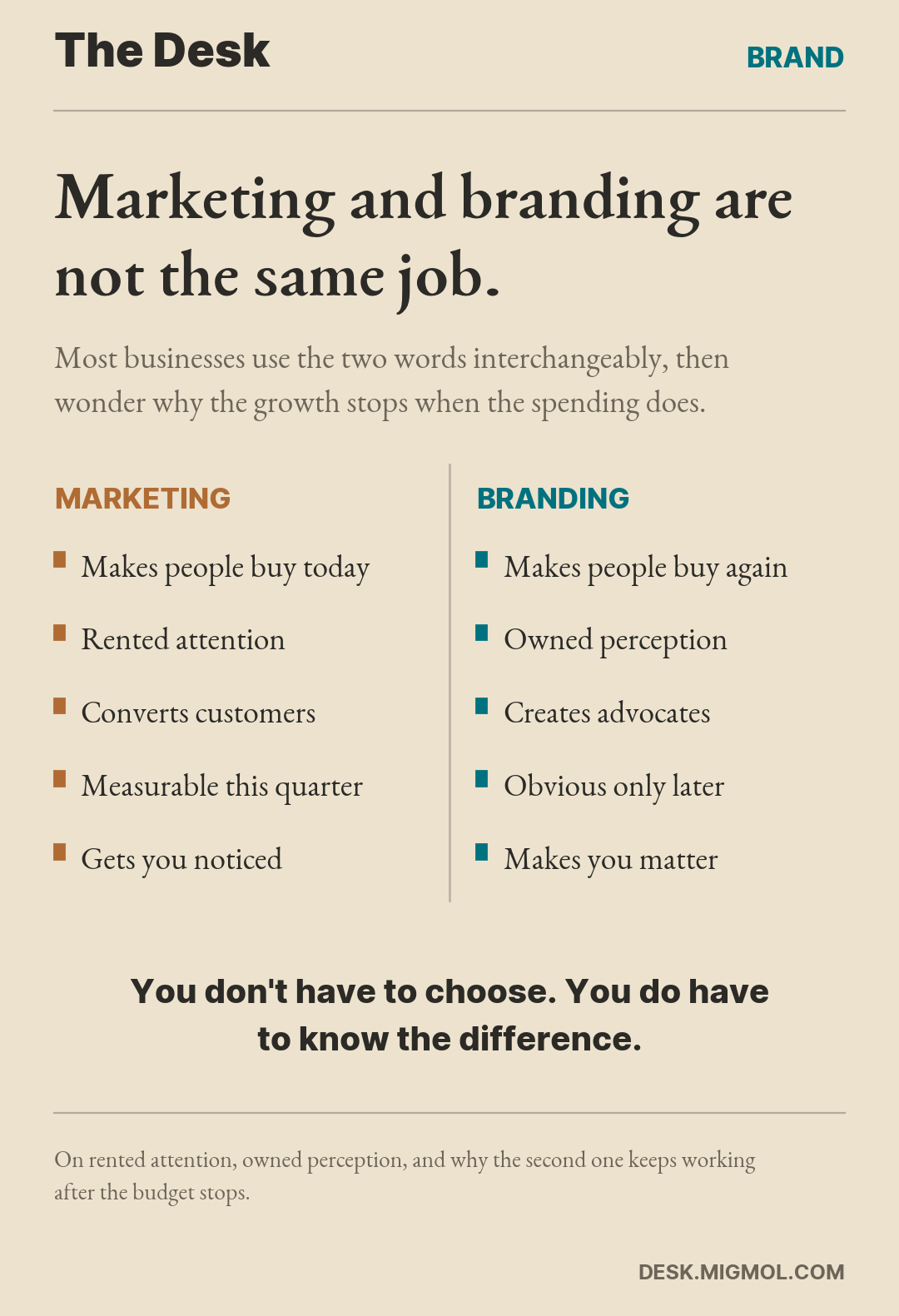
But they’re not cousins. They’re more like a spark and a fire. Marketing is the spark: quick, bright, purposeful. Branding is the fire that keeps burning after the spark is gone.
A little context on where I’m coming from: I was trained in multinational CPG, where brand managers don’t just manage campaigns. They own a P&L. You’re responsible for the full financial performance of your brand. That shapes how you think. You stop seeing a brand as a creative exercise and start seeing it as a business asset. You stop thinking in campaigns and start thinking in years. Every investment gets evaluated not just on what it returns this quarter, but on what it builds for the long term.
That’s the lens I’m bringing to this. Let me break down what I mean.
1. Marketing makes people buy today. Branding makes people buy again.
Marketing is about the transaction. Branding is about the relationship.
When you run an ad, offer a discount, or launch a promotion, you’re doing marketing. You’re giving someone a reason to act right now. That’s valuable, but it only works in the moment. Once the deal is gone, so is the reason to buy.
Branding is what happens in between transactions. It’s the feeling someone has about your business when they’re not actively shopping. It’s the reason they come back without being pushed, and the reason they recommend you to a friend without being asked.
2. They work on different parts of the brain.
This one sounds a bit nerdy but bear with me, because it actually explains a lot.
Daniel Kahneman, in his book Thinking, Fast and Slow, describes two systems of thinking. System 1 is fast, automatic, and instinctive. System 2 is slower, more deliberate, and driven by values and identity. (I’d recommend picking up the book. I’ll link it below. It’s one of those reads that quietly changes how you see everything.)
Marketing works on System 1. It’s on sale. It solves my problem. I need it now. That’s marketing doing its job, triggering a quick decision.
Branding works on System 2. It’s the part of your brain that decides who you trust, who you identify with, what feels like “you.” That’s why people pay more for a brand they love even when a cheaper option exists. It’s not irrational. It’s a different kind of logic, and branding is what earns it.
Marketing nudges behavior. Branding changes it.
3. They answer completely different questions.
Marketing answers: Why should I buy this now?
Branding answers: Why should I buy from you at all?
The first question is easier to answer: a good price, a good promo, a strong product feature. The second is harder, and most businesses never fully answer it. When your promotion ends, when a competitor matches your price, when someone else launches something shinier, what’s left? If the answer is “not much,” you’ve been relying on marketing to do a job that only branding can do.
4. Marketing is a tactic. Branding is how your whole business behaves.
People often think of branding as the logo, the colors, the fonts. That’s part of it, but a small part.
Real branding shows up everywhere: in how your team talks to customers, in whether your product actually does what you promise, in how you handle a complaint, in whether your pricing feels fair or opportunistic. It’s in the tiny moments that people don’t consciously notice but absolutely remember.
Marketing has a campaign end date. Branding never clocks out.
5. Marketing is rented attention. Branding is owned perception.
When you run ads, you’re renting space in someone’s feed. The moment you stop paying, you disappear. That’s fine; it’s how marketing works, and there’s nothing wrong with it.
But branding builds something you actually own: a place in people’s minds. When someone thinks of a category and your name comes up unprompted, that’s brand. When someone trusts you before they’ve even visited your website, that’s brand. Unlike ad spend, that doesn’t evaporate the moment you pause your budget.
6. Marketing converts customers. Branding creates advocates.
A customer buys from you. An advocate buys from you, tells their friends about you, defends you in conversations you’re not even part of, and comes back without needing to be convinced again.
Marketing can get someone through the door. But it can’t manufacture that kind of loyalty. That comes from consistently delivering on a promise over time. If you’re pouring money into acquisition but your repeat purchase rate is low, that’s a signal. Your marketing is working. Your brand isn’t.
7. Marketing is measurable. Branding is a slow build that eventually becomes obvious.
This is the tension most finance teams feel. Marketing is easy to justify: clicks, conversions, return on spend. Branding is harder to put a number on, especially in the short term.
But strong brands lower how much you have to spend on marketing to get the same result. They attract better talent, charge higher prices, and retain customers longer. The ROI is real, it just shows up differently and later. The companies that figure this out stop asking “is branding working?” and start asking “what’s it costing us not to invest in it?”
8. Marketing optimizes what exists. Branding imagines what could be.
If you want to get more out of your current business, marketing can help. Better targeting, better offers, better timing: that’s the craft of marketing.
But if you want to build something that means something? That attracts a community, not just a customer base? That has pricing power and staying power? That requires branding. It requires a point of view about who you are and what you’re here to do, and the patience to let that compound over time.
9. Marketing gets you noticed. Branding makes you matter.
We are all drowning in content, ads, and noise. Getting attention is genuinely harder than it’s ever been. But attention alone doesn’t build a business. Plenty of viral brands have come and gone.
What keeps people coming back isn’t how loud you were. It’s whether what you said actually meant something to them. Branding is the work of figuring out what that meaning is, and then showing up consistently enough that people believe you.
10. You don’t have to choose, but you do have to understand the difference.
The best businesses do both, and they do them at the right time.
When you need to hit a number this month, marketing is your tool. It’s immediate, controllable, and measurable. Use it.
But if every single dollar of your growth is coming from promotions, discounts, and paid ads, you’re renting your audience instead of building one. The moment you stop spending, you stop existing in people’s minds.
Now, I want to be fair about something: branding takes longer and it costs more. If you’re looking at a pure finance view of the world, or you’re only optimizing for now, the numbers won’t always make sense on a spreadsheet. I understand that pressure. I’ve sat in those budget meetings.
But my training taught me something: you’re not just building for now. You’re building a business that should still be standing, still be relevant, and still be growing five and ten years from now. Branding is how you do that.
And if you choose not to invest in it, someone else will. A competitor will own the category in people’s minds. They’ll earn that deep, almost irrational love that loyal customers have for brands they truly connect with. And once someone else owns that space, it is very hard, and very expensive, to take it back.
Use marketing to win the month. Use branding to win the decade.
This article is part of an ongoing series on brand strategy. If something here resonated, feel free to share it with someone building something worth remembering.

Pax Silica: Much Ado About Nothing
Pax Silica has no confirmed investor and no tenant, yet everyone is fighting over it. A lesson in owning the narrative, and why a semblance of a plan is not a plan.
Read more →
Diversity Marketing Is Working
Gap's KATSEYE ad moved denim sales while the louder campaign next door moved a stock price. Three years of Gap campaigns say the same thing about reading the room.
Read more →
Samsung's Petty Genius
They named their new foldables to box in Apple before Apple even ships. I'm a Samsung guy, and I'm here for it.
Read more →
Alex Eala Doesn't Owe Us Anything
But she showed up anyway.
Read more →