Knowing Where Your Brand Ends: A Framework for Brand Expansion That Doesn't Erode
When to expand, when to hold, and the difference between territory, promise, and portfolio expansion — using Oishi, Dove, Magnolia, Nescafé, and Happee as case studies
When Should a Brand Expand?
There is a certain kind of boardroom energy that appears when a brand becomes successful. Sales plateau. Competitors multiply. The category fragments. Someone inevitably asks: what else can this brand do? Bic sold perfume. Colgate once sold frozen dinners. Cosmopolitan tried yogurt. Each time, a successful brand looked at its equity and asked: where else can this go? The answer, in hindsight: nowhere.
The instinct to expand feels rational. If the name is strong, if awareness is high, if trust has been built over years, why not stretch it into adjacent categories and capture more of the consumer’s wallet?
Yet expansion is where many strong brands quietly erode themselves. The move that looks like growth in a spreadsheet becomes dilution in the market. The logo travels; the meaning thins.
The problem is rarely ambition. The problem is clarity.
Before asking where a brand can go, it is worth asking a more disciplined question: should it go anywhere at all?
A simple framework: when expansion compounds
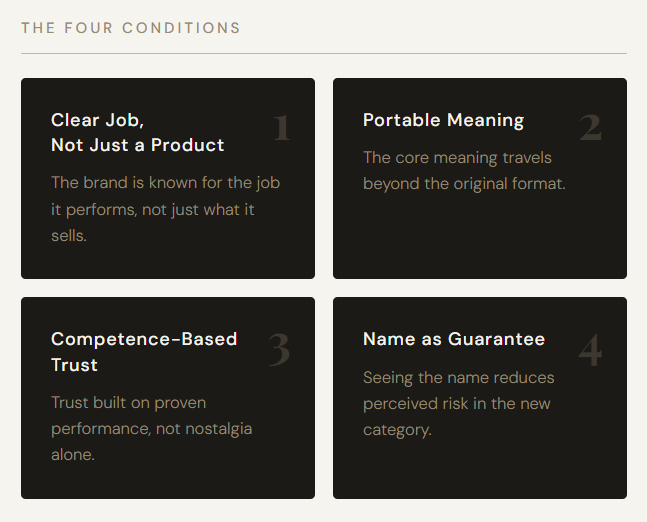
In my experience, expansion compounds rather than dilutes when four conditions are present.
The brand owns a clear job, not just a product.
If a brand is merely known for what it sells, expansion becomes guesswork. If it is known for the job it performs in people’s lives, movement becomes more predictable.
Oishi is not just a potato chip brand. It owns “snacking.” That is a world, not a SKU. Within that world, sweets, nuts, biscuits, and other snack forms feel coherent. The brand solves a specific need state: affordable, everyday indulgence that lives in the same retail aisle and occasion.
BlackBerry owned secure mobile communication for enterprise users. That was a clear job. But when they expanded into tablets and tried to compete in consumer smartphones, they treated it as territory expansion when it was actually promise expansion into a different job entirely. Enterprise security didn’t translate to consumer lifestyle appeal. The job changed; the brand couldn’t.
When a brand owns a job, expansion feels like extension. When it owns a product, expansion feels like opportunism.
Its meaning is portable.
A brand’s core meaning must travel beyond its original format. Dove began in soap, but its promise was never just cleansing. It stood for gentle care and real beauty. That promise translated into body wash, lotion, deodorant, and hair care without feeling forced.
The format changed. The meaning stayed intact.
If what the brand stands for applies only inside one product shape, stretching it elsewhere invites skepticism.
Trust is built on competence, not nostalgia.
Nostalgia is powerful but fragile. It reminds people of the past; it does not prove future performance.
When people believe a brand can execute at scale and with quality, they grant it permission to try new things. When trust is rooted only in memory, expansion feels like living off former glory.
Competence compounds. Sentiment alone does not.
The brand name functions as a guarantee.
Seeing the name should reduce risk.
Nescafé signals accessible, everyday coffee. That works across variants and formats within its lane. But when Nestlé moved into premium capsule systems, it did not stretch Nescafé upward indefinitely. It created Nespresso as a distinct architecture. The company grew; the core brand did not overextend.
This is discipline. Not everything needs to carry the same badge.
When these four conditions are met, expansion adds weight to the brand. When they are absent, expansion becomes cosmetic growth. Once you’ve confirmed these conditions are met, the next question is: which type of expansion fits your brand?
Choosing your expansion path
The three types of expansion require different preconditions. Choosing wrong is where most brands stumble.
Use this logic:
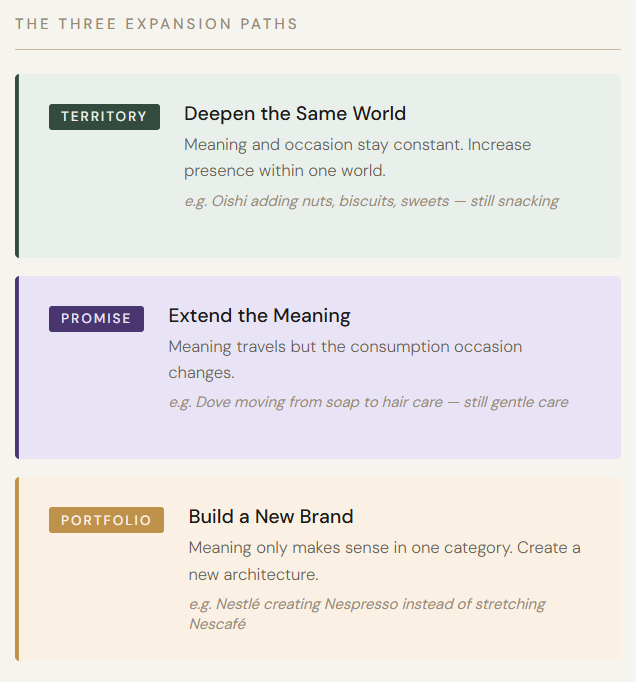
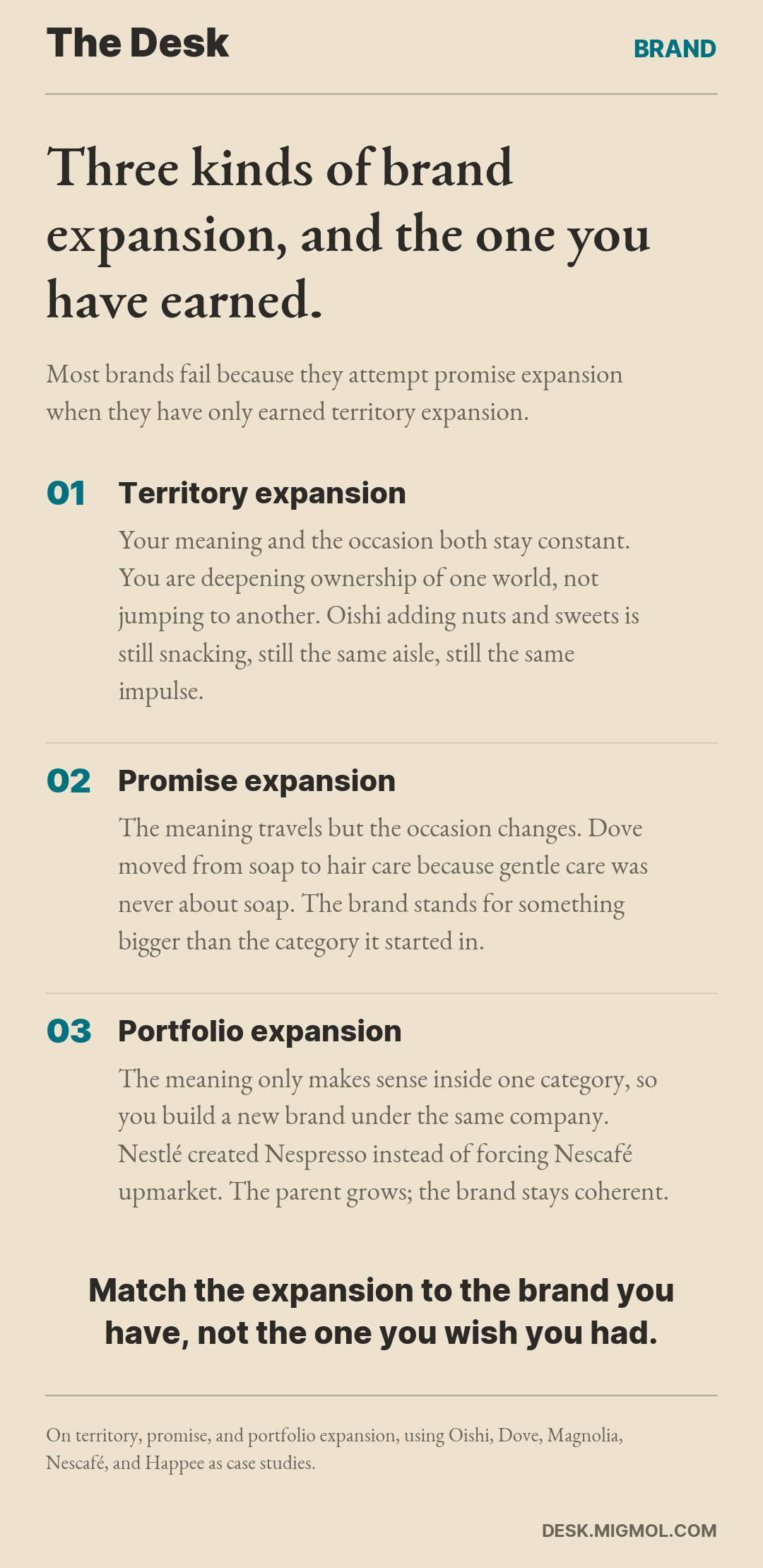
If your brand meaning only makes sense inside one category, use portfolio expansion. Don’t stretch the original brand, build a new one under the same company umbrella. This is Nestlé creating Nespresso instead of forcing Nescafé upmarket. The parent company grows; the brand stays coherent.
If your meaning travels but the consumption occasion changes, use promise expansion. The brand stands for something bigger than its original category, and that meaning can authentically apply elsewhere. Dove moved from soap to hair care because “gentle care” wasn’t soap-specific. The promise stayed; the format shifted.
If your meaning and occasion both stay constant, use territory expansion. You’re deepening ownership of one world, not jumping to another. Oishi adding nuts and sweets is still snacking, still the same retail aisle, still the same impulse. The job never changed; you’re just increasing your presence within it.
Most brands fail because they attempt promise expansion when they’ve only earned territory expansion. BlackBerry thought enterprise security equity meant consumer lifestyle equity, it didn’t. Or they force territory expansion when the smart move is portfolio separation. Match the type of expansion to the brand you actually have, not the one you wish you had.
Stress-testing the framework
Let’s apply this thinking more concretely.
Oishi
Clear job? Yes. It owns affordable snacking. Portable meaning? Within the snack world, yes. Trust built on competence? Strong manufacturing and distribution footprint. Name as guarantee? Yes, Oishi signals accessible, reliable snacking.
Timing? Strong. The core is defensible. The brand dominates its category and has operational capacity to execute in adjacent snack formats.
Oishi can continue territory expansion: more snack forms, adjacent indulgences, possibly even ready-to-eat categories that still live in the snacking universe. The brand understands sakto: the right portion, the right price, the right moment. That insight travels across chips, nuts, sweets, and biscuits because the job remains constant: accessible, everyday indulgence.
What makes Oishi’s expansion coherent is distribution and behavioral alignment. Whether a sari-sari store owner is buying from Puregold, working with a multi-line distributor, or stocking from modern trade, Oishi products move through the same channels and occupy the same mental space. A consumer reaching for Oishi Prawn Crackers can logically reach for Oishi Pillows without cognitive dissonance. The brand deepens its claim on one world rather than jumping to another.
Where it would fail is crossing into categories that require different distribution logic or trust signals. Oishi launching premium coffee would confuse its accessibility equity and demand different retail relationships. Oishi entering personal care (shampoo, soap, skincare) would be incoherent. The job changes. The competence is unproven. The distribution networks don’t naturally align. The name stops functioning as a guarantee.
The inverse lesson: if a local biscuit brand known for affordable treats tried opening premium coffee shops, or if an oral care brand jumped straight into lifestyle beauty without first owning hygiene completely, the expansion would read as opportunism, not strategy. Oishi succeeds because it knows where its job ends.
Magnolia
Magnolia’s portfolio looks scattered at first: ice cream, butter, chicken, mayonnaise, flour, and now fruit drinks. But examining closely reveals where the brand holds coherence and where it begins to fray.
The core job? Fresh, everyday refrigerated food for Filipino families. That’s not “dairy”; it’s the cold chain and daily household consumption.
Clear job? Within refrigerated staples, yes. Portable meaning? Freshness and accessibility travel across ice cream, milk, butter, chicken, and refrigerated spreads. Trust built on competence? Strong in dairy and poultry; both require cold chain mastery. Name as guarantee? For refrigerated everyday food, yes.
What works: Ice cream to milk to butter to chicken feels coherent because it’s the same storage, same distribution networks, same household refrigerator. Even mayonnaise and cheese spreads fit; they’re refrigerated condiments that live alongside the core products. The brand deepens its ownership of “what’s fresh in your fridge.”
Where it stretches: Shelf-stable products like flour, pancake mixes, and baking essentials move into pantry territory. Different part of the store, different purchase occasion, different competence signal. Magnolia hasn’t built trust as a baking authority the way it has with fresh food.
Where it risks dilution: Fruit drinks and bottled water push into beverage territory that has nothing to do with refrigeration or freshness. These categories are crowded, require different distribution muscle, and don’t map to Magnolia’s core job. A consumer reaching for Magnolia butter doesn’t logically reach for Magnolia fruit drink.
The lesson: Magnolia’s strength is in the cold chain. When it stays within fresh, refrigerated, everyday staples, the expansion compounds. When it jumps to shelf-stable or ambient beverages, it’s stretching the brand beyond what it has earned. If it moved into chips or shelf-stable snacks, the brand would fracture entirely; nothing about Magnolia signals dry goods competence.
Happee
Happee owns affordable oral care with a distinctly local identity. The job is clear: accessible, everyday hygiene for value-conscious Filipino families. Its strength is not aspiration; it’s familiarity and reliability at a price point that works for the mass market.
Clear job? Yes. Accessible oral hygiene. Portable meaning? Potentially, within hygiene. Trust built on competence? Yes, within oral care specifically. Name as guarantee? Within oral care, yes. Beyond it, unproven.
Timing? This is where it gets interesting. If Happee’s core oral care position is still being challenged by multinational brands, territory expansion (deeper into oral formats) makes more sense than promise expansion into broader hygiene. The brand should own the bathroom shelf completely before trying to own the shower.
Territory expansion into adjacent oral formats such as mouthwash, whitening strips, or kids’ toothbrushes feels structurally sound. Promise expansion into broader personal hygiene (bar soap, shampoo) could work if framed around accessible, family-friendly care, but only after the oral care fortress is fully built. The brand would need to prove that its equity in oral care translates to competence in skin and hair. That’s not automatic. Filipino consumers already have strong, affordable options in those categories: Safeguard, Palmolive, Rejoice. Happee would be entering as a latecomer without the same proof of performance.
Where it would clearly struggle: lifestyle cosmetics, beauty supplements, or premium wellness products. These require a different kind of trust, one rooted in aspiration and efficacy, not just affordability. Happee hasn’t built that kind of permission. Attempting it would feel like opportunism, not extension.
The smart path for Happee is disciplined territory expansion. Own oral care more completely before trying to own hygiene broadly.
Dove
Dove exemplifies promise expansion. Its meaning travels across categories because the brand stands for something larger than soap.
Clear job? Yes. Gentle care and real beauty. Portable meaning? Exceptionally portable, it’s category-agnostic. Trust built on competence? Yes, proven across multiple formats. Name as guarantee? Yes, Dove signals gentleness regardless of category.
Timing? Dove earned its expansion rights. Each category entry came from a position of strength, not desperation. The brand didn’t scatter, it moved methodically from soap to body wash to lotion to deodorant to hair care, proving competence at each stage.
What would weaken Dove is territory expansion that contradicts its core, performance-heavy or hyper-masculine lines that conflict with its established tone of care and authenticity. The brand can promise-expand almost indefinitely, but it cannot job-expand without fracturing.
Nescafé
Nescafé shows the importance of architectural restraint. It can expand within accessible coffee formats.
Clear job? Yes. Everyday, accessible coffee. Portable meaning? Only within that accessibility lane. Trust built on competence? Yes, but specifically in mass-market coffee. Name as guarantee? Yes, for affordable coffee. Not for premium.
Timing and structure? When Nestlé wanted to move into premium capsule systems, they correctly identified that this required portfolio expansion, not brand stretching. Nescafé couldn’t credibly move upmarket without confusing its core positioning. So they created Nespresso as a distinct architecture. The company grew; the core brand did not overextend.
Growth does not always mean stretching the same name. And timing-wise, Nestlé launched Nespresso from a position of coffee category expertise, not as a defensive reaction to Nescafé’s decline.
Timing matters as much as type
Even when a brand qualifies for expansion and has chosen the right type, timing determines whether it compounds or confuses.
Expand too early, before the core is defensible, and you dilute attention and resources. The original category remains vulnerable while the new one demands investment. Expand too late, after competitors have claimed adjacent territory or after relevance has faded, and the move reads as desperation rather than confidence. The signal to expand is not restlessness or plateau. It’s strength. The core category should be stable, the brand meaning should be clear in research and behavior, and the organization should have operational capacity to execute in a new space without sacrificing the original. If expansion requires borrowing from the core to fund the new, it’s premature. If it feels like escape velocity from a declining base, it’s reactive. The right time is when the brand has earned permission and the move adds weight rather than patches weakness.
Expansion is not bravery. It is judgment.
Brand expansion often gets framed as boldness. In reality, it is restraint.
The discipline to ask: does this brand truly own a job? Is its meaning portable? Is trust grounded in competence? Does the name function as a guarantee here?
Then the discipline to ask: are we deepening our territory, extending our promise, or building a new portfolio brand? And is this the right time, or are we moving because we’re uncomfortable standing still?
The brands that endure understand the difference. They do not expand because they are restless. They expand because the move is structurally sound.
The next time your team proposes expansion, don’t ask whether you can. Ask whether the brand has earned it. Then ask which type of expansion it has earned. The answer will tell you more than any market research deck.
Everything else is just logo placement.
The temptation to grow is universal. The ability to grow without eroding meaning is rare.

Pax Silica: Much Ado About Nothing
Pax Silica has no confirmed investor and no tenant, yet everyone is fighting over it. A lesson in owning the narrative, and why a semblance of a plan is not a plan.
Read more →
Diversity Marketing Is Working
Gap's KATSEYE ad moved denim sales while the louder campaign next door moved a stock price. Three years of Gap campaigns say the same thing about reading the room.
Read more →
Samsung's Petty Genius
They named their new foldables to box in Apple before Apple even ships. I'm a Samsung guy, and I'm here for it.
Read more →
Alex Eala Doesn't Owe Us Anything
But she showed up anyway.
Read more →