San Miguel Pale Pilsen Doesn’t Have a Youth Problem; It Has a Clarity Problem.
A brand strategy analysis of San Miguel Pale Pilsen, legacy marketing, and the cost of trying to speak to everyone
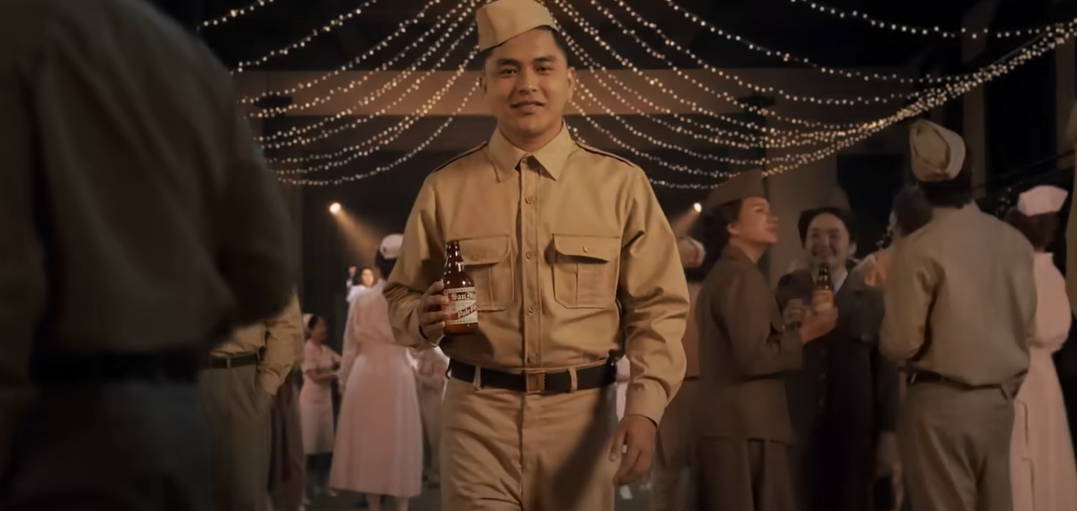
This article started from a simple irritation. Over the past few years, San Miguel Pale Pilsen’s communication has felt unsettled. The materials seem intent on crossing the bridge between Boomers and Millennials at the same time: nostalgia paired with younger faces, heritage language mixed with contemporary cues. It’s an extremely difficult assignment. Why does this make sense strategically?
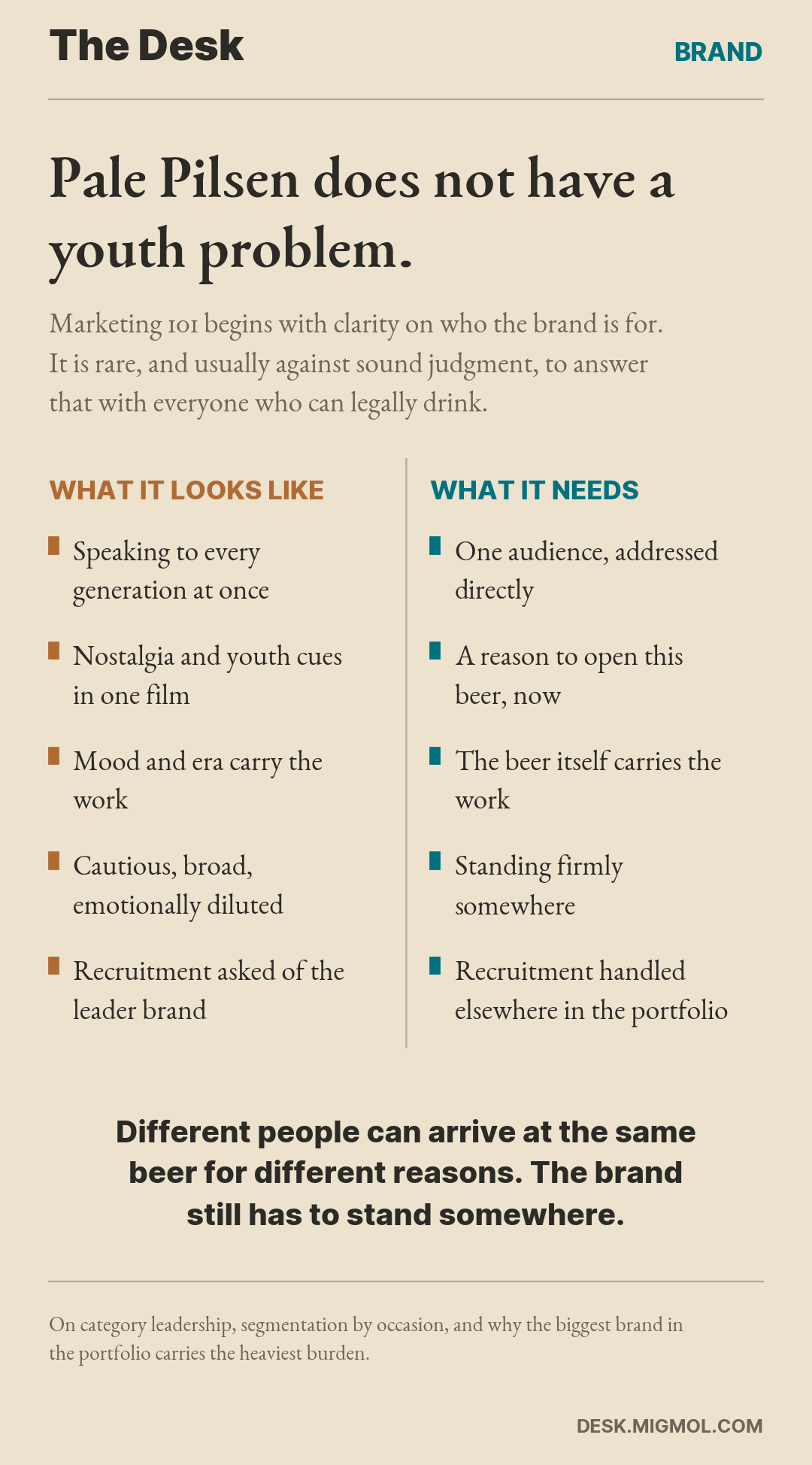
Marketing 101 begins with clarity on who the brand is for. It is rare, and usually against sound judgment, to answer that question with “everyone who can legally drink.” Yet that is effectively how Pale Pilsen is being positioned. From the outside, the brand appears to be reaching across generations rather than standing firmly somewhere. The result feels cautious, broad, and emotionally diluted.
The issue isn’t that Pale Pilsen is seen by many generations. It’s that it’s trying to speak to them all at the same time, in the same voice. Those are very different things. Strong brands don’t narrow who can recognize themselves in them; they narrow what they stand for. Once that’s clear, different people can arrive at the same product for different reasons, without the brand having to flatten itself to accommodate everyone at once.
This confusion is happening in a category that no longer behaves the way it once did. Beer sales are not what they used to be. Global alcohol consumption was already trending downward before the pandemic. Post-pandemic, going out itself has declined. Younger generations are digital natives; their exposure to alcohol is global, fragmented, and algorithm-driven. Their choices are far broader than what previous generations grew up with.
When I was younger, the choice architecture was simple. You drank beer. If you wanted something stronger, you drank whisky. If you were partying, you added tequila. Today, even a casual condo get-together tells a different story. Beer is still present, but rarely alone. There’s soju. There are canned whiskey sours. There are spiked colas. There are flavored beers. There are zero- or low-alcohol options. Mainstream lagers are now part of a wider set, not the default center.
San Miguel clearly understands this structurally. Its portfolio already reflects segmentation by need and occasion. Fruity beers skew younger and more female. Red Horse dominates a strength-led, social drinking space. San Mig Light has carved out a health-adjacent lane while reframing itself around mahaba-habang inuman, emphasizing duration and connection rather than restraint. Even Gold Eagle, another mainstream label, sits within the same system. This is not a company dependent on a single flagship; it spans the full beer value spectrum.
Collectively, San Miguel’s beer brands account for the vast majority of beer consumed in the Philippines. That level of dominance is rare in any category. Which makes the next point harder to ignore: despite Pale Pilsen’s legacy status, it is not the volume engine. Red Horse is.
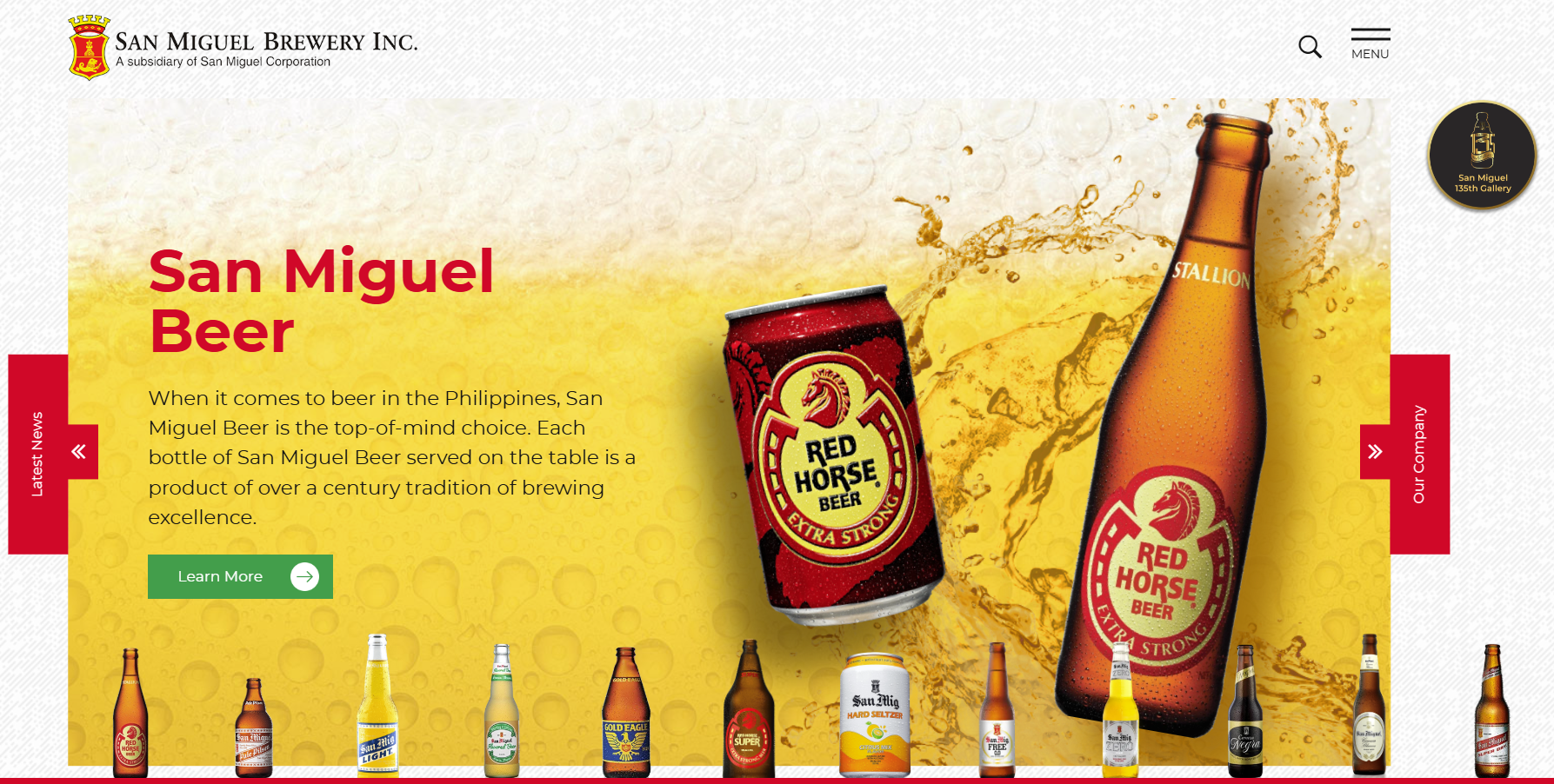
That fact alone says something important. Legacy, by itself, is not a growth driver. Scale today comes from relevance to current drinking behavior, not historical primacy. Pale Pilsen may be the cultural reference, but Red Horse does the heaviest lifting. The market has already made that distinction. Respect for heritage does not automatically translate into momentum.
Which brings us back to Pale Pilsen.
As category leader, the San Miguel beer portfolio carries a disproportionate burden. When the category slows, it feels the impact most in absolute terms. That creates pressure to grow something, somewhere. From the outside, it’s easy to see the temptation: stretch the flagship. See if the most traditional beer can still recruit younger drinkers while holding on to older ones. On paper, that sounds efficient. In practice, it’s where clarity begins to break down.
The question isn’t whether San Miguel should grow. It’s where growth realistically comes from. Do you grow the mainstream category by asking the most traditional beer to become culturally elastic? Or do you allow the flagship to anchor the system, while growth happens through adjacent brands, formats, and occasions?
This distinction matters because it challenges a common reflex in brand management: treating age, legacy, or “dad brand” status as a problem that needs fixing.
“That’s my dad’s brand” is not a problem to solve
One of the most misunderstood signals in branding is the phrase “that’s my dad’s brand.” It’s often treated as an alarm bell. In reality, it’s a marker of continuity.
Many enduring brands reached this point and didn’t panic. They made a choice. They accepted age rather than arguing with it. Budweiser leaned into heritage and Americana, then shifted youth recruitment elsewhere in the portfolio. Levi’s allowed its icons to remain icons while other lines handled trend and collaboration. Guinness didn’t try to become a party beer. It deepened its ritual, seriousness, and restraint, and younger drinkers opted in on their own terms.
The pattern is consistent. Strong legacy brands don’t deny becoming “dad brands.” They organize around it.
From the outside, Pale Pilsen appears hesitant to fully accept this role. Yet “my dad’s beer” carries authority, legitimacy, and cultural weight. Younger drinkers don’t reject it outright. They simply don’t want to be spoken to through it prematurely.
In other words, it’s not the age of the brand that turns them off; it’s the age they’re being asked to perform. Younger drinkers don’t want to borrow memories they haven’t lived yet. They don’t want to be addressed through nostalgia that isn’t theirs, or through life stages they haven’t reached. Heritage works best as something you grow into, not something you’re handed early and told to identify with.
The irony is that the natural progression is obvious. Younger drinkers age. Their consumption patterns change. The brands that endure are the ones waiting later in life with credibility intact. That only works if the flagship hasn’t diluted itself trying to stay young forever.
The fear that older drinkers will leave if the brand shifts is often overstated. Beer, especially among older cohorts, is habit-driven. As long as the product tastes the same, is available, and is priced accessibly, most stay. They may grumble about the ads, but they still buy the beer.
If Tito Mike doesn’t like the new Pale Pilsen ad, he’s not going to switch beers. He’ll complain about it, maybe joke about it, and then reach for the same bottle he’s been buying for decades.
In the Philippine context, this inertia is even stronger. Pale Pilsen functions less like a brand and more like a default. It’s always available, always understood, and rarely questioned. Boomers don’t have a clear lateral move. If they change at all, it’s usually within the same house or through reduced frequency, not by abandoning the category leader.
If you really want generations, here’s how
If San Miguel genuinely wants to speak across generations, the solution doesn’t need to be louder. It can be quieter.
Imagine three people: a man in his 60s, a man in his 40s, a woman in her 20s. Indoor setting. Intimate close-ups. No spectacle.
Each speaks calmly about what Pale Pilsen means to them.
The man in his 60s talks about continuity. A life lived. Rituals that stayed. Pale Pilsen as something steady through decades of change.
The man in his 40s talks about reward. Pressure. Responsibility. Building something. He acknowledges newer beers exist, but when the day ends, what he reaches for is a cold Pale Pilsen. Not because it’s trendy, but because it’s reliable.
The woman in her 20s talks about taste and pride. She’s traveled. She’s met people. She’s tried different drinks. And still, she’s proud of Pale Pilsen. It anchors her identity. It reminds her where she’s from.
They listen to each other. They’re surprised. Amused. They don’t resolve the differences. They don’t need to. The point isn’t shared nostalgia. It’s shared respect.
This works because each story stands on its own. Each one is meant to be seen first by its own audience, without compromise. This isn’t one message stretched across generations; it’s a stable brand identity encountered through different lenses.
The predictable objection is that this is “too complicated.” Filipinos won’t get it. It needs to be a no-brainer.
But simplicity belongs in the treatment, not the thinking. One person. One truth. Clear casting. Clear voice. That isn’t complicated. What’s complicated is collapsing generations into a single emotional note and hoping it resonates equally.
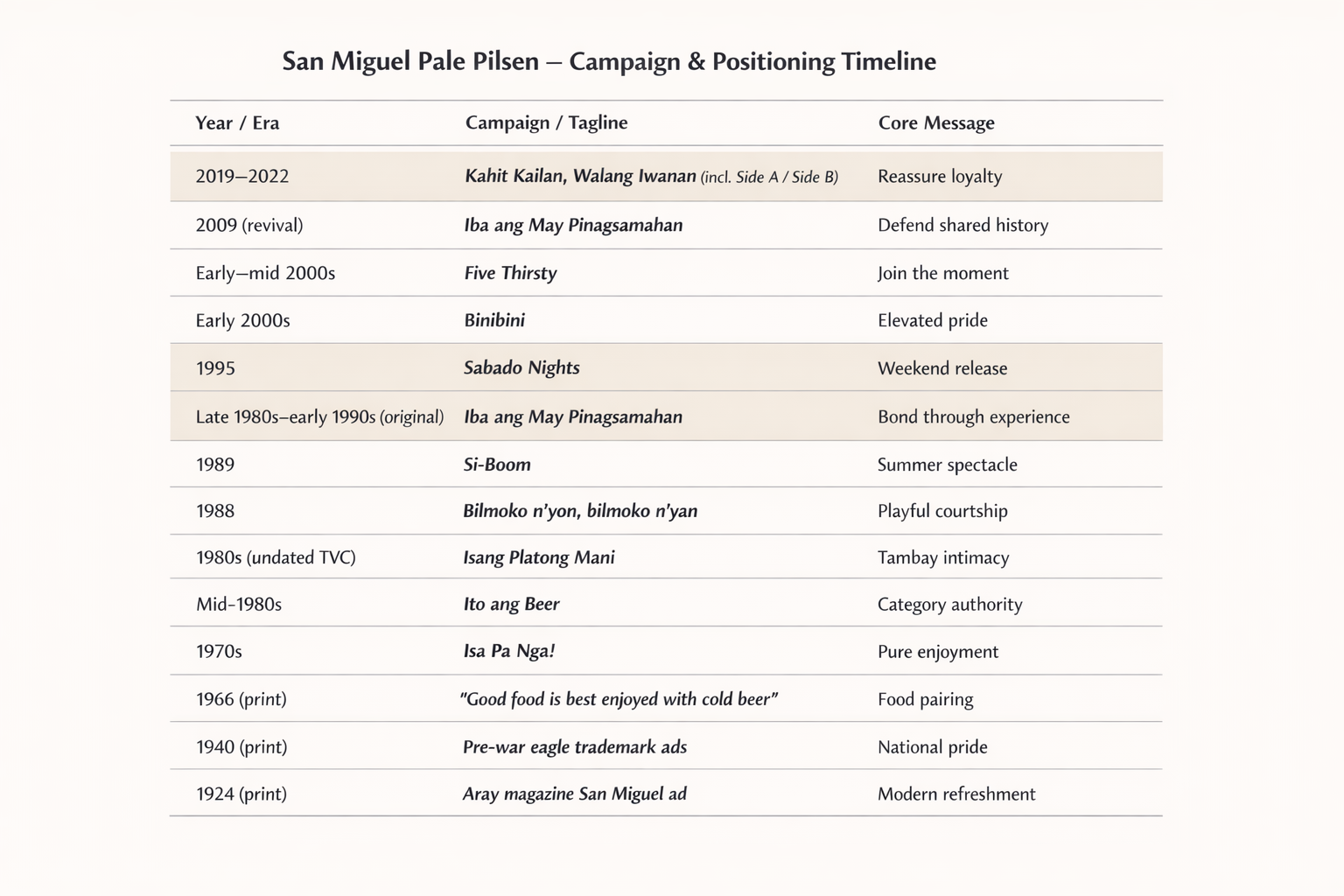
The irony is that San Miguel has done this better before. Campaigns like Sabado Nights and Five Thirsty didn’t lead with heritage or explain the past. They framed Pale Pilsen confidently within the rhythm of the current generation, how it was enjoyed, when it was opened, and what it signaled in that moment. Relevance came from clarity, not universality.
Talking to an audience that is already secured may feel safe. It does nothing to solve the category’s real problem: recruiting the next generation with conviction.
And this doesn’t need to live as one film. Three standalone pieces could run independently, each targeted to its audience. Over time, a fourth brings them together, served only to those who’ve seen the originals. Intentional. Sequential. Digital-first.
San Miguel has attempted something adjacent with campaigns like Side A, Side B. The ambition was clear, but the focus leaned heavily on mood and era, what it looked like, what it sounded like, rather than on the beer itself. I understand what it was trying to say: it existed then, it exists now. But that alone doesn’t answer the more important question. Why would I choose it? Why would I drink it today?
That question becomes sharper when you step back and look at how Pale Pilsen has positioned itself over time. Across decades, the brand’s campaigns reveal changing answers to a basic question: what role does Pale Pilsen believe it plays in people’s lives?
Clarity is the strategy
What Pale Pilsen needs is not broader appeal, but a clearer job.
At this stage of the category, the most decisive move available to Pale Pilsen is not to chase new meanings, but to hold its ground. To stop trying to evolve emotionally every cycle. To accept that its role is not to recruit aggressively, but to anchor the system.
In short, Pale Pilsen needs to stand still.
Standing still doesn’t mean going quiet. It doesn’t mean disappearing or retreating. It means choosing constancy over reinvention.
Pale Pilsen should absolutely advertise. But its advertising should not behave like recruitment. Its job is not to persuade people early or convince them that the brand still belongs to them. Its job is to remain visible, familiar, and unchanged so that people encounter it naturally over time.
In practice, that means ads that reinforce presence rather than relevance. Short, calm, repeatable work. One moment at a time. One life stage at a time. No urgency to explain itself, no need to collapse generations into a single emotional narrative.
This isn’t passive marketing. It’s disciplined marketing.
Recruitment belongs elsewhere in the portfolio, with brands designed to move faster, speak louder, and experiment more freely. Pale Pilsen’s strength has never been speed. It has been gravity.
Trying to make the flagship recruit is what creates anxiety in the work. Allowing it to anchor is what restores clarity across the system.
Pale Pilsen doesn’t need to prove that it still matters. It needs to remain unmistakably itself long enough for different generations to meet it when they’re ready.
That’s not waiting. That’s how enduring brands earn their place in time.

Pax Silica: Much Ado About Nothing
Pax Silica has no confirmed investor and no tenant, yet everyone is fighting over it. A lesson in owning the narrative, and why a semblance of a plan is not a plan.
Read more →
Diversity Marketing Is Working
Gap's KATSEYE ad moved denim sales while the louder campaign next door moved a stock price. Three years of Gap campaigns say the same thing about reading the room.
Read more →
Samsung's Petty Genius
They named their new foldables to box in Apple before Apple even ships. I'm a Samsung guy, and I'm here for it.
Read more →
Alex Eala Doesn't Owe Us Anything
But she showed up anyway.
Read more →