Work Shouldn't Just Be Work: Why Creative Autonomy Builds Better Brands and Better Teams
On Gen Z talent, micro-decisions, and why the leaders who trust their people are building something genuinely hard to compete with
I told my staff to stop being so literal.
They were sending me visuals for final approval and something felt off. The work was fine, technically competent, on brief, on time. But it was repetitive. Task-driven. You could feel that they were just going through the motions. So I told them: you have permission to express yourselves. Bring your individuality into the work. Propose new directions. Be relevant.
Because work can be an outlet. It should be. When someone is genuinely invested in what they’re creating, you can feel it. The difference between work that’s executed and work that’s felt is visible to anyone paying attention. And for our clients, brands that have been running on the same tired playbook for years, that kind of energy is exactly what moves the needle.
But here’s the thing. Telling your people they have permission is only half the equation. The other half is whether they actually believe you mean it. I’ve seen plenty of leaders say “we value creativity” and then quietly reject anything that makes them uncomfortable. If the person with final say has been thinking the same way for 50 years, new ideas don’t survive long. They die quietly, and your people learn, fast, to stop offering them.
This matters beyond morale. It matters because of where brands are right now.
A lot of company heads will tell you they want to be relevant to Millennials and Gen Z. And the urgency is real. There are brands that had their prime in the 80s and 90s that are slowly losing their core market as that generation moves into retirement. Building relevance is a long game; it happens in a million different steps, starting with the core of your product and working outward. I’ll get into the full picture another time. But one of those steps, one that gets overlooked constantly, is the details.
If your Gen Z staff aren’t even allowed to express themselves, even in something as small as a color shade, then how exactly are you planning to connect with Gen Z consumers?
When you hire young talent, you’re not just hiring a skill set. You’re hiring a perspective. There is a literal DNA of that generation sitting in your office. We’re not asking them to make the big strategic calls. We’re asking them to put more of themselves, their instincts, their aesthetic sense, their way of seeing the world, into the art, into the copy, into the details. Those are micro-decisions. Fine, small things. But I was literally asking my team to update a shade of blue, to rethink how they used yellow and red. That sounds trivial. But that’s exactly what a creative director does. That’s how a brand gets shaped, not in one dramatic overhaul, but through a thousand small, considered choices made by people who are paying attention and bringing themselves to the work.
Think about what we are as people. We are the sum of a billion decisions, preferences, habits, thoughts, and experiences accumulated over a lifetime. That’s what forms a person, not one defining moment, but the accumulation of everything small. The same is true for a brand. The same is true for a culture. And if you’re blocking those micro-decisions, flattening your team’s instincts in the name of comfort or consistency, you’re not protecting anything. You’re slowly draining it.
So the question becomes: what kind of leader actually allows this to happen?
A friend of mine who runs a company told me he was proud that his leadership team was made up of people who were both trustworthy and competent. Not one or the other, both. That combination is rarer than it sounds, and it’s what allowed his team to make decisions quickly and confidently without everything needing to be escalated up the chain. He was describing, without using the term, the difference between Type 1 and Type 2 decisions. Type 1 decisions are the big, hard-to-reverse ones; they genuinely need senior eyes and careful deliberation. Type 2 decisions are everything else: faster, lower-stakes, recoverable. The mistake most organizations make is treating everything like a Type 1. They bottleneck. They slow down. And without meaning to, they send a message to their people: we don’t trust you.
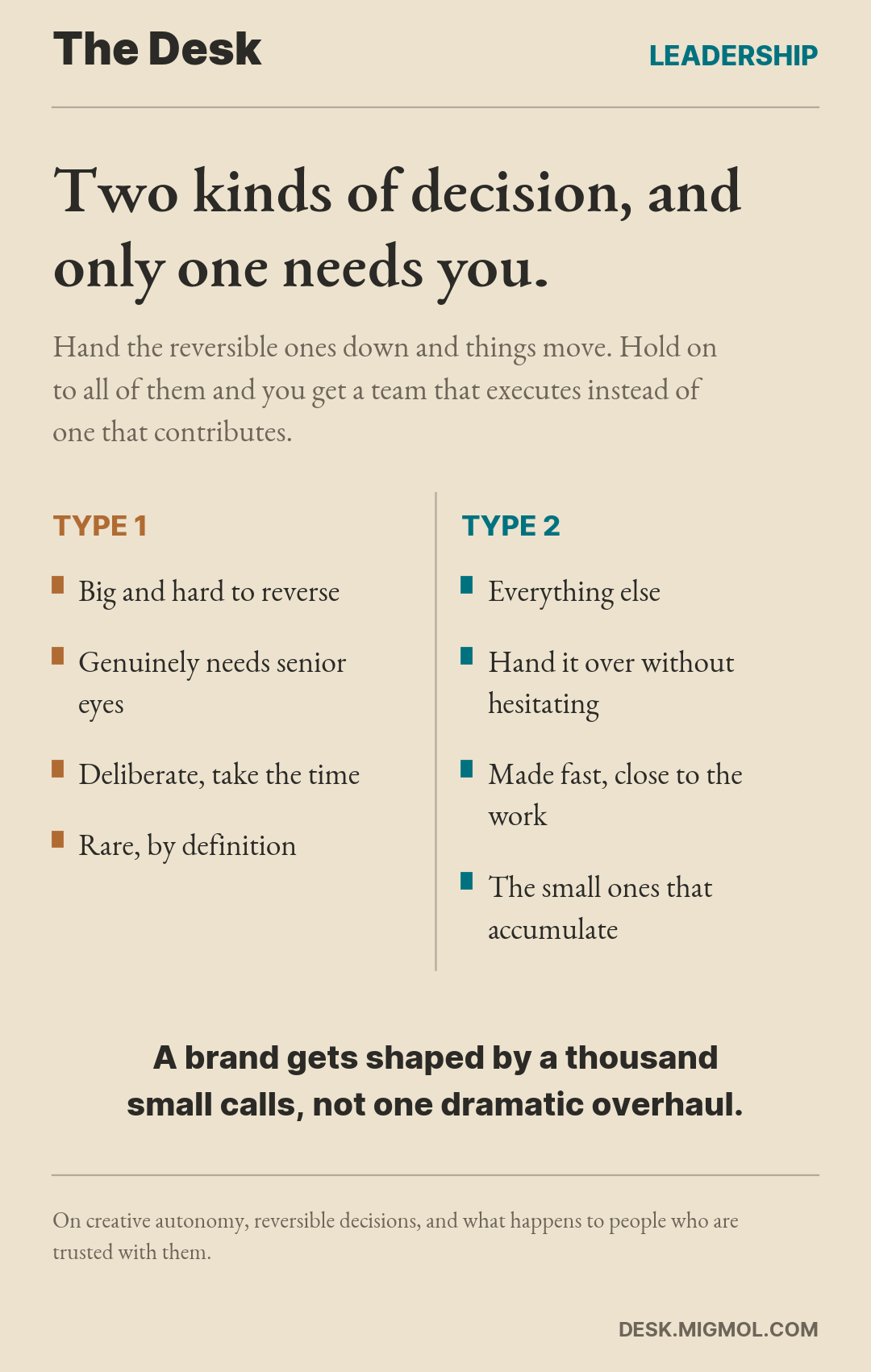
When you have the right leaders in place, you hand them Type 2 decisions without hesitation. Things move. People feel like they have real agency. And that feeling unlocks something. It’s the difference between a team that executes and a team that contributes.
The mindset shift that makes all of this possible is a simple one: knowing the edge of your own knowledge. A good leader knows what they know. A great leader builds a team that covers everything they don’t, and genuinely respects those people for it. Not performatively. Actually. When you have that kind of mutual respect, disagreement becomes a tool rather than a threat. You can challenge a direction without it becoming personal. You make better decisions, faster, with more confidence.
And when that culture exists, work changes. People stop protecting themselves and start contributing. They stop executing tasks and start making decisions, small ones, the kind that accumulate. The kind that, over time, shape something.
We are each the sum of a billion small decisions. So are our brands. So are our cultures. The leaders who understand that, who build the conditions for their people to bring themselves to the work, at every level: those are the ones building something that’s genuinely hard to compete with. And it absolutely shows up in the bottom line.

The Position Is Not the Person
I ran into a former leader in a mall. Someone from a company I used to work with. I made sure I said hi. I went out of my way, I made sure he saw me, I did the whole thing. Then I walked away and felt the ick.
Read more →
Communication Can Outrun Intelligence
One of the most valuable skills in business, and the same skill can march a company off a cliff. Both are true.
Read more →
Develop Your People Anyway
The CFO's question is real. So is the CEO's answer. Twenty years on both sides of the training budget taught me which fear to respect.
Read more →
Alex Eala Doesn't Owe Us Anything
But she showed up anyway.
Read more →