Working with Intention: Why Every Presentation, Slide, and Decision Needs a Direction
On purposeful communication, storytelling with data, and why facts alone rarely move people

One thing I repeat to my team, almost to the point of sounding boring, is this: every slide has to lead somewhere.
Never just present data. Never just tally numbers. Never just report facts and call it a day.
Each slide carries one idea. One point. And every presentation is simply a sequence of those points, arranged to lead to an action. Convince someone of a perspective. Push for a decision. Plant a seed that might grow later. If a slide does not move the room even slightly, it does not belong there.
This is really about working with intention.
Everything we do at work leads to something. Or it should. When it doesn’t, we are existing without really being. We are busy, but we are not purposeful.
So I tell fresh graduates, and quietly wish some tenured professionals would hear it too: never read your slides. The people in the room can read. They are not children waiting for a bedtime story. The slide exists to support what you are saying, not to replace your thinking.
Everything on a slide should serve the main idea. The chart, the number, the footnote. All of it points in one direction.
That is also why some of the most effective slides I have ever seen contain almost nothing. An image and a line of text. Singular. Focused. Memorable. Sometimes evocative. Sometimes uncomfortable.
We like to pretend that work is purely rational. That decisions are made only on facts, numbers, and logic. But anyone who has spent enough time in meeting rooms knows this is incomplete. We are influenced by framing, by imagery, by emotion, by perspective. Even in accounting, even in finance, even in data-heavy disciplines, there are countless ways to tell a story.
And often, the most compelling stories are the ones told through numbers. Because when done well, they persuade in two places at once: the mind and the gut.
I have learned, both in work and in life, that facts alone rarely move people. They inform. Emotion moves. Perspective moves. Meaning moves.
In all my years in corporate, this has quietly become one of my most relied-on tools. Not louder slides. Not more data. Clear intention. Respect for the audience. And the discipline to know what I want a room to walk away believing or doing.
It is a skill anyone can learn. And one that pays dividends far beyond presentations.

The Position Is Not the Person
I ran into a former leader in a mall. Someone from a company I used to work with. I made sure I said hi. I went out of my way, I made sure he saw me, I did the whole thing. Then I walked away and felt the ick.
Read more →
Communication Can Outrun Intelligence
One of the most valuable skills in business, and the same skill can march a company off a cliff. Both are true.
Read more →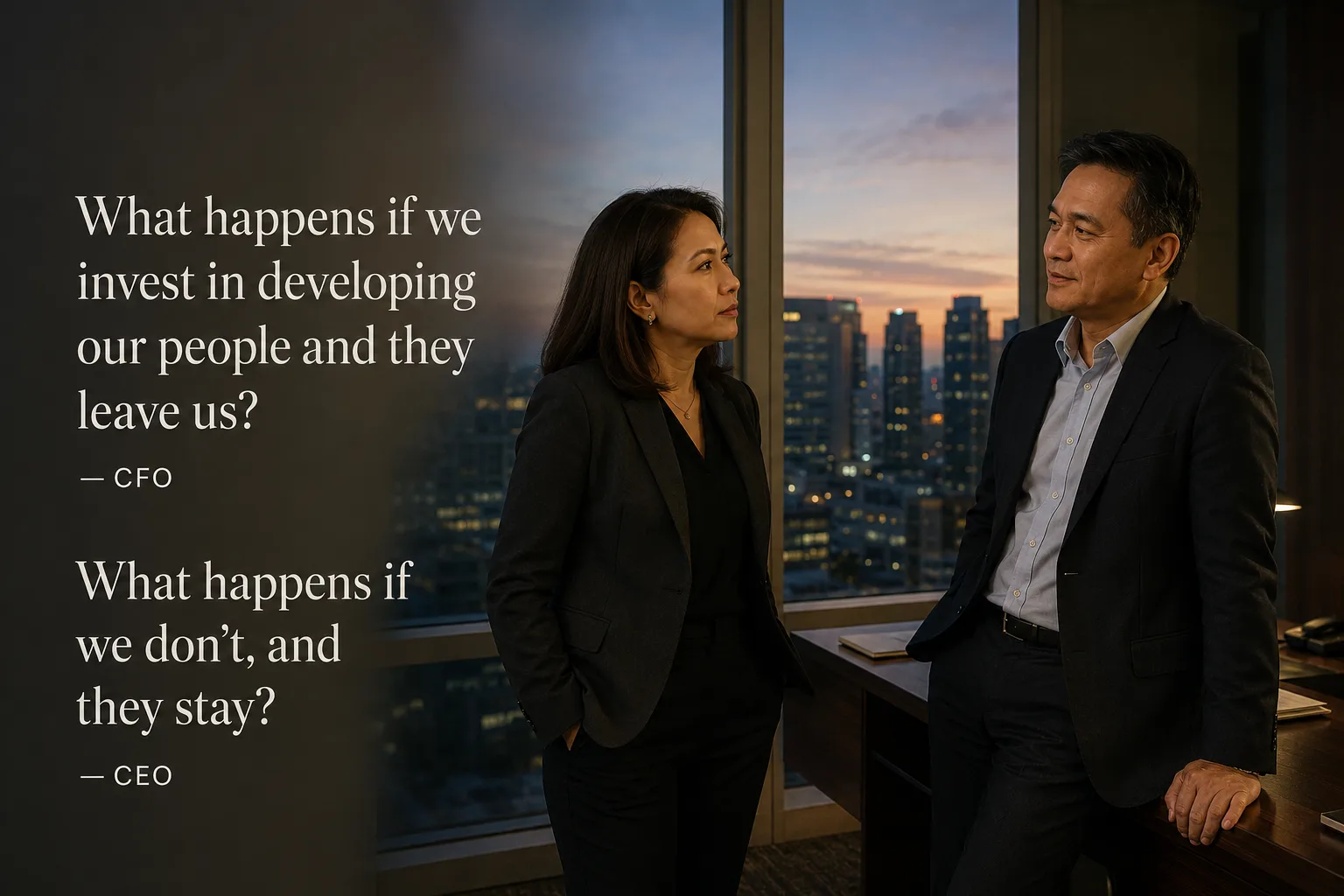
Develop Your People Anyway
The CFO's question is real. So is the CEO's answer. Twenty years on both sides of the training budget taught me which fear to respect.
Read more →
Alex Eala Doesn't Owe Us Anything
But she showed up anyway.
Read more →