16,563 Ballots Were Shaded Before Anyone Voted
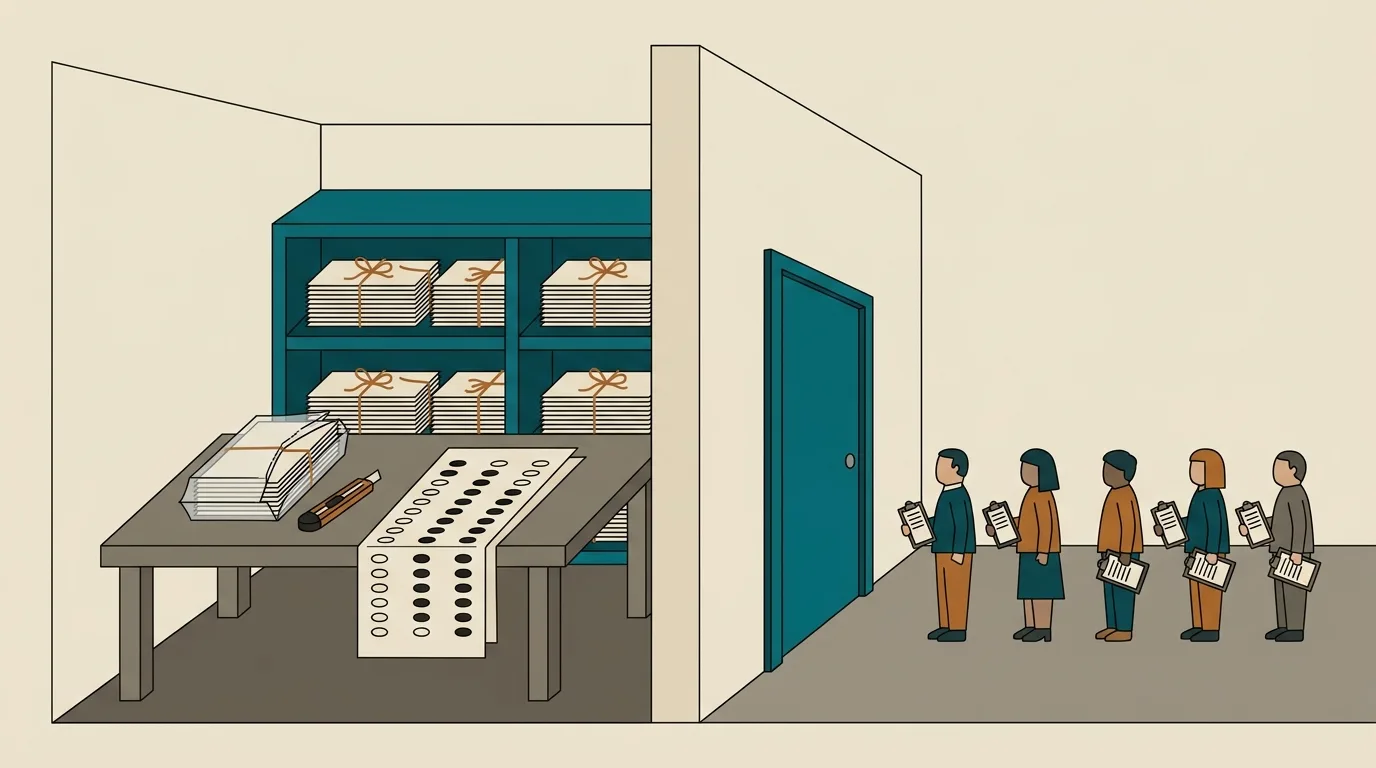
On the eve of the first Bangsamoro parliamentary election, 16,563 ballots in Maluso, Basilan were already shaded. That’s 36 precincts, about half the voters in town. The ballots were sitting in the municipal treasurer’s office, which is exactly where the law says they’re supposed to be.
Nobody had to break a rule to get to those ballots. The rule put them there.
Where the ballots sleep
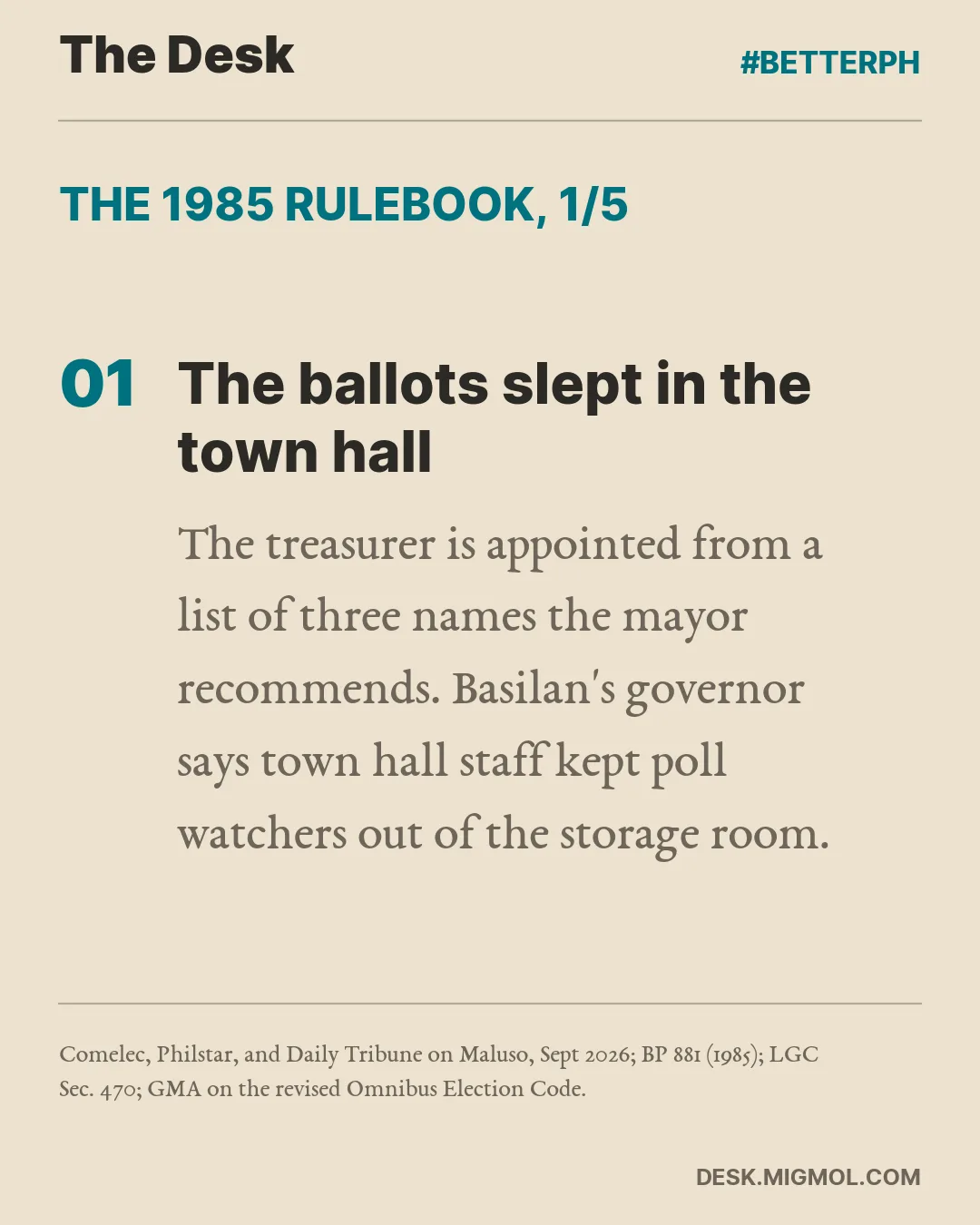
Before election day, ballots are kept by the local treasurer. The treasurer is appointed by the Secretary of Finance from a list of three names the mayor recommends, and works inside the town hall. In Maluso, the mayor is Kaiser Hataman. His brother, Basilan Governor Mujiv Hataman, is in the rival party, and he told Philstar’s Ana Marie Pamintuan that town hall personnel didn’t let poll watchers into the room where the “sealed” boxes were stored.
Comelec caught it before voting started, which is the good news. It reprinted the ballots, took control of the town, and extended voting hours. Chairman George Garcia called it electoral sabotage, which carries life imprisonment, and the commission says it already has persons of interest.
Garcia’s own conclusion is the one that matters for 2028: custody of ballots “should not be under the control of partisan individuals or those who could be influenced by politicians.” That’s the head of Comelec saying the current arrangement, the legal one, is the weak point.
Pamintuan asked the question I’d ask too. What if it happened in 2022 or 2025 and nobody noticed?
1985
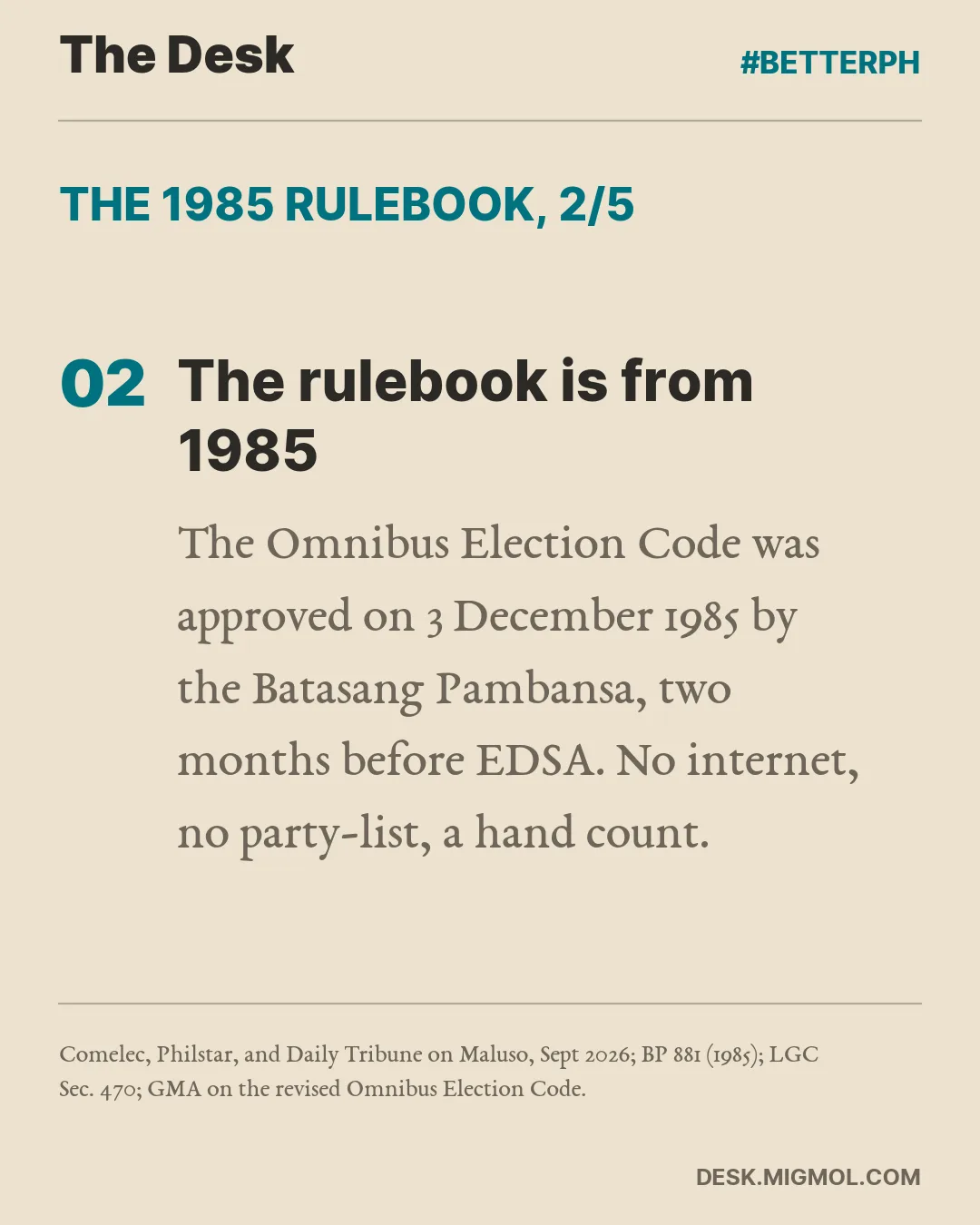
The law behind most of this is the Omnibus Election Code, Batas Pambansa 881. It was approved on 3 December 1985 by Marcos Sr.’s Batasang Pambansa, two months before EDSA. The country removed that regime in an uprising over a stolen election, and kept its election rulebook.
It was written for a country with no internet, no Facebook, no GCash, no party-list system, and a Comelec that counted by hand.
Garcia has been saying this for years to anyone in Congress who’ll listen. At a House budget hearing in September 2025: “Our Omnibus Election Code was passed in 1985. Our Automated Election Law was passed in 2007. The party-list law is also more than 20 years old. Our Fair Elections Act is also almost 20 years old.” The newest election law on the books, he pointed out, was the one postponing barangay elections. (There’s a newer one now. It postpones them again. That’s Part 3.)
What a 1985 law can’t see
The gaps are specific. Three of them.
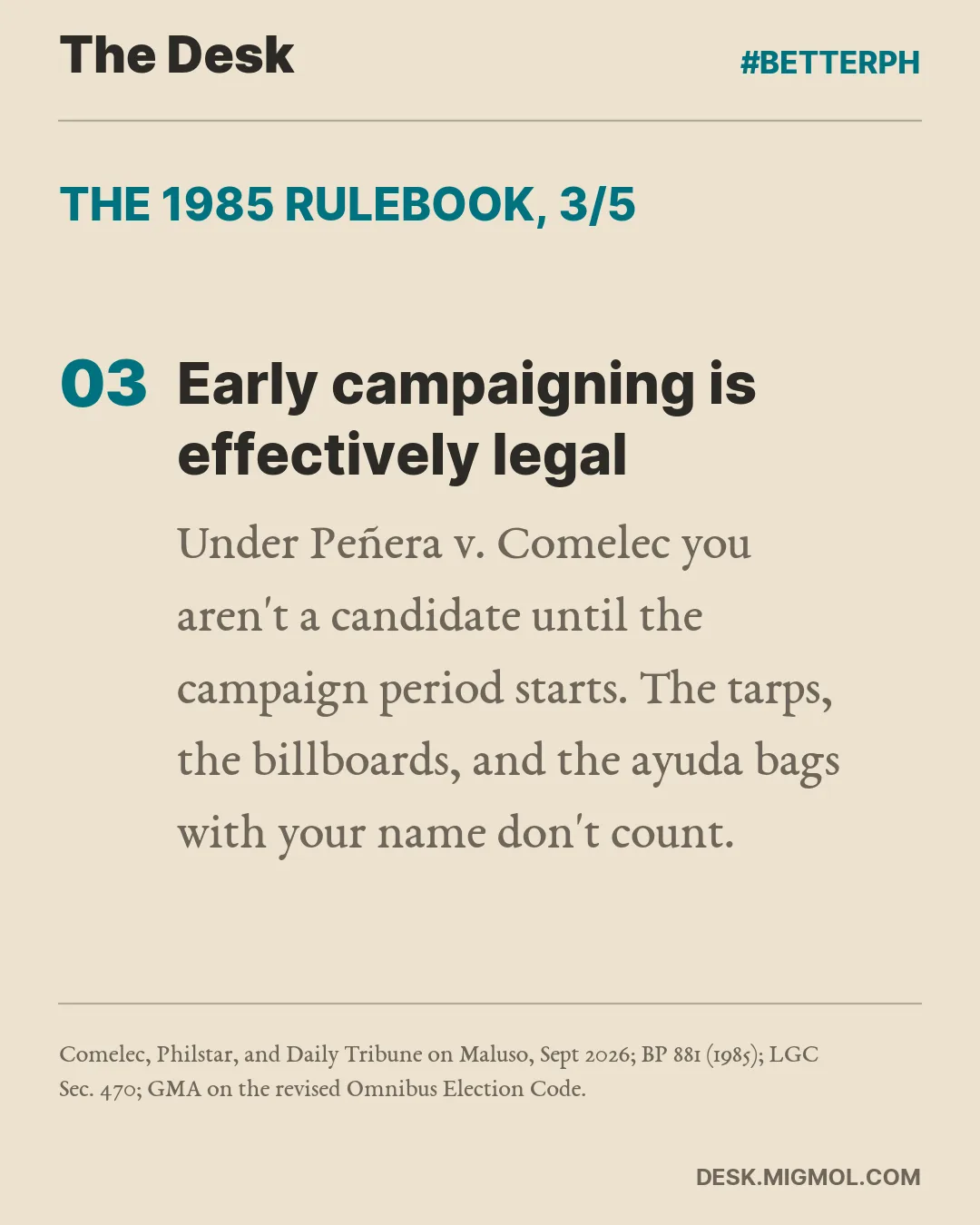
Premature campaigning is effectively legal. Under Peñera v. Comelec, you only become a “candidate” once the campaign period starts. Before that, the billboards with your face, the birthday tarps, and the ayuda bags with your name on them don’t count as campaigning, because legally you aren’t running yet. Every Filipino knows the campaign starts the day after the last election. The law thinks it starts 90 days before the next one.
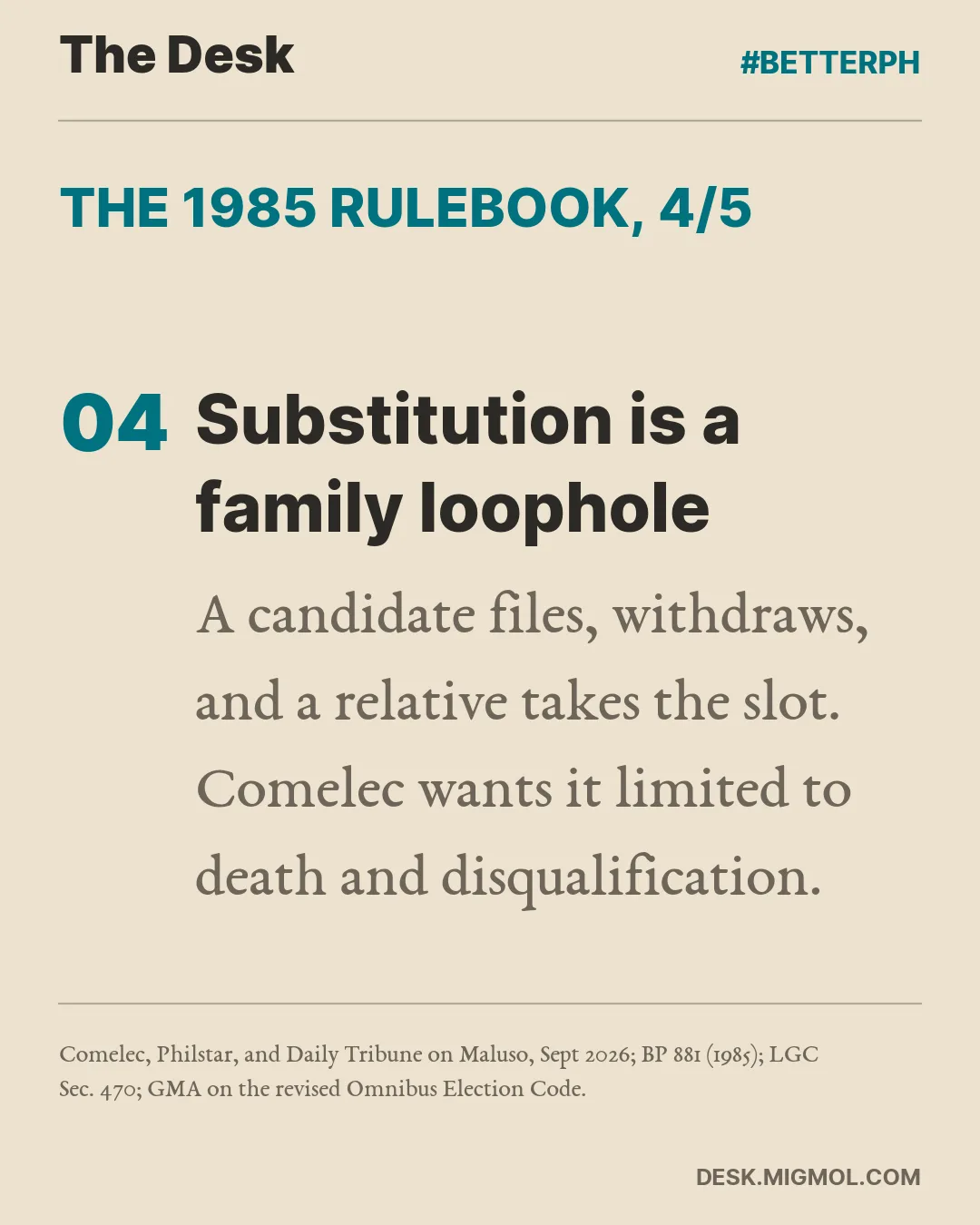
Substitution is a loophole you can drive a whole family through. A candidate files, withdraws, and a relative takes the slot. Comelec wants substitution limited to death and disqualification.
Nuisance candidates aren’t a crime. Fielding a fake candidate with your opponent’s surname to split the vote costs you a filing fee.
Garcia says the outdated laws have forced the Supreme Court into “judicial legislation,” filling holes Congress left open. The EU sent 226 observers to the 2025 midterms and came back with 21 recommendations, led by a comprehensive review of a legal framework with “significant gaps and ambiguities.”
The fix is already written
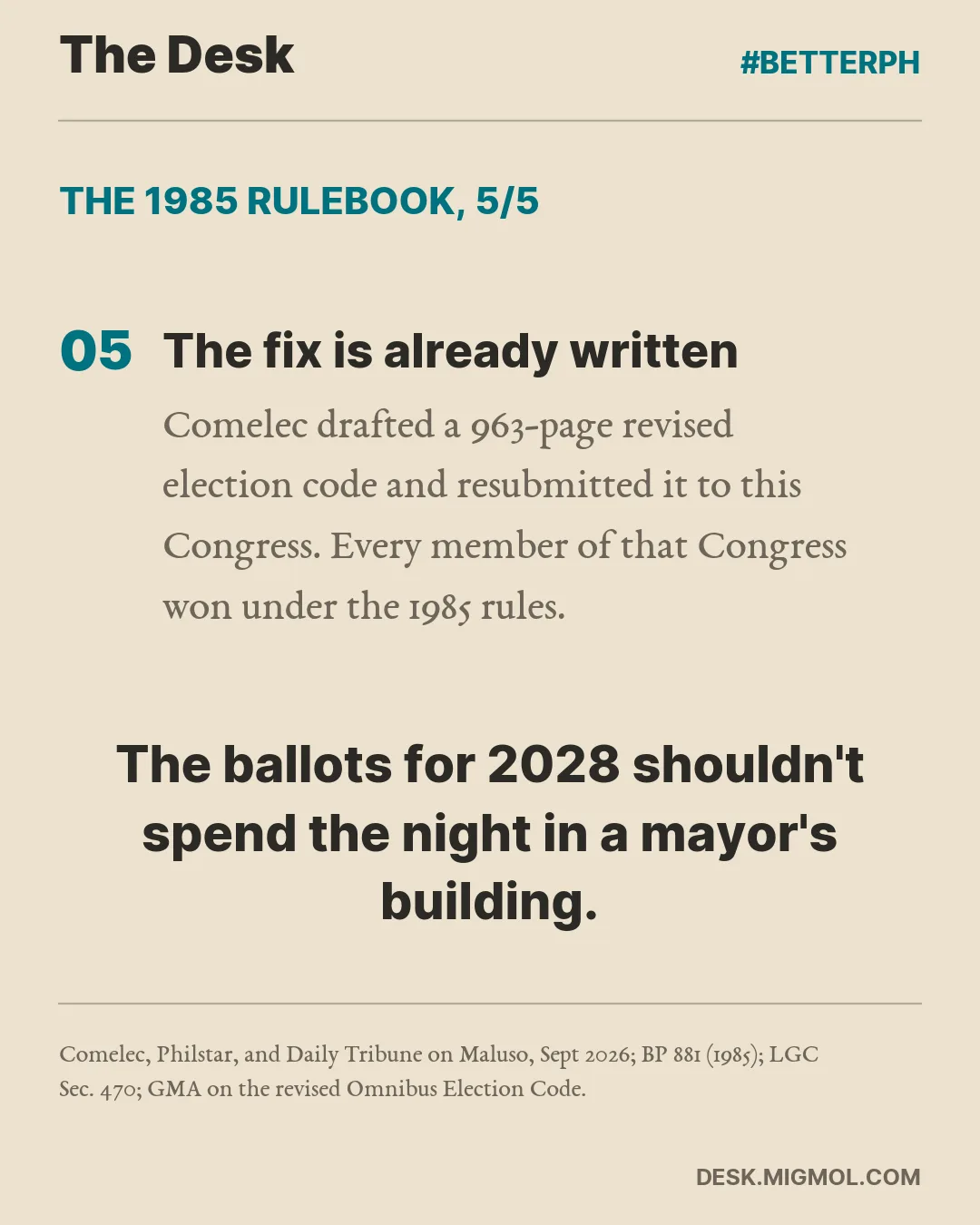
Comelec finished a 963-page revised Omnibus Election Code in 2023 and resubmitted it to this Congress. Criminalize nuisance candidacies. Limit substitution to death and disqualification. Ban campaigning once a certificate of candidacy is filed. Update spending limits and restrict contributions. Overhaul the party-list system. Pull the scattered special election laws into one code.
Nobody has to invent anything. After Maluso, add one obvious line: ballots stay in Comelec custody, or in a neutral custody the town hall can’t walk into, with watchers allowed in at every stage.
Why it hasn’t moved
I get why it’s slow. A 963-page code is a big lift, and every page touches somebody’s interest.
But look at who’d have to pass it. Every member of Congress won under the 1985 rules. The loopholes are the ones they used, or watched their opponents use. Closing them means making their own next election harder.
That pattern runs through this whole series. The people who’d have to change the rules are the people the rules protect.
The 2028 elections are less than a year and a half away. Overseas online voting starts 9 April 2028, and Comelec is already drafting the terms of reference for it. If the code doesn’t pass in this Congress, we run a presidential election on a 1985 rulebook with a known hole in the treasurer’s office, and we find out afterward whether anyone used it.

₱457 Million in Cash, and Nobody Asked
The bank filed the report. The AMLC said it had too many to read. Part 4 of 4 on anti-corruption with teeth.
Read more →
If you're above 40, this is the 2nd Iran Oil Crisis in Your Lifetime.
In 1980, a crisis in Iran pushed oil to $149 a barrel in today's dollars. Saudi Arabia had warned that prices that high would push the world to find something else, and it did. In 2026 it is Iran again, and this time the something else is already in our driveways.
Read more →
₱17.99 Billion, and We Can't See How It Counts
The counting machine reads marks and adds them up. Your cashier's terminal is harder to build. So why is the code that counts our votes still kept in a reading room in Makati?
Read more →
What does the world need from the Philippines? Right now, nothing it can't get somewhere else.
China refines 91% of the world's rare earths. Taiwan makes over 90% of its most advanced chips. We import 98% of our garlic and ship our nickel out as raw ore. What could the Philippines own that the world can't do without?
Read more →