What does the world need from the Philippines? Right now, nothing it can't get somewhere else.
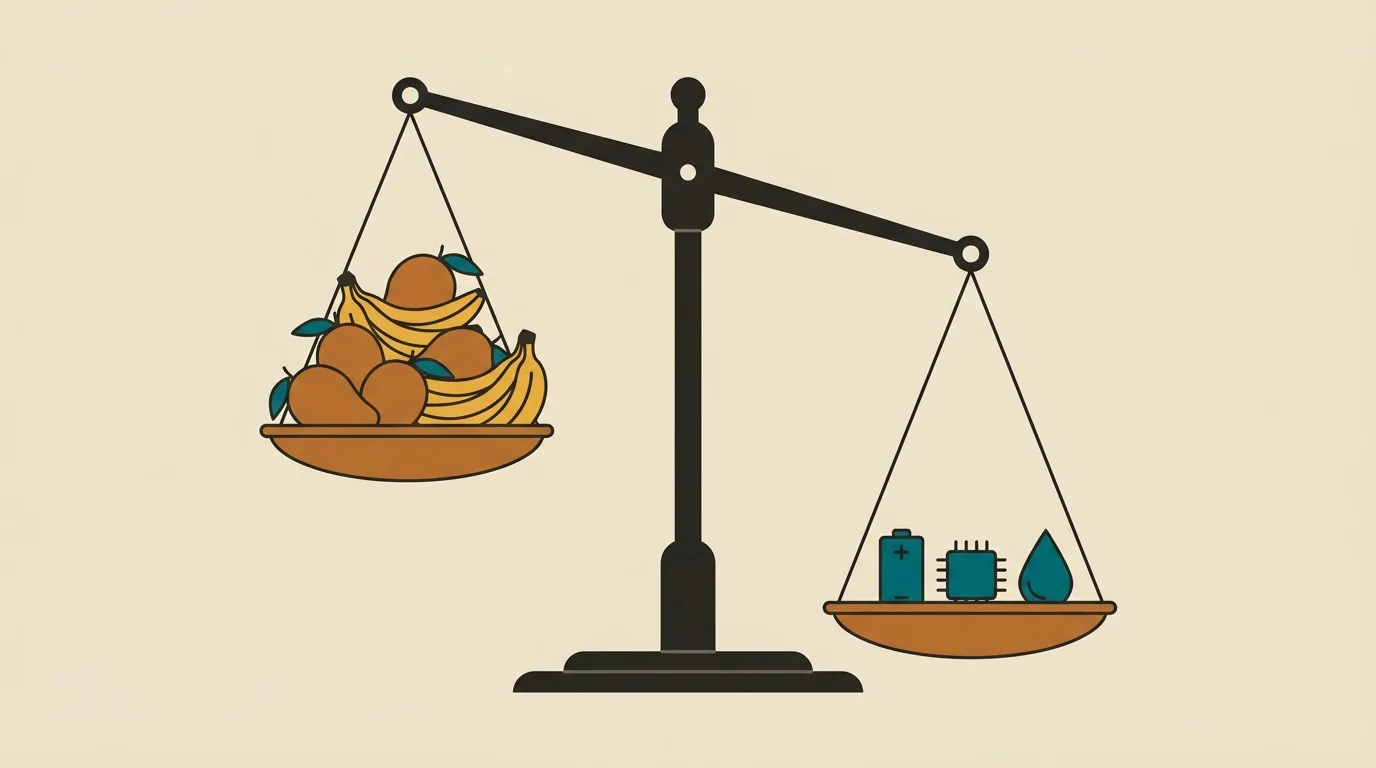
Garlic from China is cheaper at the grocery than garlic grown in Ilocos. I’m amazed every time. The Department of Agriculture’s own numbers say the same thing: imported garlic sells for ₱130 to ₱180 a kilo in Metro Manila wet markets, local garlic for around ₱400, and about 98% of the garlic we eat is imported. Onions and fruit tell the same story. That by itself is a travesty and the point of another article, but it shows how backward we are at planning our industries, creating value, and figuring out our place in the world.
It feels like we haven’t moved in a hundred years. We still see ourselves as a source of raw ingredients. We grow food, then we export the food, and food carries very little weight when two countries sit down to negotiate.
The countries that can say no
China can lean on the United States because of rare earth minerals. It mines 60% of the world’s magnet rare earths, refines 91%, and makes 94% of the permanent magnets that go into motors, phones, and missiles, according to the International Energy Agency (IEA). When China put export controls on seven heavy rare earths in April 2025, carmakers in the US and Europe had to slow or stop their lines until licenses came through.
China got there by doing the work no one else wanted. Refining rare earths is dirty and toxic, and China absorbed the damage to its land, its water, and its people’s health, subsidized the industry, and priced everyone else out for decades. By the time the rest of the world noticed, the monopoly was built. I don’t want us to pay that price, but the strategy is plain: own the step everyone else skipped.
Other countries have their version.
Taiwan makes over 90% of the world’s most advanced chips through Taiwan Semiconductor Manufacturing Company (TSMC). That is why an island China claims as its own has a seat at every table. People call it the silicon shield.
The Middle East has oil, and we felt that one ourselves this year. When the Strait of Hormuz closed during the Iran war, President Ferdinand Marcos Jr. declared a national energy emergency on March 24, and diesel went past ₱130 a liter. We import 98% of our oil, most of it from the Middle East. I wrote about what that does to our power bills in Literal Power to the People.
Canada has potash, the fertilizer that American farms run on. In July 2026, Washington put 50% tariffs on a list of Canadian goods and left potash off it. The US can’t bully a country that feeds its crops.
The mango test
Now put the Philippines at the same table. “If you don’t agree, we’ll stop sending you mangoes.”
Two things can happen. They buy mangoes somewhere else, or they stop eating mangoes. Nobody’s factory stops. Nobody’s harvest fails.
Taiwan saying no more chips, Canada saying no more fertilizer, the Middle East saying no more oil, China saying no more rare earths: those stop economies. Our threat stops dessert.
It plays out with bananas right now. We supply about 80% of the bananas Japan imports, and we still pay a tariff of 8% in summer and 18% in winter under our trade deal with Japan, while Thailand and Vietnam pay little or nothing. So in this year’s review of the Japan-Philippines Economic Partnership Agreement (JPEPA), the government’s offer is to make Japanese cars cheaper for us in exchange for duty-free bananas.
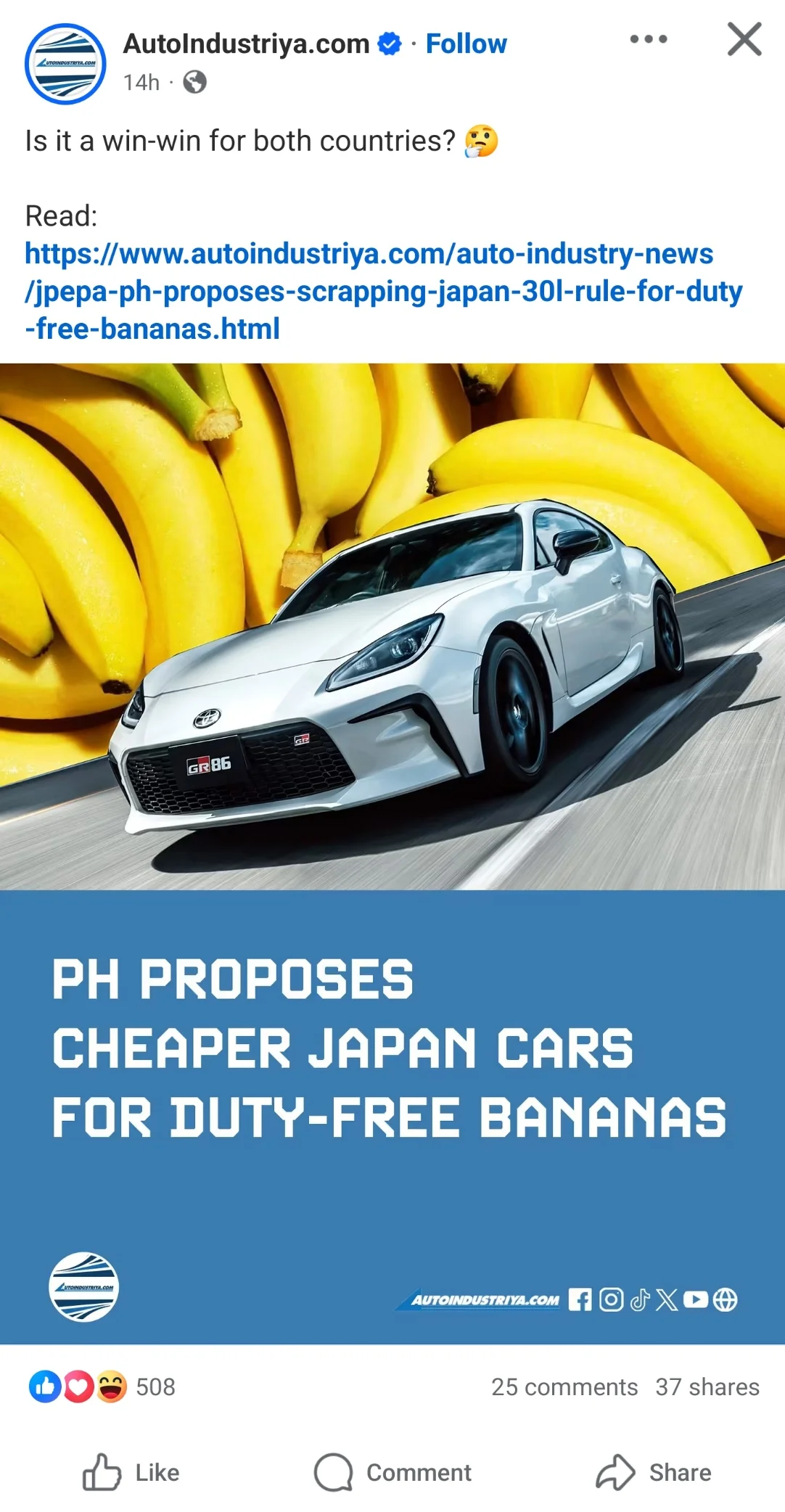
Four out of five bananas Japan buys from abroad are ours, and we still have to give something up to sell them. That is what being big in something the buyer can replace gets you.
So what does the Philippines have? And do we have the foresight to build something the world has to buy from us?
A raw ingredient country
Poor Philippines. There’s natural gas, but Malampaya is running down and we never found enough to replace it. About half of our primary energy is imported, and almost all of our oil. Everything is expensive because of it.
Our famous crops don’t give us much of a claim either. We are the world’s second-largest coconut exporter, behind Indonesia, which now supplies more than half of the world’s coconut oil, and our coconut farmers earned an average of ₱338.72 a day in 2019. We are back to being the second-biggest banana exporter, at about 3 million metric tons in 2025, and Ecuador ships more than twice that. Our Carabao mango is often called the sweetest in the world, yet we eat about 92% of our own harvest, and the last time the Department of Trade and Industry (DTI) checked, we were the seventh-biggest mango exporter with about 4% of the market.
Coffee is worse, because we used to have it. In 1880 we were the fourth-largest coffee exporter in the world, and for a couple of years after rust wiped out plantations in Brazil, Africa, and Java, we were practically the world’s only source. Then the rust reached Batangas in 1889. Today we drink far more coffee than we grow and import the difference from Vietnam and Indonesia.
Ube went global, and we couldn’t keep up. We exported 1.7 million kilos of ube and ube products worth $3.2 million in 2025, and we imported frozen ube from Vietnam to fill the gap.
Nickel: the one lever we’re giving away
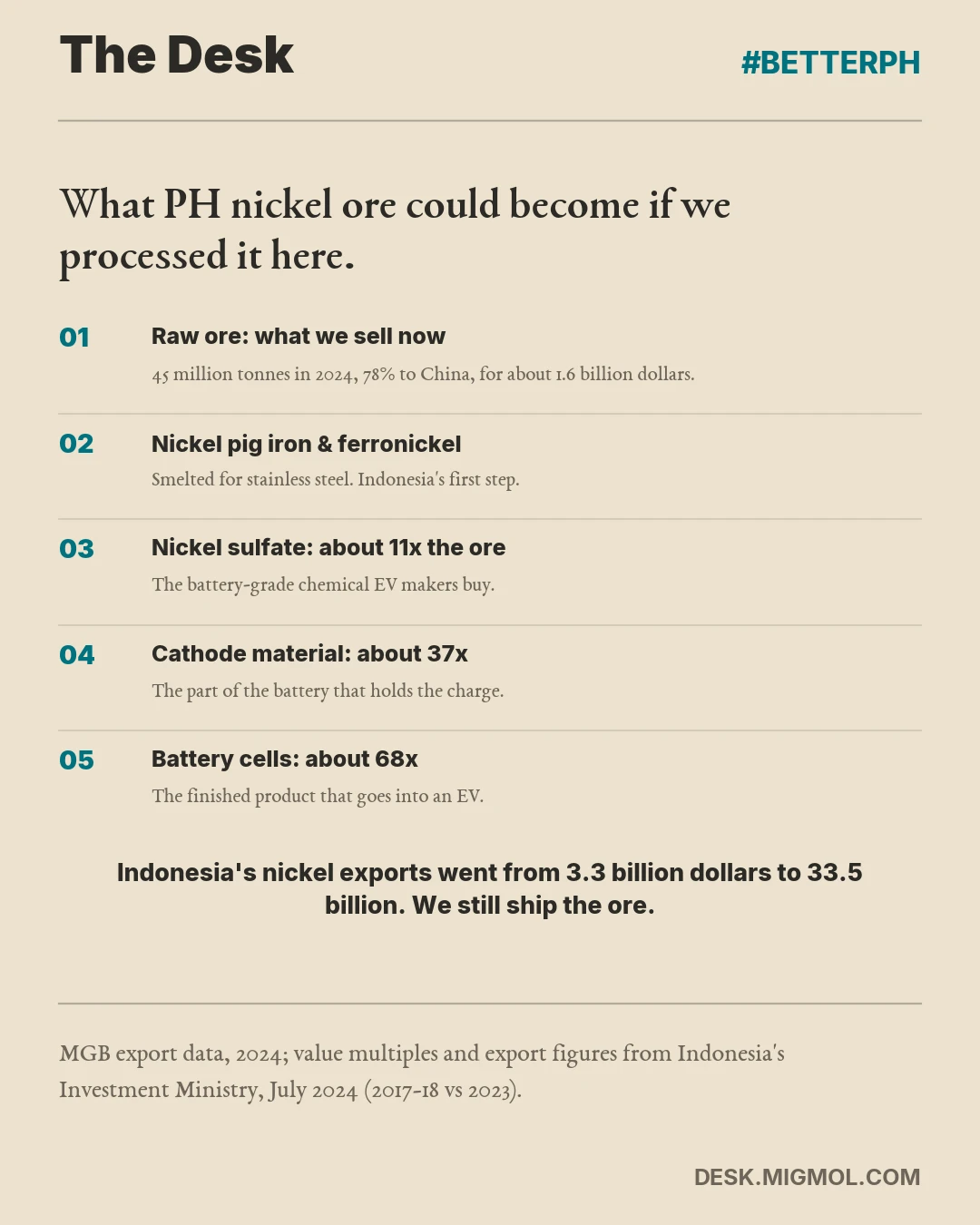
We are the world’s second-largest nickel miner. In 2024 we shipped 45 million tonnes of raw nickel ore, 78% of it to China, for about $1.6 billion. Nickel goes into stainless steel and into the batteries of every electric car, which puts it in the same league as rare earths and chips. It is the closest thing we have to what China, Taiwan, and Canada hold, and we sell it as dirt on a boat.
Indonesia sold it the same way until it banned raw ore exports in 2020. Its share of the world’s refined nickel went from about 2% a decade ago to 61% today, and its nickel exports went from $3.3 billion in 2017 to 2018 to $33.5 billion in 2023. The difference is processing. Indonesia’s own government puts the value of each step against the raw ore:
- Nickel pig iron and ferronickel. Ore smelted into an iron-nickel alloy for stainless steel. It’s the first, easiest step, and where Indonesia started.
- Mixed hydroxide or sulfide. An intermediate made by leaching low-grade ore with acid under pressure. We already make some of this, and ship it out to be finished.
- Nickel sulfate, about 11 times the value of the ore. The battery-grade chemical EV makers actually buy.
- Cathode material, about 37 times. The part of the battery that holds the charge.
- Battery cells, about 68 times. The finished product that goes into the car.
We are not starting from zero. Sumitomo runs two high-pressure acid leach plants here, Coral Bay in Palawan and Taganito in Surigao del Norte, that turn low-grade ore into a nickel and cobalt intermediate, which is then refined in Japan. In March 2026, Sumitomo said it plans to shut one of them down, and the Board of Investments is looking for someone to take it over.
We also had the policy. In 2025 the Senate passed a ban on raw ore exports after a five-year grace period, and the bicameral committee dropped it that June because the House said there wasn’t enough data to show miners could build processing plants in time.
Indonesia’s version has its own problems: Chinese companies own most of the smelters and take most of the profit, and the environmental damage is real. But Indonesia now has a say in the world’s battery supply chain, and it is using it: this year it stopped approving new plants for the basic products and now pushes investors toward battery-grade material. We still ship ore.
Built on purpose
None of this is quick. Indonesia tried an ore ban in 2014, backed down in 2017, and tried again in 2020. But it decided what it would own, protected it with law, and put up with the growing pains. We had the same bill on the table last year and let it go.
Nickel is the lever we have. Pick it, process it here, and make the world come to us for the finished product.
The other half of this is the smaller things only we can make: our salt, our rum, our coffee, and the labels that would protect them. That’s the next piece.
16,563 Ballots Were Shaded Before Anyone Voted
Nobody had to break a rule to reach the pre-shaded ballots in Maluso. The rule put them there. The Omnibus Election Code was written two months before EDSA, and Comelec's 963-page fix is still waiting.
Read more →
₱457 Million in Cash, and Nobody Asked
The bank filed the report. The AMLC said it had too many to read. Part 4 of 4 on anti-corruption with teeth.
Read more →
If you're above 40, this is the 2nd Iran Oil Crisis in Your Lifetime.
In 1980, a crisis in Iran pushed oil to $149 a barrel in today's dollars. Saudi Arabia had warned that prices that high would push the world to find something else, and it did. In 2026 it is Iran again, and this time the something else is already in our driveways.
Read more →
Filipiñana (2026) No Spoiler Review: A Beautiful Film That Doesn't Need a Complicated Plot
Rafael Manuel's first feature is slow, weird at first, and beautifully shot, and it justifies its simple premise.
Read more →