Avengers: Endgame is the biggest box office hit of all time again. Adjust for inflation and the answer is Gone with the Wind.

Gone with the Wind sold about 202 million tickets in the US across its first three runs. In 1940 the whole country had about 132 million people.
Keep that in mind the next time a studio announces a record, because one just did. In early October, Avengers: Endgame passed Avatar to become the highest-grossing film of all time again, at $2.9255B against Avatar’s $2.9237B. It took a re-release to do it: the Endgame Encore run, timed ahead of Avengers: Doomsday in December, added more than $120 million seven years after the film first came out. The margin is about $2 million.
It’s been a big year for records. Spider-Man: Brand New Day became the biggest movie ever released in North America, at $952 million, and it sits third worldwide at $2.45B. All of these are real records. They’re also records set in today’s dollars, against films that sold tickets for a fraction of what we pay now.
The list everyone quotes
This is the all-time worldwide top 10 as it gets reported, in the dollars of the day each ticket was sold.
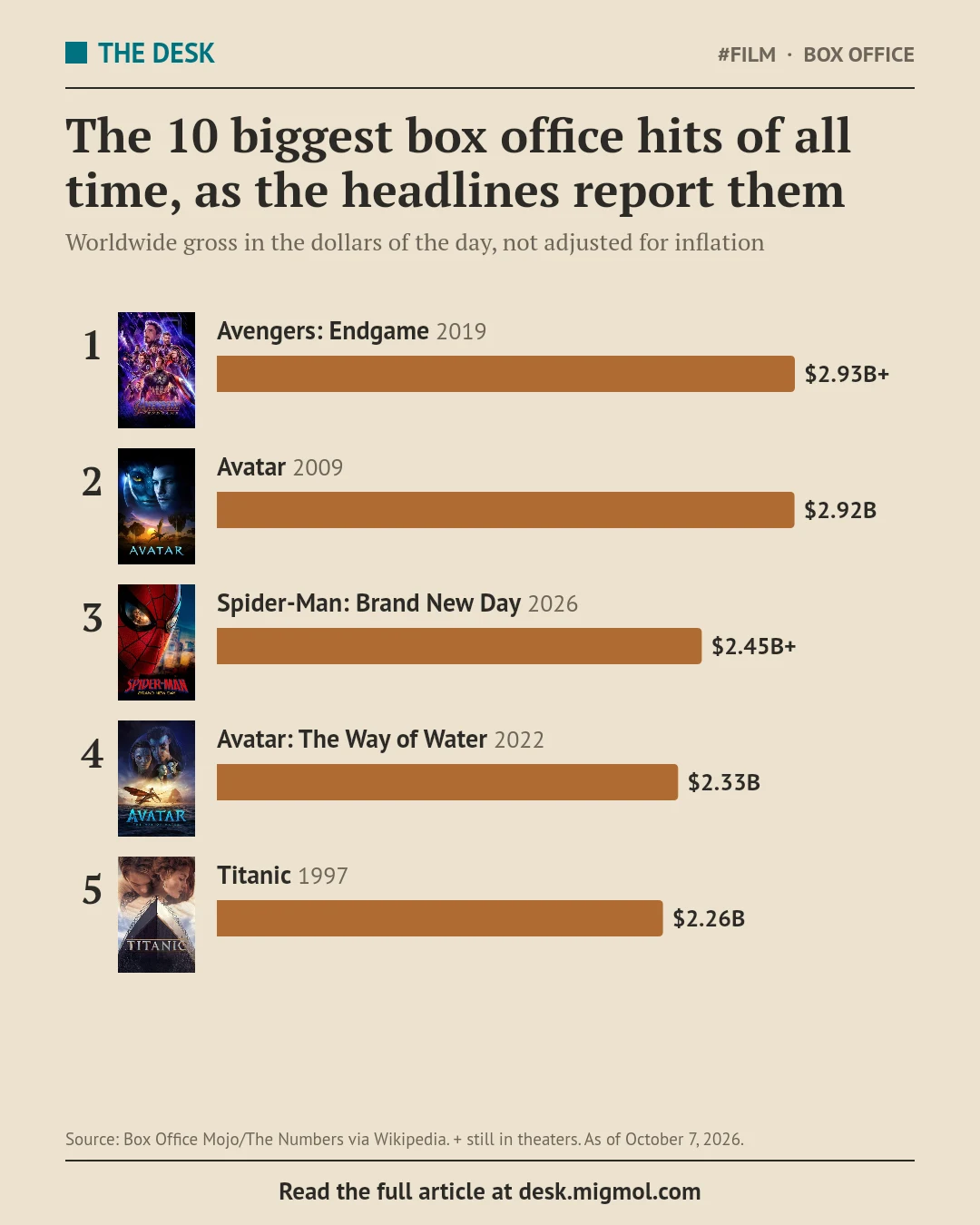
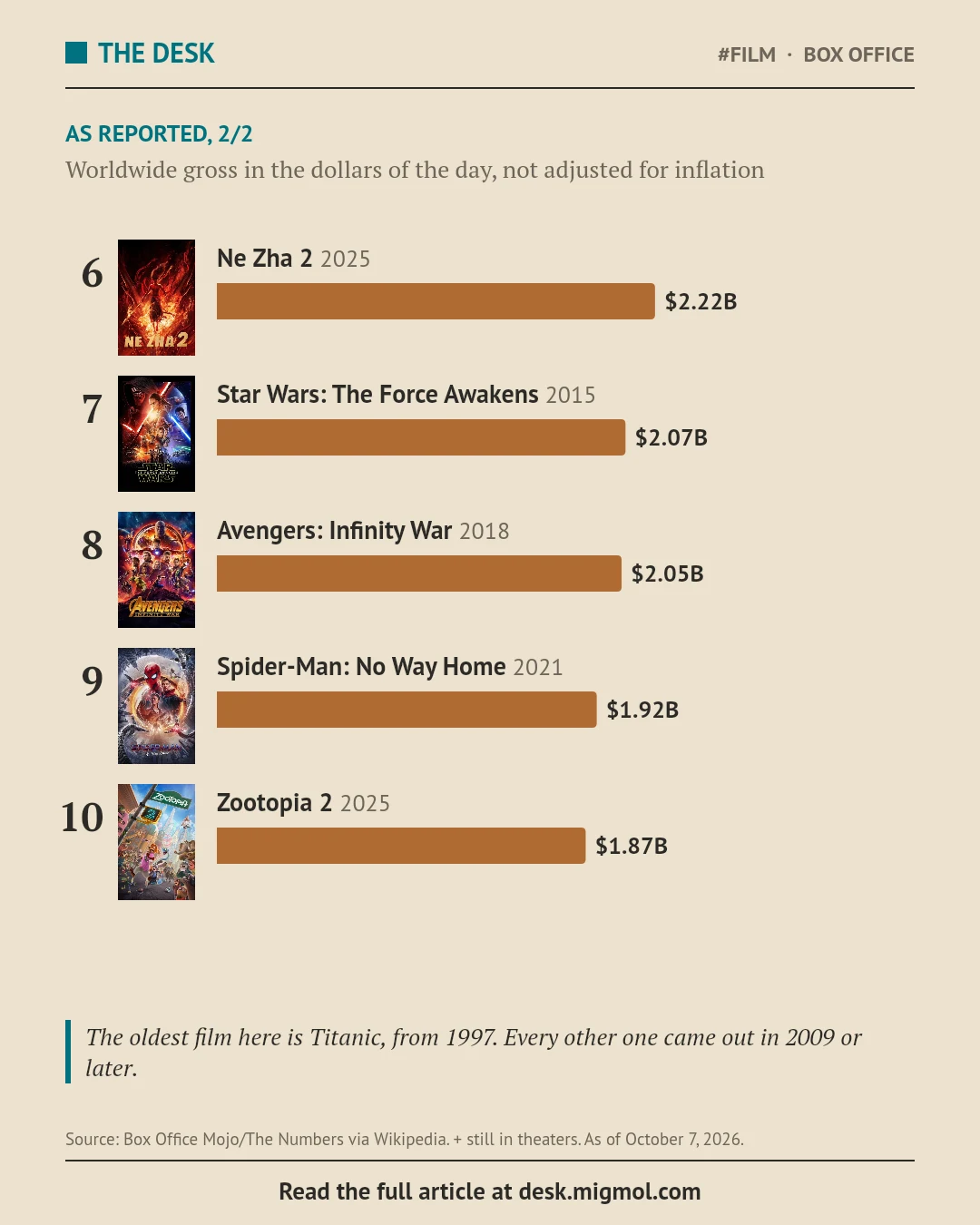
Look at the years. Titanic, from 1997, is the oldest film on it, and every other one came out in 2009 or later. Three of the ten came out in the last two years. Either movies got dramatically more popular after 2009, or the list is measuring something else.
It’s measuring something else. Ticket prices have multiplied many times over since 1939, so a film released today starts with a huge head start just by existing. On top of that, the market itself grew. China barely showed up in Hollywood’s numbers before the 2000s, and now a Chinese animated film, Ne Zha 2, sits sixth on the list almost entirely on its home audience.
So the reported list is a fair record of revenue. As a measure of which film the most people paid to see, it’s useless.
The same list, adjusted for inflation
Adjust every gross to the same year’s dollars and the top 10 changes completely. The figures below come from the estimate Guinness World Records built by counting tickets sold, carried forward to 2025 dollars. The teal bar is the adjusted figure, and the amber bar is what was reported.
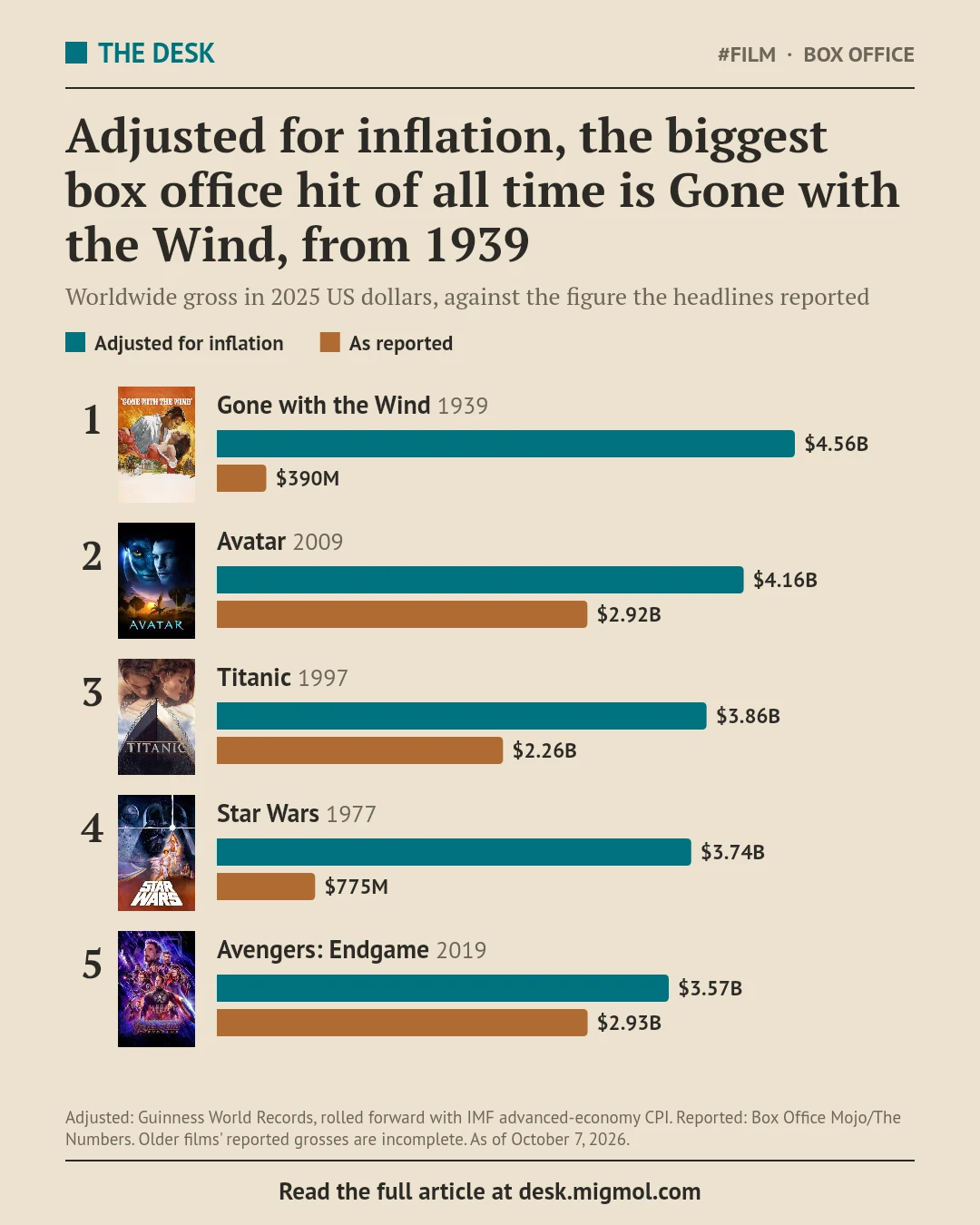
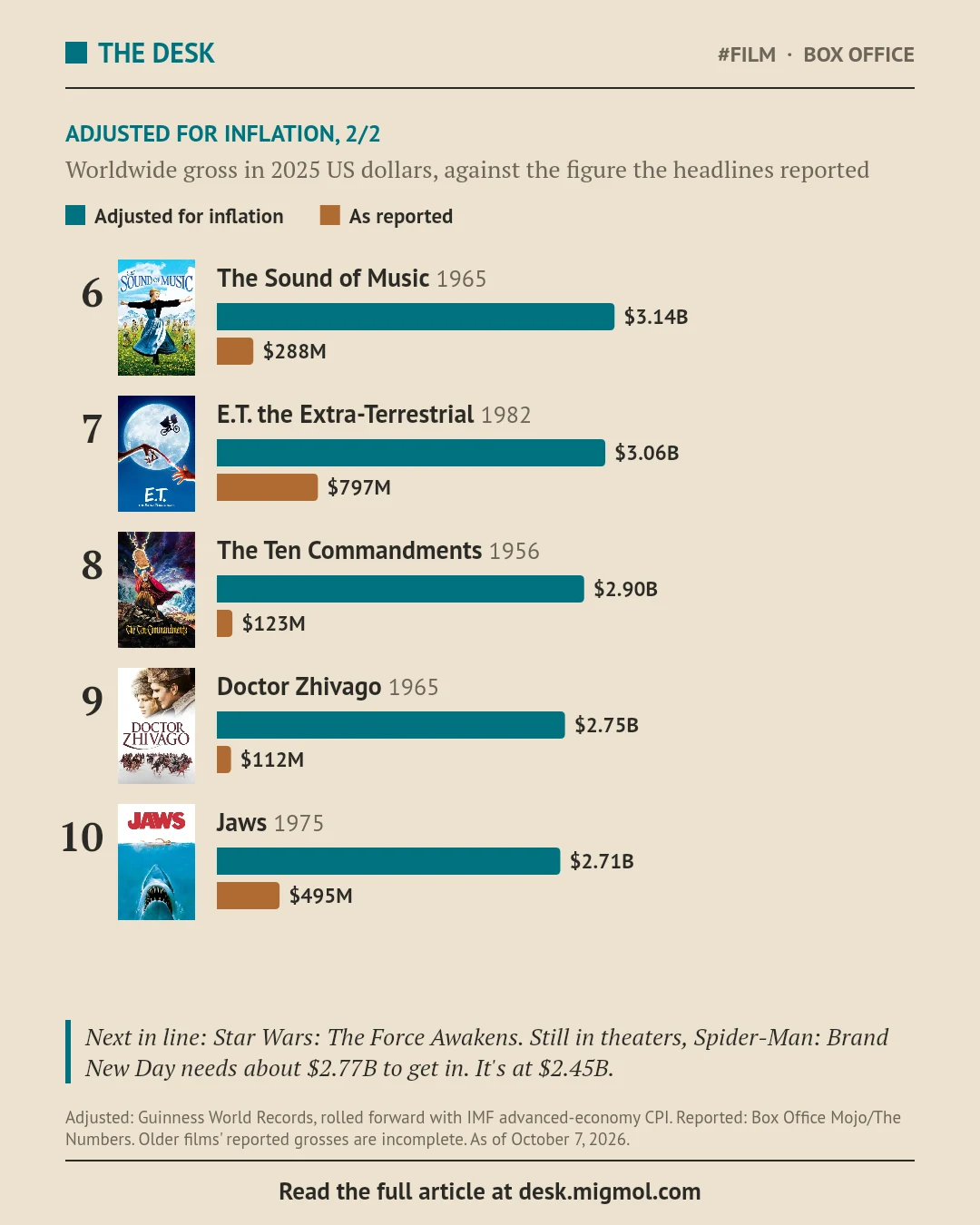
Gone with the Wind is first at $4.56B, on a reported gross of about $390 million. Seven of the top 10 came out before 1983, from Gone with the Wind in 1939 to E.T. in 1982. Only three modern films survive the adjustment, and all three were already giants: Avatar, Titanic, and Avengers: Endgame. James Cameron made two of the top three.
The new record changes very little here. Even with the re-release, Endgame is fifth at about $3.57B, and Avatar is still ahead of it by roughly $600 million. Endgame won the headline by $2 million, and on the adjusted list it still trails Avatar, Titanic, and the original Star Wars.
Seven of the ten reported champions fall out completely. Star Wars: The Force Awakens is closest, just outside at roughly $2.7B. Ne Zha 2, Zootopia 2, and Spider-Man: No Way Home aren’t near it.
Brand New Day would need about $2.77B to crack the adjusted top 10. It’s at about $2.45B and past its peak. It won’t get there. That takes nothing away from it. It’s the biggest Spider-Man film ever made, by a lot, in an era where people have a hundred other things to watch at home. Gone with the Wind competed with radio.
Every film on one chart
Put all 18 films from both lists on one chart, oldest on the left, and the pattern is hard to miss. The teal line is the adjusted gross and the amber line is what was reported. The shaded band between them is what inflation hides.
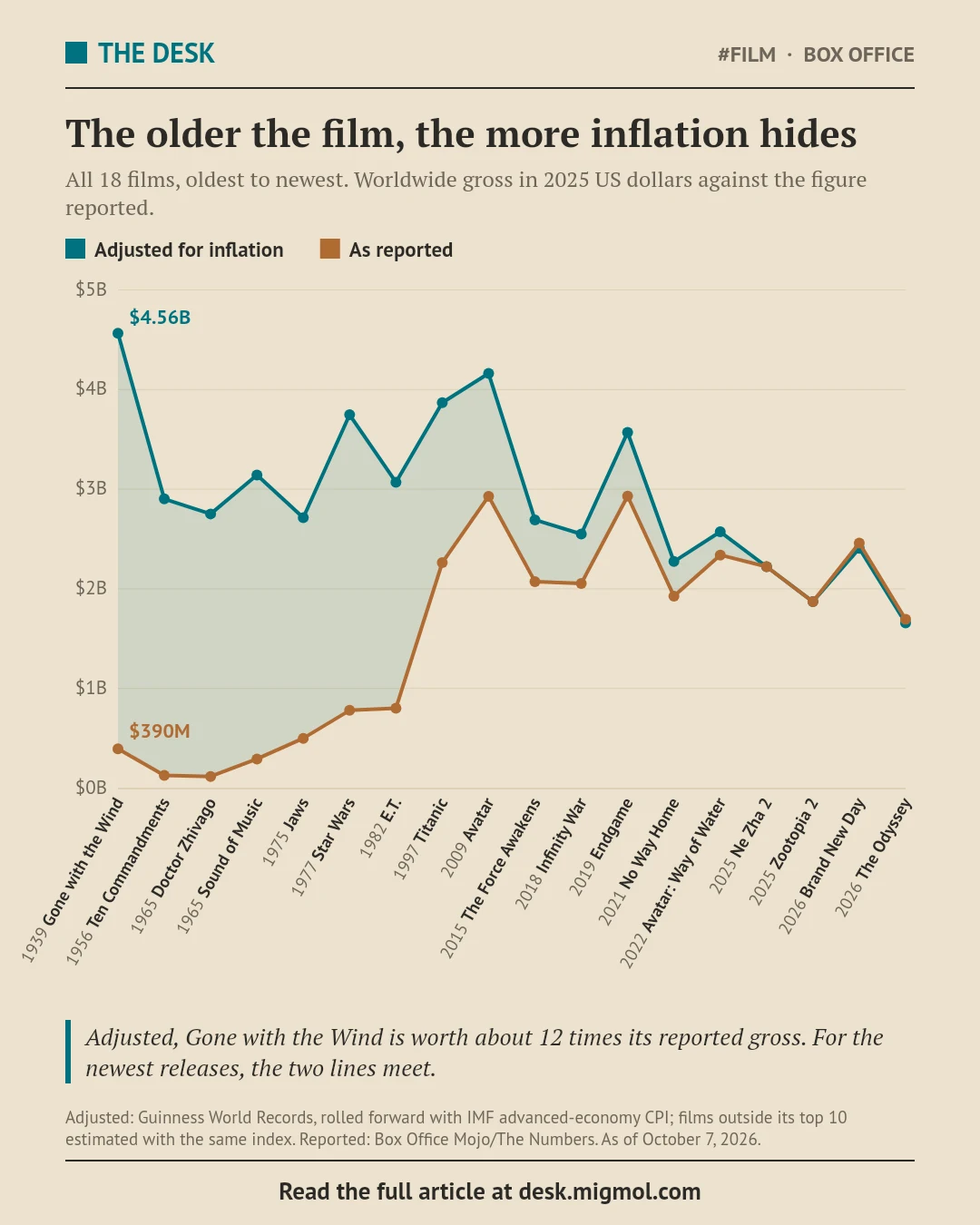
On the left, the amber line barely leaves the floor. The Ten Commandments and Doctor Zhivago report around $120 million each and adjust to nearly $3B. From Titanic onward the lines start converging, and by 2025 they meet, because a film’s reported gross is already in roughly today’s money. That’s the whole bias of the headline list in one picture: the closer a film is to today, the less inflation discounts it.
The numbers have holes, and Gone with the Wind still wins
Adjusting for inflation is an estimate, and every method has a weakness. The older films have messy records, so their reported grosses undercount. Doctor Zhivago’s only reliable figure is from the US and Canada. Some of these classics were also re-released for decades, which means part of their total was earned in later, pricier years. Endgame’s Encore is the same thing happening in real time. Different price indexes and exchange rates shuffle the middle of the list.


What doesn’t shuffle is the top. Gone with the Wind is generally considered the most successful film ever made, and Guinness lists it as the record holder. More than 200 million tickets in one country, in its first few runs, is a number nobody in the streaming era is getting close to.
The best money a studio ever spent
There’s a second way the reported list hides the real winners: it ignores what each film cost to make. Divide the worldwide gross by the production budget, among every film on both lists, and the classics win again, by a wider margin.
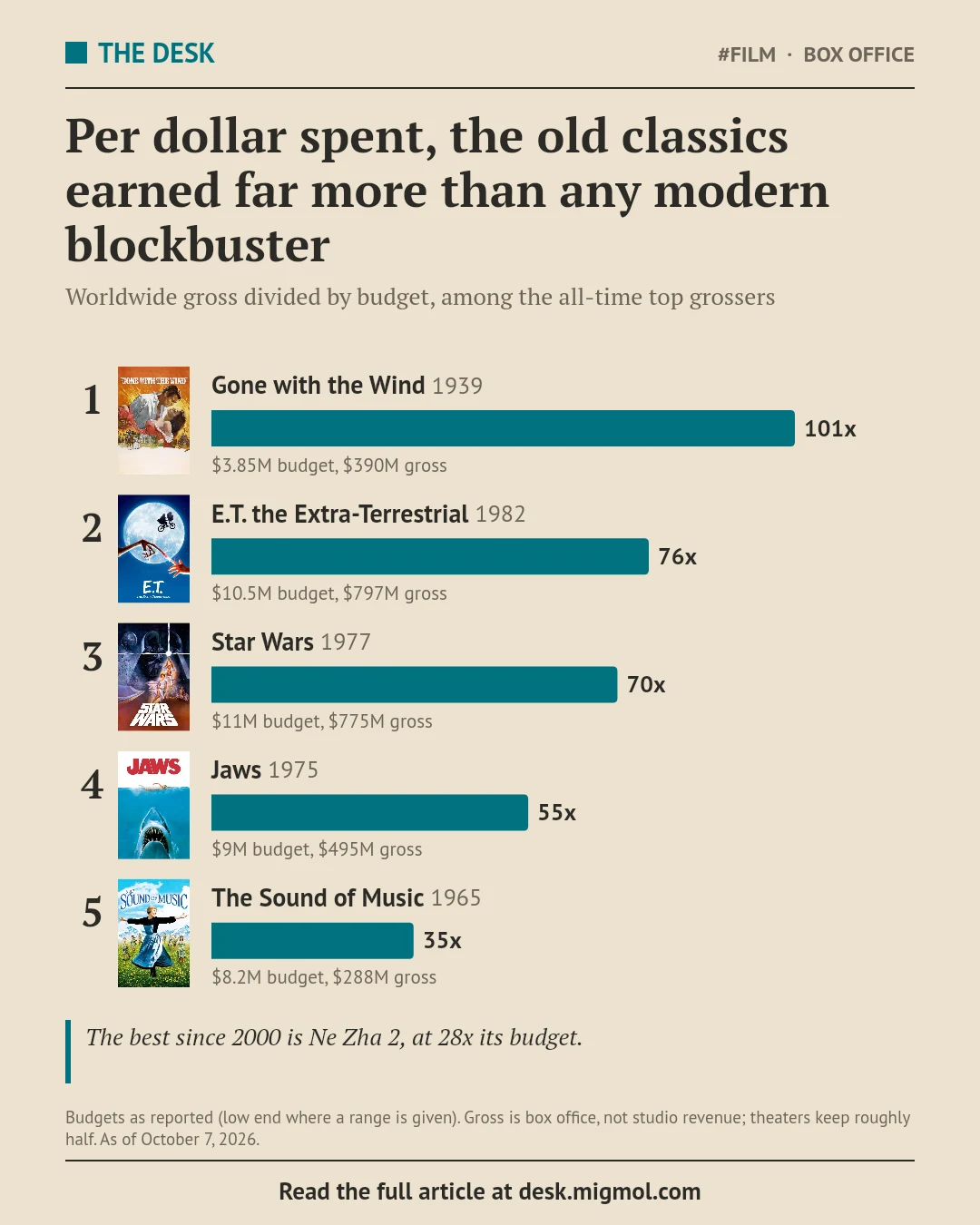
Gone with the Wind made about 101 times its $3.85 million budget. E.T. made 76 times, Star Wars 70 times, Jaws 55 times. The best film since 2000 on this measure is Ne Zha 2, at 28 times an $80 million budget, which is remarkable for a modern release and still a fraction of what the old films did.
The big modern blockbusters look a lot less efficient this way. Avatar made about 12 times its budget. Avengers: Endgame, even with the re-release, made about 8 times, and The Force Awakens, at a reported $447 million net budget, made under 5. Box office gross isn’t what the studio keeps either. Theaters take roughly half, and marketing on a modern tentpole can run close to the production budget itself.
If you leave the blockbusters out entirely, the champion is a different kind of film. Paranormal Activity was shot for about $15,000 and grossed $194 million, close to 13,000 times its budget. No studio planned that.
A chart that keeps score
Every year a new release will be called the biggest ever, and some of them will deserve it. So I’m keeping a living version of the adjusted chart on The Desk, with posters, both numbers side by side, and the films closest to breaking in. When a new release moves the list, the chart moves with it.
Endgame and Avatar have now traded the record back and forth through re-releases, and Avengers: Doomsday arrives in December. On the adjusted chart, none of that touches Gone with the Wind.

Filipiñana (2026) No Spoiler Review: A Beautiful Film That Doesn't Need a Complicated Plot
Rafael Manuel's first feature is slow, weird at first, and beautifully shot, and it justifies its simple premise.
Read more →
Almost Famous No Spoiler Review: On a Rewatch in My 40s, This Could Be Cameron Crowe's Best Film
Rewatched in my 40s, Almost Famous is a love letter to rock and roll and a mirror held up to it at the same time, and it could be Cameron Crowe's best film.
Read more →
Primetime (2026) No Spoiler Review: A Solid Robert Pattinson Performance Stuck in a So-So Story
Robert Pattinson gives us the weirdness we love as his own version of Chris Hansen, but a simple plot dragged out keeps Primetime at okay.
Read more →
What does the world need from the Philippines? Right now, nothing it can't get somewhere else.
China refines 91% of the world's rare earths. Taiwan makes over 90% of its most advanced chips. We import 98% of our garlic and ship our nickel out as raw ore. What could the Philippines own that the world can't do without?
Read more →