Fake It Till You Make It Has a Ceiling
The advice buys you time to build something real. The trouble starts when the building never happens, and you take other people down with you.

Fake it till you make it is decent advice. I’ve used a version of it myself. You walk into a room you’re not fully ready for, you carry yourself like you belong, and the confidence buys you enough runway to actually learn the thing. That part is real. Confidence can run ahead of competence for a while, and the competence catches up.
But there’s a ceiling to it. Past that ceiling, the same move that got you in the door is the thing that brings you down, and it usually brings other people down with you. I’ve watched this happen at three different levels. Someone who was my peer. Someone who worked under me. And someone who was above me.
Start with the peer.
I was about fifteen years into my career and I’d gotten into an international program. Good people, high bar. And there was one person there who was supposed to be my peer. Same level, same seat at the table. Everyone could feel that something was off. He didn’t have the experience. He didn’t have the logic or the common sense the work needed. We all felt it, even if nobody said it out loud at first. This can’t be the same level as me. You know the feeling.
At the start, he had an easy time. He was always the leader. He always got the good assignments. Faking it worked, exactly like the advice promises. But over time his projects started to fail. He treated people badly. He leaned on the small bit of power he had and abused it. And slowly the real colors came out. People stopped liking him. People stopped giving him projects. That was the whole downfall. Nobody pushed him out. He just ran out of the thing he never had.
The second one worked under me. He was a promising hire, and I put a lot of confidence in him, and for a while it looked right.
Then the deadlines started slipping and the execution kept coming out wrong. He told me himself, eventually, that he was the type who just faked everything. And when he said it, I realized I’d been so sold on him that I missed what was actually there. All that outward projection, the certainty, the way he carried himself, was really his insecurity pointing the other way. He didn’t have enough experience yet. Not enough to have the wisdom to make the call or to lead. He was shaking underneath it. And because there wasn’t enough substance behind the front, the work got delayed. People got upset. I ended up coaching him hard, a lot more than I’d coach most people, just to hold things together. I don’t blame him for trying, and I get why he did it. But wanting the seat is not the same as being ready for it.
The third one was above me. A leader who abuses his position. This is the one that does the most damage, because the higher you are, the more people you take with you.
Everyone in the industry already knows about him. Talk to enough people and you get the same read: he doesn’t really make much sense. But he has the position, and the position is what he uses. You can be walking down a clear, logical path with him, step by step, and he’ll come out with something completely out of the blue. You can see he isn’t listening. He isn’t following. And yes, he’s a leader, and he got to where he is. But at the cost of what? His organization is a mess. His reputation is damaged. And I think, underneath all of it, at the cost of his own self-doubt and even self-hatred. Because when you abuse power like that, it lands on you too. You can’t do that to people all day and not have it do something to you.
Three levels, same pattern. I’m not saying drop the advice. Fake it till you make it still has its place. Before a big presentation, stand a little taller, take the power pose, walk in like you belong, even if your stomach says otherwise. When imposter syndrome shows up, which it will, the fake confidence is what gets you through the next five minutes. That’s what the advice is actually for: small, temporary boosts to get you past a moment you’re not fully ready for.
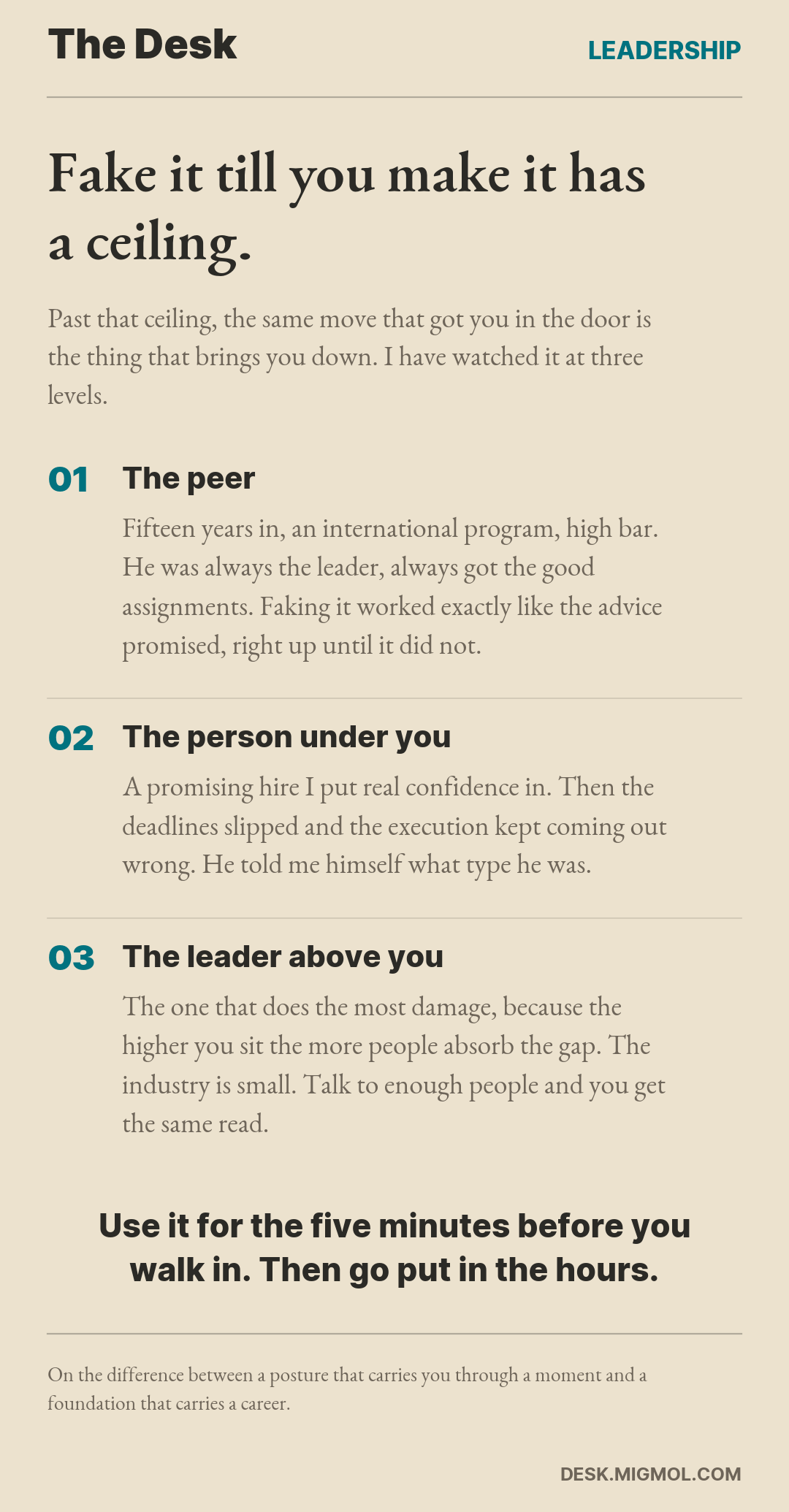
But that’s not what the work is. The work is the foundation, and there’s no posing your way through a foundation. You can perform your way into the room, into the title, into the seat. You cannot perform your way through the years of reps that make the decisions in that seat actually sound. Somewhere between the pose and the position, you have to go build the real thing, or the gap just keeps growing behind you.
And the higher you climb, the more that gap costs, because the industry is small. People talk. They compare notes. They remember who delivered and who just talked. You can get away with the front for a while, sometimes for years, but eventually you’re in a room with people who’ve seen enough to tell the difference, and the truth gets out. It always does.
So use the fake-it move for what it’s built for: the nerves, the doubt, the five minutes before you walk in. Then go put in the hours everyone else can’t see. Build the foundation. Do the work. Don’t just fake it.

The Position Is Not the Person
I ran into a former leader in a mall. Someone from a company I used to work with. I made sure I said hi. I went out of my way, I made sure he saw me, I did the whole thing. Then I walked away and felt the ick.
Read more →
Communication Can Outrun Intelligence
One of the most valuable skills in business, and the same skill can march a company off a cliff. Both are true.
Read more →
Develop Your People Anyway
The CFO's question is real. So is the CEO's answer. Twenty years on both sides of the training budget taught me which fear to respect.
Read more →
Alex Eala Doesn't Owe Us Anything
But she showed up anyway.
Read more →