The Position Is Not the Person

I ran into a former leader in a mall. Someone from a company I used to work with. I made sure I said hi. I went out of my way, I made sure he saw me, I did the whole thing.
Then I walked away and felt the ick.
Because by then I knew what he actually was. He was a ceremonial head. Someone else was always calling the shots, and anyone who stayed long enough worked that out. So why did part of me still need to show face? Why was the reflex to be polite still fully intact, after I had stopped believing in him?
The reflex outlived the belief. That’s what bothered me.
We get trained into this. Not instructed, trained. You learn early that agreement is cheap and disagreement is expensive, and you learn it by watching what happens to the one person who tried. So you pander. You laugh at the joke. You call a half-formed thought a strong direction. Do it long enough and you stop performing, because part of you now believes the man at the top really is the smartest person in the building. And the training doesn’t expire when you resign. It follows you into a mall on a weekend and makes you walk twenty steps out of your way to greet someone who never actually decided anything.
Then there are the ones who hold up.
I have a chat group of former colleagues from a business unit at Nestlé. We still talk. Part of that is the bond we formed in the trenches. A bigger part is our collective adoration of our former BU head. He was not an easy leader to work for. He was tough. But he made sense, he took us through the storm, and all of us came out better professionals than we went in.
And the tell is this. We still quote him. Not to him, and not where he can hear it. We quote him to each other, in a group chat, when he is nowhere around and has no idea it’s happening. When one of us is in his home market we make sure to visit, and he still makes time for dinner. Nobody is angling for anything. There is nothing left to get from him.
Two encounters, two reflexes. One was trained into me. The other I chose.

Past 40, you learn to tell the difference. Between what’s genuine and what’s for show. Between figureheads and the people actually in charge. Between performative leadership and the kind that gets people moving and gets things done. You don’t pick that up from a book. You pick it up from having worked for enough of both.
Companies don’t have a monopoly on this. Nations have handed themselves over to someone who turned out to be a product of the position. The office made them look formidable and there was nothing behind the office. Whole cabinets nodded, whole populations pandered, and the emptiness only showed from a distance, at a cost nobody had budgeted for. A country at least has a constitution, courts, and a press whose job is to be rude to power. If that isn’t enough to protect a country, what is protecting your company? An HR department and a values poster in the lobby.
So, three things I look for. All of them observable. You don’t need a psychometric profile, you just need to watch someone for a quarter.
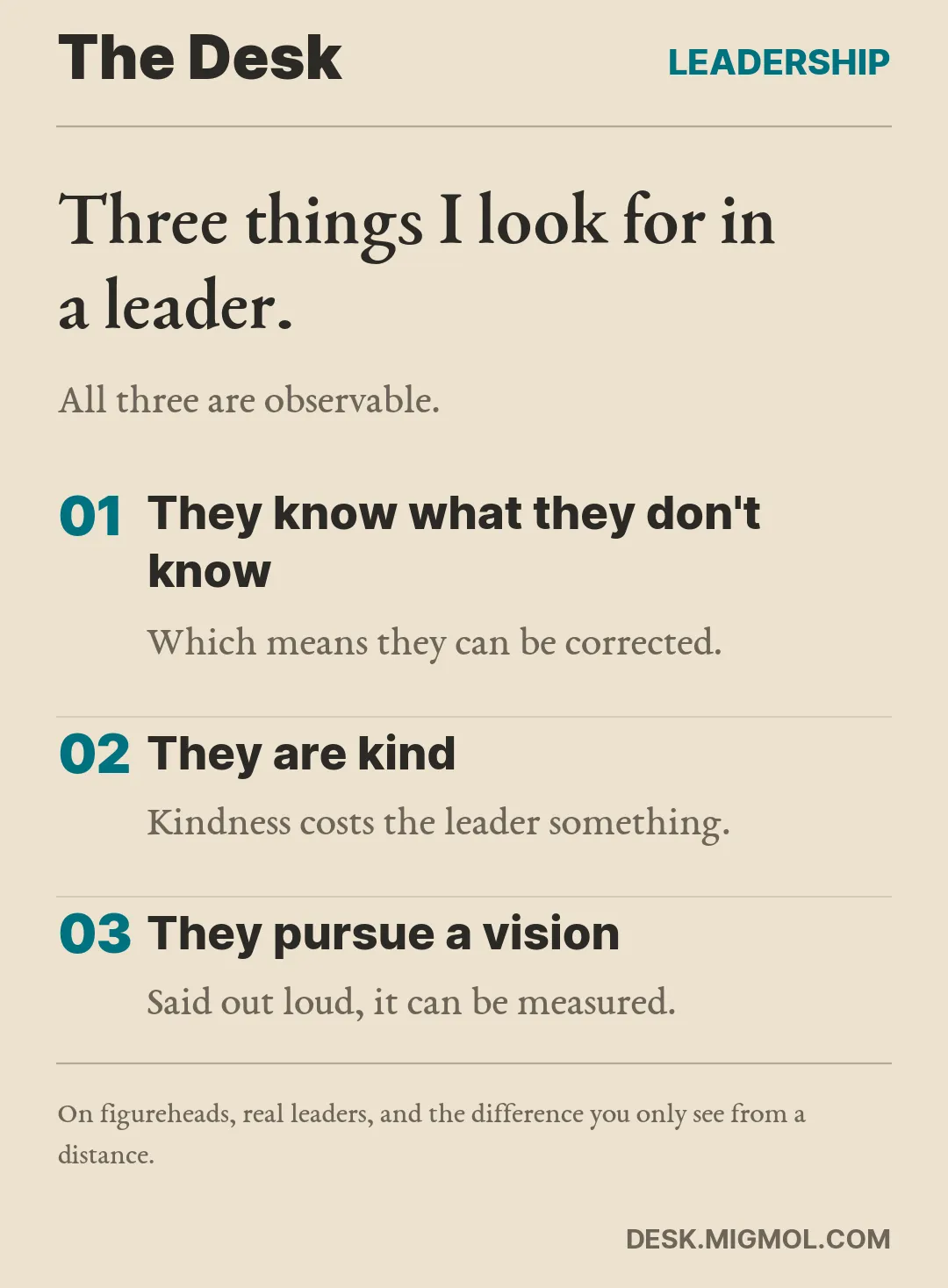
They know what they know, and they know there are things they don’t. The rarest of the three. It reads as humility but it’s closer to plain accuracy. A leader who can say “I don’t know, find out and come back to me” is telling you they can be told things, and everything else depends on that. The ones who can’t be corrected get ringed by people who bring them agreement instead of information, until they are the least informed person in their own company. My BU head could be argued with. That’s half of why we still quote him. His reasoning was portable, so we could carry it out of the room and use it somewhere else.
They’re kind. Which is a different thing from nice. Nice is conflict avoidance wearing a smile. Nice tells you the deck is great and then rewrites it at midnight, and nice is why nobody in the building knows where they stand. Kindness costs the leader something. Hard feedback delivered in a way the person can survive. Taking the hit publicly for a call you made. The BU head was not nice. Ask anyone in that group chat. He was kind in the way that counts, which is that he told us the truth and treated the storm as something we were crossing together.
They have the courage to have a vision and pursue it. The vision isn’t the hard part. Everyone has opinions about the future. Pursuing it is hard, because a vision is a public bet with your name on it, and once you say it out loud you can be measured against it. That’s why so many leaders never have one. If you never commit to a direction you can never be wrong about it, and you get to spend a career being credited for whatever happened to work. Meanwhile your people are building in four directions, all of them certain they’re following you.
Now, to anyone who recognized himself in the first half.
Leaders are judged by three courts. Continuously, and you have influence over none of them.

The organization judges you. The deference reads like respect. It’s closer to a survey result, and everyone filled it in a long time ago. They know which ideas were yours and which ones you absorbed from a manager who never got the credit. They know whether you can be handed bad news. They discuss it in the parking lot, in the group chat, in the car on the way home. They just don’t discuss it with you, and you’ve read that silence as agreement.
The industry judges you. And not only the people who worked for you. Your customers, your suppliers, your peers, your competitors, and everyone who used to sit in your meetings and now sits in somebody else’s. All of them formed a view, all of them carry an accurate account of what you were like to deal with, and all of them distribute it in rooms you will never enter. Your reputation is whatever a former direct report says when a recruiter asks, and whatever a supplier says when a rival asks whether you were worth working with.
And your truest self judges you. That one you cannot manage. No comms plan reaches it. You know whether you earned the position or the position earned you. You know, at two in the morning, whether the room agreed with you because you were right or because you were the one signing the payroll.
Power corrupts; it doesn’t have to be absolute.
The chair isn’t yours. You’re only the one sitting in it. One day someone will run into you in a mall, say hello because they were trained to, and walk away feeling something they’ll have to think about later.

Communication Can Outrun Intelligence
One of the most valuable skills in business, and the same skill can march a company off a cliff. Both are true.
Read more →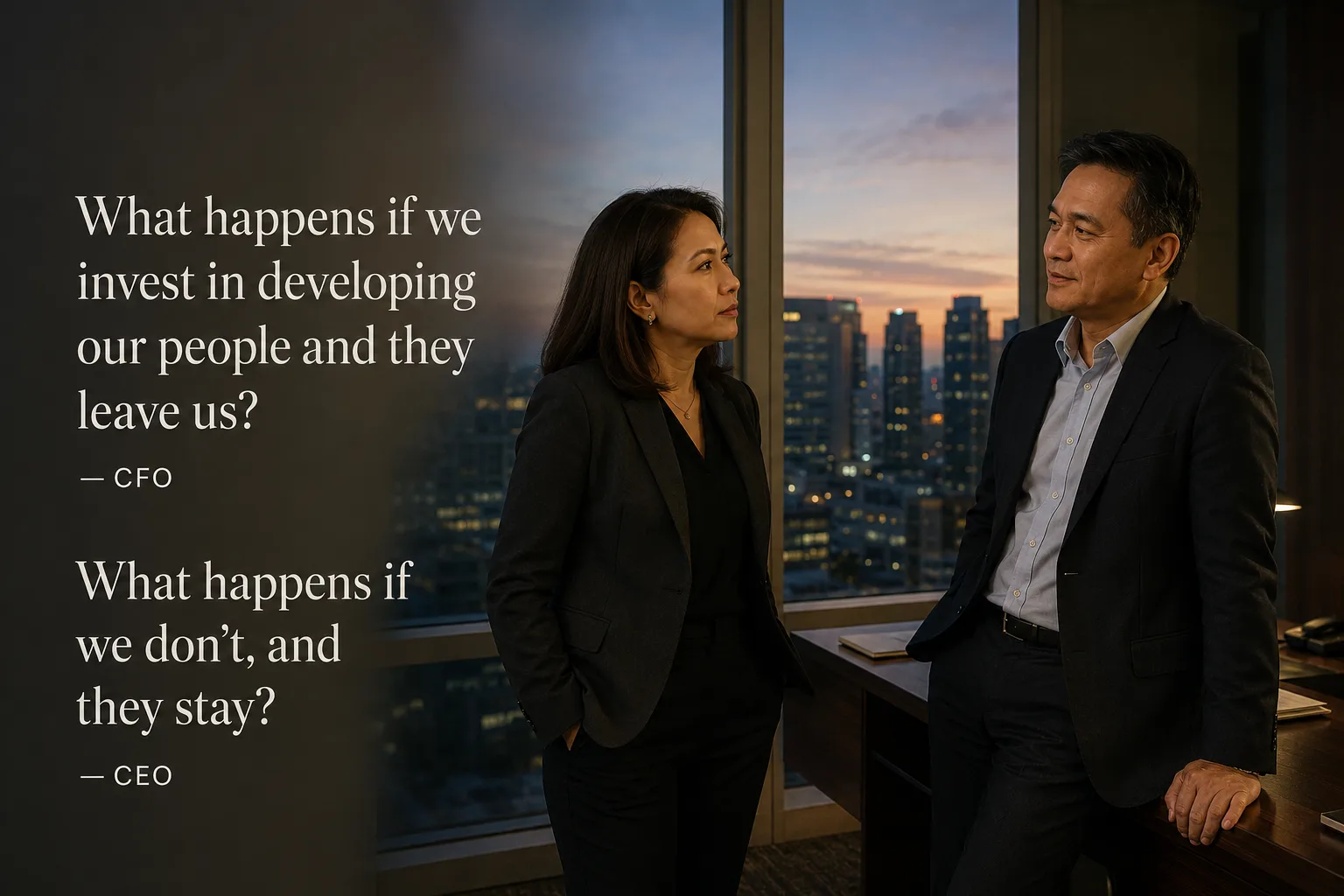
Develop Your People Anyway
The CFO's question is real. So is the CEO's answer. Twenty years on both sides of the training budget taught me which fear to respect.
Read more →
I Closed the Book Too Early
A few months ago I wrote LeBron off. Now the entire NBA is frozen, waiting on one 41-year-old to decide where he plays. That is what owning the narrative looks like, and why relevance is the only real leverage.
Read more →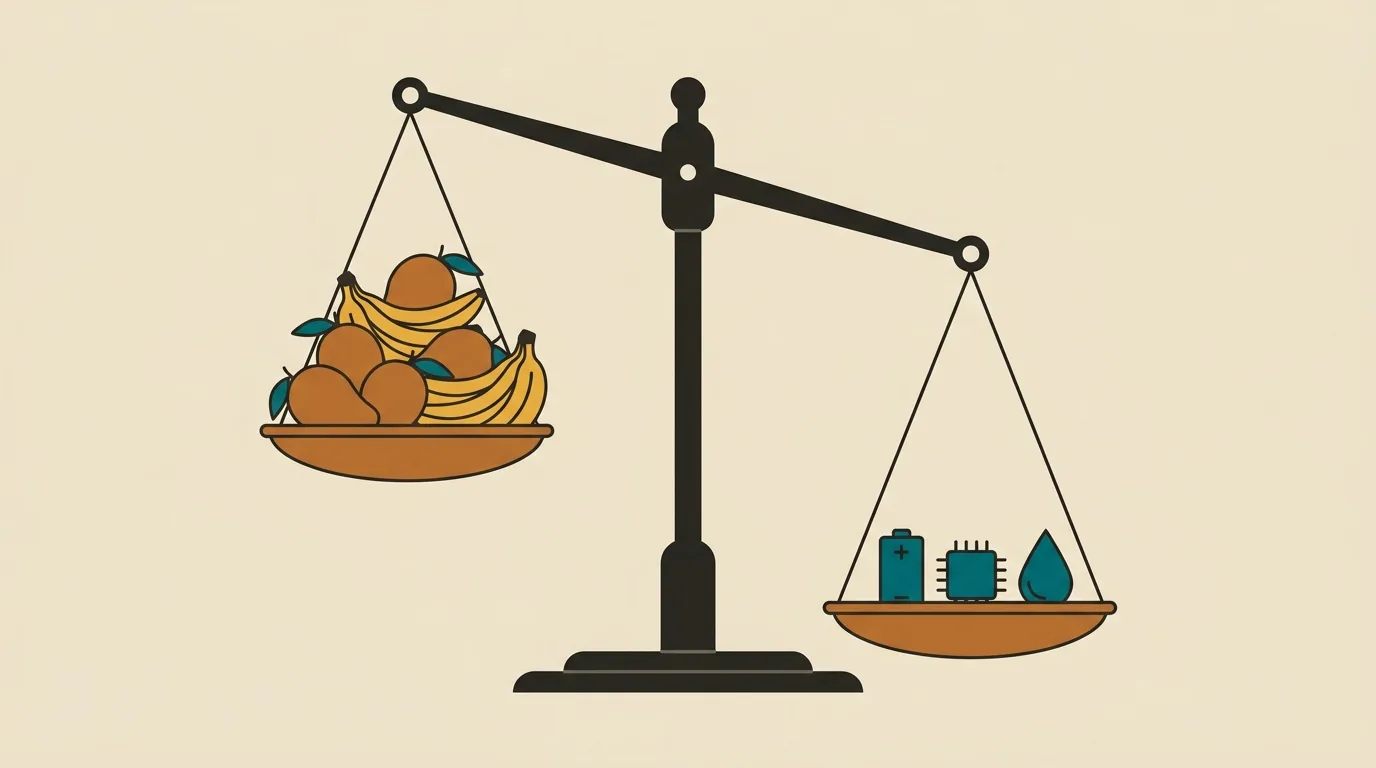
What does the world need from the Philippines? Right now, nothing it can't get somewhere else.
China refines 91% of the world's rare earths. Taiwan makes over 90% of its most advanced chips. We import 98% of our garlic and ship our nickel out as raw ore. What could the Philippines own that the world can't do without?
Read more →