An Open Letter to DMCI Homes: Acacia Estates Was the Pilot. Finish the Job.
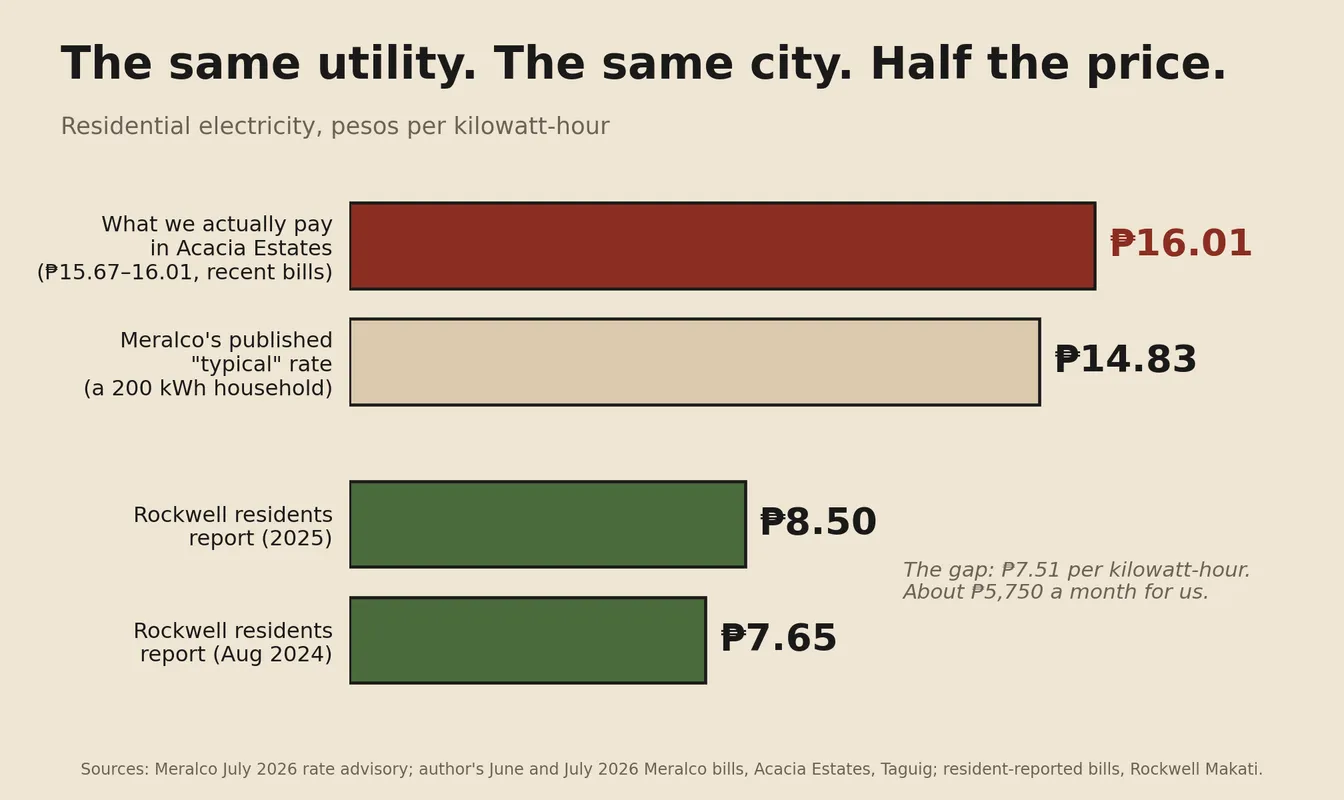
We pay around ₱16 per kilowatt-hour. Residents in Rockwell report paying about half that. DMCI already ran the fix inside Acacia Estates thirteen months ago, and it stopped at the common areas.
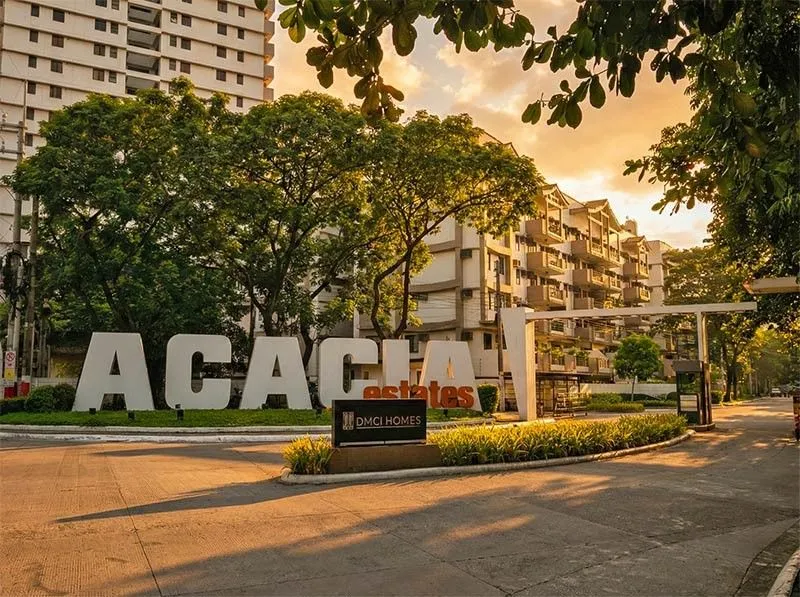
My Meralco bill last month was ₱12,260.20 for 766 kilowatt-hours. That is ₱16.01 per kWh.
That was one of our heavier months. Over the last twelve we averaged 516 kWh, about 6,200 kWh for the year. The rate hardly moves either way: our June bill was 871 kWh and worked out to ₱15.67. So call it ₱16 a kilowatt-hour, all year round.
Residents in Rockwell report paying around ₱7.65 per kWh in 2024 and roughly ₱8.50 last year. Half of what we pay, at a more expensive address, from the same utility, in the same city.
Most residents do not know this is even possible. Large electricity users in the Philippines can skip the default utility rate and shop for their own supplier, the way a business shops around for a cheaper phone plan. A single condo building, a subdivision or a school usually does not use enough power on its own to qualify. But it can pool its usage with others nearby, cross the minimum threshold together, and negotiate as one large buyer. This is called retail aggregation, and it is open to malls, subdivisions, cities, barangays, anyone, as long as the combined group clears the usage requirement. It is not a special favor. It is a program the ERC built for exactly this.
In June 2025, DMCI Homes signed a deal with Meralco’s retail arm, MPower, to bring its properties into the Competitive Retail Electricity Market and the Retail Aggregation Program. The ERC chairperson came to the signing. The press release called it a first for Philippine real estate. One of the two pilot sites was Rosewood Pointe, which is here, inside Acacia Estates.
The pilot covered the common areas. The lobbies got a negotiated rate. The corridor lights and the pumps got a negotiated rate. The 10,000-plus homes around them did not, and thirteen months later still have not.
I would like to understand why, and I would like a date.
Nine years here
My family has lived in Acacia Estates for nine years. Two of my cousins are here. So is an uncle. My wife and I run into former officemates on the walking paths and people we went to school with pushing strollers past the guardhouse. You move into a condo expecting to know nobody and end up unable to get to the store without saying hello three times.
We walk the property for pleasure and exercise, at night and never once thinking twice about it. And the more that we do, the more we appreciate how nice Acacia Estates is. The trees along the internal roads have been left alone long enough to actually become trees. That is rare, and DMCI does not get enough credit for it.
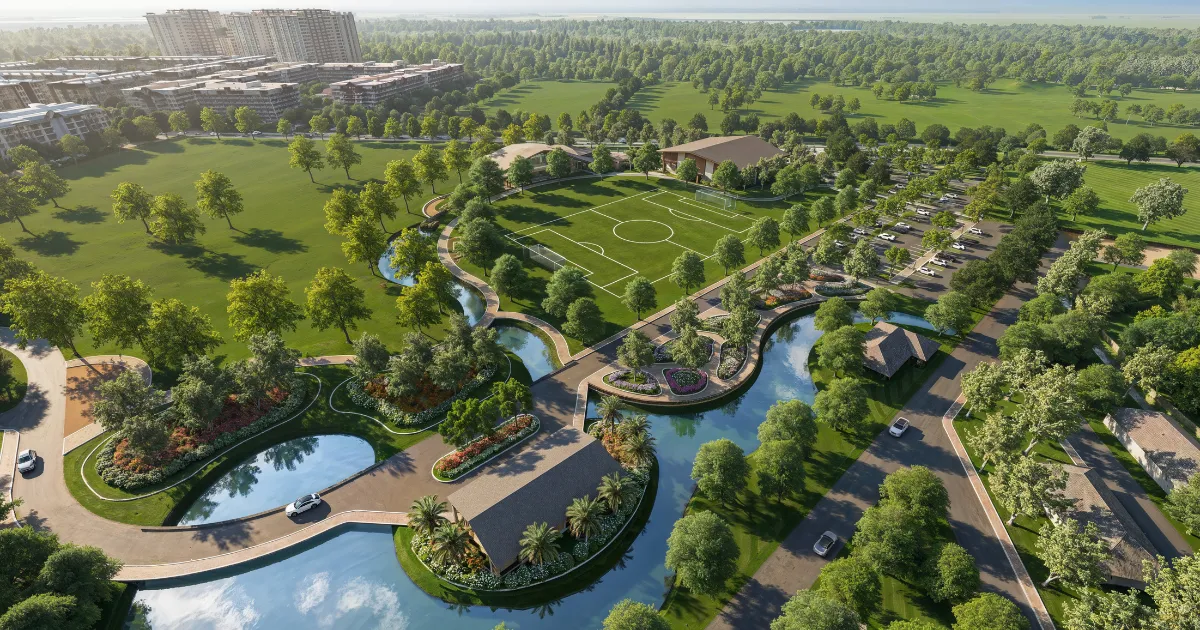
It is about to get better. Acacia Park Central adds 6.8 hectares of park, pushing the estate’s open space from about 24 hectares to 66. That is roughly 14 square metres of green per resident, against the 9 the World Health Organization asks of a city.
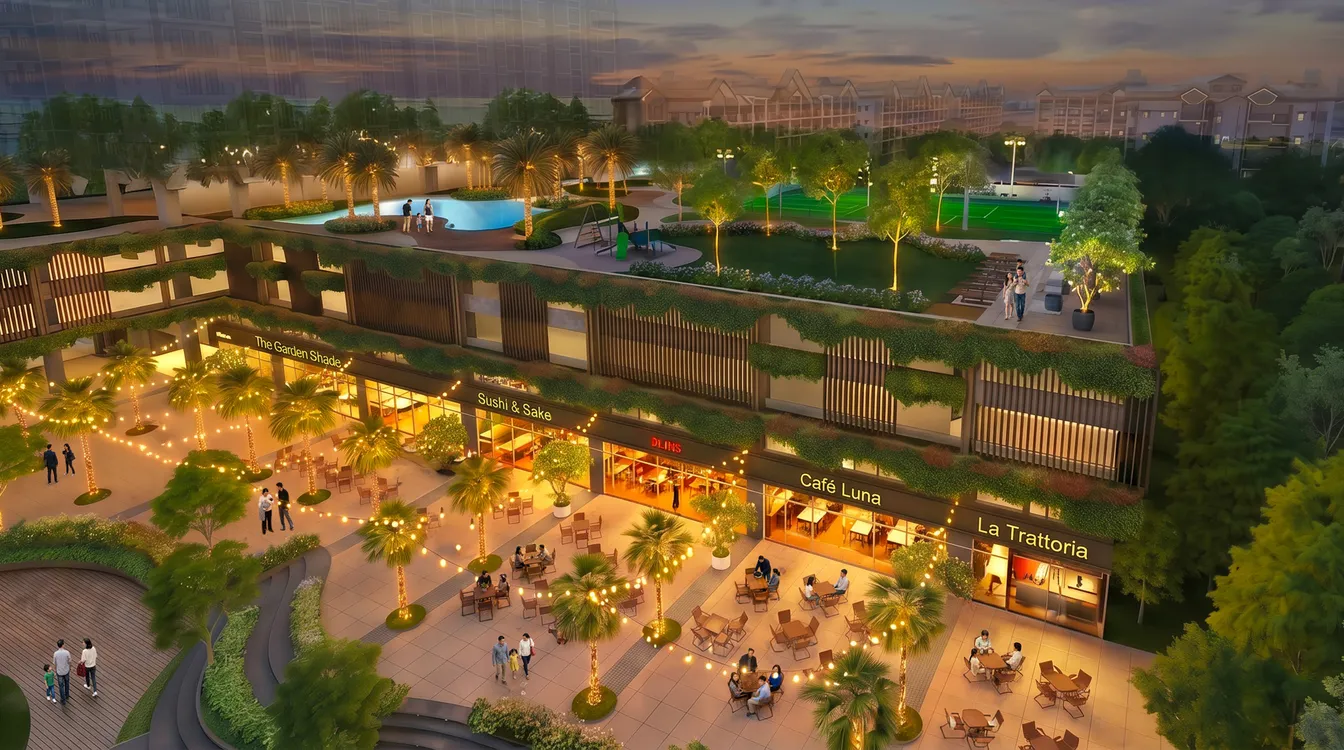
The Town Center redevelopment brings a supermarket, a proper commercial strip, open-air dining and a plaza. Phase 1 takes down The Tent to make room. We will miss it, but I have seen the renders and I understand the trade.
We are not going anywhere. That decision was made a long time ago.
Which is why I am asking about the one thing all of this leaves untouched. DMCI is about to give every resident here more green space than the WHO asks of a city. On the electricity bill that arrives every month, we are all still on the default retail rate.
The money, plainly
Your bill has one big negotiable part. The generation charge is what Meralco pays for the electricity itself, and it runs about 58 percent of the total. The rest is wires, taxes and fees that nobody negotiates.
In the first quarter of 2026, buyers in the competitive retail market paid ₱5.33 to ₱5.41 per kWh for generation. Everyone else paid ₱6.12 to ₱6.43. That is 12 to 17 percent cheaper, and contestable customers realized ₱4.91 billion in savings in that quarter alone.
Two things about that discount. It is a percentage off a per-kilowatt-hour charge, so it lands the same way in a quiet 368 kWh February as in a brutal 871 kWh June. And it needs no equipment, no construction and no capital from anybody. It is a contract.
On our real year, 6,192 kWh, that is ₱7,600 to ₱10,800 back. Match what Rockwell residents report paying and it is closer to ₱46,500.
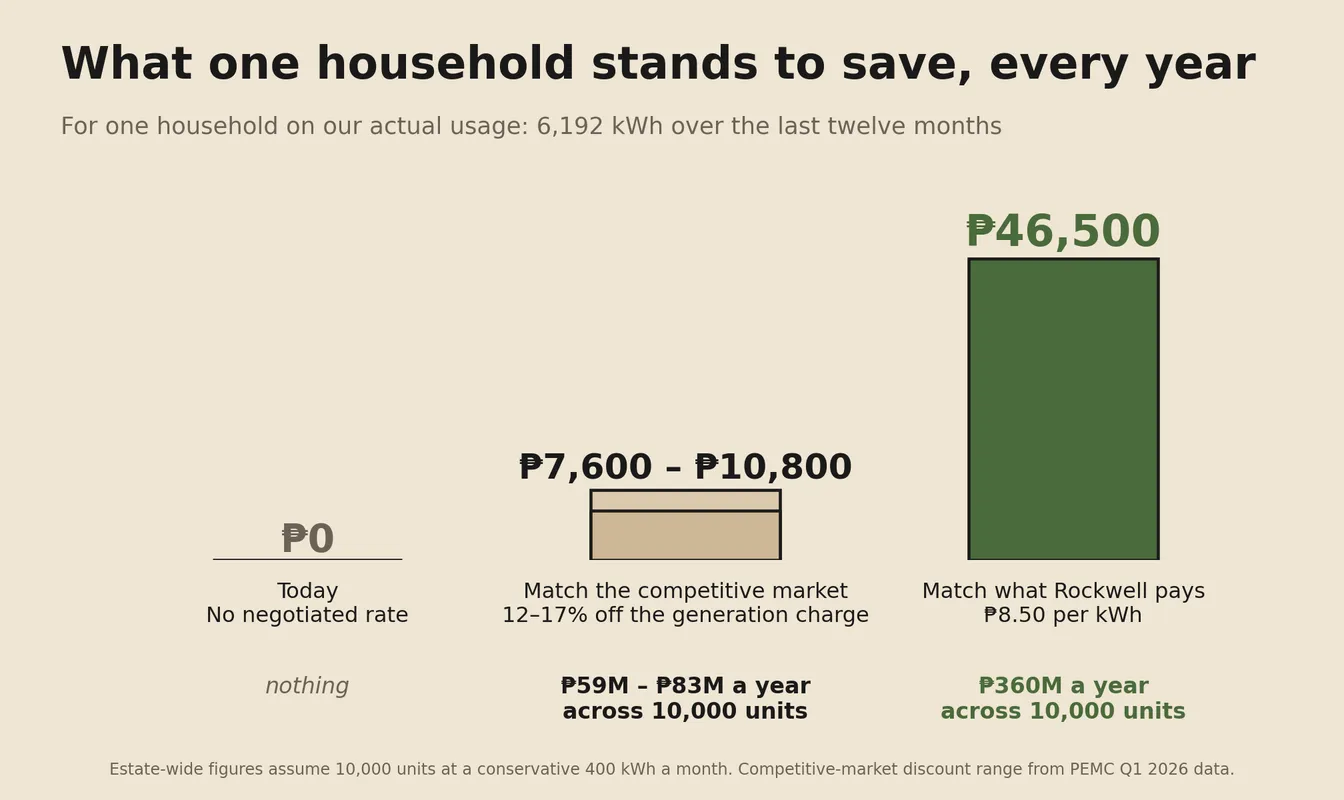
Across 10,000 units at a conservative 400 kWh a month, the estate keeps ₱59 million to ₱83 million a year. At Rockwell parity, ₱360 million. Against the ₱4.5 billion DMCI has committed to the upscaling, that conservative figure arrives every year, forever, and costs nothing to build.
We qualify 55 times over
On 26 June 2026, the ERC dropped the threshold for joining the competitive market from 500 kW to 100 kW.
Acacia Estates residential demand alone averages roughly 5,479 kW. Fifty-five times the bar, before you add the common areas of all 14 communities, the Town Center, or DMCI’s own construction operation at the back of the estate.
DMCI is drawing industrial-scale power on this property, for its own construction work, at whatever rate the company arranged for itself, while 10,000 households a few hundred metres away pay retail. Bundle all of it into one negotiation and Acacia becomes one of the largest single blocks of demand any supplier could book in Taguig. A block that size does not ask for a favor. It sets terms.
Piloting the common areas of one condo, on a property carrying that much load, is like negotiating hard on the parking lot and paying sticker for the building.
What stings about the comparison
Rockwell’s actual contracted rate is not published anywhere and never will be. Negotiated rates are private by design. That is rather the point. The reason I cannot show you their contract is that somebody at Rockwell went and negotiated one.
The pattern is everywhere once you look. Ayala Land has owned DirectPower Services, its own licensed electricity supplier, since 2012. Filinvest moved eleven properties onto clean energy supply. MPower switched Aseana City over. In June 2026, the first two residential aggregation groups in the country energized: nine households in Blue Ridge A, Quezon City, and thirteen in Greenhills West, San Juan. Nine households organized and got what 10,000 units here have not been offered.
And DMCI Holdings, through Semirara Mining and Power, is the largest coal producer in the country, runs 900 MW of generating capacity, and holds a licensed retail supplier in Sem-Calaca RES. The parent company of this estate’s developer sells electricity for a living.
What we are asking for
A negotiated supply contract covering all of Acacia Estates, residential units included, energized within 12 months.
Three things would make it real: a) a written commitment from DMCI Homes and DMCI Homes Property Management to pursue estate-wide aggregation, published to residents with a target date; b) a load assessment covering residential, common area, commercial and construction demand, so the estate negotiates as one block instead of building by building; and c) quarterly updates to residents on where it stands.
Twelve months sits comfortably inside DMCI’s own timeline. Acacia Park Central Phase 1 lands in 2027. The Town Center is in full swing by 2028. A negotiated rate by mid-2027 would arrive alongside the first thing residents can walk into.
Solar panels, EV charging, and the cheapest power in the city
That was the ask. This part is the wish, and it is a good one.
Acacia Estates spans 130 hectares and more than 63 are still undeveloped. In April 2026 the DOE lifted the net metering cap for non-residential users from 100 kW to 1 MW and put utilities on a 10-working-day clock to approve applications. Most of what made rooftop solar impractical at scale is now gone. Ayala Land already runs 15.3 MW across 13 malls. We have 14 communities’ worth of roofs and tens of hectares of empty land.
Then there is charging. The government’s roadmap for electric vehicles targets EVs at half of everything on Philippine roads by 2040, with 20,400 charging stations to match.
That target reads differently from a condo. When an EV comes up among people who live in towers, most of us rule it out before checking the price. No roof of our own, no wallbox, nowhere to plug in overnight. The 2040 plan quietly assumes a country of people with garages, and a huge share of Metro Manila does not live that way. My family does not either.
Acacia is unusually well placed to fix that. One properly sized, solar-fed charging area, built once and built right, instead of two chargers per basement retrofitted in a panic in 2029. We have the land, the roofs, the density to make it pay, and 25,000 people who currently have no reason to consider an EV at all.
To my neighbors
Most of us do not know any of this is on the table. I did not.
Three things we can do. Ask property management, in writing, whether your building is enrolled in the competitive market or the aggregation program, and if not, when. Bring it up at the next homeowners’ meeting and ask for it to be minuted. Send this to the people in your building, because aggregation is a numbers game by definition.
And pull up your own bill. Divide the total by the kilowatt-hours. Whatever number you get, hold it next to ₱8.50.
To DMCI Homes
Thank you for the estate. You built something in Taguig that people actually want to stay in, and staying is exactly what we are doing. You kept the density down when you did not have to. You planted well, then had the discipline to leave it alone. Nobody writes this much about a place they are indifferent to.
You also already did the hard part. You signed the deal, you ran the pilot here, and the regulator applauded you for it. What is left is the unglamorous stretch: extending it to the people who live in the buildings.
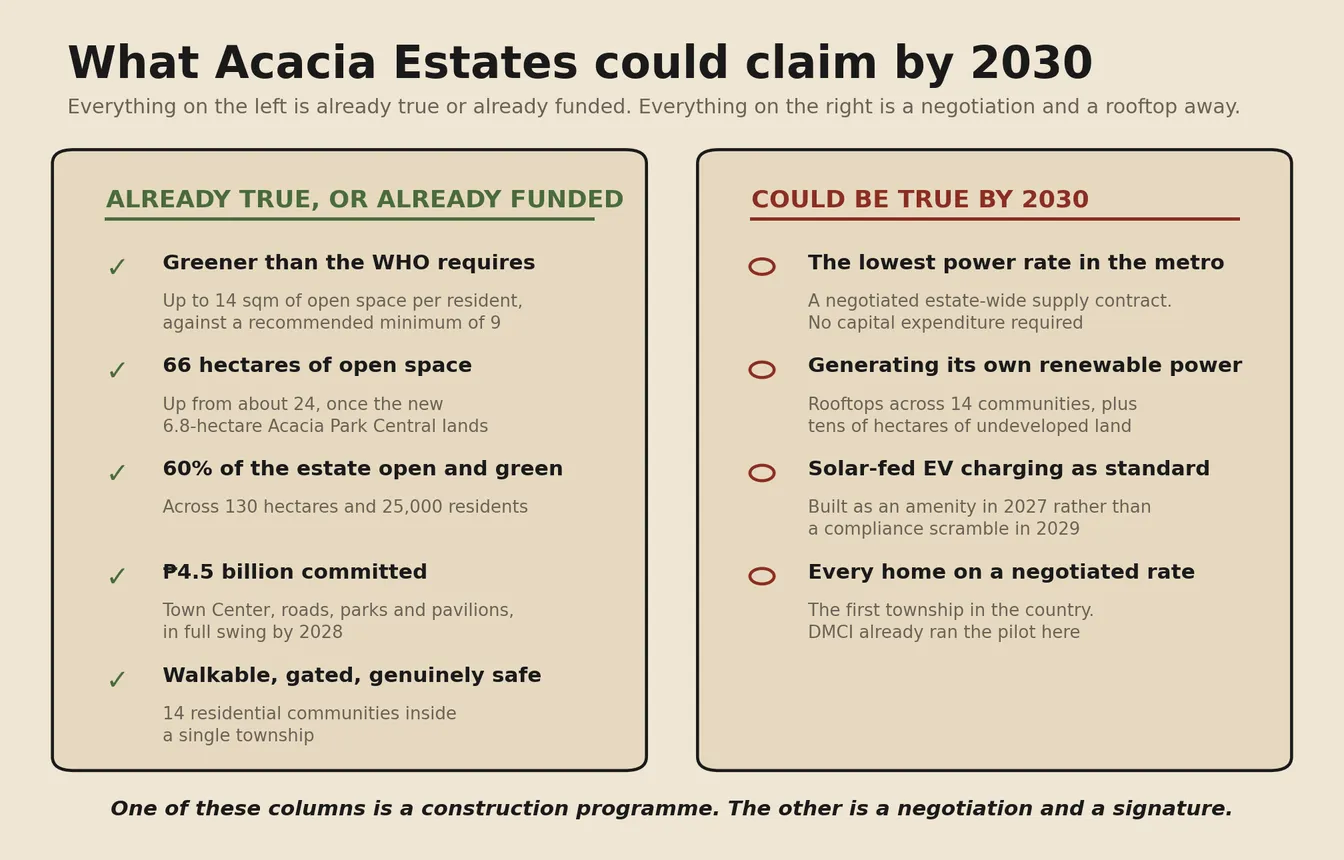
Greener than the WHO asks a city to be, cheapest to run of any township in the metro, generating a good share of its own power, and the one address in Manila where a condo resident can own an electric car without thinking about it. Put those four on one 130-hectare property and Acacia Estates stops being the best-kept secret in Metro Manila and becomes one of the most coveted addresses in it.
The left column is nearly done. The right one needs somebody at DMCI to pick up a phone.
We are staying either way. We would just love to say we were first.
The Molinas, Acacia Estates, Taguig. Nine years and counting.

The Government Wants to Reduce Plastic; the Private Sector Was Left to Figure It Out.
RA 9003 promised a recycling system in 2000 and never funded it. RA 11898 handed the same job to companies in 2022, with fines up to ₱20 million attached.
Read more →
Culinary Class Wars: Philippines — Dark Horses and Predictions
Who goes further than anyone expects, who cracks, and my actual call on how this ends. Part 3 of 3.
Read more →
More Stressed Than Singapore
The Philippines just topped Southeast Asia in workplace stress, ahead of a country where workers earn several times what we do. A lot of that is our own doing. Some of it we keep calling dedication.
Read more →
Alex Eala Doesn't Owe Us Anything
But she showed up anyway.
Read more →