The Government Wants to Reduce Plastic; the Private Sector Was Left to Figure It Out.
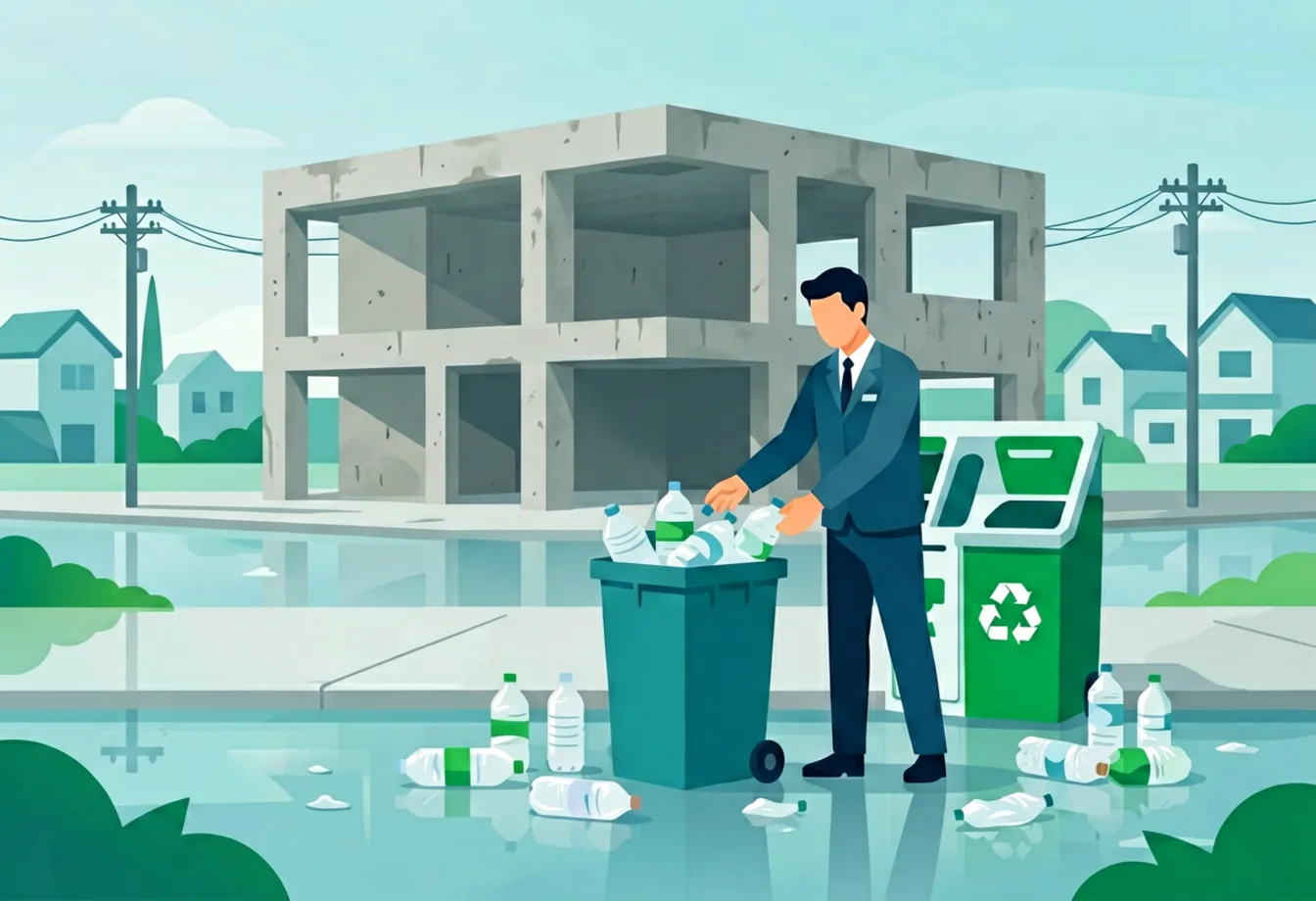
The National Solid Waste Fund was created by law in 2000 to pay for recycling in every barangay. Twenty-six years later it has never been operationalised. In 2022 the government gave the job to companies instead.
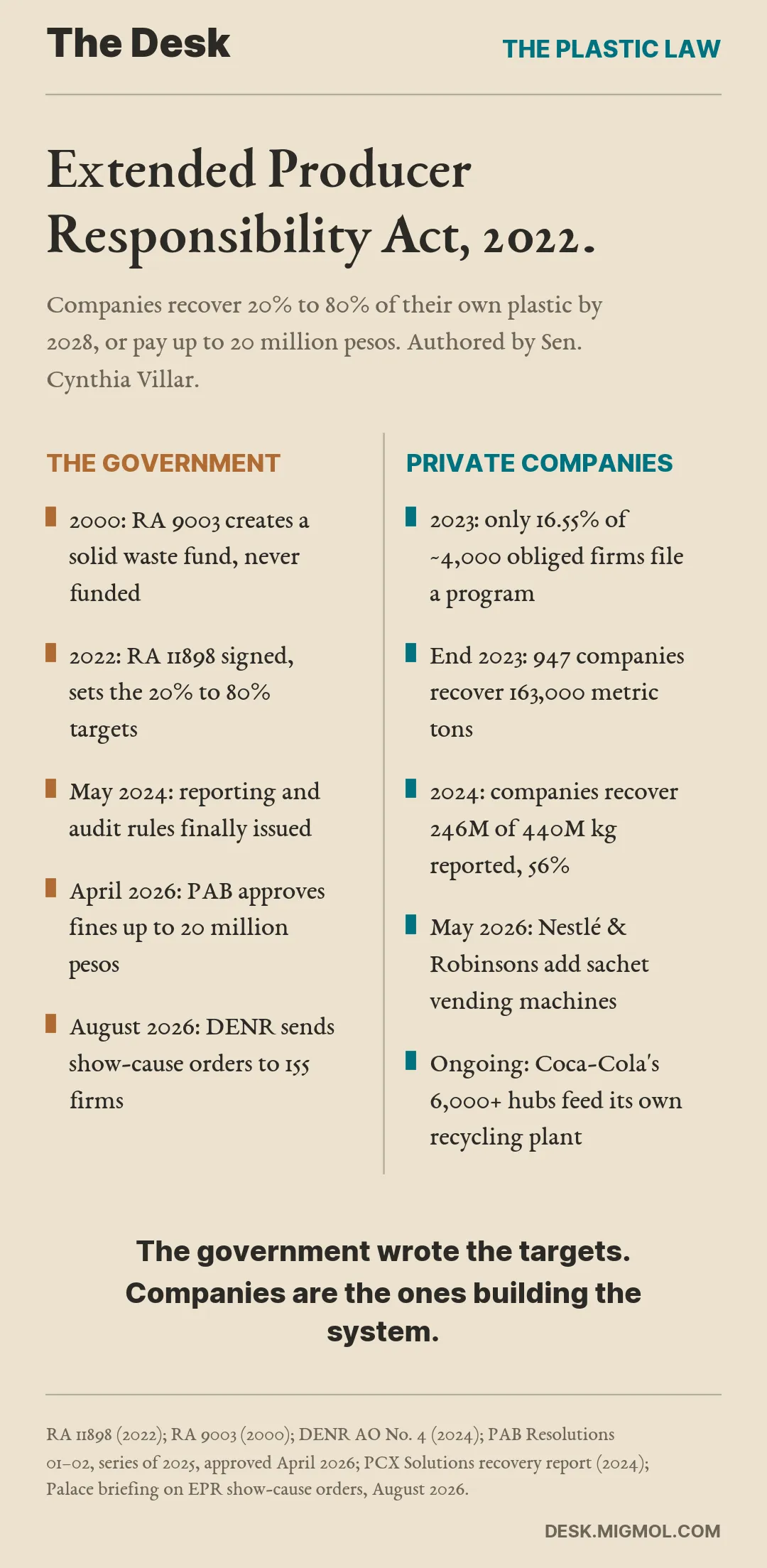
That handover is RA 11898, the Extended Producer Responsibility Act, principally authored by Senator Cynthia Villar. Companies above ₱100 million in assets have to recover their own plastic packaging from the environment. 20 percent by 2023, climbing to 80 percent by 2028. Miss it and the fines start at ₱5 million and run to ₱20 million by the third offense, with automatic suspension of your business permit on top, or twice the cost of covering the shortfall, whichever is higher.
The targets are clear. What nobody answered is how.
There is no national collection system to plug into. Household segregation collapses at pickup, where contractors recombine what people separated. The government’s own rules for how compliance would be reported and audited, DENR Administrative Order No. 4, only landed in May 2024, more than a year after the first 20 percent target had already lapsed. The resolutions setting out the actual penalties, PAB Resolutions 01 and 02, were not approved until April 2026, nearly four years after the law passed. Enforcement is still catching up: in August 2026, DENR sent show-cause orders to 155 companies it suspects of falling short, the first real move against noncompliance, and even then nobody has been fined yet. Companies were told to hit a number, then told years later how the number would be counted and what missing it would cost.
What was already promised
RA 9003, the Ecological Solid Waste Management Act, is the law that created that fund. It also required a materials recovery facility in every barangay. By 2022 only 17,047 barangays had one, running roughly 19 percent behind the national plan’s own target. On the enforcement record across those 26 years, one expert’s summary was that no one has really been punished.
So the government wrote itself a job in 2000, did not fund it, did not do it, and did not punish itself for not doing it. Then in 2022 it handed the same job to the private sector, with fines up to ₱20 million and the loss of a business permit attached.
Companies are actually building it
This part deserves saying plainly, because it is easy to write about corporate plastic and reach for cynicism.
Nestlé and Robinsons put reverse vending machines for used sachets into four Metro Manila supermarkets this year, with the collected material going to an upcycler that turns it into board for furniture. Coca-Cola runs Tapon to Ipon, more than 6,000 collection hubs across over 170 cities and municipalities, sari-sari stores and carinderias among them, feeding the bottle-to-bottle recycling plant it built with Indorama in General Trias. You can walk into a supermarket and hand back a sachet, which was not true a few years ago.
That is real infrastructure, privately funded, doing the work a National Solid Waste Fund was supposed to do.
What you get when you fund nothing
You also lose the ability to steer, and the numbers show it.
Coverage is thin. Of roughly 4,000 covered enterprises, only 16.55 percent had submitted programs in 2023. By December 2025, 1,017 were registered. A law aimed at the companies that put packaging into the market is reaching a quarter of them.
The recovery figures are contested. One industry report found 947 companies recovered around 163,000 metric tons by the end of 2023, past the first-year target. In 2024, companies reported 440 million kilograms and recovered about 246 million, roughly 56 percent. Critics of the scheme make a fair point: it is not clear how much of that was already happening anyway, through the informal collection economy that has sorted this country’s waste for decades without a law telling it to.
And recovery is not the same as recycling. A large share of what gets collected is co-processed, which mostly means burned as fuel in cement kilns. That counts toward the target. Whether it should is a policy question, and it is exactly the kind of question a government would have to answer if it were paying for the system. Since it is not paying, the answer is being set by whoever finds it cheapest to comply. Environmental groups have also flagged that plastic credits, the instrument many companies buy to hit their numbers, can end up rewarding the cheapest disposal rather than the best one.
The law also only counts what comes back. It says nothing about producing less, redesigning packaging, or building refill and reuse systems. Sachets stay sachets. The country keeps making the problem at full speed and pays companies’ compliance teams to chase it afterwards.
What it would take
Fund the fund. The National Solid Waste Fund has existed on paper since 2000 and would pay for the collection layer that every recovery target depends on. Build the barangay MRFs the same law already requires, so companies are plugging into a system instead of each inventing one. Decide, in public, whether burning plastic in a cement kiln counts as recovery, because right now that is being decided by procurement departments. And set targets for reduction, not only for collection, since a recovery rate on a growing pile is not progress.
Companies will keep building collection hubs either way. They have to. The fines are real and the deadlines are moving.
What is missing is the part the government kept for itself in 2000 and never delivered. Twenty-six years is long enough to call that a decision rather than a delay.

Culinary Class Wars: Philippines — Dark Horses and Predictions
Who goes further than anyone expects, who cracks, and my actual call on how this ends. Part 3 of 3.
Read more →
More Stressed Than Singapore
The Philippines just topped Southeast Asia in workplace stress, ahead of a country where workers earn several times what we do. A lot of that is our own doing. Some of it we keep calling dedication.
Read more →
An Open Letter to DMCI Homes: Acacia Estates Was the Pilot. Finish the Job.
We pay around ₱16 per kilowatt-hour. Residents in Rockwell report paying about half that. DMCI already ran the fix inside Acacia Estates thirteen months ago, and it stopped at the common areas.
Read more →
Alex Eala Doesn't Owe Us Anything
But she showed up anyway.
Read more →