Missed Opportunity: Electric Motorcycles and Tricycles
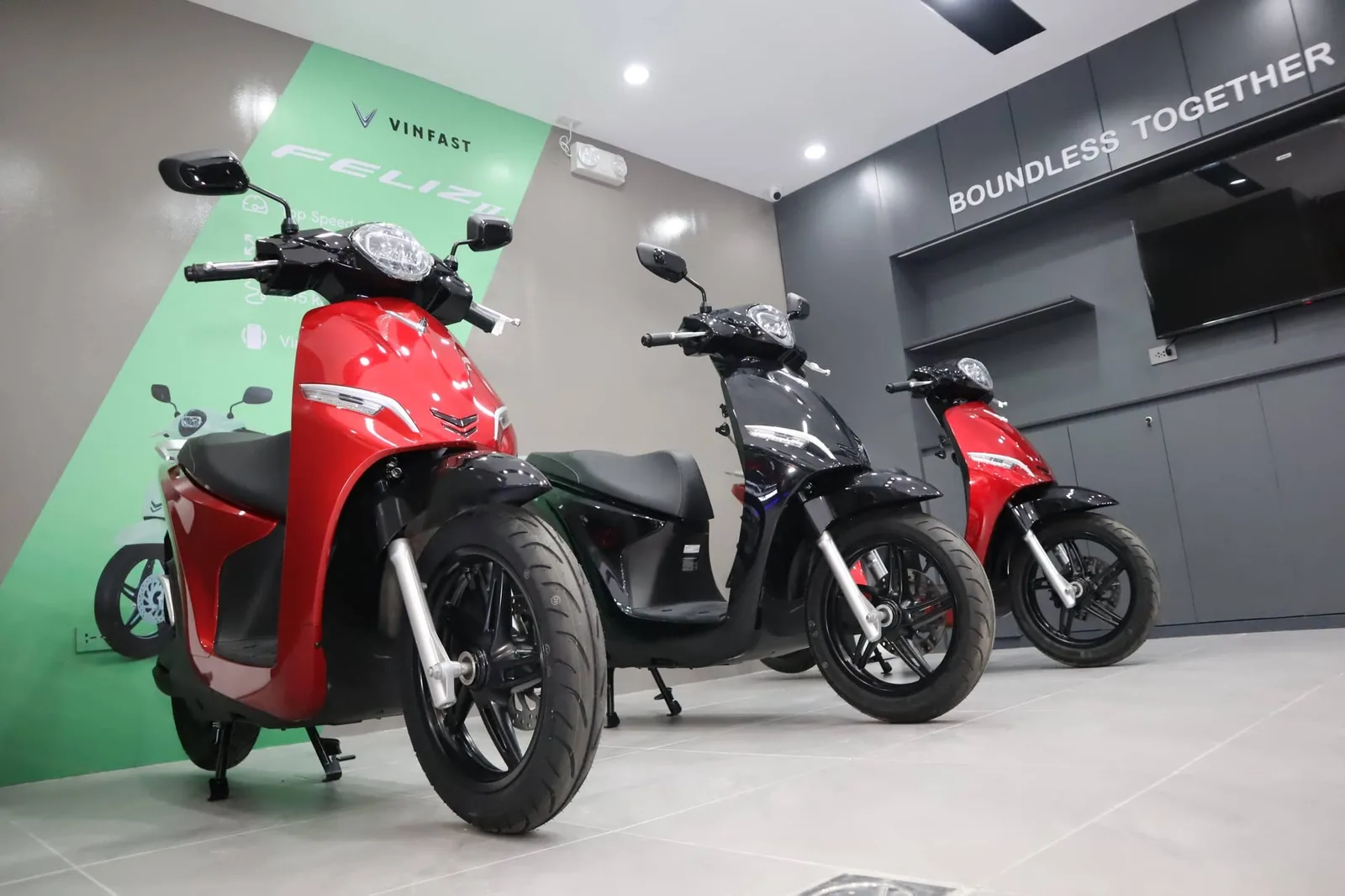
VinFast is not going to win the Philippine car market. Nobody thinks of Vietnam and pictures a car. We buy Japanese, we buy American, and now, apparently, we buy Chinese. A Vietnamese badge in a showroom in Quezon City has lost the argument before the salesman opens his mouth. That has nothing to do with the product. It’s what fifty years of brand equity does to a market. (Or in the case of Chinese EVs, an overwhelming economy of scale.)
But go to Vietnam. The first thing you notice, ten minutes out of the airport, is not a car. It’s the motorcycles. A river of them at every intersection, at every hour, even in the rain. Vietnam has around 84 million registered motorcycles against a population of roughly 100 million. That is the thing they actually know how to do.
On July 31, VinFast put three electric motorcycles on the Philippine market: the Evo, the Feliz II, and the Viper. The Evo starts at ₱62,900, the Feliz II at ₱64,900, and the Viper at ₱73,900, and none of those prices include the battery. You rent it, at ₱439 a month for one or ₱799 for two, and you swap it at a station instead of waiting on a charge. VinFast says a swap takes about a minute. One battery is good for around 80 km, two for around 150 km, with top speed running 70 to 90 km/h depending on the model. You can buy the battery outright instead. An Evo with one is ₱75,600, but owning it locks you out of the swapping network entirely, which tells you where the company thinks its business actually is.
That is a lower price than a Honda Click, while not being a slave to global oil prices. It is also the first time the pitch has been aimed at the vehicle Filipinos actually buy.
The case for electric two-wheelers here is much stronger than the case for electric cars, and it isn’t even close.
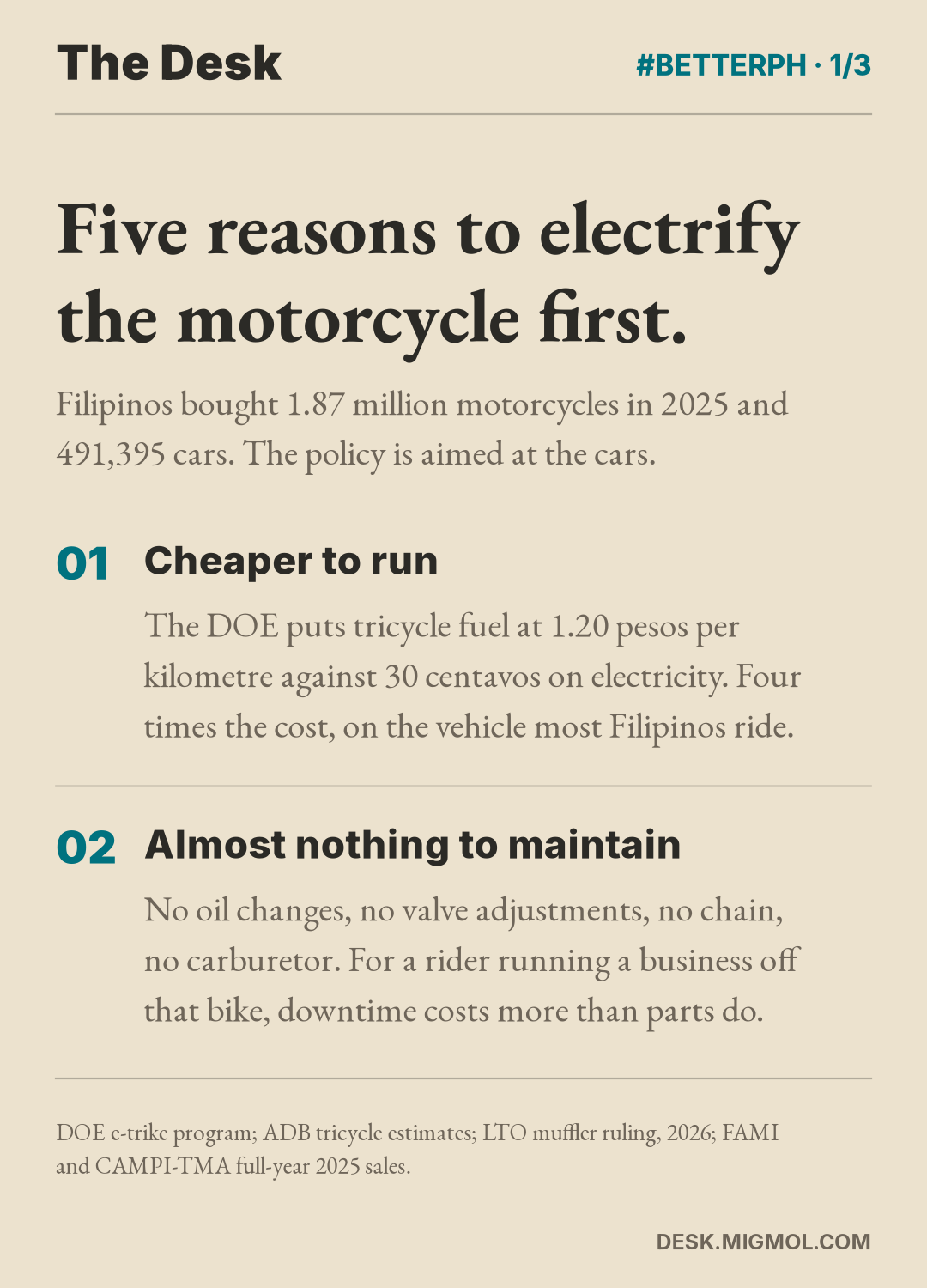
Running cost is the obvious one. A gasoline motorcycle costs roughly ₱2.13 per kilometer to run. The DOE’s own tricycle numbers put fuel at ₱1.20 per kilometer against ₱0.30 for electricity, so the gap/savings is real. VinFast claims a rider saves ₱157,680 over five years, which works out to ₱31,536 a year. Take that with a grain of salt, because the subscription isn’t in the computation yet. Twelve months of one battery is ₱5,268, and if you use all 20 swaps a month at ₱35 once the promo ends, that’s another ₱8,400. The savings are still there! They just didn’t spell it out for whatever reason.
Maintenance is the quieter argument, but a really good one. No oil changes, no valve adjustments, no chain and sprocket, no carburetor or injector to clean. Fewer moving parts means fewer things a rider has to pay a shop to look at, and in a country where a lot of riders are running a business off that bike, downtime costs more than parts do.
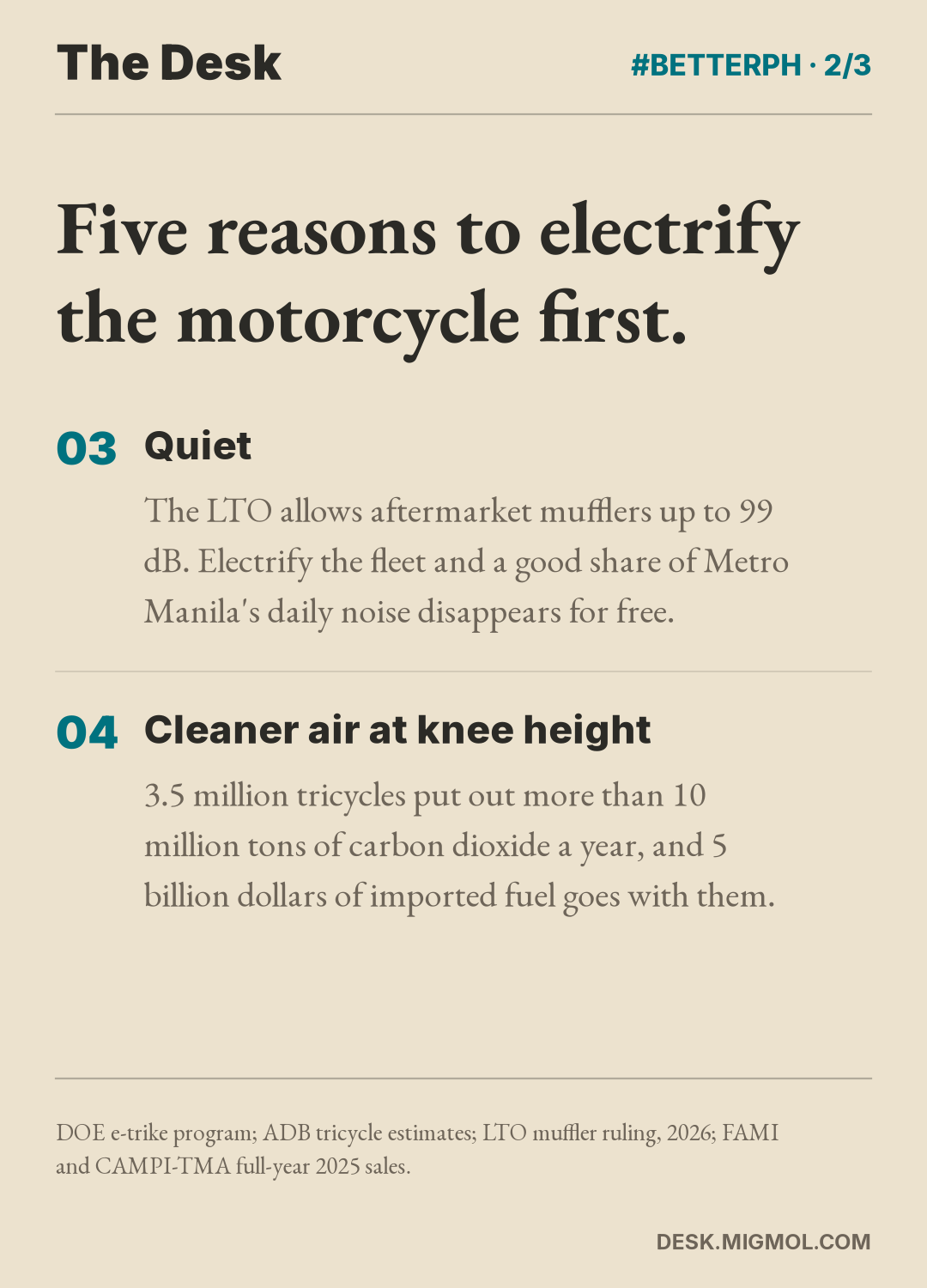
Then noise, which we badly underrate. A good share of Metro Manila’s daily misery is auditory. The LTO says aftermarket mufflers are legal up to 99 dB, which is jackhammer territory, and thousands of them pass under your window every night. Electrify the fleet and that problem disappears for free.
Air is the same argument at eye level. There are 3.5 million motorized tricycles in service in the Philippines, and the ADB puts their fuel bill at nearly $5 billion in imports a year. Each one is a tailpipe that spouts carbon monoxide at knee height in every barangay in the country.
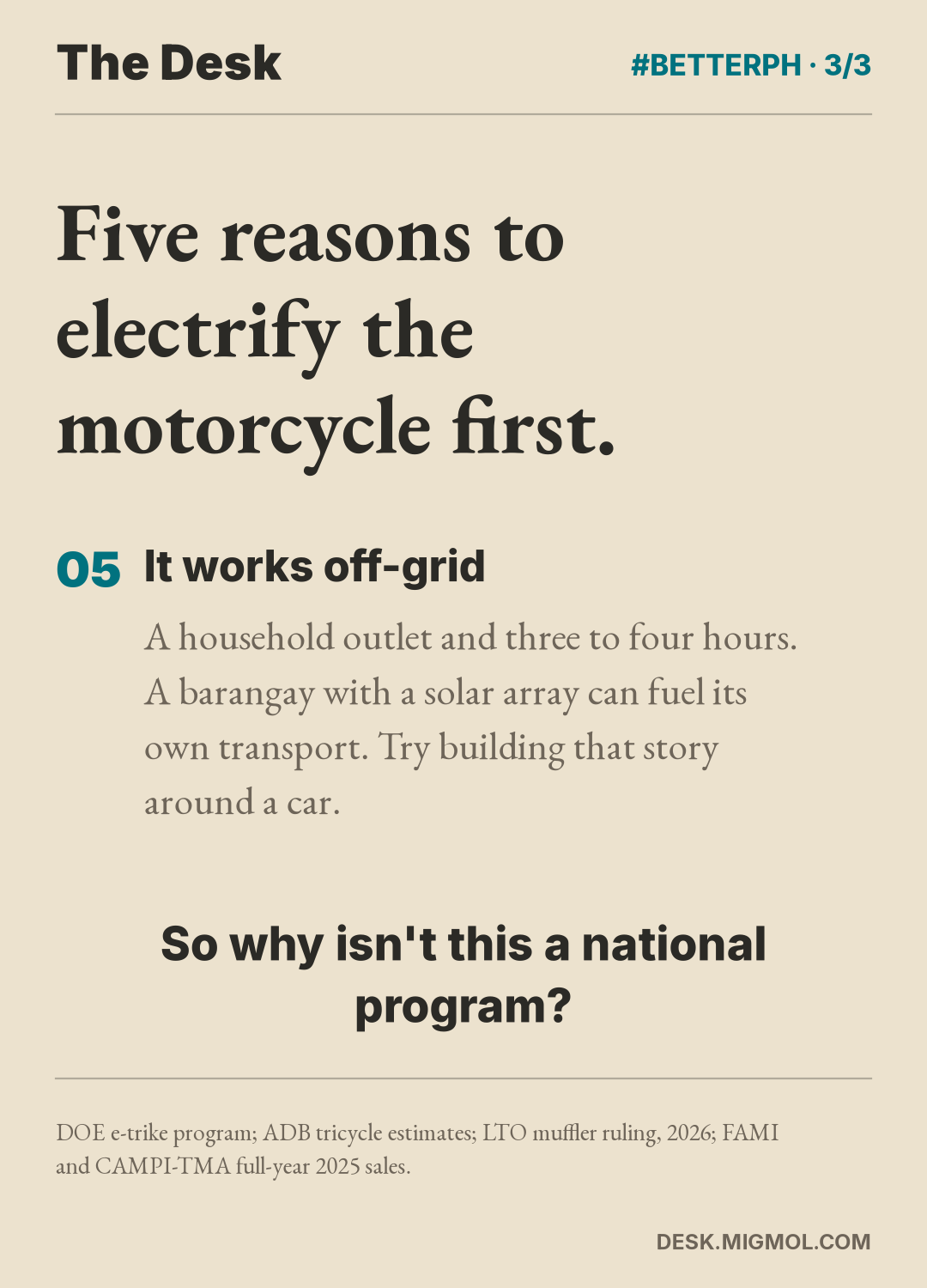
The last one is ours alone. An electric motorcycle needs a household outlet and three to four hours. But this is where government can really be felt. A barangay with a solar array and a few outlets can fuel its own transport, and off-grid and brownout-prone provinces are exactly where that math turns from nice to necessary. Try building that story around a car.
We have so many more motorcycles than cars!
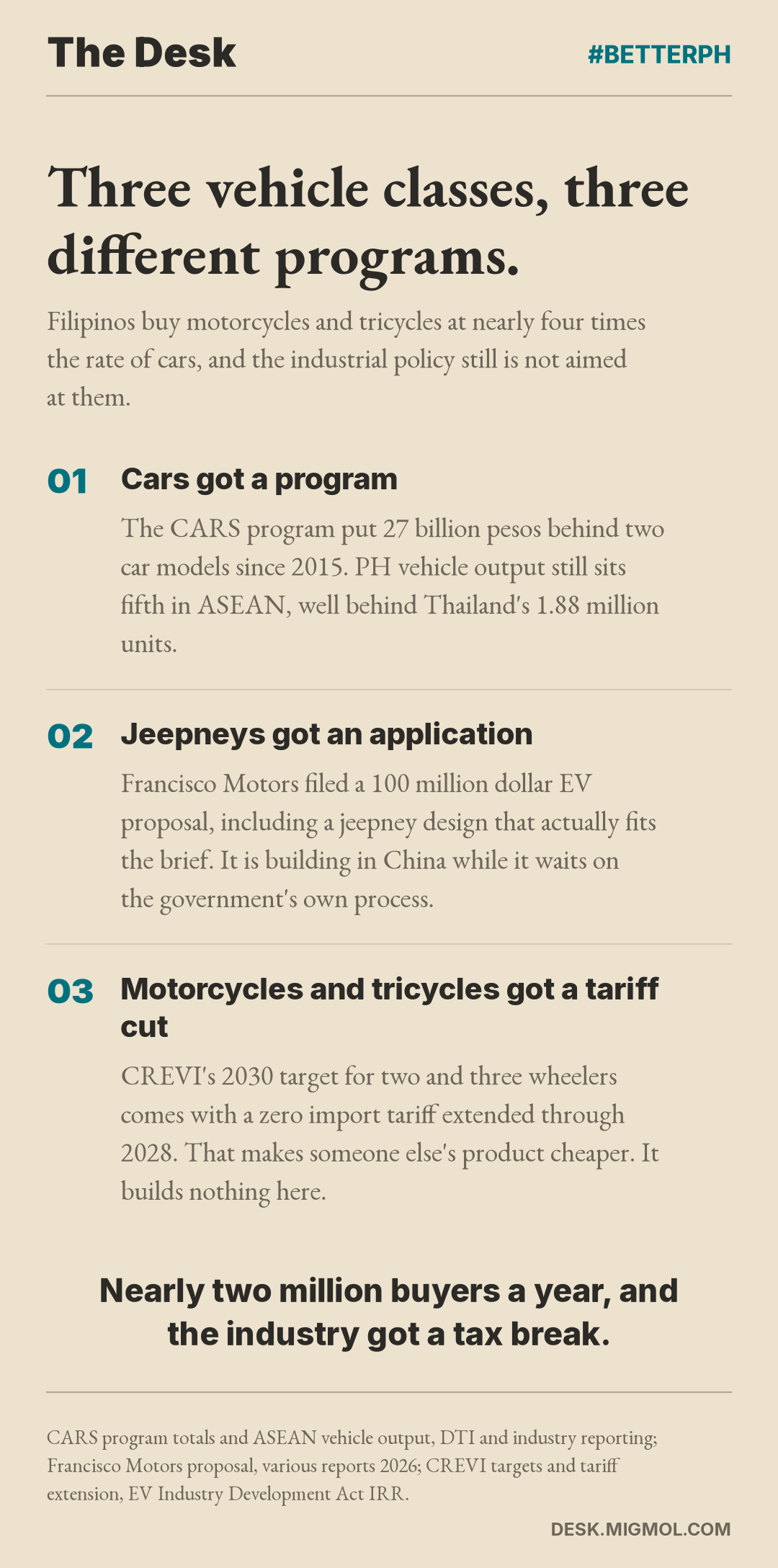
In 2025, Filipinos bought 491,395 cars and 1.87 million motorcycles, nearly four to one. In the first nine months of 2023, 8.47 million motorcycles and tricycles were registered against about 1.3 million private cars. Add the 3.5 million tricycles doing the last-mile work plus the motorcycle taxi fleets, and the honest picture is that this country moves on two and three wheels, at least numbers-wise. But each ‘number’ is a family. So you affect more lives when you address the issues of the most people.
Government knows this. CREVI, the roadmap under the EV Industry Development Act, sets a target of 50% electric share for motorcycles and tricycles by 2030. That is four years out. The instrument attached to it is a zero import tariff, extended through 2028, covering e-motorcycles, e-bikes, e-trikes, e-jeepneys, and hybrids.
A tariff cut is a consumption policy. It makes it cheaper to buy someone else’s product. It is not an industrial policy and it will not build a single production line locally.
A tariff cut is money not collected. So where did the budget go? The CARS program put ₱27 billion behind two car models since 2015, and PH vehicle output still sits fifth in ASEAN against Thailand’s 1.88 million units. We spent real money defending a segment we were never going to win. The segment where we already have close to two million buyers a year and a parts and service network in every municipality got a tax break.
Which brings me to Francisco Motors. They are one of the original jeepney builders, and they have put together a $100 million proposal for two EVs under the government incentive program. One is an electric jeepney, 22 seated and eight standing, 90 km/h, and that is exactly right. The other is the Elektron, a compact SUV with 400 to 600 km of range and up to 340 kW, and that is the one getting the headlines. They are running a factory in China while they wait on Philippine government processes, with a 30-hectare facility planned in Camarines Norte.
I want them to succeed. But what does a jeepney maker gain from designing an SUV, building it in China, and calling it the first Philippine EV? Their inheritance is body-on-frame utility vehicles for public transport, built cheap and repaired forever by anyone with a welder. That is the asset. An SUV competing with BYD on range is a fight against people who have been at it longer with far more money. There is no value-creation there. That’s just a trader passing on the cost to consumers.
But I can’t fault them entirely. If the incentive program is written around cars, then you propose a car.
Now look at what happened in Cebu. On August 27, an Asia-based electric motorcycle manufacturer told the provincial government it is looking at building a plant there. The company makes motorcycle parts, assembles motorcycles, and produces batteries, all three, and its CEO was to announce it himself at the Cebu Economic Forum on September 8 and 9. Brian To, the province’s economic adviser, described what they want: Cebu as a test site for EV motorcycles, “which is very different from the typical EV automobile manufacturing model.”
That is the investment that would actually build something here. Parts, assembly, and batteries is the localization a tariff cut can never deliver, and it was courted by a governor’s office running its own investment forum, against declining foreign direct investment and what To listed as the roadblocks: bureaucracy, fiscal policy, and foreign investment regulations. Every one of those is national government’s to fix, not a province’s.
The forum ran September 8 and 9, and no plant was announced. The company was never named, and none of the coverage reports an investment amount or a signed agreement. The e-mobility speaker who did talk manufacturing was Sheldon Lee, co-founder of the Singapore-based Kilats, who told Cebu to move beyond importing and assembling, starting with fully built or knocked-down units and working toward components. His ask of government was a plug-and-play investment framework, simpler permits, and simpler vehicle registration.
The Vietnamese were at that forum too. To took a call from a Vietnamese government representative arranging accommodation for their delegates, and said the province wants to capture part of that momentum. VinGroup Philippines’ Dao Quy Phi was on the program, speaking on EV investment in Cebu. A province is doing the industrial diplomacy while the national program subsidizes sedans.
So how do we move forward? Three things:
First, set the standard before the network locks. VinFast’s charging partner plans up to 30,000 swapping stations, and swapping is available only to subscribers. Whoever reaches scale first writes the battery format, and every local builder afterwards either matches it or is shut out. The rollout is still at dealer locations today, not at thirty thousand sites. Mandate an interoperable swap standard now, while mandating it still costs nothing. This is foresight and understanding the power of policy.
Second, move the subsidy to where the volume is. Whatever replaces CARS should point at two and three wheels, tied to output and export performance, with a sunset, and withdrawn if the targets are missed. There is a manufacturer weighing a Cebu plant, with no announcement yet. That is the test.
Third, use the franchise. LGUs already control tricycle franchises. Tie renewal to electrification on a published schedule, pair it with financing a driver can actually service, and you convert 3.5 million vehicles without passing a single new law.
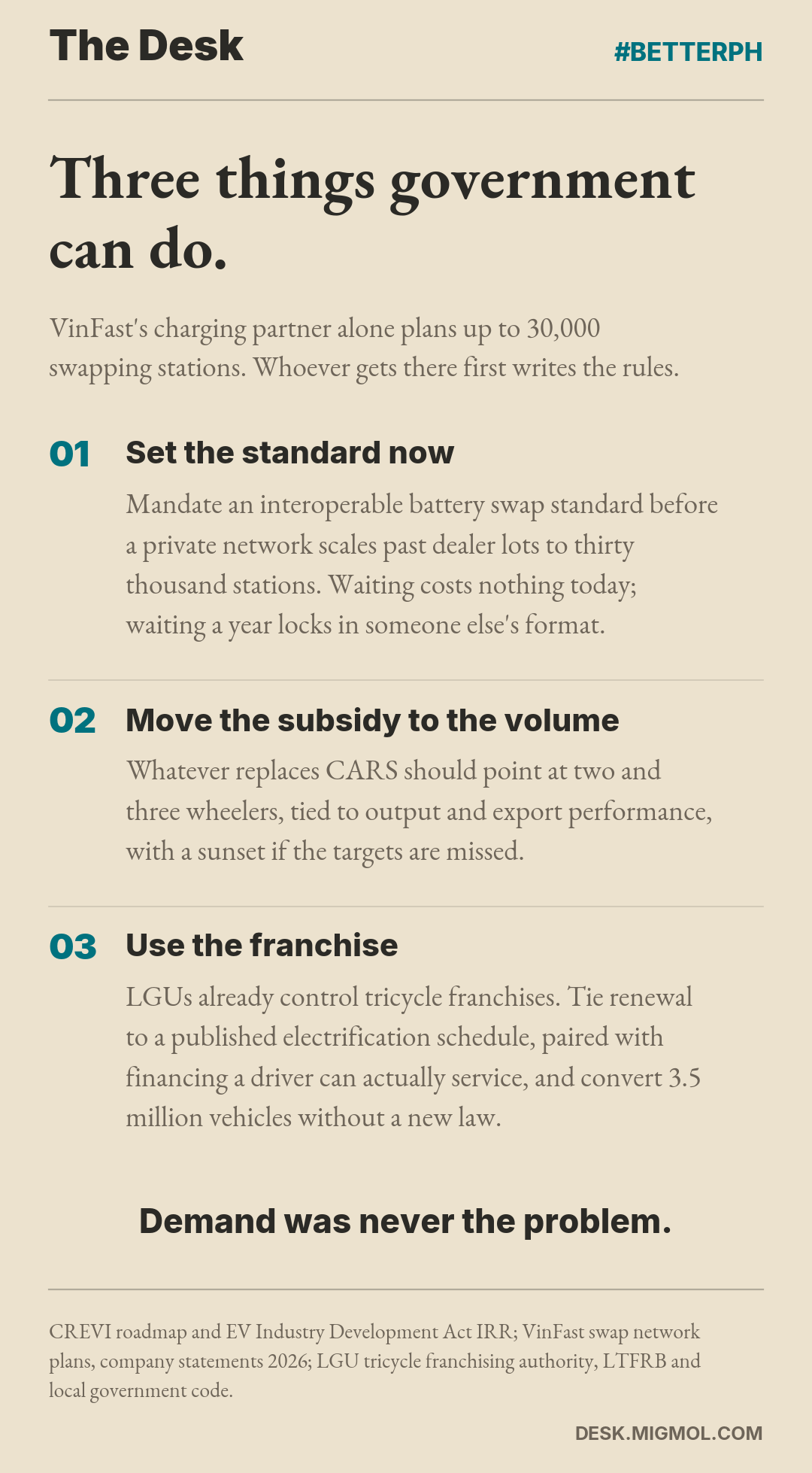
Electric two and three wheelers went from 172 units in 2023 to 43,441 in 2024. Demand was never the problem.
VinFast came here with the right vehicle. The embarrassing part is that we needed a Vietnamese company to point at it.

None of Our Best Players Play Here
Sotto and Ramos play in Japan. Tamayo and Quiambao play in Korea. Four of our best players have all found somewhere better to work, and every reason why is structural.
Read more →
Do Our Basketball Leagues Make Sense?
China beat us by 44 points and ended our Asian Games title defense in the group stage. The reason has almost nothing to do with the twelve men on the floor.
Read more →
Yabang, High; Basketball IQ, Low
The last Philippine team to win the FIBA Asia Cup did it in 1985, coached by an American. We produce players at a rate no country can match. We have never produced coaches.
Read more →
Alex Eala Doesn't Owe Us Anything
But she showed up anyway.
Read more →