Yabang, High; Basketball IQ, Low
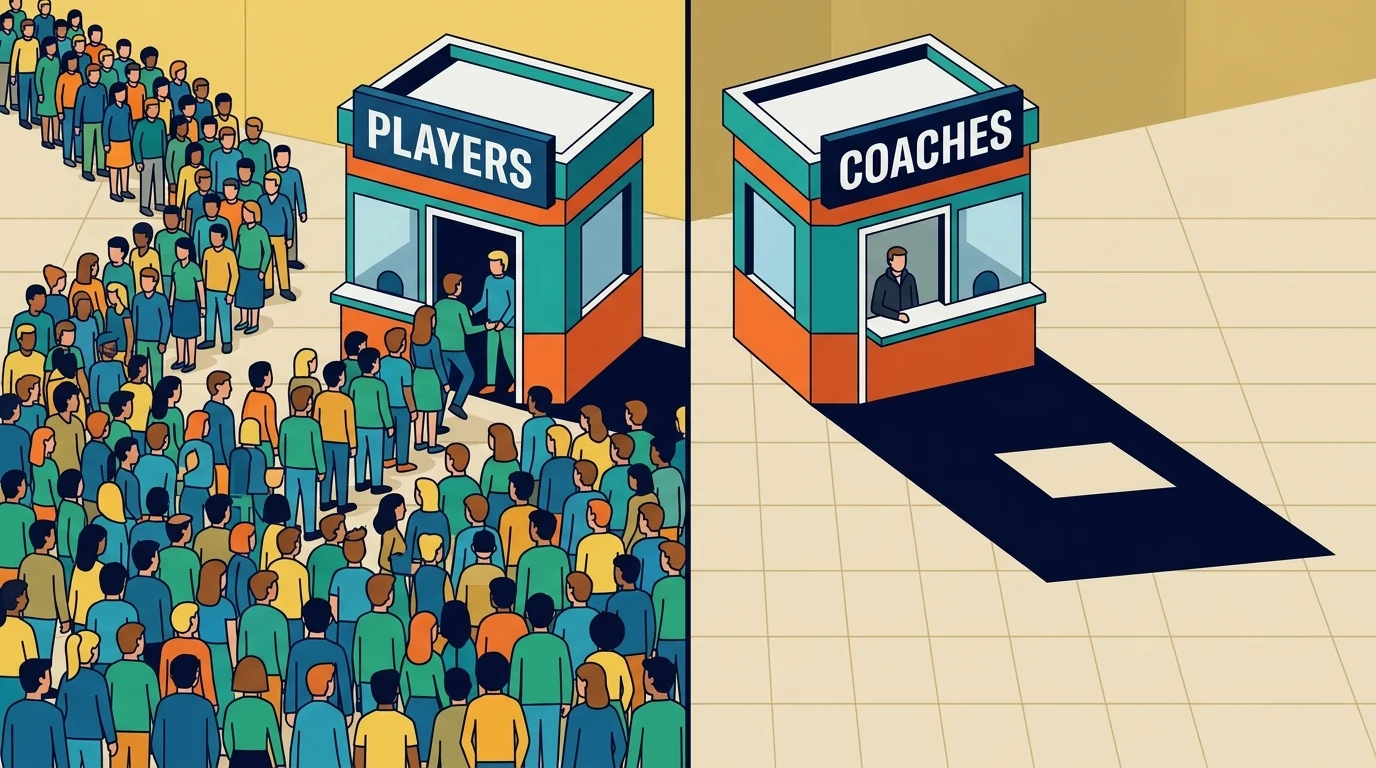
The last Philippine team to win the FIBA Asia Cup won it in 1985, and an American coached them.
His name was Ron Jacobs, and he’s described as the most successful foreigner ever to coach this country. He also won the 1982 Asian Youth title and two Jones Cup titles. Since then we’ve had Norman Black, Tim Cone, Tab Baldwin, Mark Dickel, and Rajko Toroman, the Serbian who built the first Smart Gilas. None of them were born here.
Just to be clear, I have nothing against our foreign coaches. They have served our country and they’re not even Filipinos. Some have even chosen to live here and build families. Jacobs, Toroman, and Cone gave this country real results. Cone has the job right now and he’s the winningest coach in PBA history. Importing expertise is what smart countries do, and I’ll spend most of Part 7 arguing we should do more of it, in both directions.
The question isn’t why we hire foreign coaches. It’s what it means that we keep having to.
We are 115 million people. This is the second religion here. Over 40 million of us play or have played. And at the top of the coaching profession, the country keeps reaching outside itself. A nation that produces players at a rate almost nobody can match has never produced coaches at the same rate.
That’s the deficit this part is about, and it’s the cheapest one on the list to fix.
We don’t know the nitty gritty
We’re mayabang about basketball. We think we know this game because we’ve watched it our whole lives, and watching is not knowing.
Put on a serious technical breakdown of an offensive set, the kind that names the actions and walks through the reads, and ask how much of it a passionate Filipino fan can actually follow. Not the highlights. The mechanics. Who’s setting the screen and why, what the defense is supposed to do about it, what the counter is when they do.
Most of us can’t. I can’t, not properly, and I’ve been watching this sport for thirty years. I watch LeBron and Nash break down the game and I can only absorb 30% of what they’re saying.
Decades of one-star-player basketball taught this country that teams win because of a star player. That’s the whole theory of the game as most of us hold it: get the guy, feed the guy, watch the guy. We like heroes, saviors even. Teams win on roles, routines, execution, and a read on the opponent. We know that in the abstract and we’ve never been taught it in the concrete.
We pride ourselves with “Never Say Die,” which is good and is a trait: grit. Filipinos definitely have that. The tagline for the Gilas Team is “PUSO,” which again is good and is a reflection of our national traits. But hope is not a strategy, it is not a plan. Di pwedeng puro puso lang, dapat may utak din.
Look at Lithuania, since they’re the country people reach for when they want proof a small nation can do this. Under three million people. What they actually have, in their own description of themselves, is a deep base of educated and experienced coaches, sports directors who stay in post, and a high-IQ team identity a child learns at nine and a national team still runs at twenty-nine.
Culture and passion, they have. We have those too, in greater quantity. The rest of it we’ve never built.
It starts in PE class
This is where a Filipino child actually meets this game: a ball, a hoop, some basic dribbling drills, and forty-five minutes.
Nothing is taught. Not spacing, not a single set, not why you’d cut there instead of here. PE basketball in this country is supervised recess with a scoreboard. When we were old enough, sometimes the PE teacher wouldn’t even appear. He’d just tell the class representative to get a bag of basketballs and we just played basketball. Whatever technical instruction a child gets depends entirely on whether the teacher assigned to them happens to know the sport, which is not a system, it’s a coin flip.
Compare that to how a Spanish or Serbian kid meets basketball: inside a structure, with concepts, from grade school.
So the first ask of this series is that we teach real plays and real spacing in the grade-school PE curriculum, as a DepEd standard rather than a school’s or teacher’s discretion.
And this needs one more thing said about it, because it’s the reason nobody has done it yet. PE is filed as a physical subject. It sits at the bottom of the academic hierarchy, well below math and science, treated as the hour where children run around so they’ll sit still later.
A PE class that teaches actual basketball systems is teaching pattern recognition, spatial reasoning, and decision-making under time pressure. It’s a mental subject and a creative one. Nobody has built the curriculum as though that were true, and that’s the gap the whole framework hinges on.
The armchair army
The other thing this country has in surplus is people who can break down a game from the couch.
You know these people. You might be one. (Am I also one of them? Haha!) They can tell you exactly what the coach should have run out of that timeout, why the rotation is wrong, which player is being wasted. Some of that is noise. A lot of it isn’t. There is an enormous amount of real basketball knowledge sitting in this country with nowhere to go, dead-ending in group chats and comment sections.
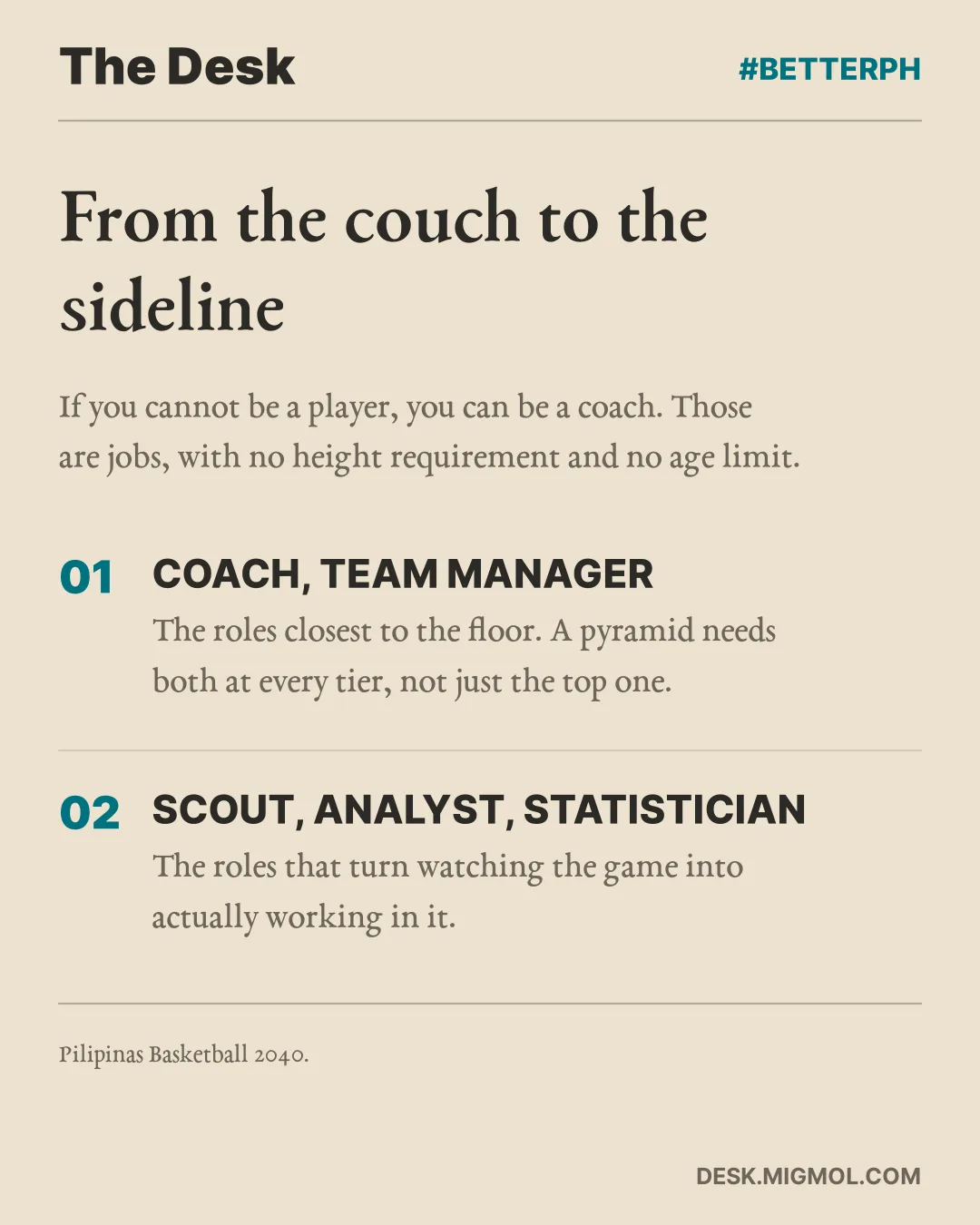
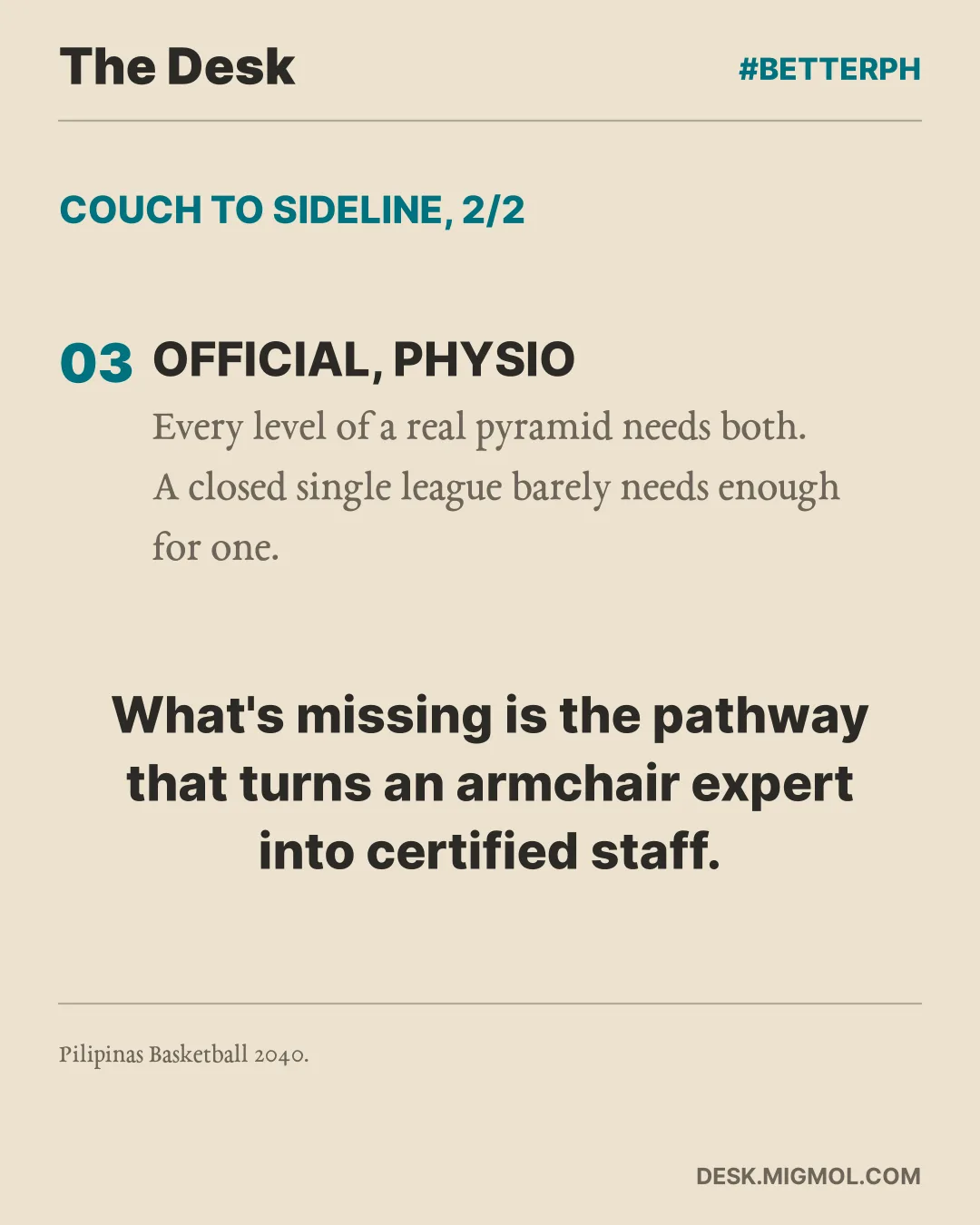
If you can’t be a player, you can be a coach. If not a coach, a team manager, a scout, an analyst, a statistician. Those are jobs. They’re jobs with no height requirement and no age limit, which makes them available to a far larger share of the population than playing ever will be.
What’s missing is the pathway that turns an armchair expert into certified staff.

The machine exists. It’s running at a twentieth of the speed.
I assumed, when I started writing this, that we’d have to propose building a national coaching ladder from nothing. We actually don’t.
The SBP Coaches Academy already exists. It trains and accredits coaches on a stated Academy, Accreditation, and Assessment system. It runs Level 1 and Level 2 accreditation plus refresher courses. It’s open to coaches from schools, clubs, and community teams. It issues a certificate and an ID. DepEd divisions already publish advisories for it, which means the DepEd and SBP channel this framework wants isn’t a new idea at all, just an under-used one.
It accredits at least a thousand coaches a year.
We have 42,010 barangays. At a thousand a year, putting one accredited coach in every barangay takes forty-two years. Set it against DepEd’s school count and it’s longer.
The academy isn’t failing. It’s working, at roughly a twentieth of the scale this country needs, and nobody has ever published the number it’s supposed to reach.
That changes the ask, and it improves it. We’re not asking anyone to admit they were doing nothing. We’re asking them to fund the thing they already built, at the size the problem actually is.
Three things to start with
Teach real basketball in grade-school PE. Plays, spacing, and reads, as a DepEd standard rather than a teacher’s discretion. Fund it as education, because that’s what it is.
Scale the SBP Coaches Academy and publish its target. A thousand a year against 42,010 barangays is a forty-two year plan nobody has admitted is the plan. Name the number of accredited coaches this country should have by the 2039 World Cup and fund backwards from it.
Build the ladder above Level 2. A coaching pathway that ends at a weekend accreditation isn’t a career. It needs rungs that lead to a paid job in a real league, which is the subject of the next part.
Next: China beat us by 44 points at the Asian Games, and the reason has almost nothing to do with the twelve men on the floor.
Part 2 of Pilipinas Basketball 2039. Read Part 1: 1st Sport, 2nd Religion, 3rd World, and 40th Ranked. Next: Do Our Basketball Leagues Make Sense?.
None of Our Best Players Play Here
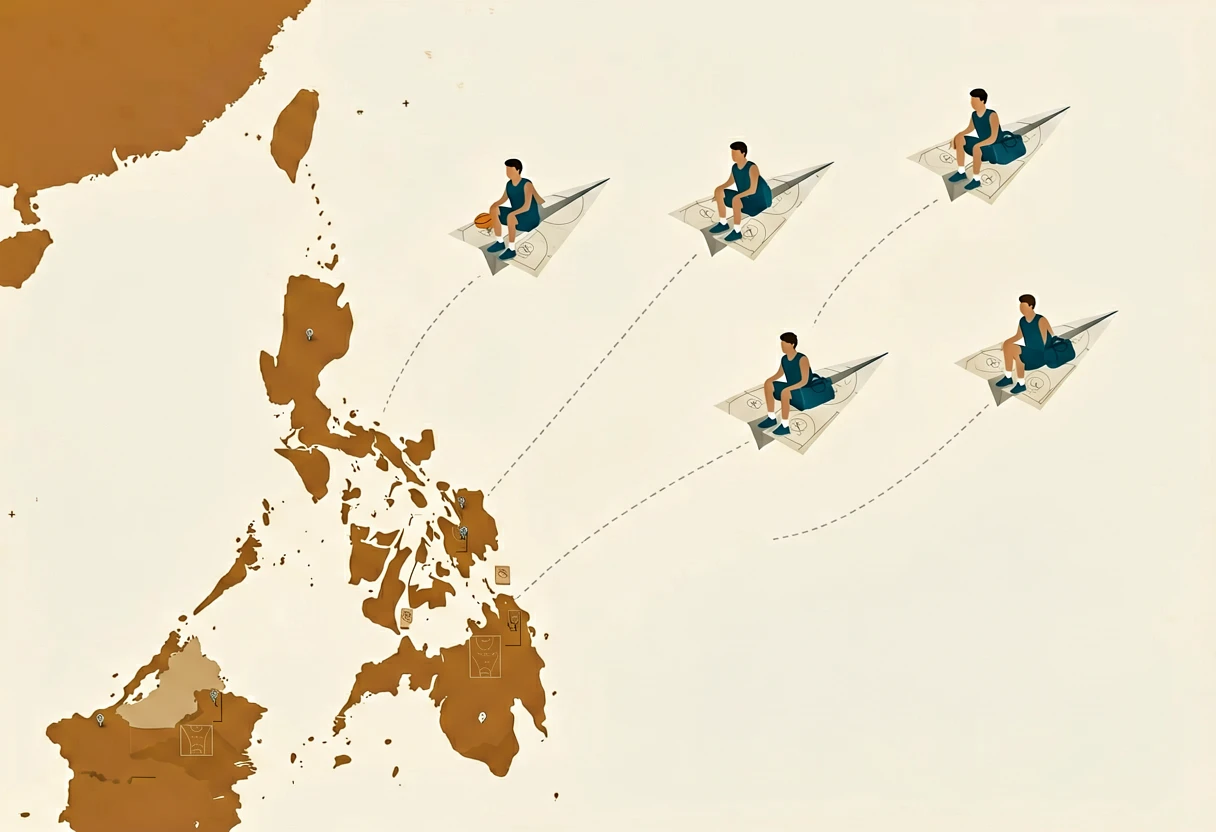
Sotto and Ramos play in Japan. Tamayo and Quiambao play in Korea. Four of our best players have all found somewhere better to work, and every reason why is structural.
Read more →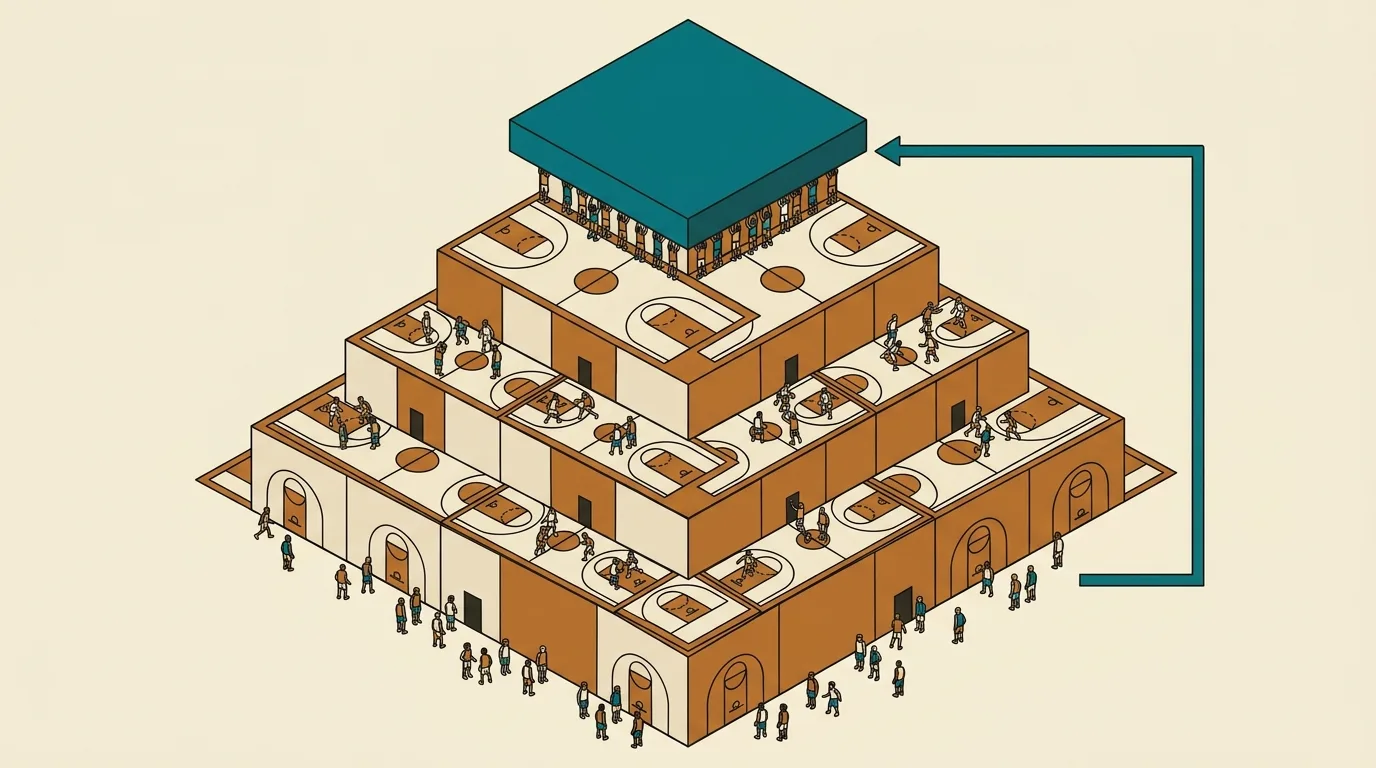
Do Our Basketball Leagues Make Sense?
China beat us by 44 points and ended our Asian Games title defense in the group stage. The reason has almost nothing to do with the twelve men on the floor.
Read more →
Who Pays for the Senior Discount Charged to Restaurants? It's Not the Government.
The store funds it, the Supreme Court has said so twice, and the bill never lands in a budget anyone has to defend.
Read more →
Alex Eala Doesn't Owe Us Anything
But she showed up anyway.
Read more →