Do Our Basketball Leagues Make Sense?
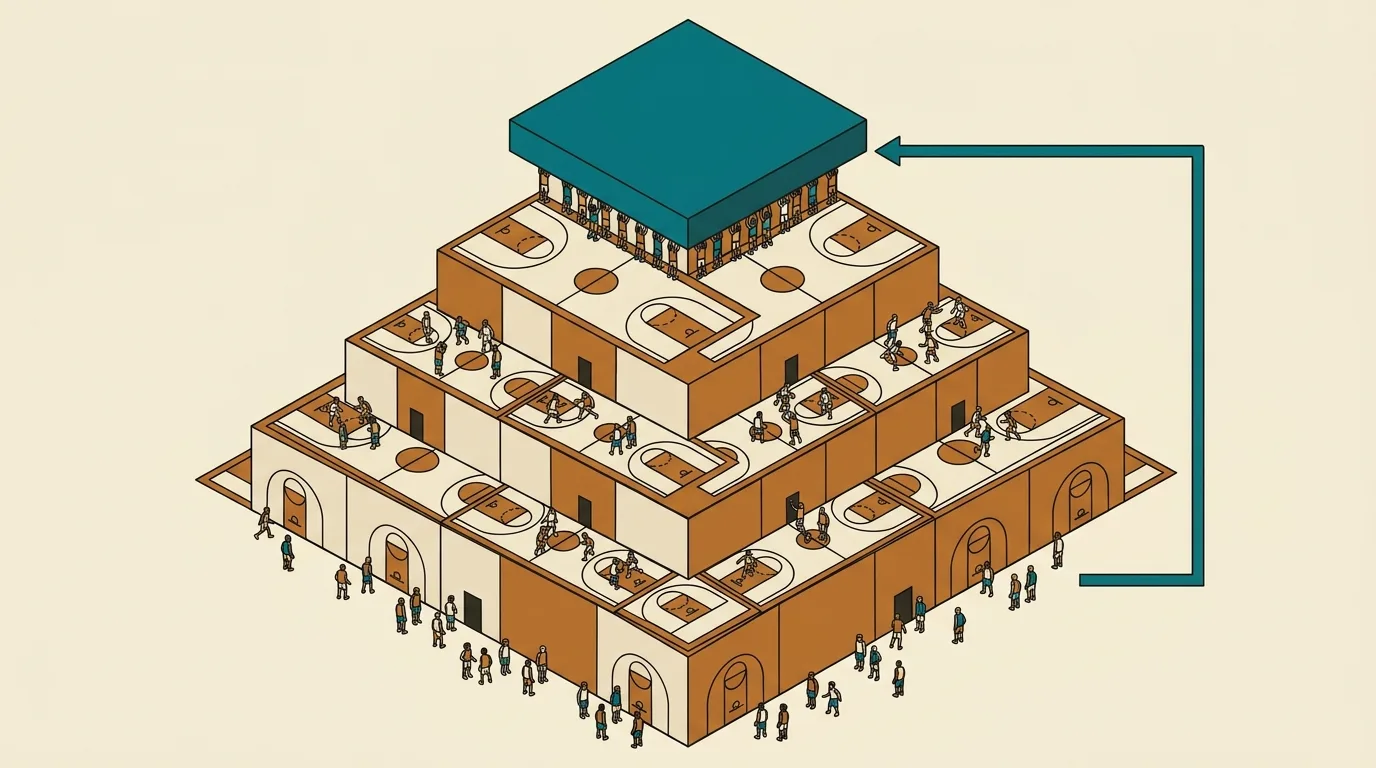
China 105, Philippines 61.
We needed to lose by fewer than 37 to reach the quarterfinals. We lost by 44 on September 14, finished 1-2, third in Group C, and went out in the group stage. It’s the worst Asian Games finish in Philippine basketball history, worse than the seventh place in 2014. Three years ago we won that tournament, our first gold in it in 61 years, and we beat China in the semifinal to do it.
There’s already a round of blame going around, and most of it is aimed at the twelve men who lost and the people who picked them. That’s the conversation we always have. We had it in 2014, we’ll have it again in 2029, and it will change nothing, because the squad is the symptom.
At the end of the day, we sent a depleted team. And everyone knows it. The defending champions could not field their best side for the best in Asia. June Mar Fajardo retired from the national team two weeks earlier. The roster that turned up was assembled from who was available, which is how this country has assembled every national team for as long as I’ve followed it.
A country with 40 million players should not have an availability problem.
That’s a structural failure, and structure is what this part is about.
Two actors bought a fifth-division club
In February 2021, Ryan Reynolds and Rob McElhenney bought Wrexham, a Welsh football club in the National League, the fifth tier of English football, for about 2.5 million dollars. Reynolds said at the time that the goal was the Premier League, which was a joke with a documentary attached.
Wrexham won the National League in 2022-23. They finished second in League Two the year after. Then second in League One, which put them in the Championship, England’s second division. Three consecutive promotions, the first club ever to do that in the top five English leagues.
The obvious objection is Hollywood money. But money doesn’t buy promotion in a league where you have to finish top of the table to go up. What the money bought was a climb the structure permitted.
Put the same 2.5 million dollars into a Philippine basketball team below the PBA today and it converts into nothing at all, because there’s nowhere for it to go.
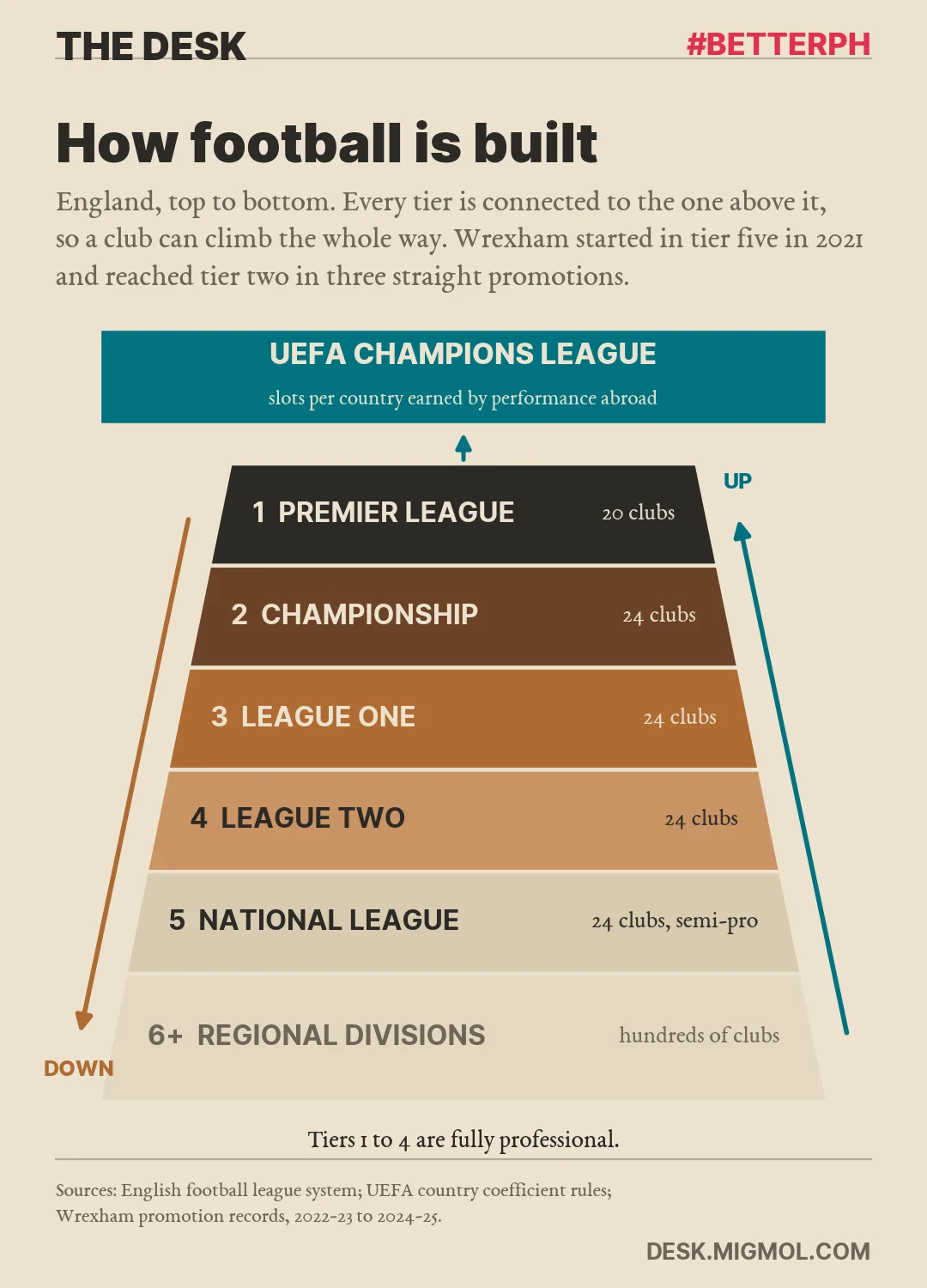
That’s the shape. Tiers one to four are fully professional. Below them sit the semi-professional National League and then dozens of regional divisions running down into genuinely local football, hundreds of clubs, all connected.
The connection is the whole thing. Best teams go up, worst go down, every season, at every level. Three consequences are worth stealing.
Every game matters everywhere. A club sitting fourteenth still has something to play for, because the drop is real. In a closed league a bad team’s season is over in January and its incentives invert.
Money follows competence rather than ownership. You can’t buy into the top tier. You play your way in.
And the lower tiers are real businesses rather than farm affiliates. A third-division club is somebody’s actual club, with its own town and its own supporters, not a development squad owned by a bigger one. That last point is what makes hundreds of professional jobs economically possible, and it’s the thing we don’t have.
Japan was behind us
In November 2014, FIBA suspended Japan from international competition because its domestic leagues were divided and disorganized and its federation had missed the deadlines to fix it.
The suspension forced a merger. The B.League launched in 2016 as a three-tier professional pyramid, B1, B2, and B3, with promotion and relegation between them, explicitly modeled on European football rather than on the NBA’s closed franchise system.
Japan was behind us. Japan is not behind us now, and Japanese clubs sign our players.
Disclaimer: I know that starting this season, the B.League transitions to a new structure and there will no longer be any relegation. But the point is, they fixed their structure before they could be great.
Japan built the pyramid, took the benefit, and is now closing the top of it. The answer is that promotion and relegation is the tool that builds a league system out of a fragmented one. Japan needed a decade of it before a stable top division was viable. We are where Japan was in 2014, not where Japan is in 2026. Use the tool for the job it does.
Japan placed second in the Asian Games, doing to China what China did to us. (Of course, as we all know, Korea won gold. But let’s talk about KBL and B.League in the next article).
The country that beat us can’t build a football team
China spent more money on football than any nation in history and it did not work.
In 2015 the state published a fifty-point plan: 20,000 football schools, 70,000 pitches, a World Cup hosted and won by 2050. The Super League bought at the top of the world market, including about 45 million pounds for a single Brazilian midfielder. Then sixteen clubs folded in 2020, and in 2021 the reigning champions, Jiangsu, ceased operations entirely months after winning the league, because the parent conglomerate walked away.
Why it failed is the part that should stop us cold. China’s professional league was built in 1994 as a government and big-business project with no links to local communities or junior development. And with roughly 100,000 children playing regularly in a country of 1.4 billion, the arithmetic could never produce a national team no matter what was spent.
A club with a community doesn’t evaporate. A line item does.
So the country that dismantled us by 44 points is, in its own national sport, a cautionary tale about exactly the structure we currently have.
What works for us is that China had to manufacture participation and couldn’t. We already have over 40 million players and a court in nearly every one of 42,010 barangays. We’re being asked to build the part China could never buy, and we already own the part China could never manufacture.
What ours could look like
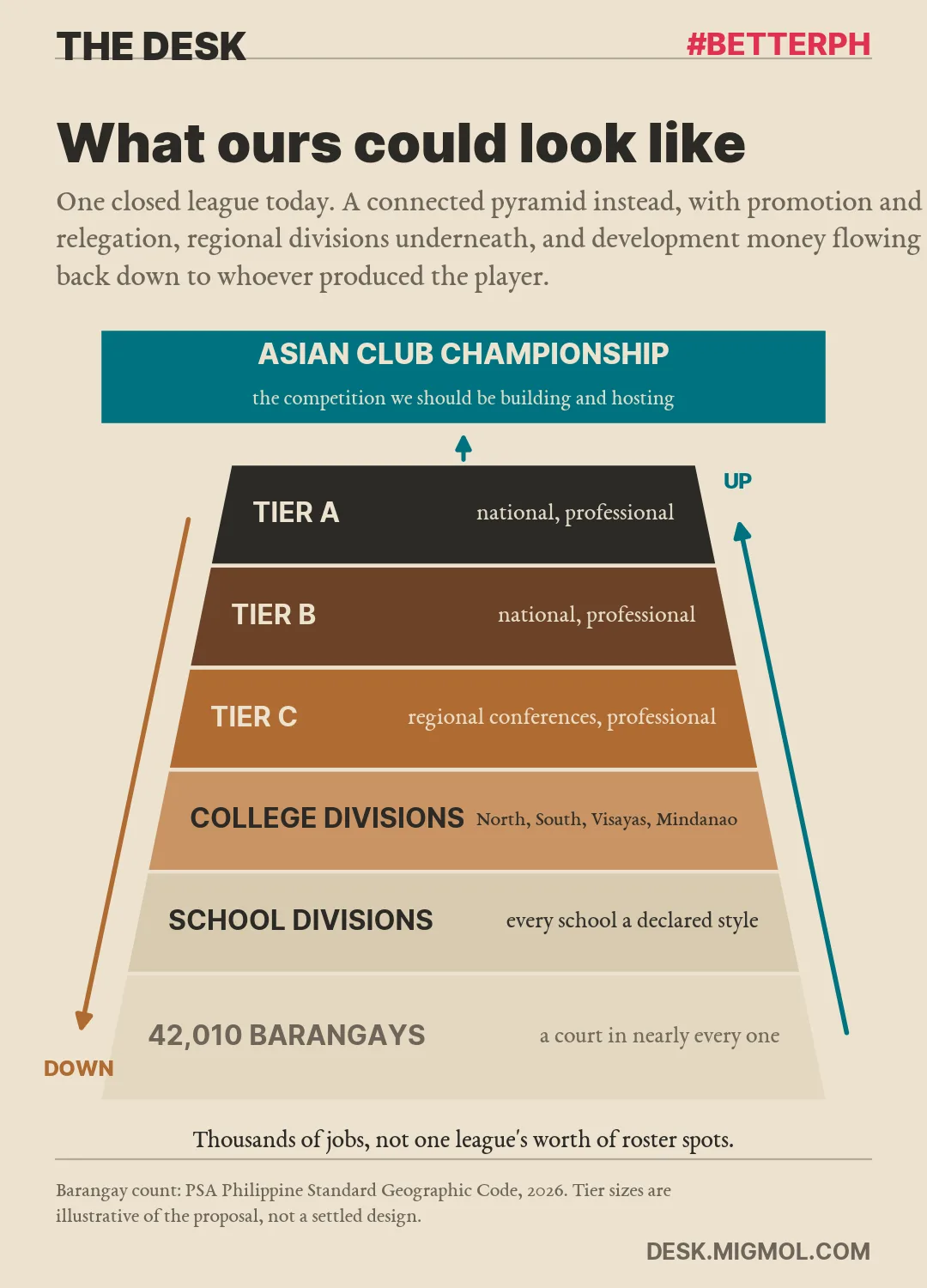
Three professional tiers with promotion and relegation between them. Regional divisions at college and school level: North Luzon, South Luzon, Visayas, Mindanao. Foreign clubs invited in as guest teams.
The most important word in this proposal is absorbed. The PBA, the D-League, and the MPBL all fold into the structure. Nobody is abolished, nobody loses a franchise, nobody is bypassed. The existing leagues keep everything they have and gain a ladder underneath them. The PBA becomes the top of something instead of the whole of something.
Disclaimer: the D-League has actually stopped since 2024, but the same goes for whichever leagues are running when this happens.
A pyramid also opens up ownership from below, which is the only direction it can be opened from. If somebody can buy into Tier C for a fraction of what a top-flight franchise costs, build something real, and earn his way up, then money and ambition have somewhere to go that doesn’t require an invitation from the people already inside. Reynolds and McElhenney didn’t outbid anyone and didn’t ask permission. They bought the fifth division and climbed.
Some of you might argue that we already don’t have depth, because the D-League died and it’s not like we can get good players from the MPBL. Then we take a page out of the other basketball leagues in Asia: an Asian import and a regular import, maybe even two, so a team can have three imports at a time. We can also invite more foreign and visiting teams to play here.
And of course, we should try to align our schedules with the other Asian leagues, so we can have an Asia-wide champions league.
And a league with a ladder is a better league to play in. Part 4 is entirely about the players leaving to play in the KBL and the B.League.
The jobs
This is the argument that reaches people who don’t care about the national team at all.
A closed single league is a fixed number of jobs. Roughly a dozen teams, roughly a dozen roster spots each, and that’s the entire professional playing market in a country of 115 million people who all play this game. Everything else is a hobby.
A pyramid multiplies players. It also multiplies head coaches, assistants, strength and conditioning staff, physios, analysts, statisticians, officials, broadcast crews, and club operations, in every region rather than only in Metro Manila.
The coaching number is the one to sit on. You cannot staff hundreds of clubs without producing thousands of educated coaches, which means the basketball IQ problem from Part 2 gets solved as a side effect of employment rather than as a separate program.
Three things to start with
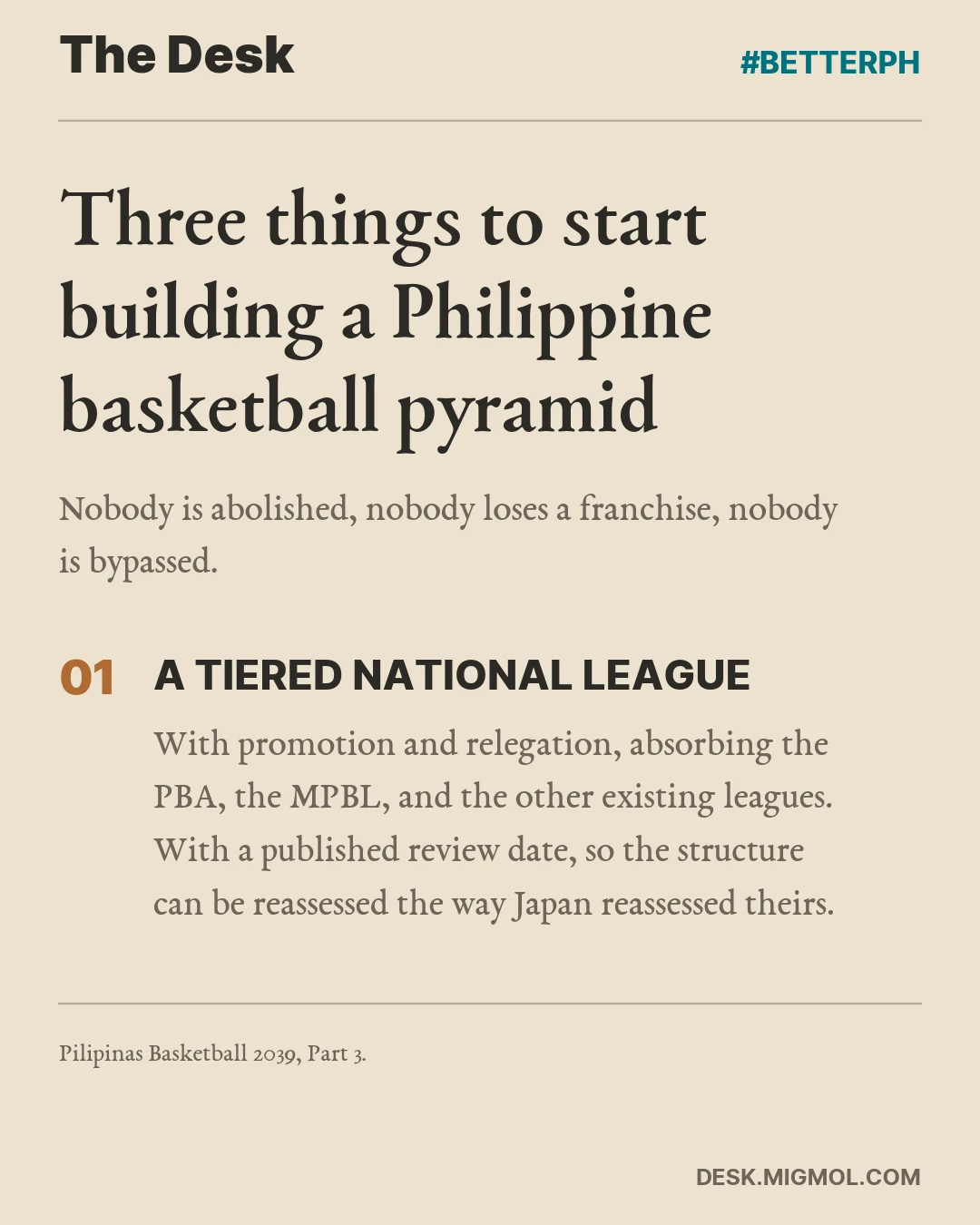
A tiered national league with promotion and relegation, absorbing the PBA, D-League, MPBL, and perhaps one more league. With a published review date, so the structure can be reassessed the way Japan reassessed theirs.
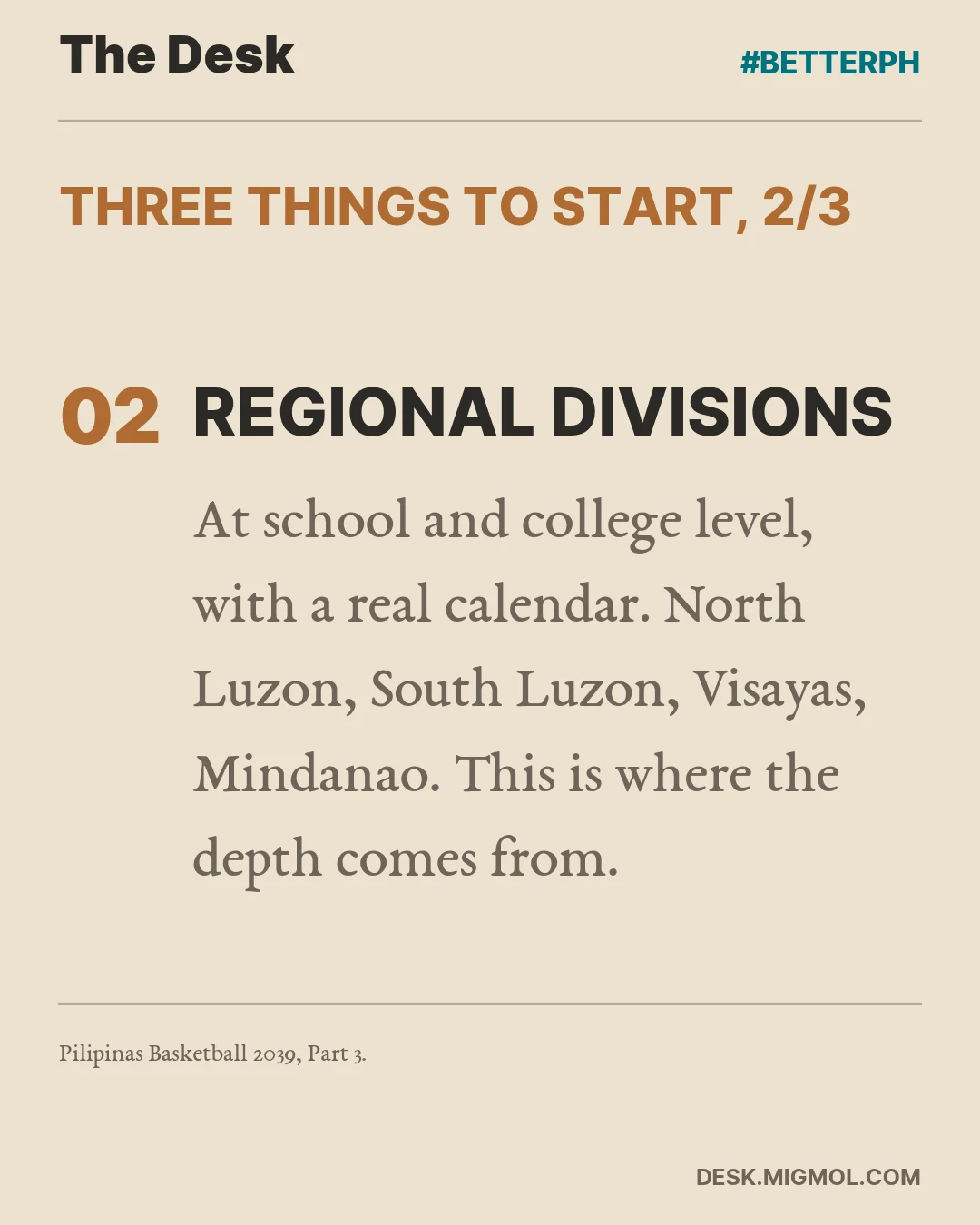
Regional divisions at school and college level, with a real calendar. North, South, Visayas, Mindanao. This is where the depth comes from.
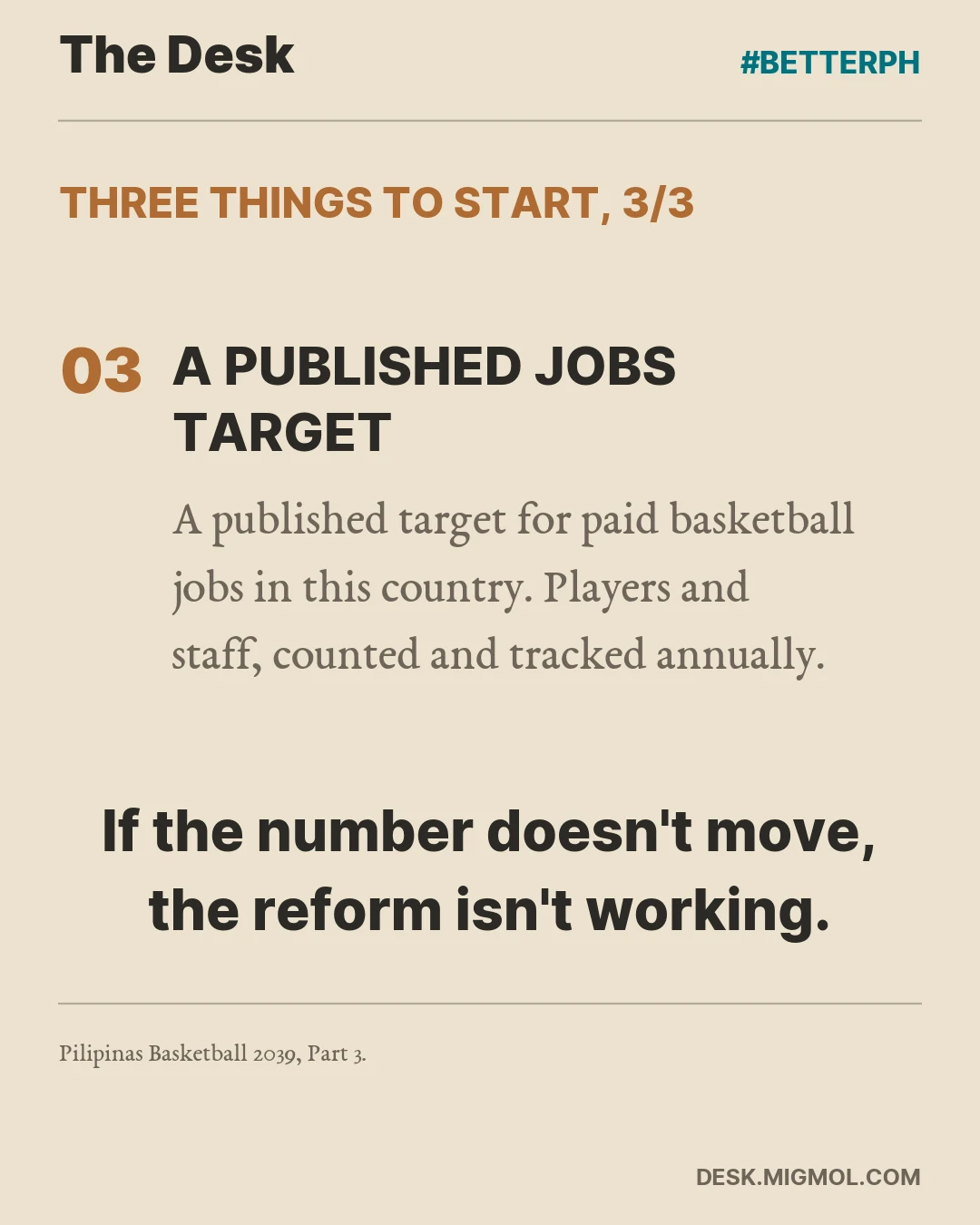
A published target for paid basketball jobs in this country. Players and staff, counted and tracked annually. If the number doesn’t move, the reform isn’t working.
Next: the players leaving to play in the KBL and the B.League, and the reasons all live at the top of the pyramid.
Part 3 of Pilipinas Basketball 2039. Part 1 · Part 2. Next: None of Our Best Players Play Here
None of Our Best Players Play Here
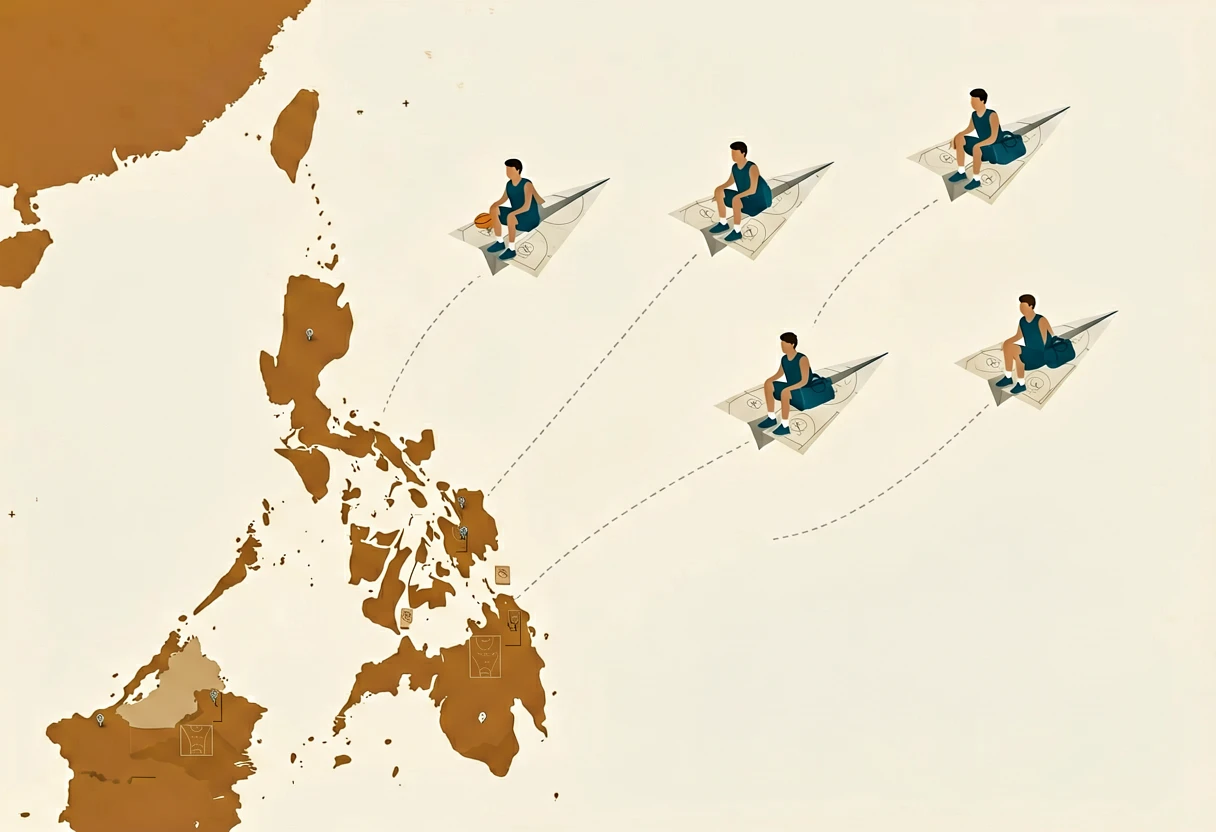
Sotto and Ramos play in Japan. Tamayo and Quiambao play in Korea. Four of our best players have all found somewhere better to work, and every reason why is structural.
Read more →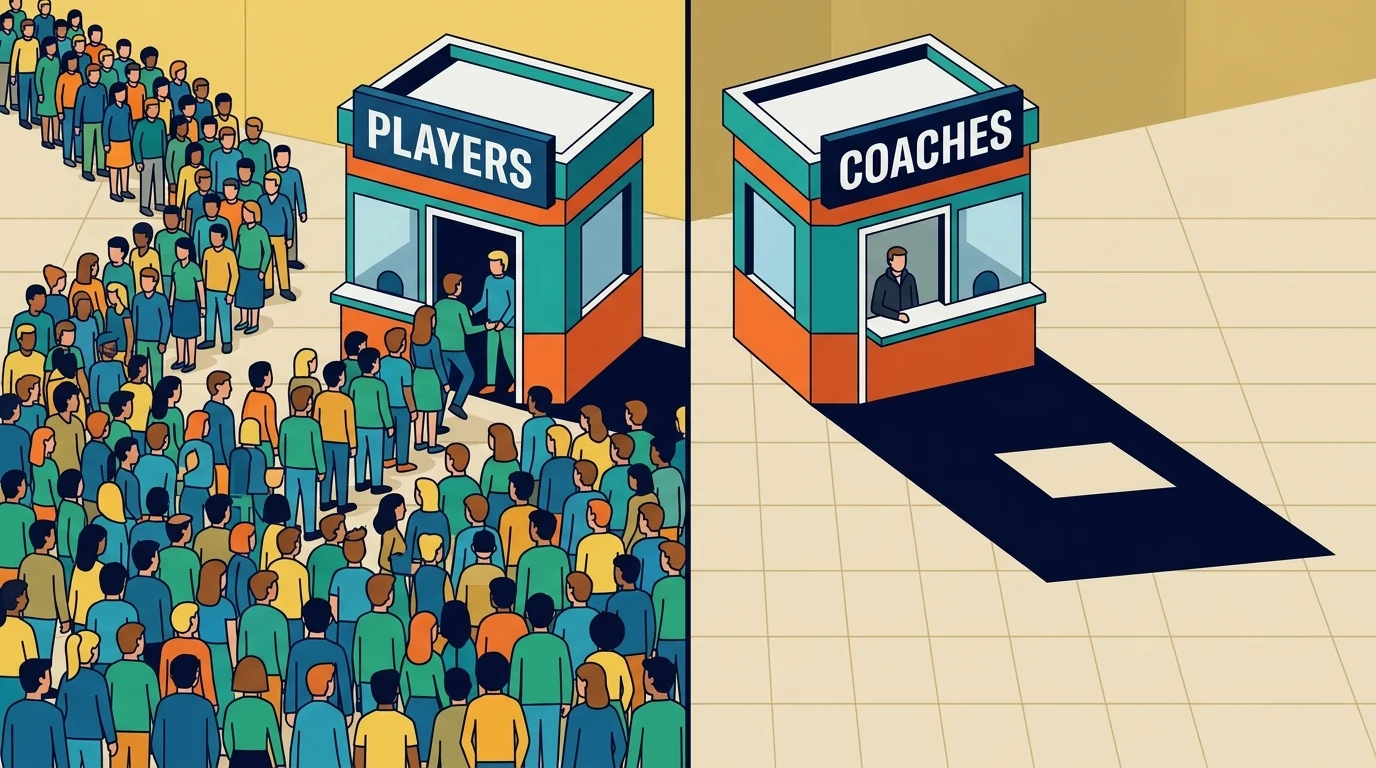
Yabang, High; Basketball IQ, Low
The last Philippine team to win the FIBA Asia Cup did it in 1985, coached by an American. We produce players at a rate no country can match. We have never produced coaches.
Read more →
Who Pays for the Senior Discount Charged to Restaurants? It's Not the Government.
The store funds it, the Supreme Court has said so twice, and the bill never lands in a budget anyone has to defend.
Read more →
Alex Eala Doesn't Owe Us Anything
But she showed up anyway.
Read more →