None of Our Best Players Play Here
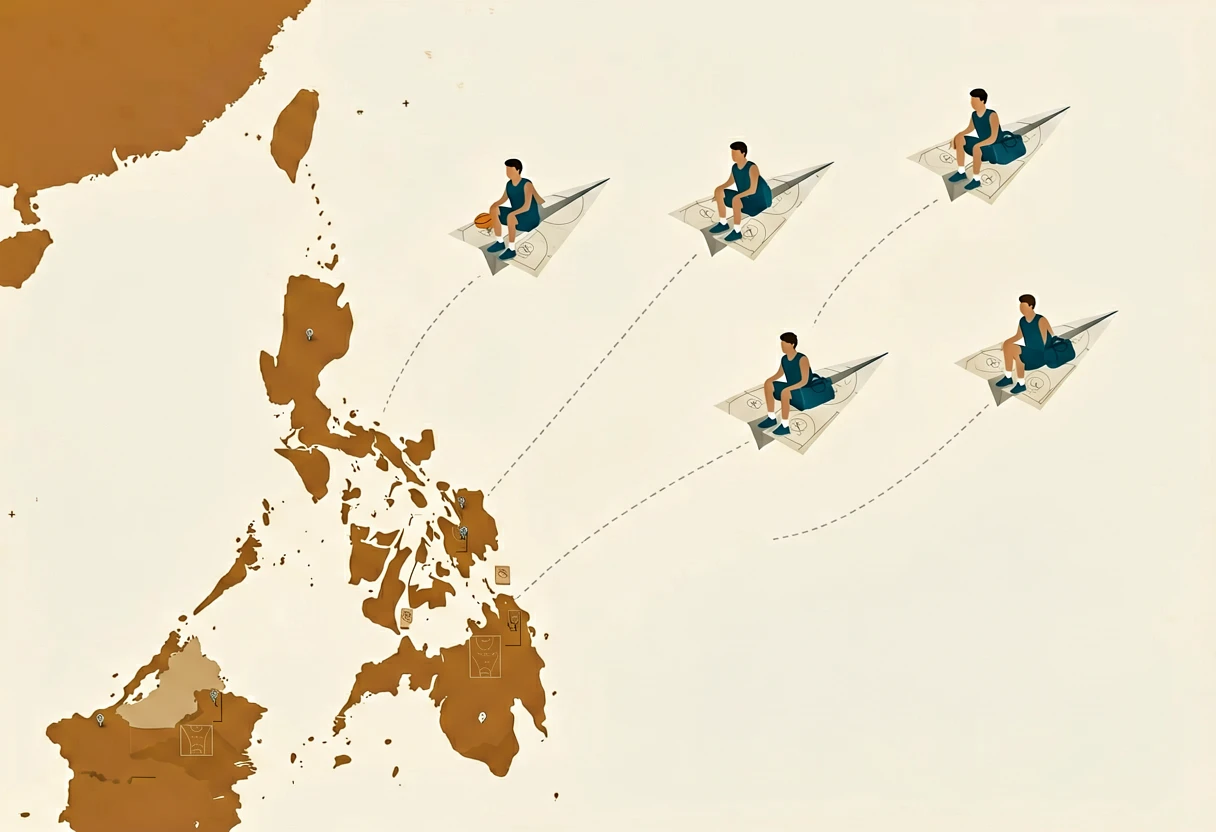
Name the four Filipino players you’d put on a poster right now.
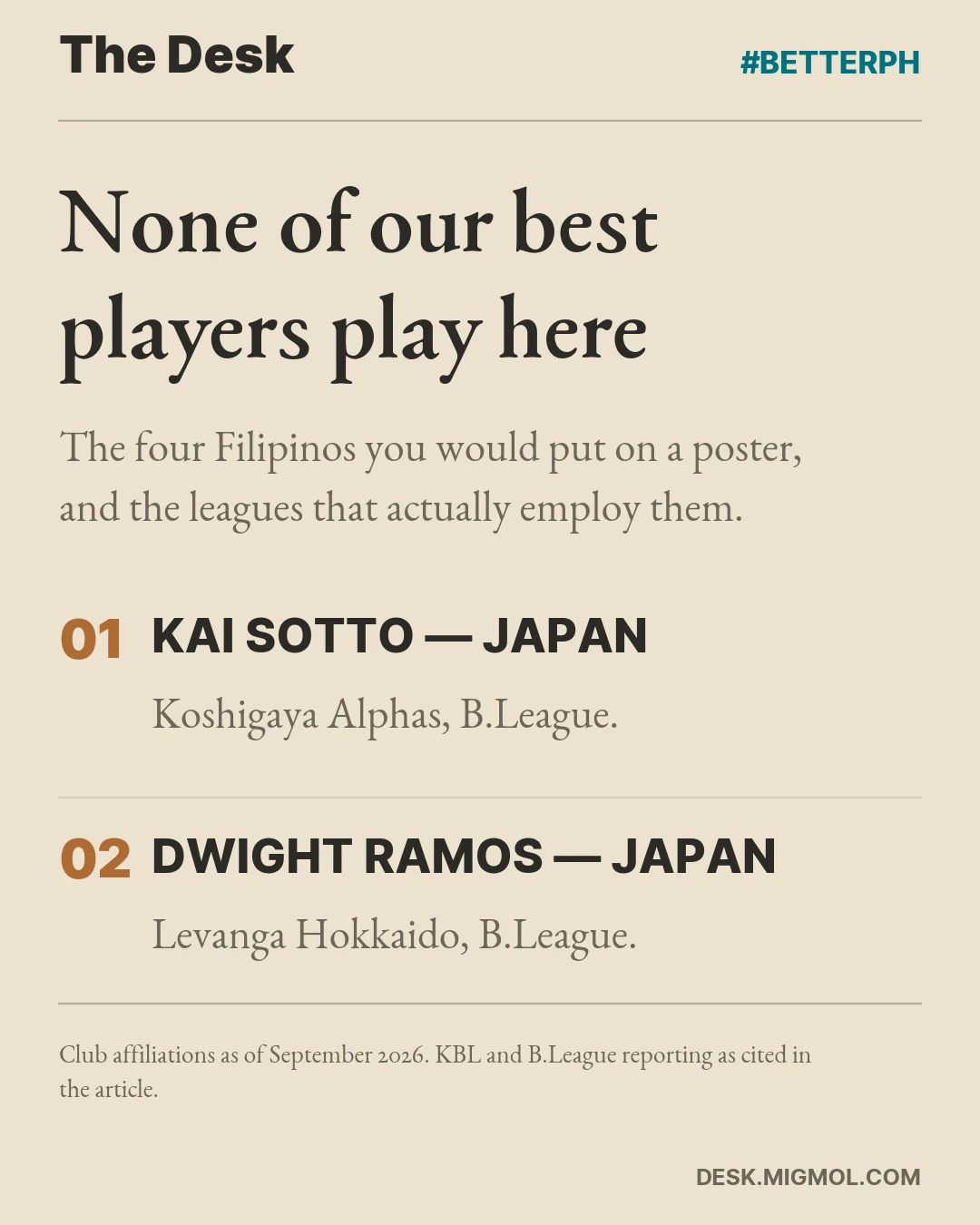
Kai Sotto plays for the Koshigaya Alphas in Japan. Dwight Ramos plays for Levanga Hokkaido, also in Japan. Carl Tamayo plays for the Changwon LG Sakers in Korea, where he made the Mythical Five for the eventual champions. Kevin Quiambao plays for the Goyang Sono Skygunners in Korea, where he was named Rookie of the Year.
Not one of them plays in the Philippines.
Part 3 argued that our problem is a league system with no ladder underneath it. This part is about the league sitting at the top, because the PBA has been treated as untouchable in this conversation for most of my life.
We have become the supply
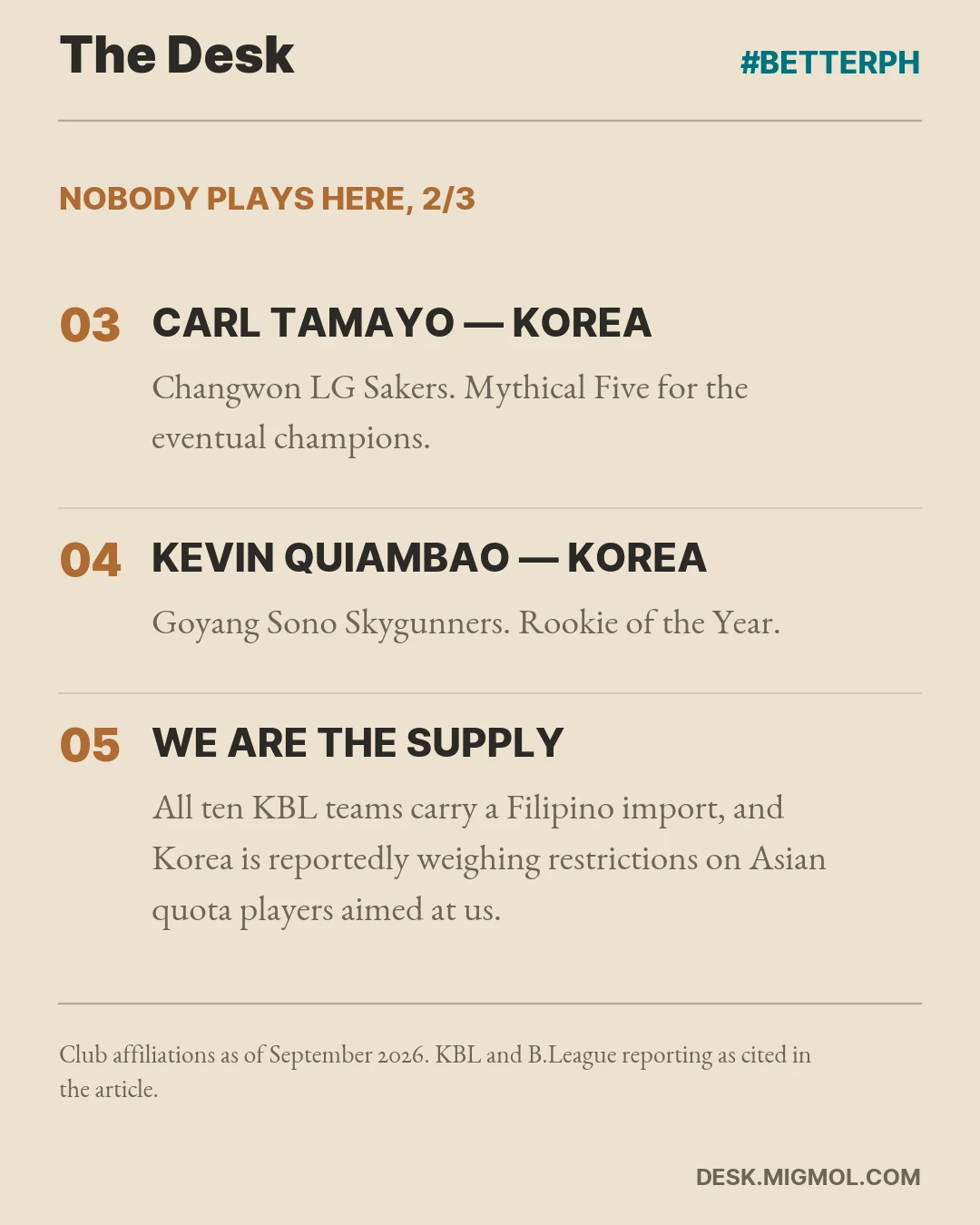
Every one of the KBL’s ten teams now carries a Filipino import. We are not an occasional signing in Korea. We are the labor pool.
It has gone far enough that the Korean league is reportedly weighing restrictions on Asian quota players, aimed squarely at us. A foreign league is working out how to hire slightly fewer Filipinos, because we have become too much of a good thing. That is a compliment and an indictment in the same sentence.
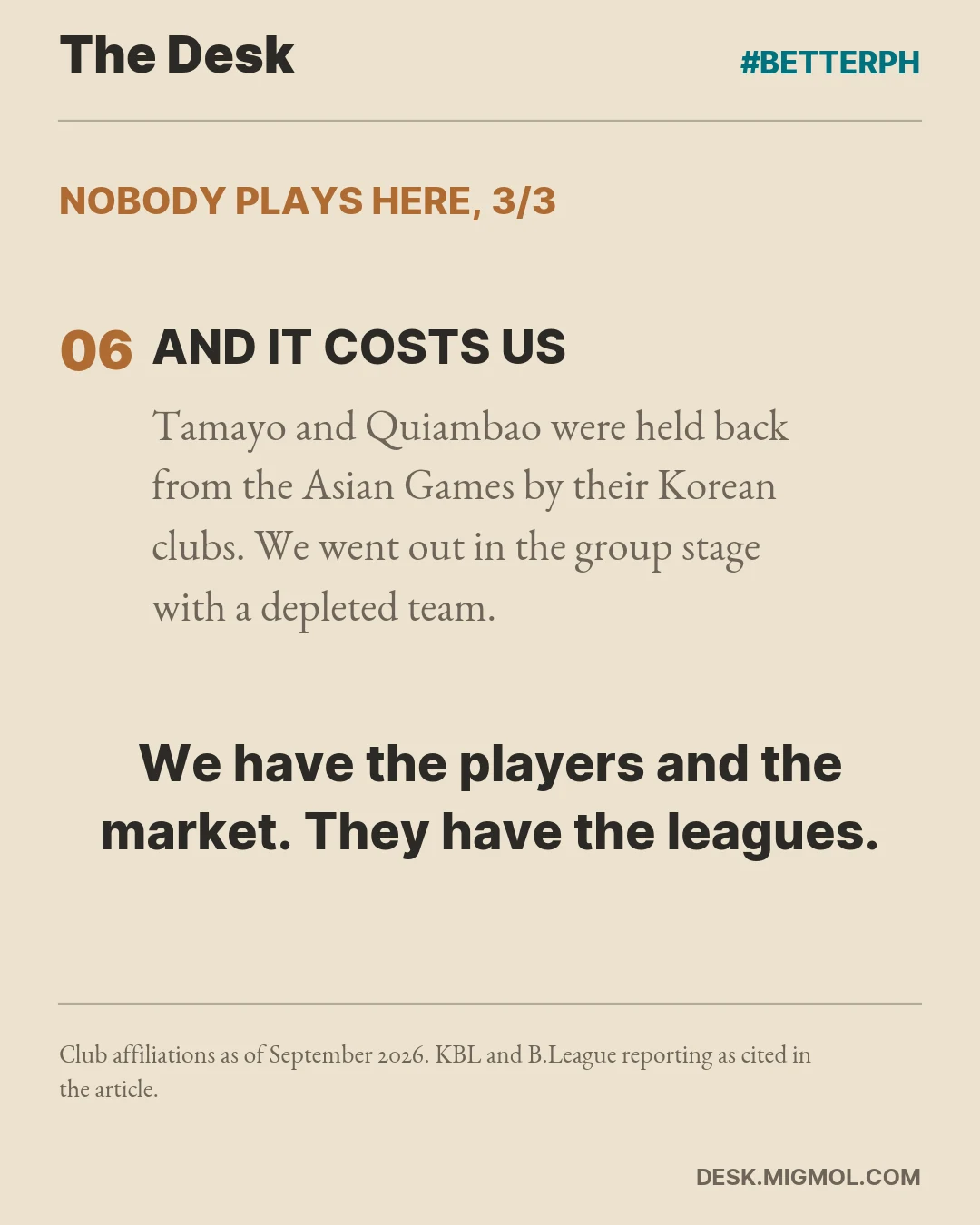
It costs us directly, too. Tamayo and Quiambao were both unavailable for the Asian Games squad, held back by their Korean clubs. Go back to the 44-point loss to China that opened Part 3. We went out in the group stage with a depleted team, and part of what depleted it is that our best players are employed by leagues with the contractual power to say no.
We have 115 million people and a basketball culture neither Japan nor Korea can match. They have better leagues anyway. That is not a talent problem.
Two companies own half of it
This usually gets said in group chats rather than in print, although Philippine sportswriters have been circling it for years and at least one paper has put the word duopoly in a headline.
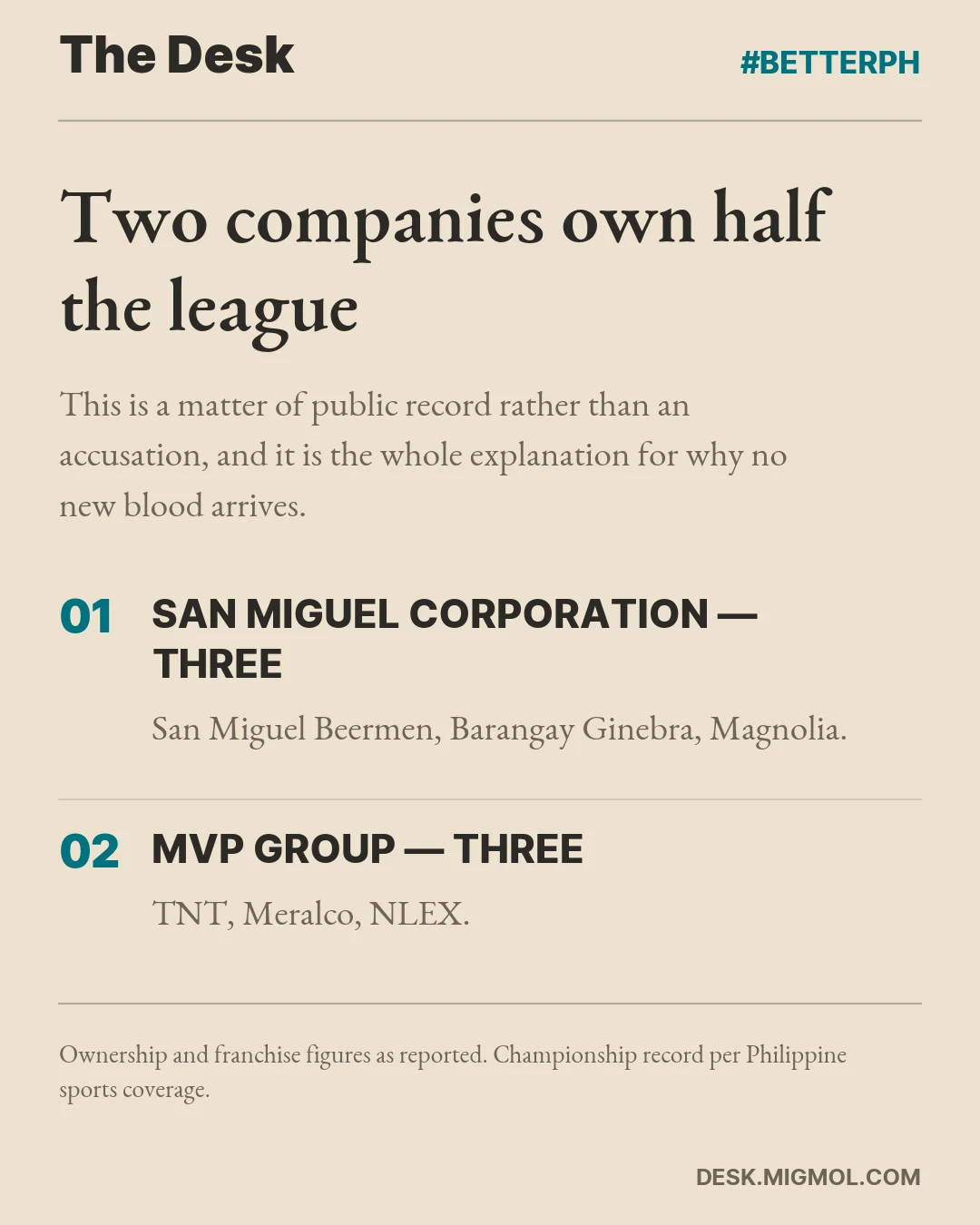
The PBA has twelve teams. San Miguel Corporation owns three of them: San Miguel Beermen, Barangay Ginebra, and Magnolia. The MVP Group owns three: TNT, Meralco, and NLEX. Two companies, six franchises, half the league.
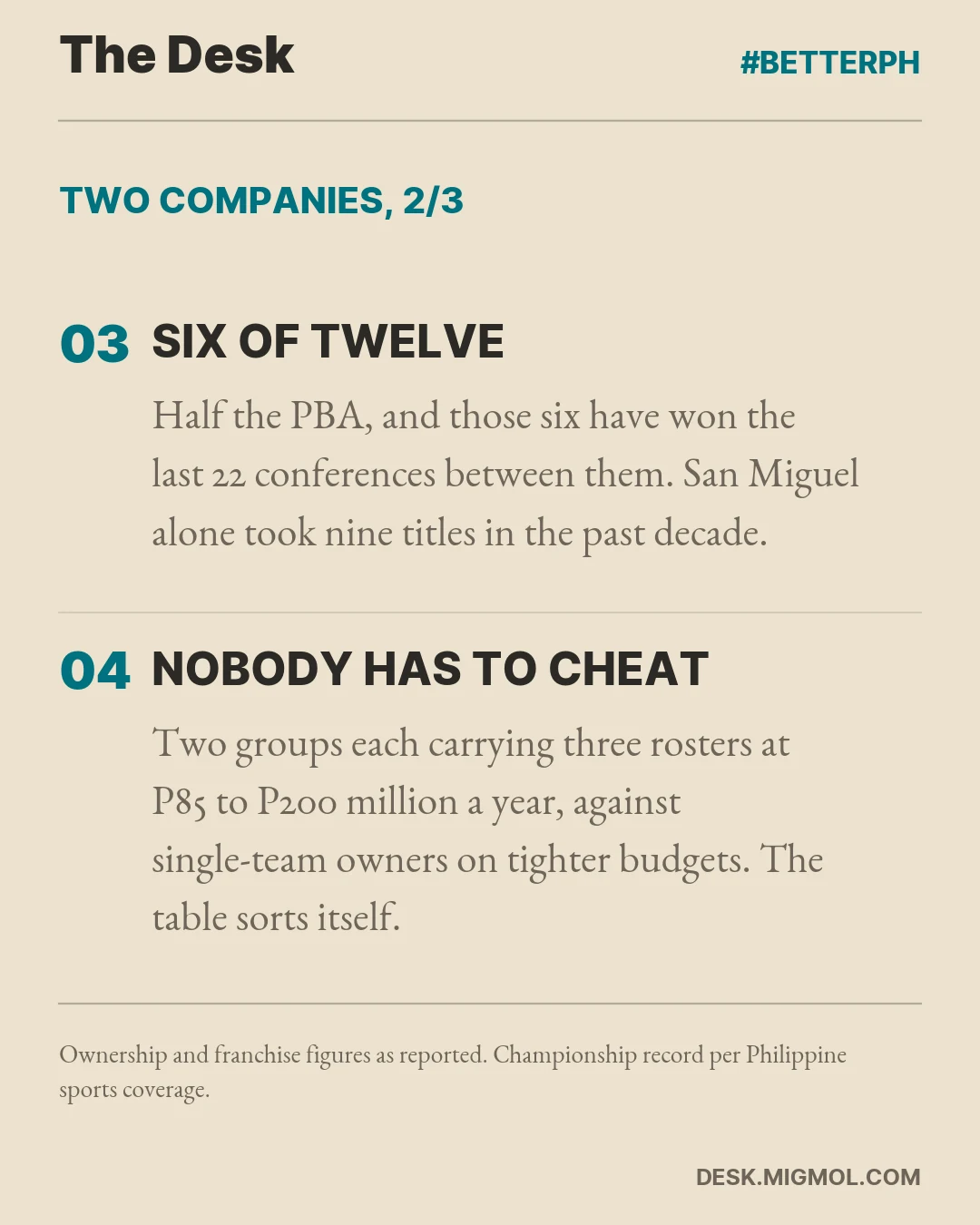
Those six teams have won the last 22 conferences between them. Not most of them. All of them. San Miguel Beermen alone took nine titles in the past decade, and Meralco’s Philippine Cup in 2024 was the first championship in that franchise’s history.
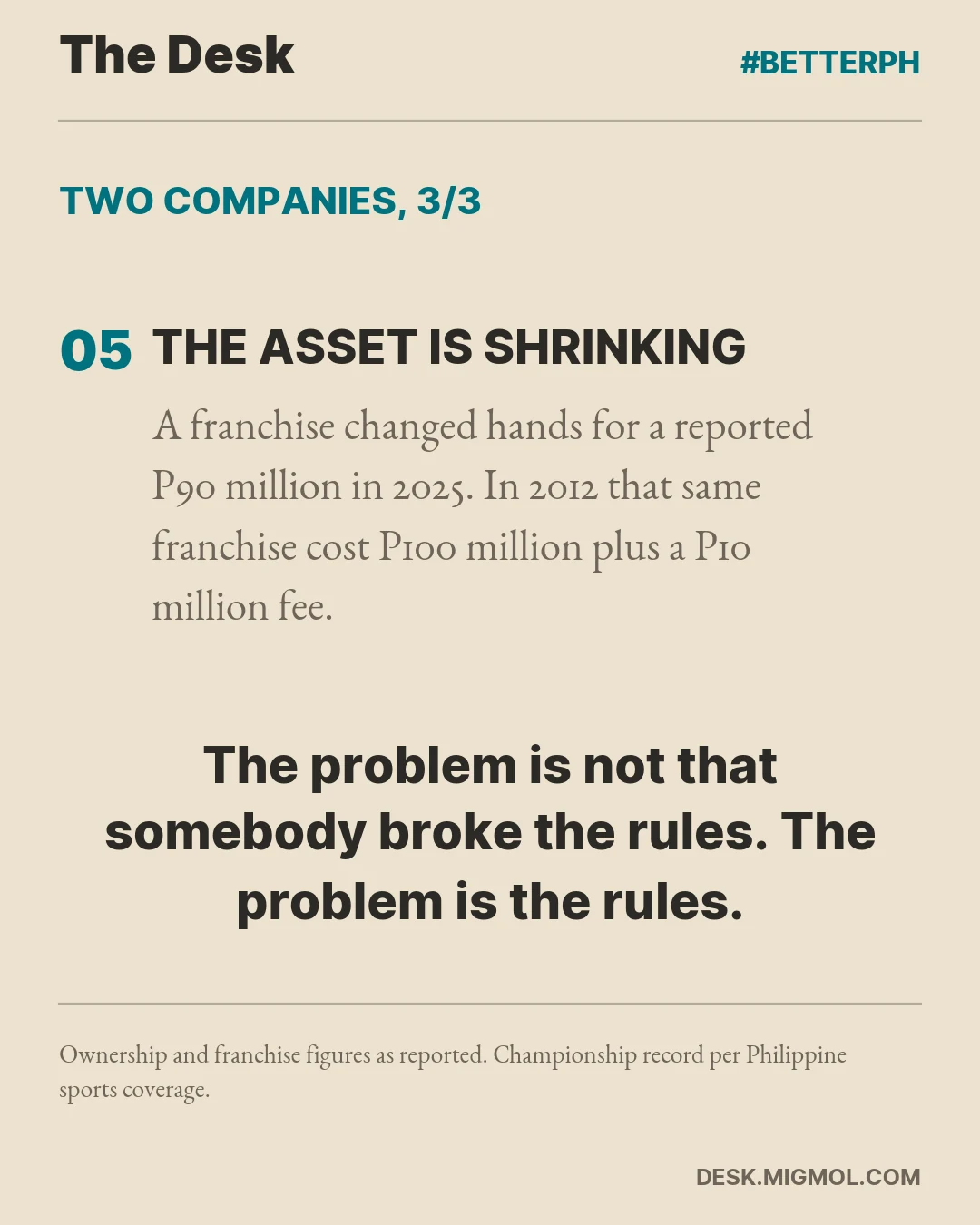
I don’t believe in a conspiracy here. These are well-run organizations. They scout properly, they pay properly, and they’ve kept teams alive for decades in a market that has killed plenty of others. Nobody has to cheat for this outcome. If two companies can each carry three rosters at P85 million to P200 million a year and everybody else is running one on a tighter budget, the table sorts itself. The problem isn’t that someone broke the rules. The problem is the rules.
Look at what it does to the price of getting in. When Pureblends took over the NorthPort franchise ahead of the 2025-26 season it reportedly paid about P90 million. In 2012, NorthPort itself paid P100 million plus a P10 million application fee. A PBA franchise costs less today than it did fourteen years ago, in nominal pesos, before you adjust for anything at all. Franchises in functioning leagues appreciate. This one is depreciating, in the most basketball-obsessed country on earth.
That’s the indictment, and it isn’t about anybody’s character. A closed league with a settled hierarchy is a poor asset. You can’t be promoted into it, you can’t realistically win it, and you can’t sell it for more than you paid. So new blood doesn’t arrive, and when a franchise does change hands it changes hands at a discount.
We all know how many owners own teams in the PBA. I won’t get into that. But imagine if there was a team by SGA, a team funded by Manny Pacquiao. Look at the UAAP and NCAA! We already have several conglomerates, families, and companies supporting teams. Look at the women’s professional volleyball league! And let’s not let how things are, the current structures, current ownerships and structures, keep us from a better basketball for the Philippines. Ang dapat makinabang ay lahat ng Filipino basketball fans, hindi lang yung mga may hawak ng franchise ng teams ngayon.
Parang perya na lang
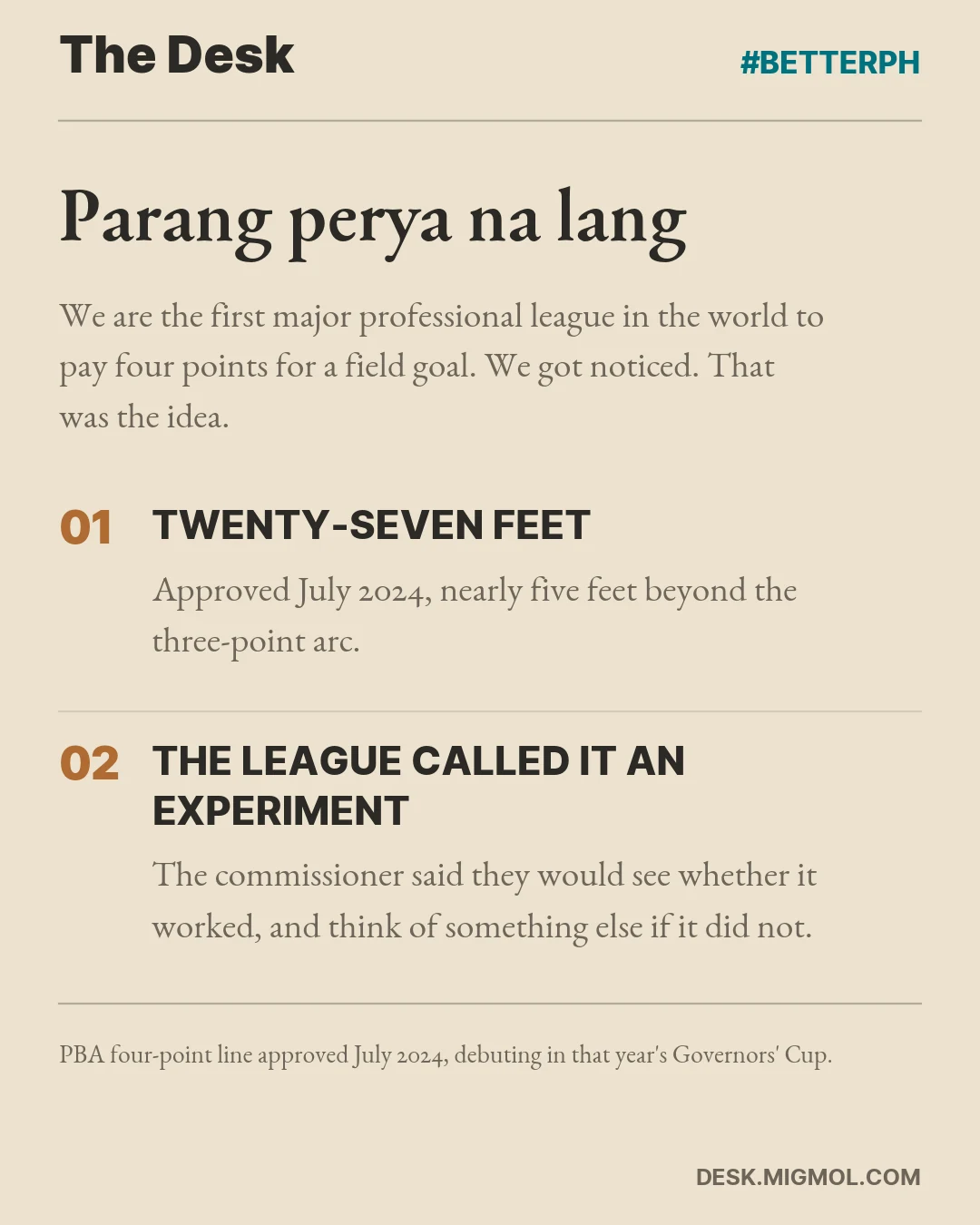
In July 2024 the PBA board approved a four-point line, 27 feet from the basket and nearly five feet beyond the three-point arc. It debuted that year in the Governors’ Cup and made us the first major professional five-on-five league in the world to award four points for a field goal.
We got noticed globally. That was the idea.
Almost everyone I know who still watches hates it, and most basketball people I know think it’s gimmicky. Tim Cone, the winningest coach in league history, was unhappy with it. ESPN’s own coverage asked whether it was a game changer or a failed gimmick. The league called it an experiment, and the commissioner said out loud that they’d see whether it worked and think of something else if it didn’t.
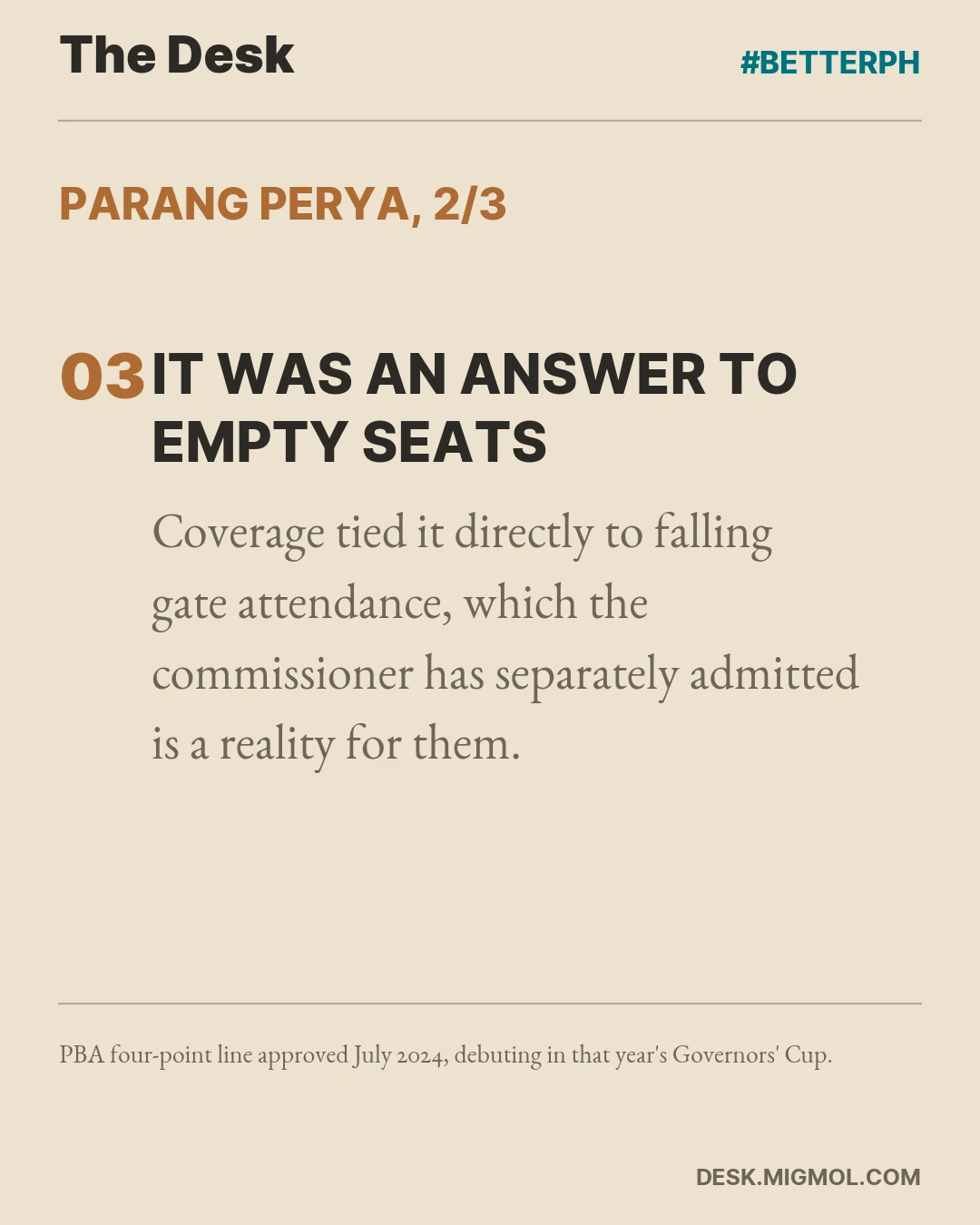
The coverage tied the four-point line directly to falling gate attendance, and the commissioner has separately admitted the empty seats are a reality for them. This is a league that knows people aren’t coming and is trying things.
Parang perya na lang. Come watch our peculiar oddities.
There’s a bitter footnote to it. We’re the only major league on earth that pays four for a jump shot, so shooting is supposed to be the thing we’re known for. At the Asian Games our shooters actually delivered in stretches. Jerrick Ahanmisi went 7-for-11 from three against Kazakhstan. Calvin Oftana hit six against Bahrain. We still finished third in our group and went home before the knockout rounds, in the worst Asian Games finish in Philippine basketball history. The novelty bought us a reputation. It didn’t buy us a result.
What makes it worse is that better answers already exist and we’re ignoring them. Professional 3x3 is a legitimate format. It’s an Olympic discipline, it’s played seriously all over the world, and watching it is more legitimate than watching a four-point line. The Big 3 built an entire watchable product out of half-court basketball, and it’s more interesting and less offensive than a novelty arc. Those are formats. Ours is a gimmick bolted onto the format we already had.
And we have the 3x3 argument sitting right there, unused. Our women’s 3x3 team is ranked 19th in the world, which is the best ranking any Philippine basketball team holds. If the PBA wanted a new product that might actually pull a younger crowd into a building, it’s been available this whole time, it costs half a court, and nobody has to redraw anything.
Give every franchise a sister team
Instead of the four-point line, I’d put a PBA Women’s League in front of the board.
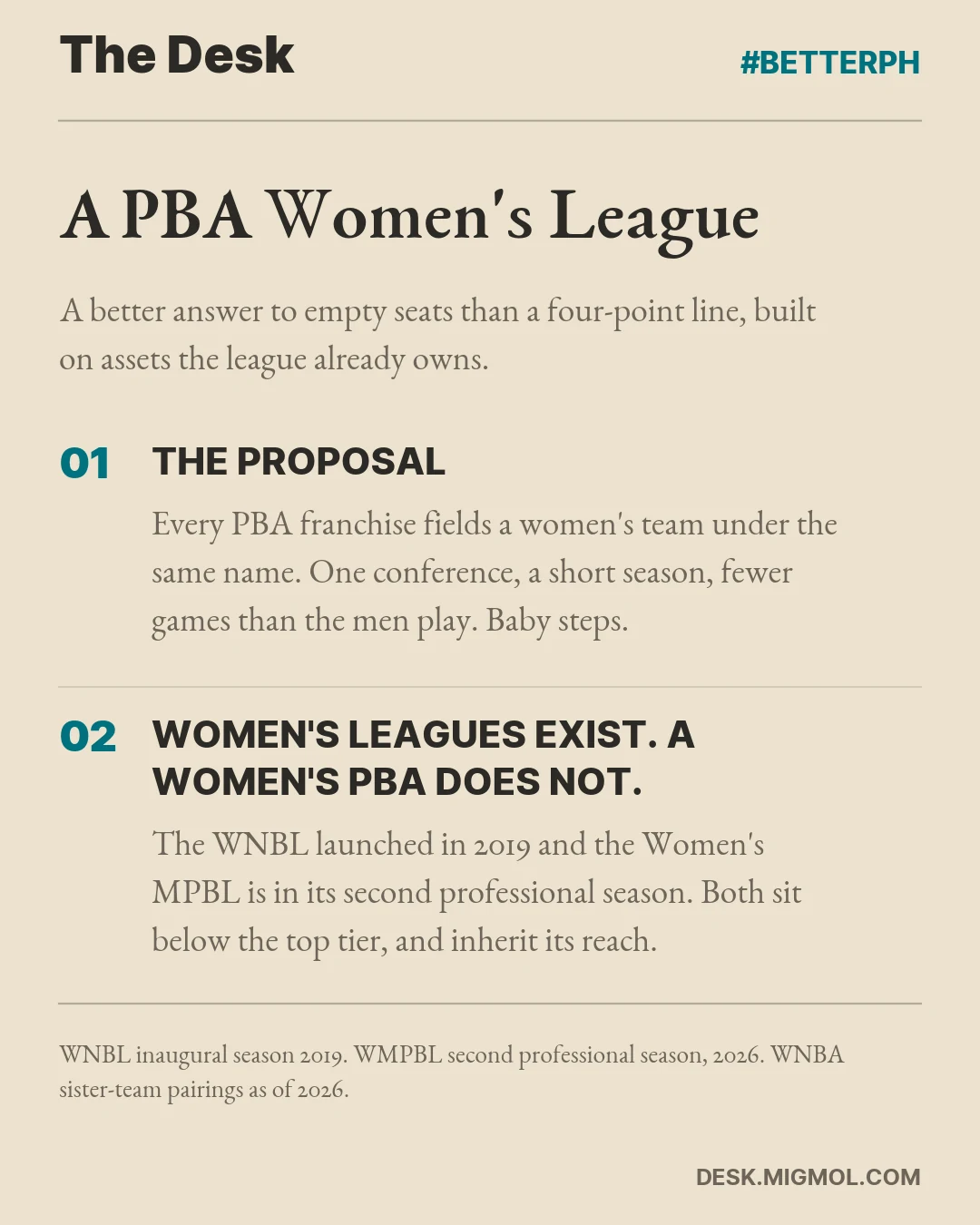
Every PBA franchise fields a women’s team under the same name. One conference, a short season, fewer games than the men play. Baby steps.
This country does have women’s professional basketball and almost nobody writes about it. The WNBL launched in 2019 as the first women’s pro league here, and the Women’s MPBL is in its second season as a professional league right now. Those are real leagues and those are professional athletes.
But the MPBL isn’t the top of Philippine basketball, and I’d wager that on any given weekend more people are watching a UAAP or NCAA game than an MPBL one. A women’s league attached to a lower tier inherits that tier’s reach, and that’s the ceiling it’s been playing under. Women’s basketball here has leagues. It has never had a PBA.
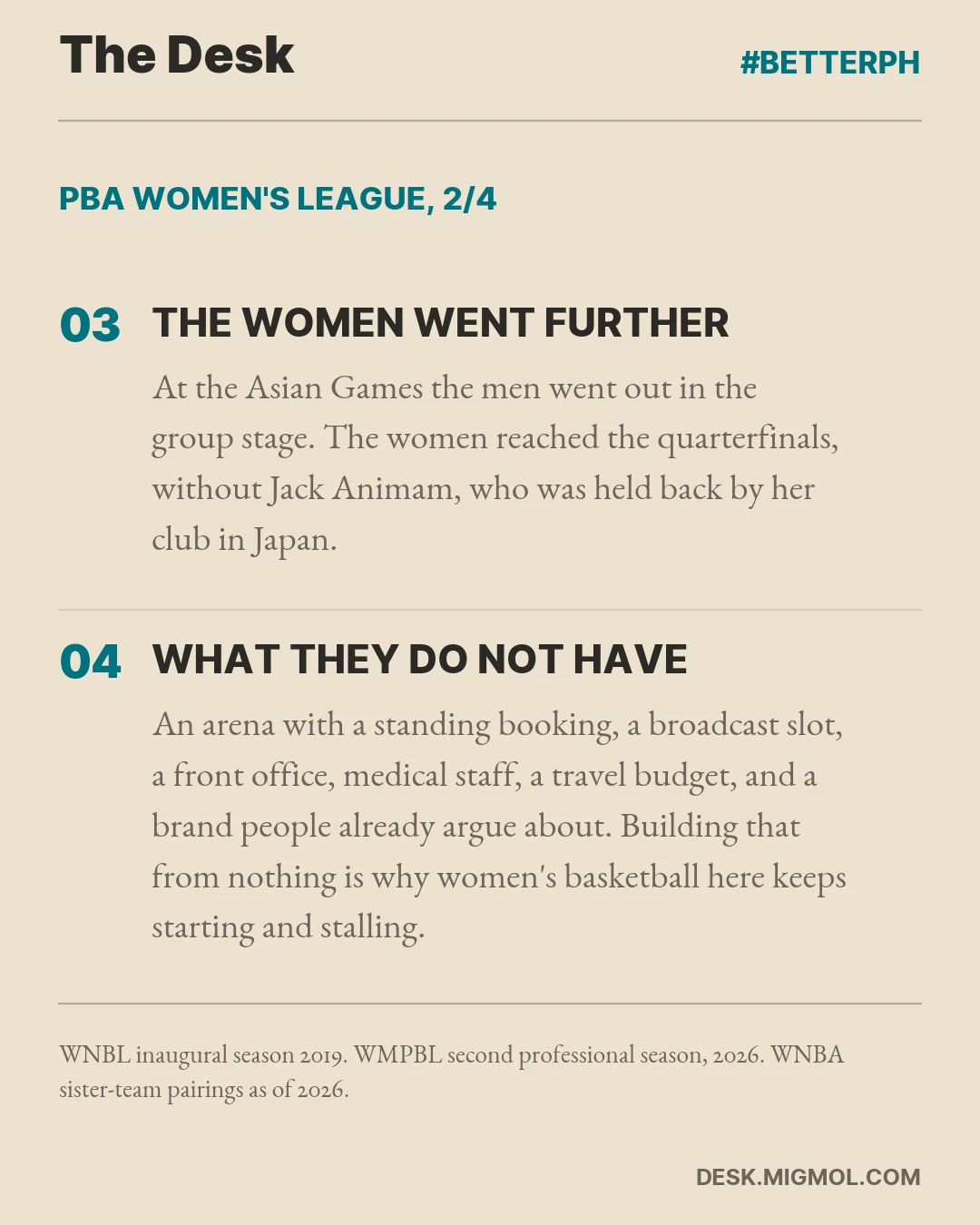
What they don’t have is everything a PBA franchise has already paid for. An arena with a standing booking. A broadcast slot and the crew that fills it. A front office, a marketing department, medical staff, a travel budget, and a brand that people already argue about in jeepneys. Building all of that from nothing is exactly why women’s basketball here keeps starting, stalling, and starting again.
A sister team inherits all of it on day one, at close to zero marginal cost.
This isn’t theoretical either. It’s roughly how the WNBA is built. The Liberty and the Nets, the Fever and the Pacers, the Lynx and the Timberwolves, the Mercury and the Suns, the Mystics and the Wizards, the newest franchise in the Valkyries playing in the Warriors’ building. Most of those pairs share an ownership group and an arena. European football clubs do the same thing, running the women’s side under the same badge, in the same colors, out of the same training ground.
And if the board wants a reason beyond the commercial one, it’s playing in Aichi-Nagoya right now. The men went 1-2 and went home in the group stage. The women beat Kazakhstan and Hong Kong, lost only to host Japan, and reached the quarterfinals before losing to Chinese Taipei, which is still further than the men got. They did it without Jack Animam, who was held back by her club commitments in Japan, and without Kacey dela Rosa and Vanessa de Jesus either.
Sound familiar? The women’s program has the same export problem as the men’s, a thinner roster than the men’s, and a better result. It also has no PBA.
And the short season is the whole point of the proposal rather than a limitation of it. Nobody has to bet a full calendar on an untested crowd. Run one conference, count the gate, read the ratings, and let the thing earn its second season.

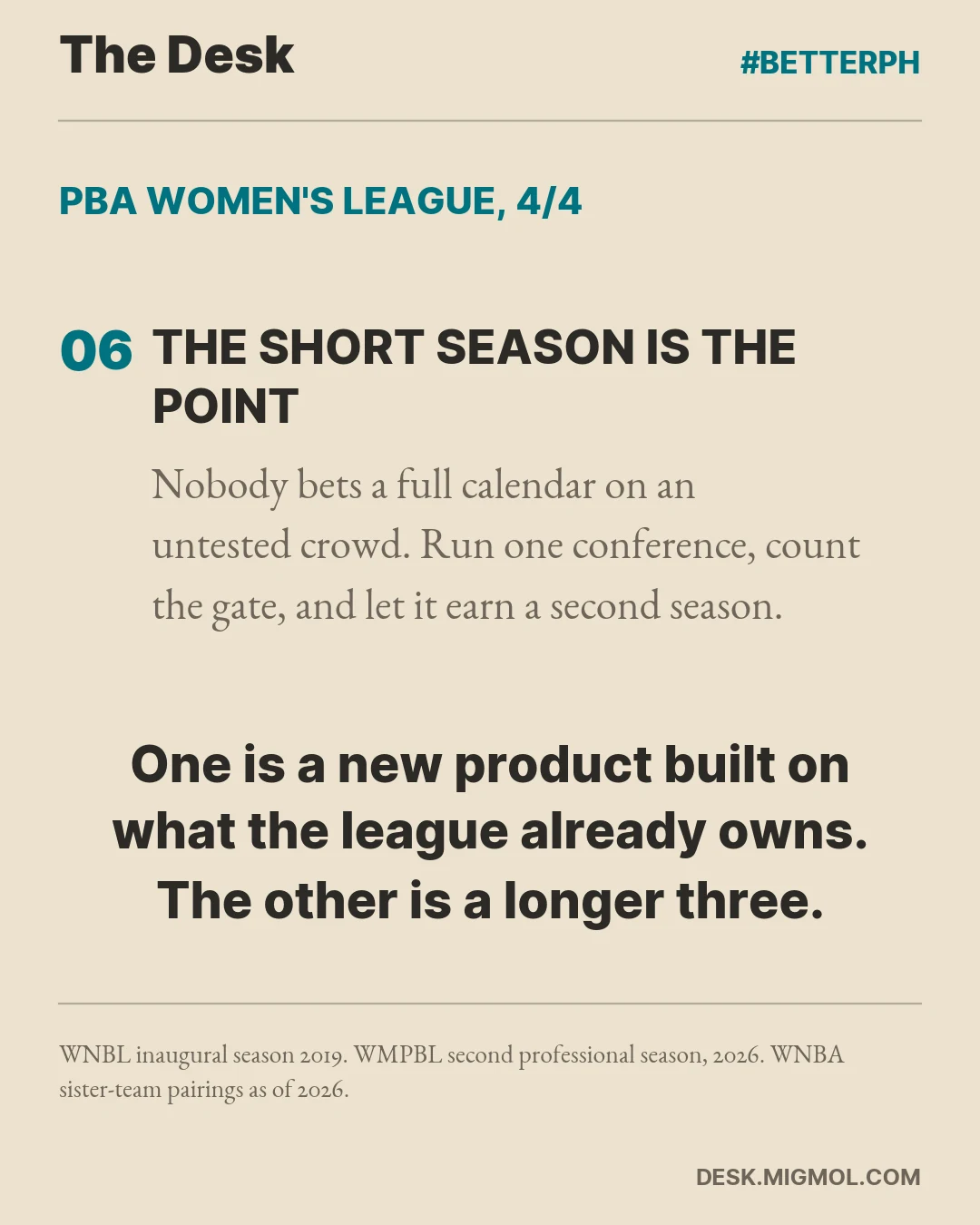
Set that next to a four-point line and it isn’t close. One is a new product built on assets the league already owns. The other is a longer three.
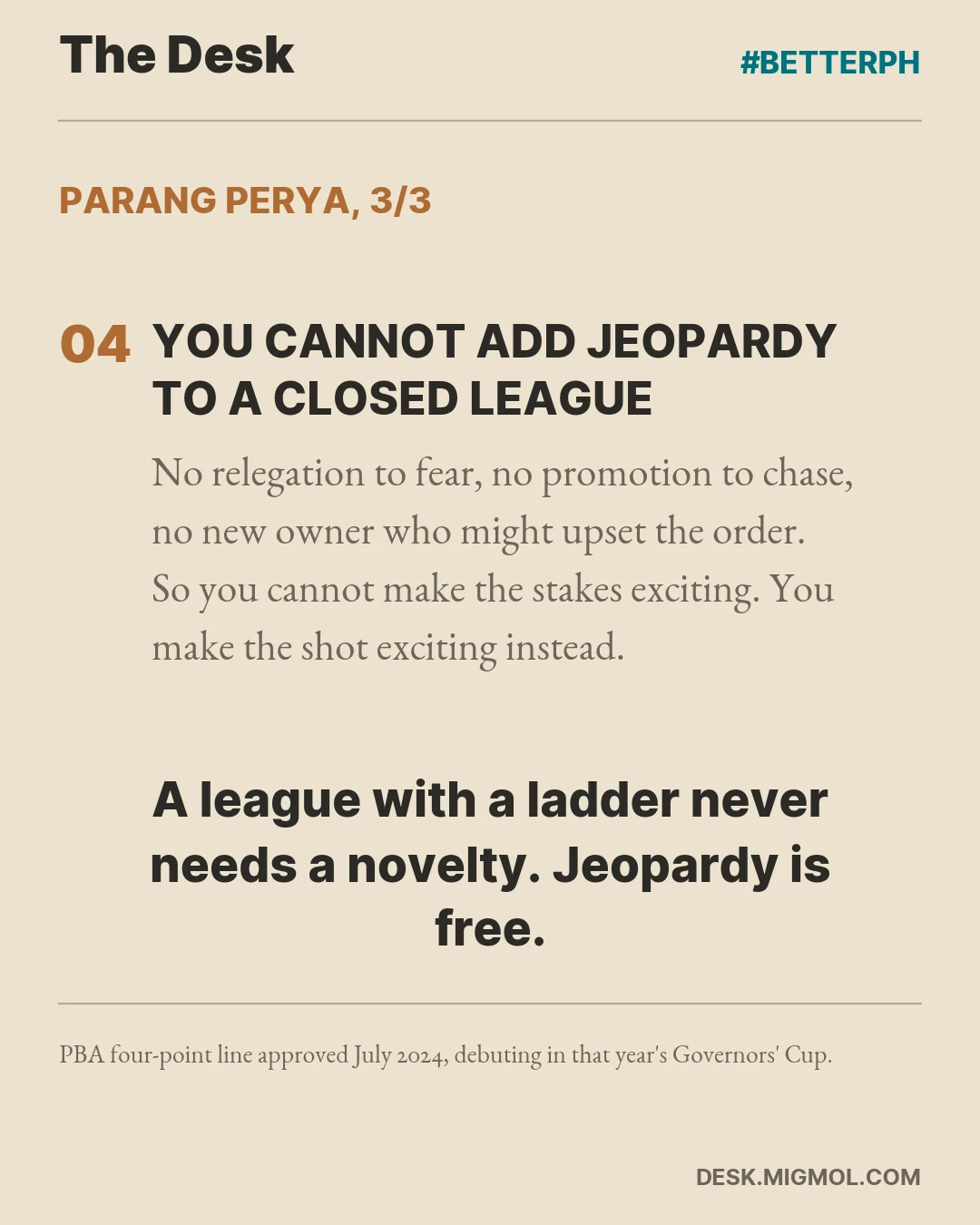
But the gimmick is a symptom rather than the disease. You cannot add jeopardy to a closed league. There’s no relegation to fear, no promotion to chase, no cup upset to dread, and no new owner who might arrive and upset the order. Every source of natural drama available to a football club in a functioning pyramid is structurally unavailable to a PBA franchise. So you can’t make the stakes more exciting, and you’re left trying to make the shot more exciting.
A league with a ladder never needs a novelty. Jeopardy is free.
I think the way for the PBA to be relevant again, for it to be competitive, is to really have it mean something. Make the games count. Play for basketball; not for ads. Don’t get me wrong, those are important. That’s why the B.League is shifting again, but let’s fix what’s broken first.
The room is getting older
This one is my observation, not a statistic.
The fans are ageing. So are the officials, and so are the commentators. A lot of them need to retire, and a good number of the fans already have.
The sourced half is what I can hand you with confidence. The commissioner has admitted the empty seats. The league’s own diagnosis is that it has large television numbers that don’t convert into people in the building.
A league whose audience ages along with it has failed to recruit, which is the same failure as not recruiting new owners or new teams. Everything about this institution is closed, including the way in for somebody young.
Sanctioned by a league he never signed up for
I’ll give the PBA this much first, because it’s true: the rules are more relaxed now than they were, and they were reworked after what I’m about to describe.
But I remember what happened to the Ravena brothers, and the younger one is the case that should bother everybody.
Thirdy Ravena was a three-time UAAP Finals MVP at Ateneo and was widely projected as the top pick of the 2019 PBA draft. He didn’t enter it. He wanted to play abroad, and in June 2020 the San-En NeoPhoenix signed him to the B.League.
The problem was a rule the PBA had passed in 2018, barring prospects who skip the draft for two years from their last year of college. Thirdy last played for Ateneo in 2019. Staying in Japan meant crossing that line.
So a league he had never signed with, never been drafted by, and never played a single minute for was in a position to sanction him for not joining it. He was called a draft dodger. His own answer at the time was “I’m just a kid with a dream”, and he ended up writing the PBA a letter explaining his situation. The commissioner eventually said no action was needed and wished him well.
A twenty-three-year-old had to write a letter to an organization he didn’t work for, explaining why he’d taken a job somewhere else.
His older brother Kiefer’s case was different and more defensible on its face. Kiefer was under contract, having signed an NLEX extension in September 2020 that tied him to the club for three more seasons, and when Shiga Lakestars signed him in 2021 the PBA blocked it on those grounds. FIBA issued the actual suspension and the board abided by it. People remember it as the PBA simply banning him for choosing Japan, and that isn’t quite what happened.
But look at the two cases together and the instinct behind them is the same one. One brother was held to a contract in a market where he had exactly one domestic buyer. The other was threatened for declining to enter that market at all.
The scandal was never that a contract got enforced. It’s that a three-year contract existed on those terms in the first place, and that a league felt entitled to a player who had never agreed to anything with it. In a pyramid there are competing employers at several tiers and a contract gets priced against real alternatives. In a closed twelve-team league with half of it under two groups, a player signs what he’s offered, because the alternative is not playing at home.
Predatory and selfish is how it looked to me at the time, and I haven’t revised that. It did nothing to push Philippine basketball forward.
And look at how it ended. The PBA reworked its free agency and rookie rules after the Ravena and Parks situations, which is an admission in everything but name. But the player it was aimed at never came back. Thirdy signed in Japan in June 2020, played four seasons with San-En, went to Dubai after that, and has now signed with the Toyama Grouses for this season. Six years on, he still works abroad.
The league won that argument and lost the player, permanently. Then it changed the rule anyway.
The PBA is the ceiling
Some of you PBA diehards might think that I’m trying to kill the PBA. It is the opposite. Part 3 is explicit that it gets absorbed rather than replaced, keeping everything it has and gaining a ladder underneath it.
But every complaint in this piece has the same root. The players leave because there’s one domestic buyer and better leagues elsewhere. New owners don’t come because there’s nothing to buy and nowhere to climb. The product needs gimmicks because a closed league can’t generate jeopardy. The audience greys because nothing about the institution has a way in.
Fix the structure and each of those fixes itself, slowly, without anyone having to be shamed into it.
Three things to start with
Let a tier exist below the PBA, and let clubs move between them. This is the whole of Part 3 in one line, and it’s the only one of these three that matters on its own.
Publish what a franchise is worth, and what one costs to run. A league that wants new blood has to let new blood see the books. Right now the only figures available come from trade columns.
Retire the four-point line, and launch a PBA Women’s League instead. Every franchise fields a sister team under its own name. One conference, a short season, shared arena and shared staff. If the problem is that people have stopped coming, the answer is more basketball worth watching, not a longer three.
Next: what happens the first time a UAAP champion plays a PBA champion.
Part 4 of Pilipinas Basketball 2039. Part 1 · Part 2 · Part 3. Next: If the PH Can Win it All, a College Team Should Beat a Pro Team

Do Our Basketball Leagues Make Sense?
China beat us by 44 points and ended our Asian Games title defense in the group stage. The reason has almost nothing to do with the twelve men on the floor.
Read more →
Yabang, High; Basketball IQ, Low
The last Philippine team to win the FIBA Asia Cup did it in 1985, coached by an American. We produce players at a rate no country can match. We have never produced coaches.
Read more →
Who Pays for the Senior Discount Charged to Restaurants? It's Not the Government.
The store funds it, the Supreme Court has said so twice, and the bill never lands in a budget anyone has to defend.
Read more →
Alex Eala Doesn't Owe Us Anything
But she showed up anyway.
Read more →