You cannot get kids into sports and then sell them bets on the game. The law should say so.

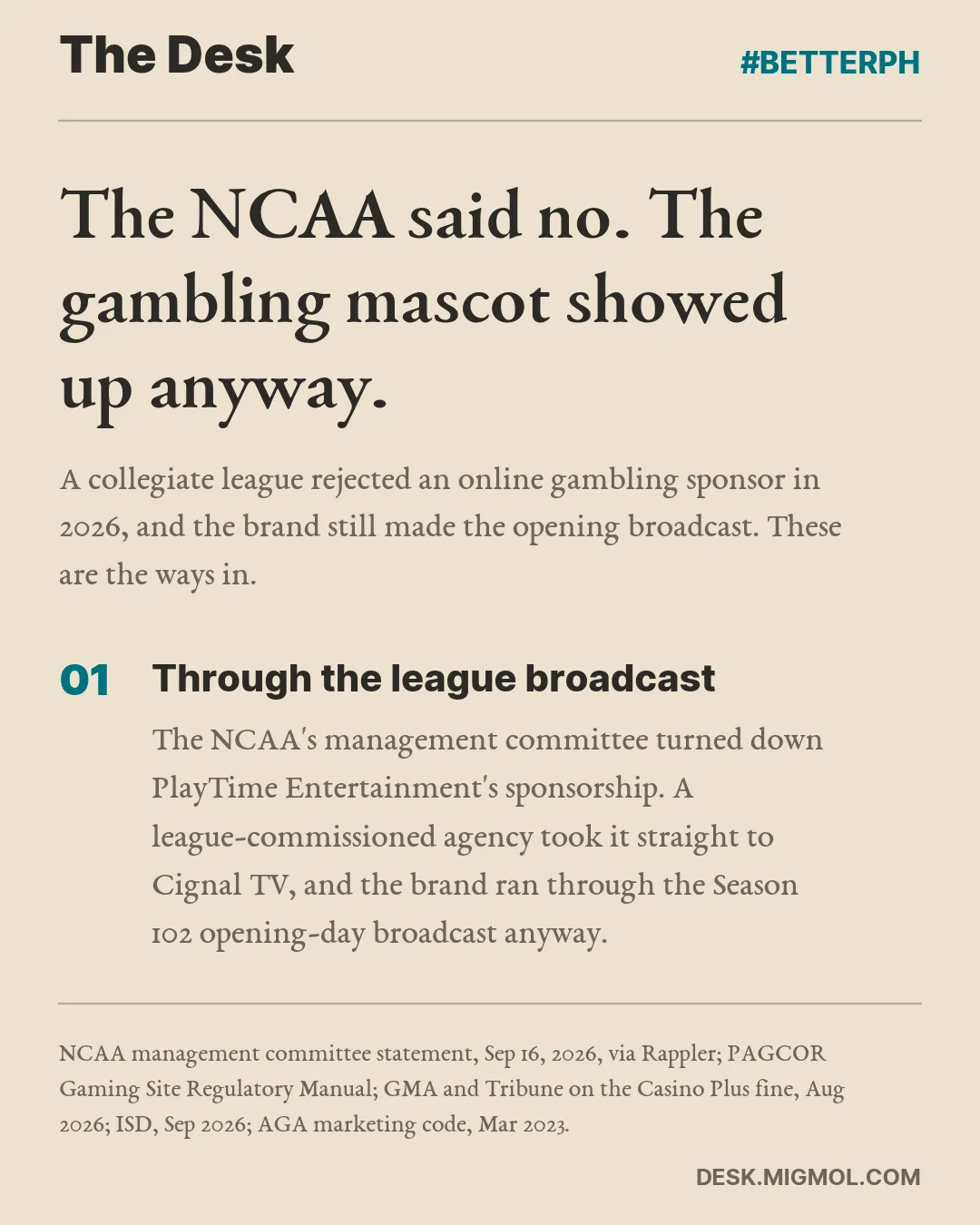
On the opening day of NCAA Season 102, a giant white cat in a red PlayTime Entertainment shirt stood courtside at the Mall of Asia Arena, right beside the broadcast hosts. PlayTime is an online gambling platform. The NCAA had already told it no.
The league’s management committee had rejected PlayTime’s sponsorship proposal. Not all ten member schools opposed it, but the committee wanted a unanimous vote and didn’t get one. So a league-commissioned agency took the deal straight to Cignal TV, which didn’t know it had been turned down, and the brand ran through the opening broadcast anyway. A business news page had already posted it as a “new sponsorship deal”, mascot and all, before the league caught up. On September 16 the NCAA put out a statement saying no agreement had ever been signed, and opened an investigation.
A collegiate league voted no, and a gambling brand still got onto its broadcast. That is how thin the wall is.
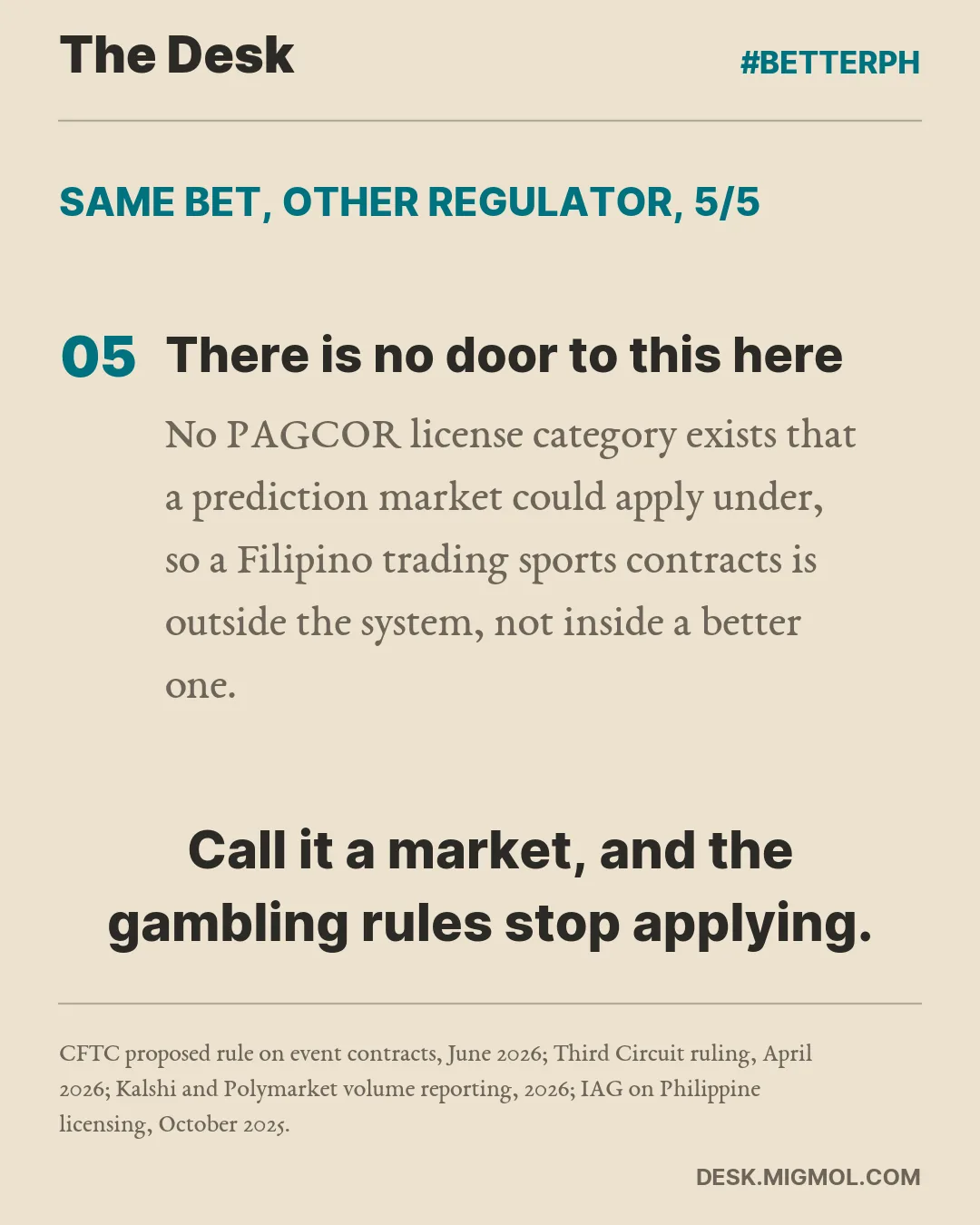
A building has to stay 200 meters away. A screen does not.
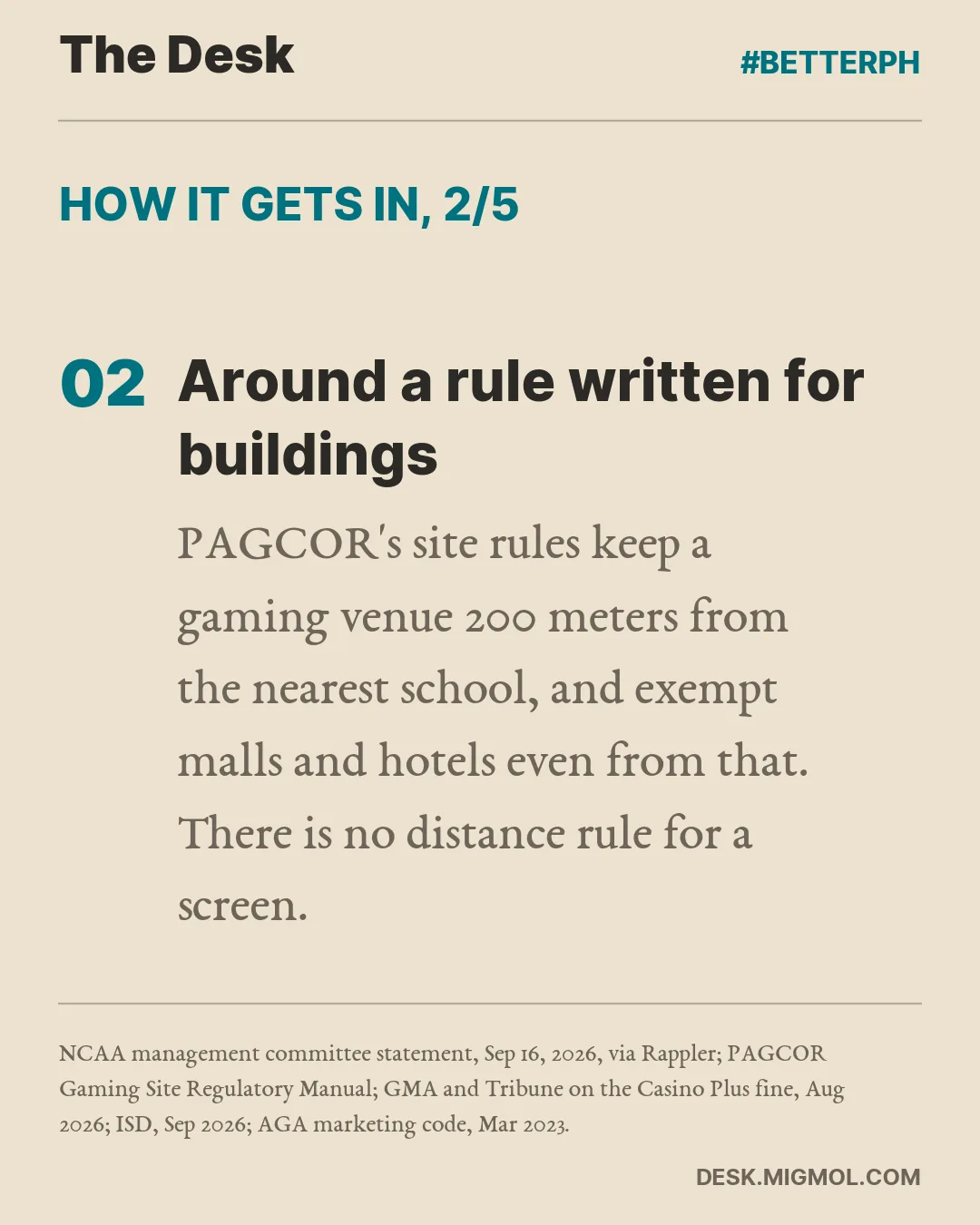
The rules already accept that gambling and schools shouldn’t share a street. They just only thought about buildings. PAGCOR’s own site rules put a gaming venue at least 200 meters from the nearest school or church, and malls, arcades, and hotels are exempt even from that. There is no distance at all for a phone. The same product that cannot open a storefront across from a high school sits in its students’ pockets, runs through their league’s broadcast, and arrives through their favorite content creator.
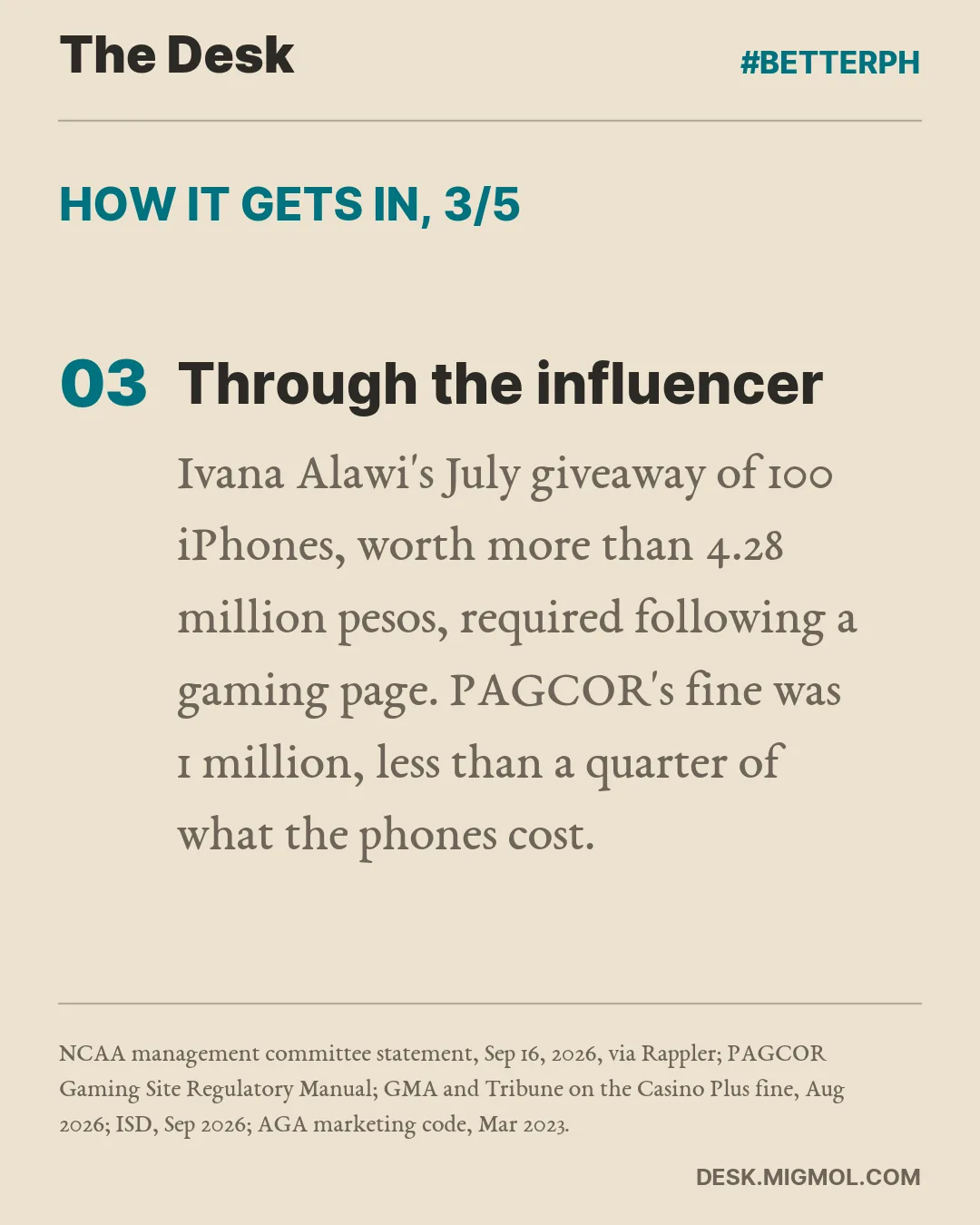
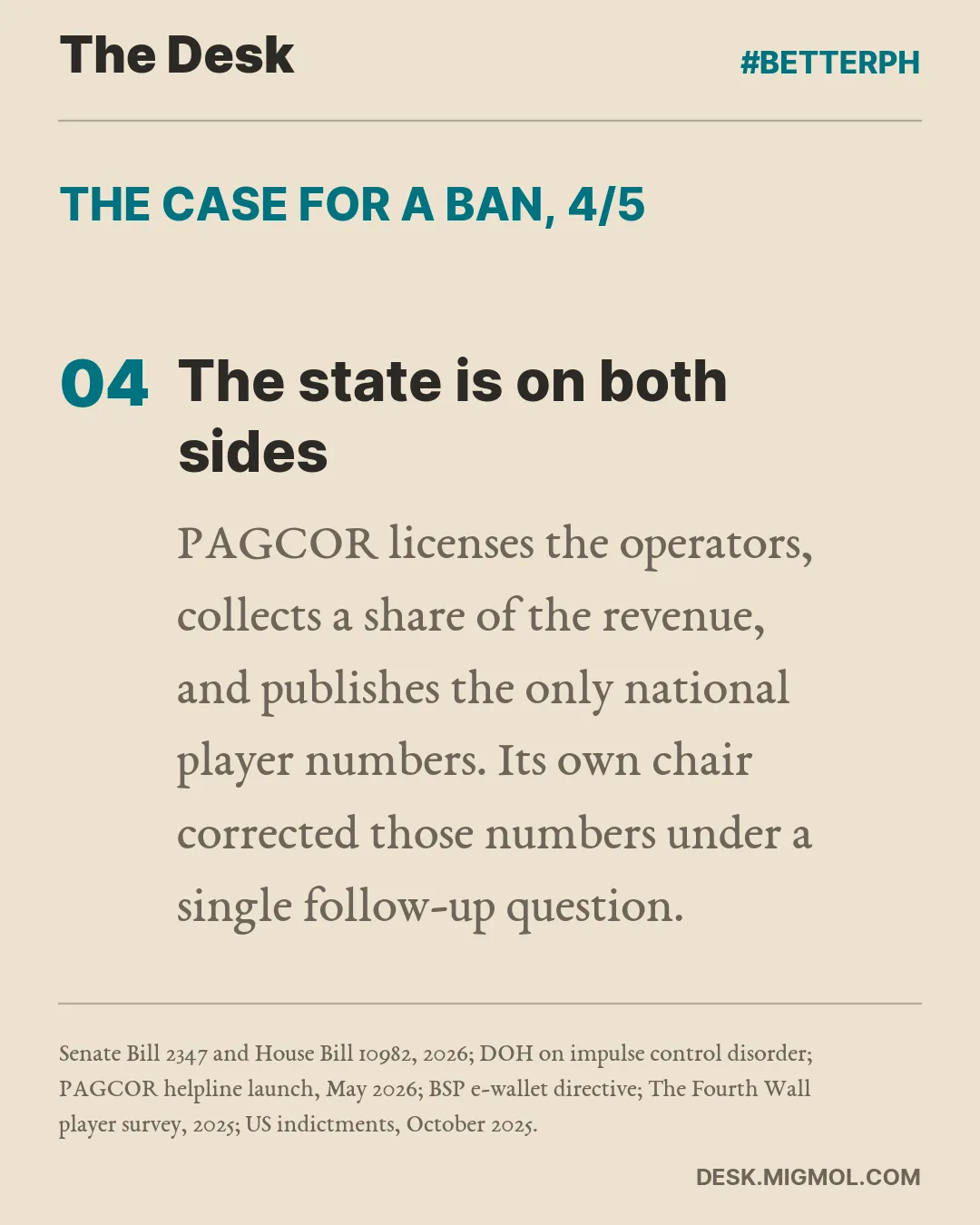
That last route got tested in July. Ivana Alawi gave away 100 iPhone 17s, worth more than ₱4.28 million, and to join you had to follow a gaming platform’s Facebook page. PAGCOR fined the operator, Casino Plus, ₱1 million for running the promotion without approval. That’s less than a quarter of what the phones cost. As a marketing expense, the fine was a bargain.
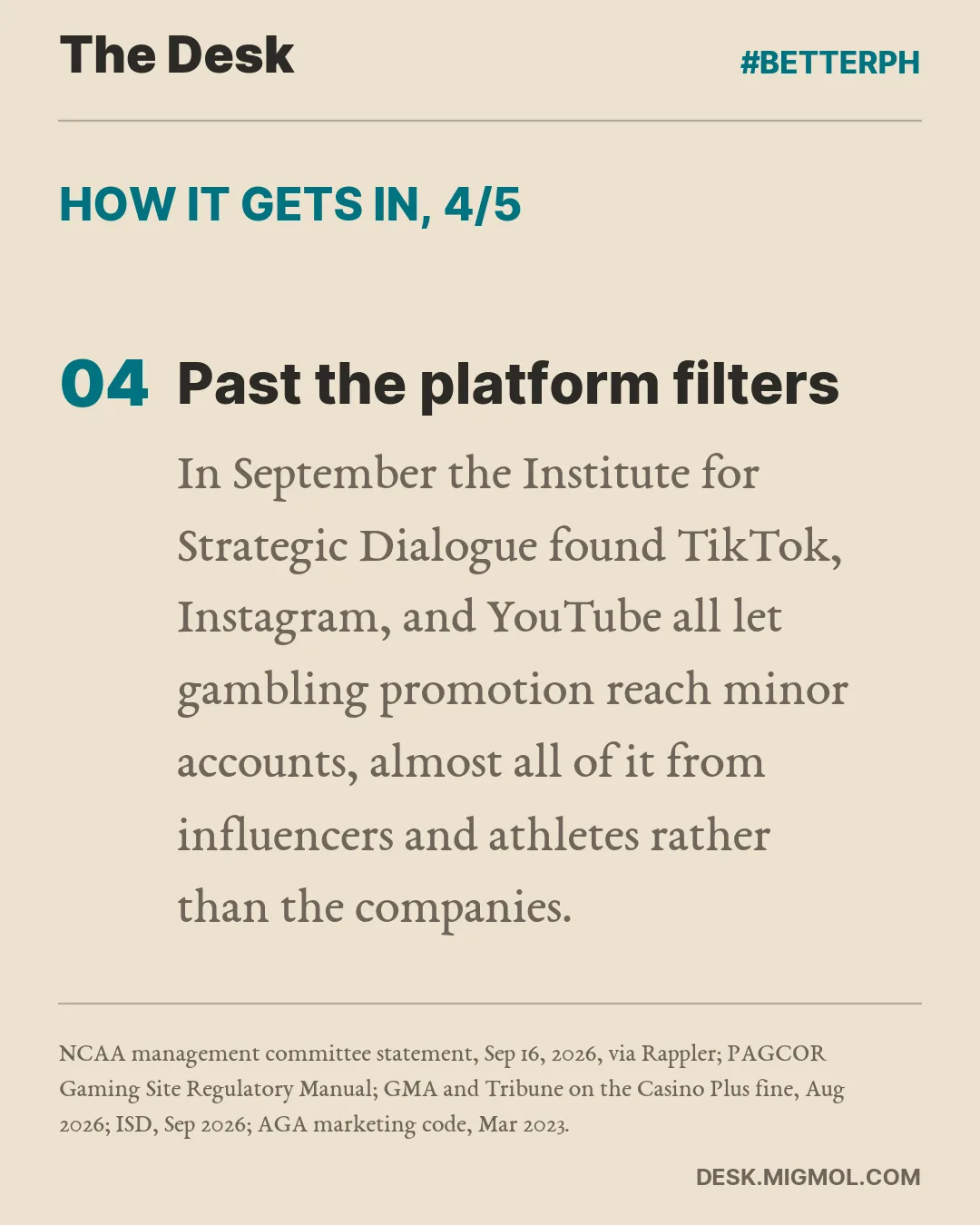
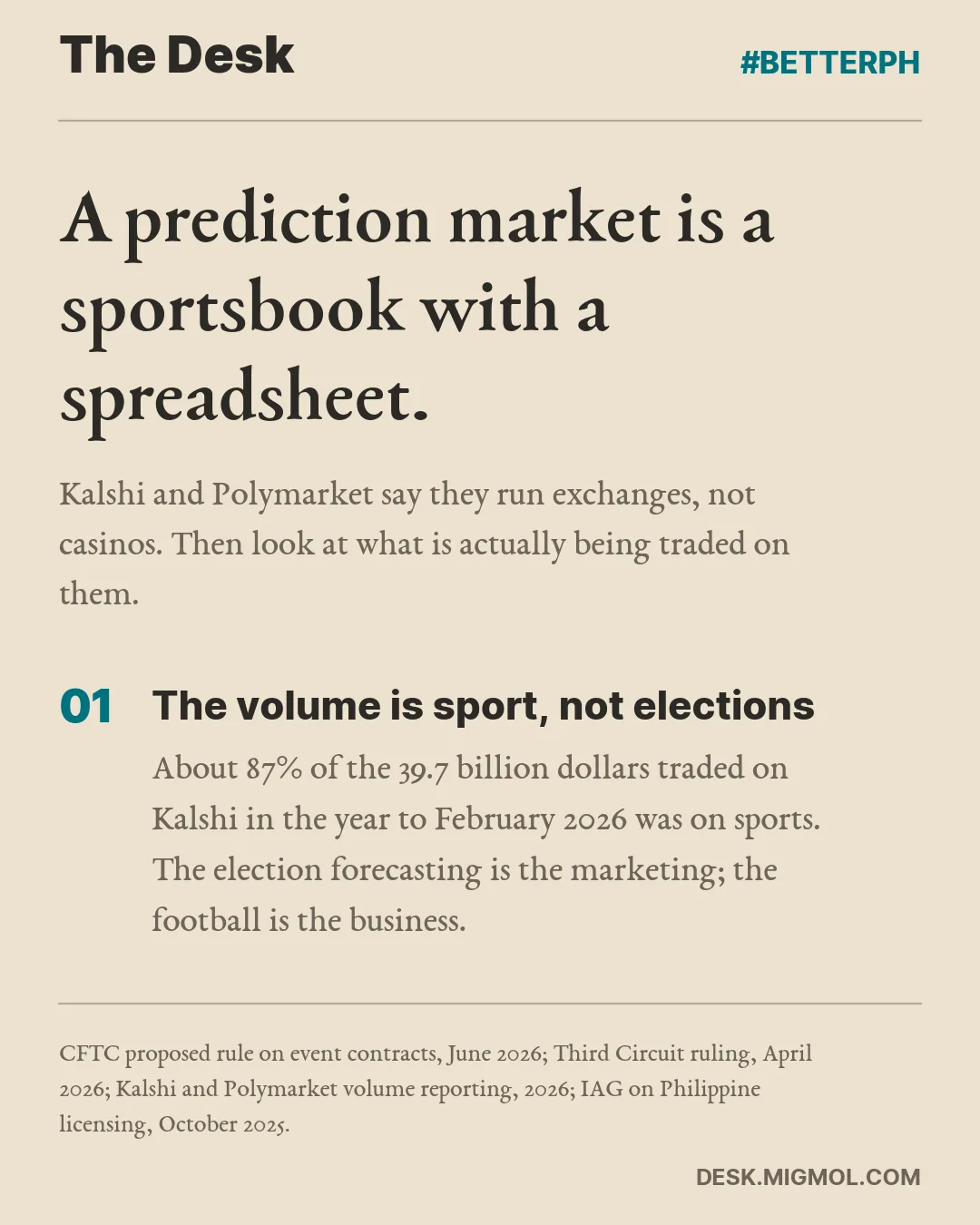
The platforms aren’t catching it either. In September the Institute for Strategic Dialogue tested TikTok, Instagram, and YouTube and found all three let gambling promotion reach minor accounts through search, and almost all of it came from influencers, athletes, celebrities, and brand partners rather than from the gambling companies themselves. Moderation is built to catch an ad, and a creator’s post doesn’t look like one. The same study found the platforms barely try to limit ads for prediction markets like Kalshi and Polymarket, which sell sports bets as “event contracts” and are about 87% sports by volume.

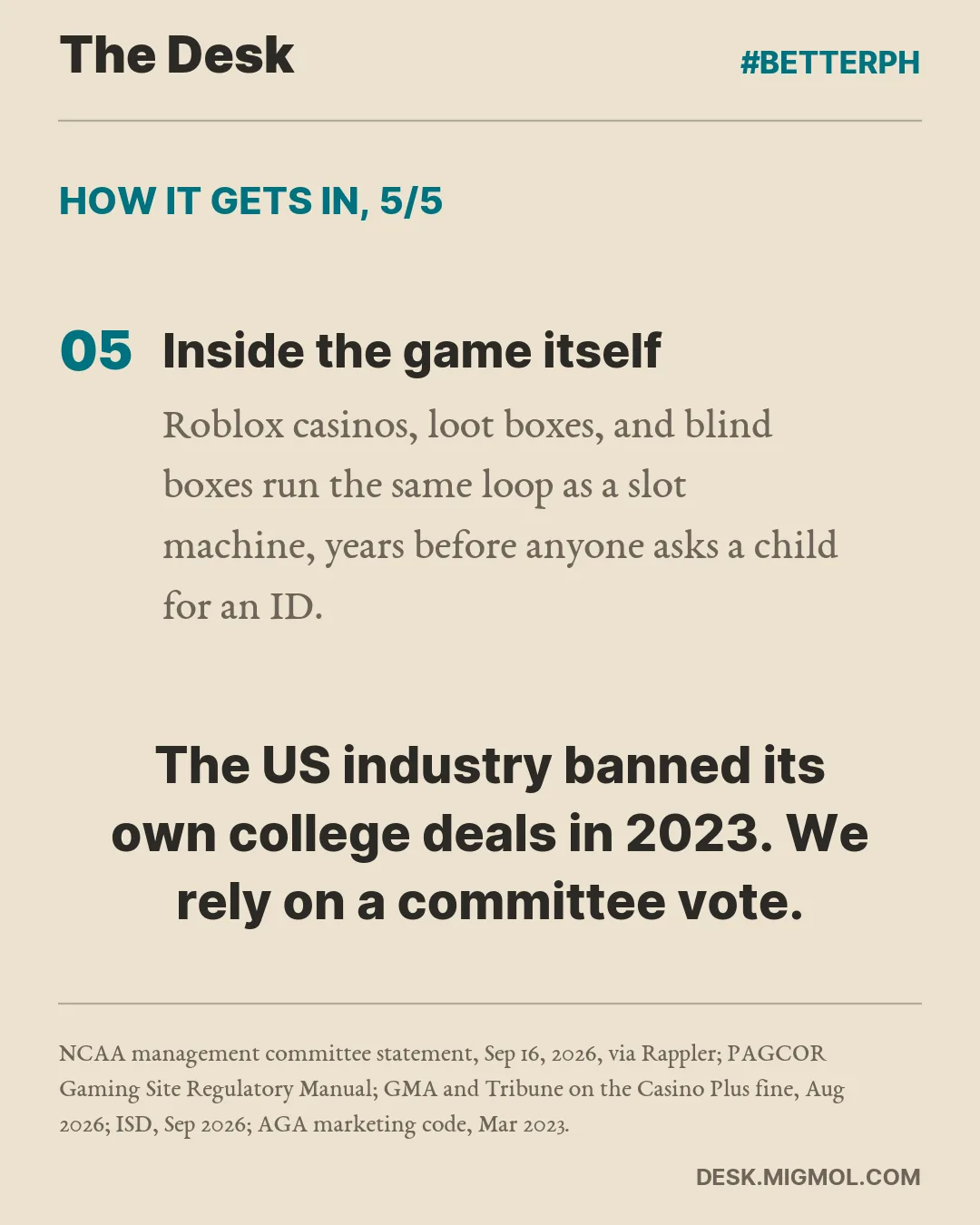
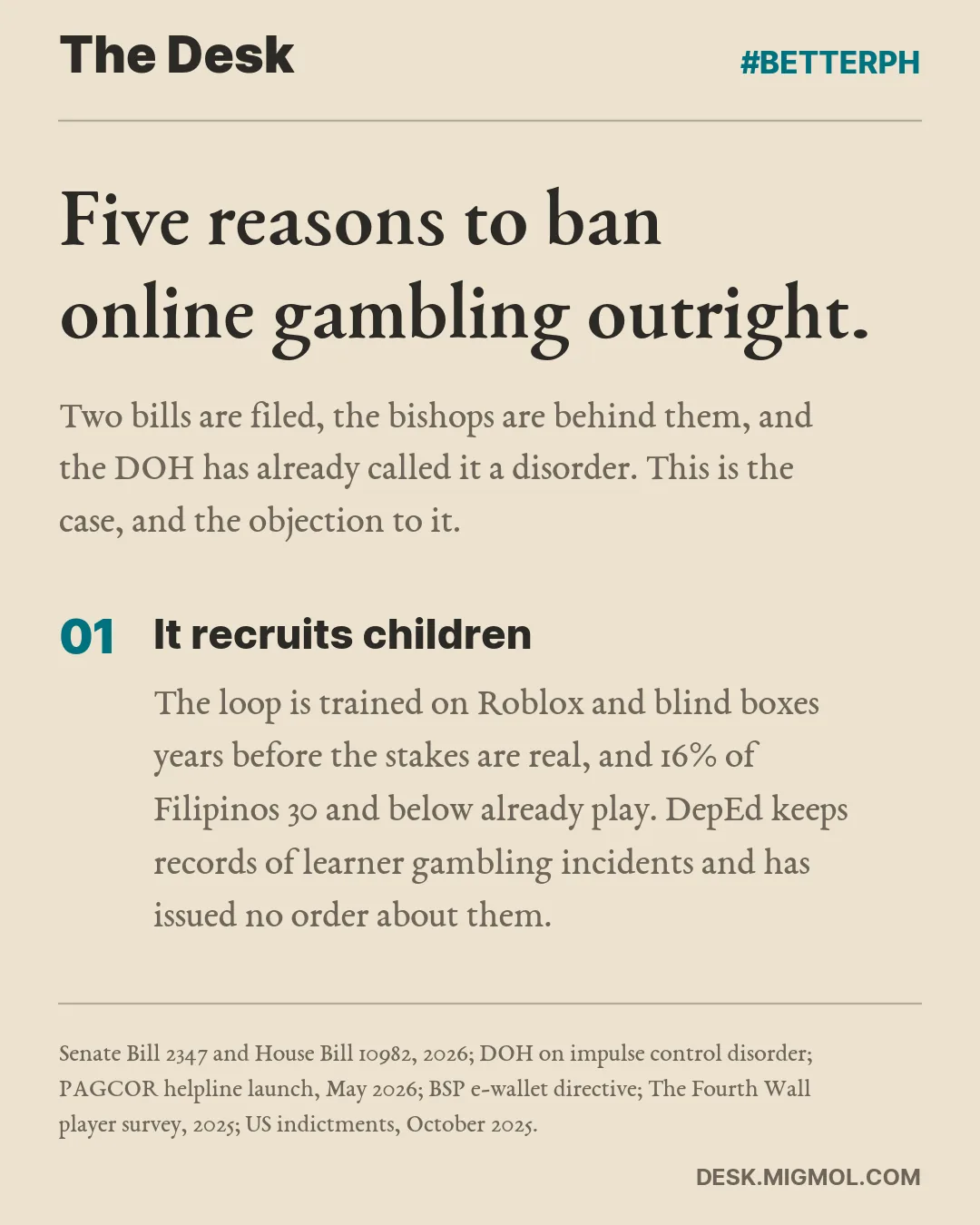
Then it goes inside the games, where it doesn’t look like gambling at all: the Roblox casino that turns game currency into casino play, and the loot box and blind box that run the same loop as a slot machine. The reflex gets trained there, years before anyone asks a child for an ID.
Even the American industry drew this line
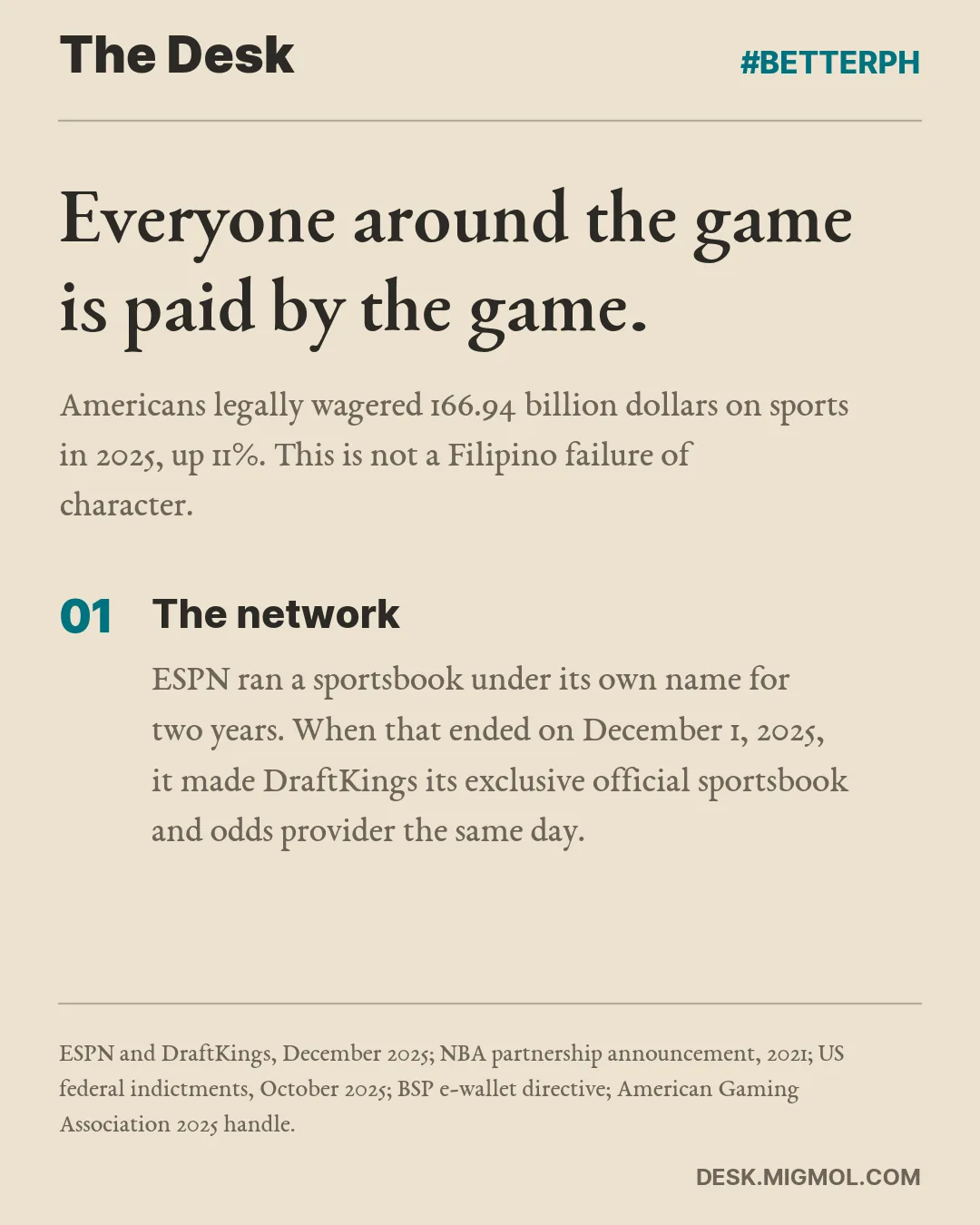
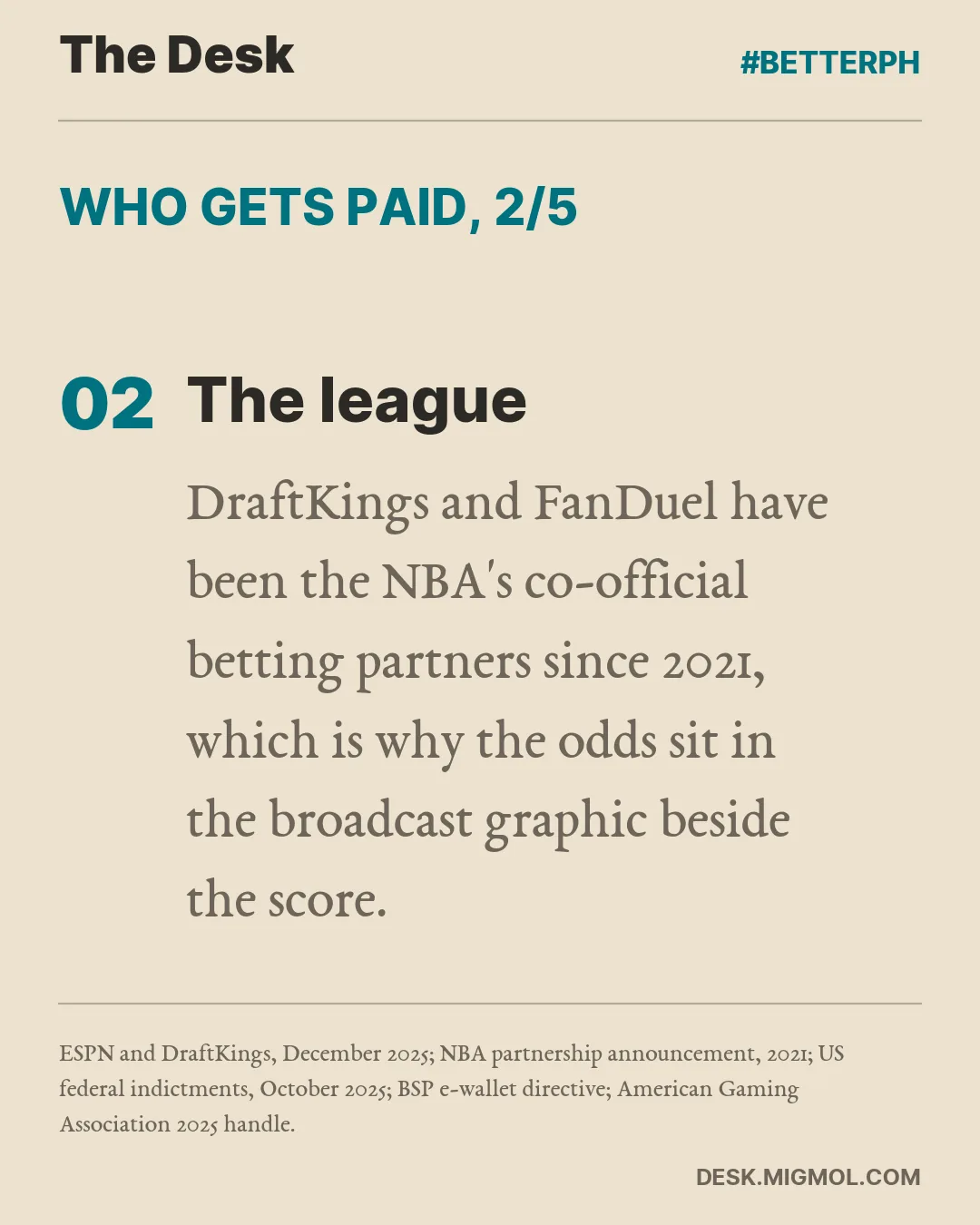
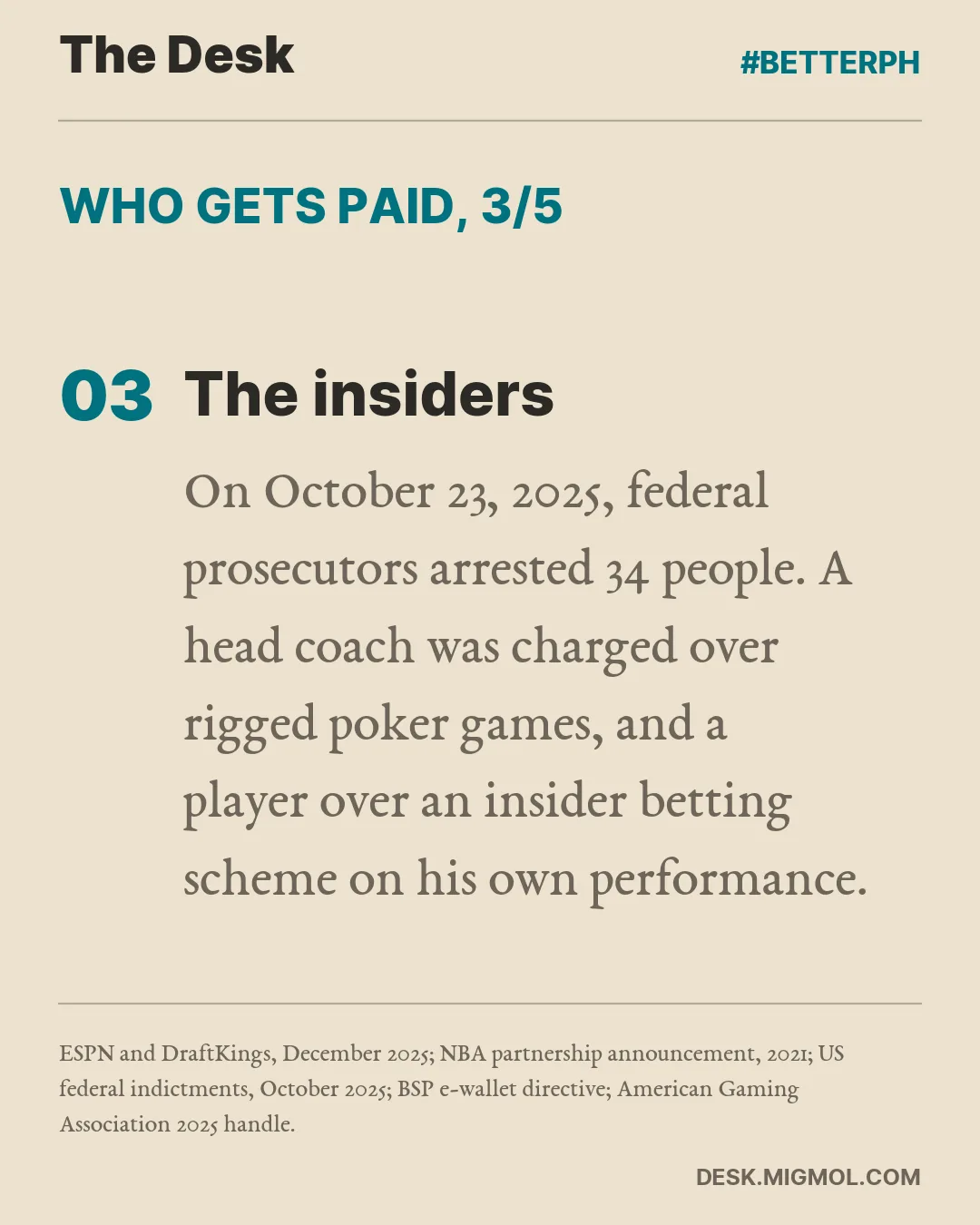
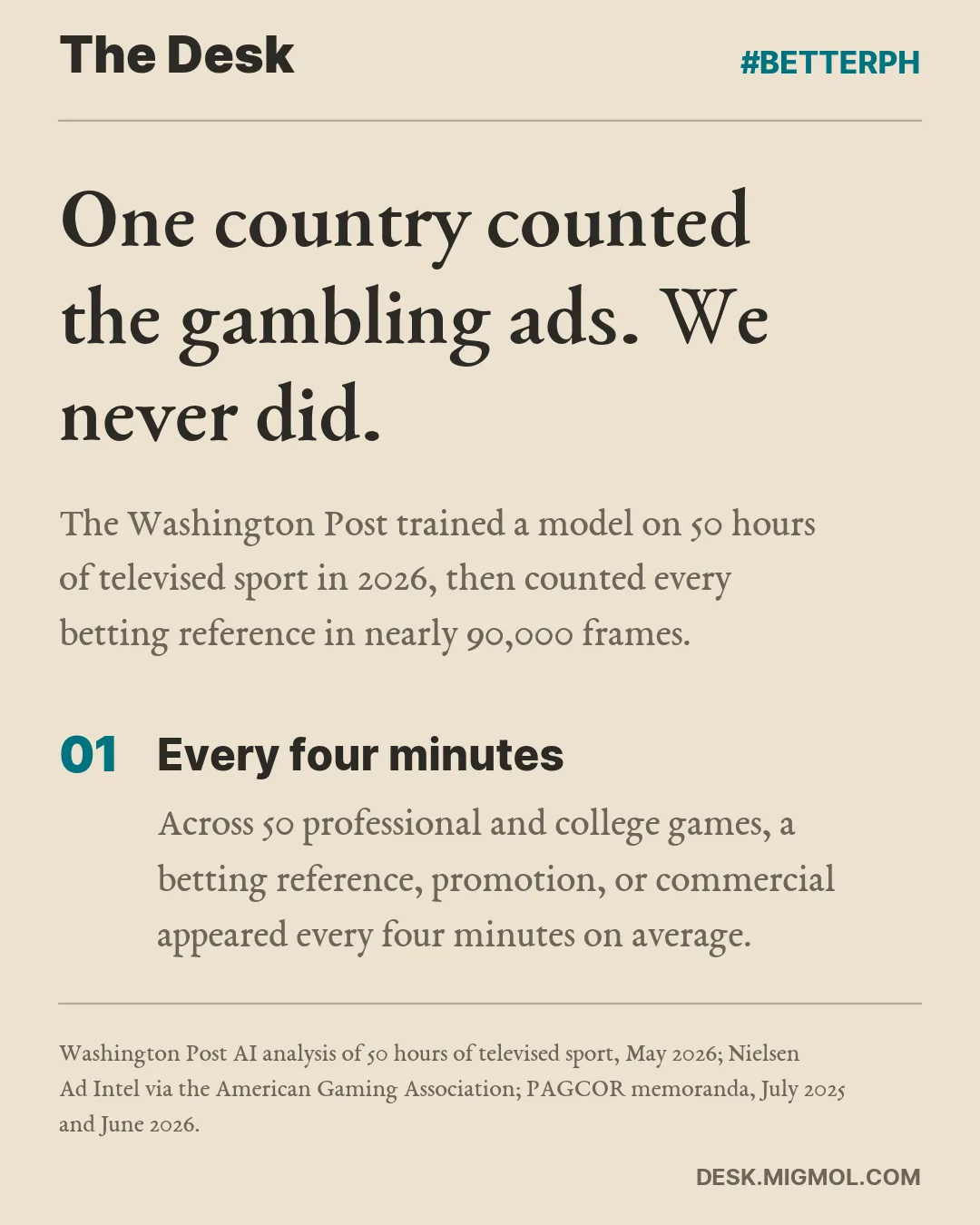
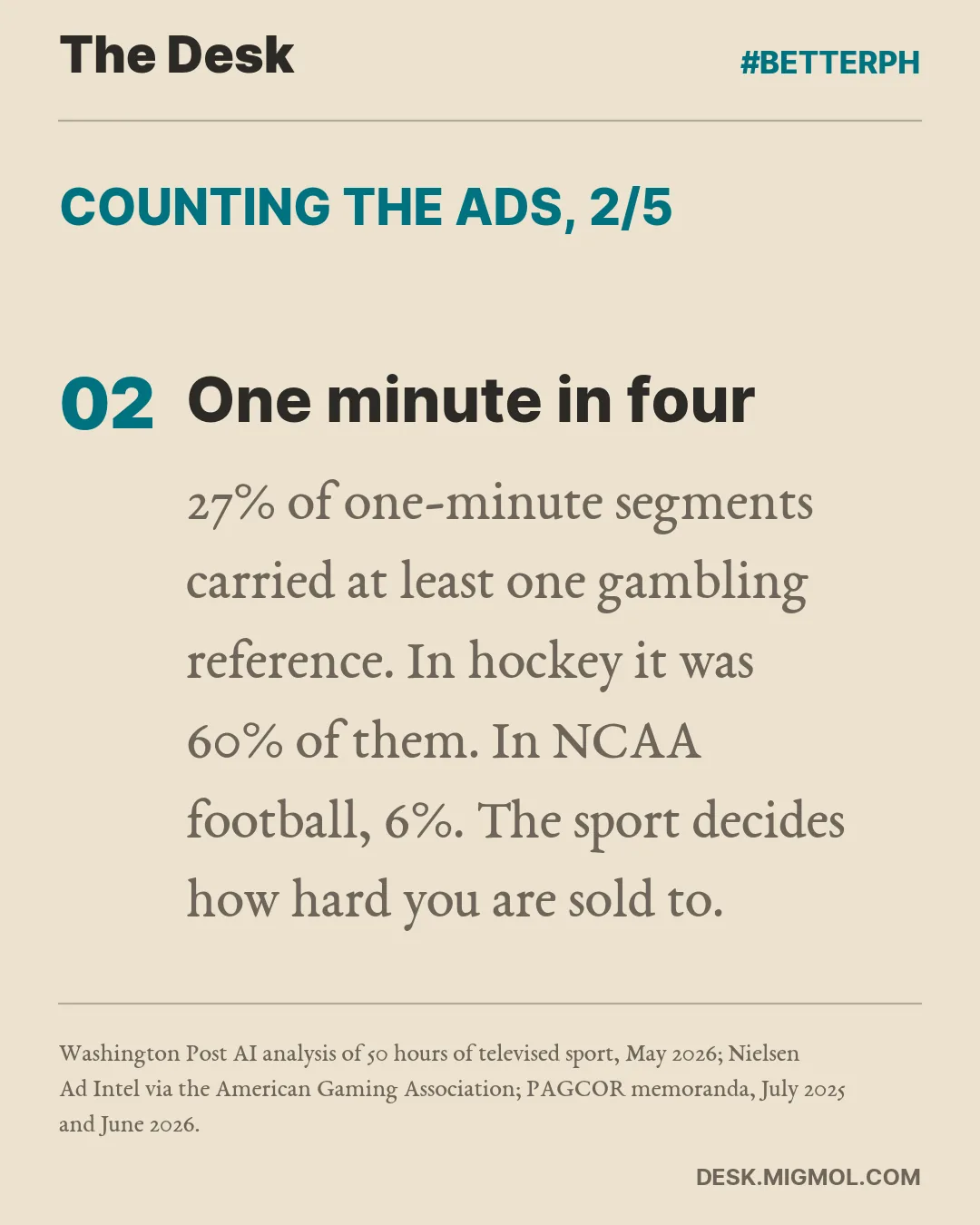
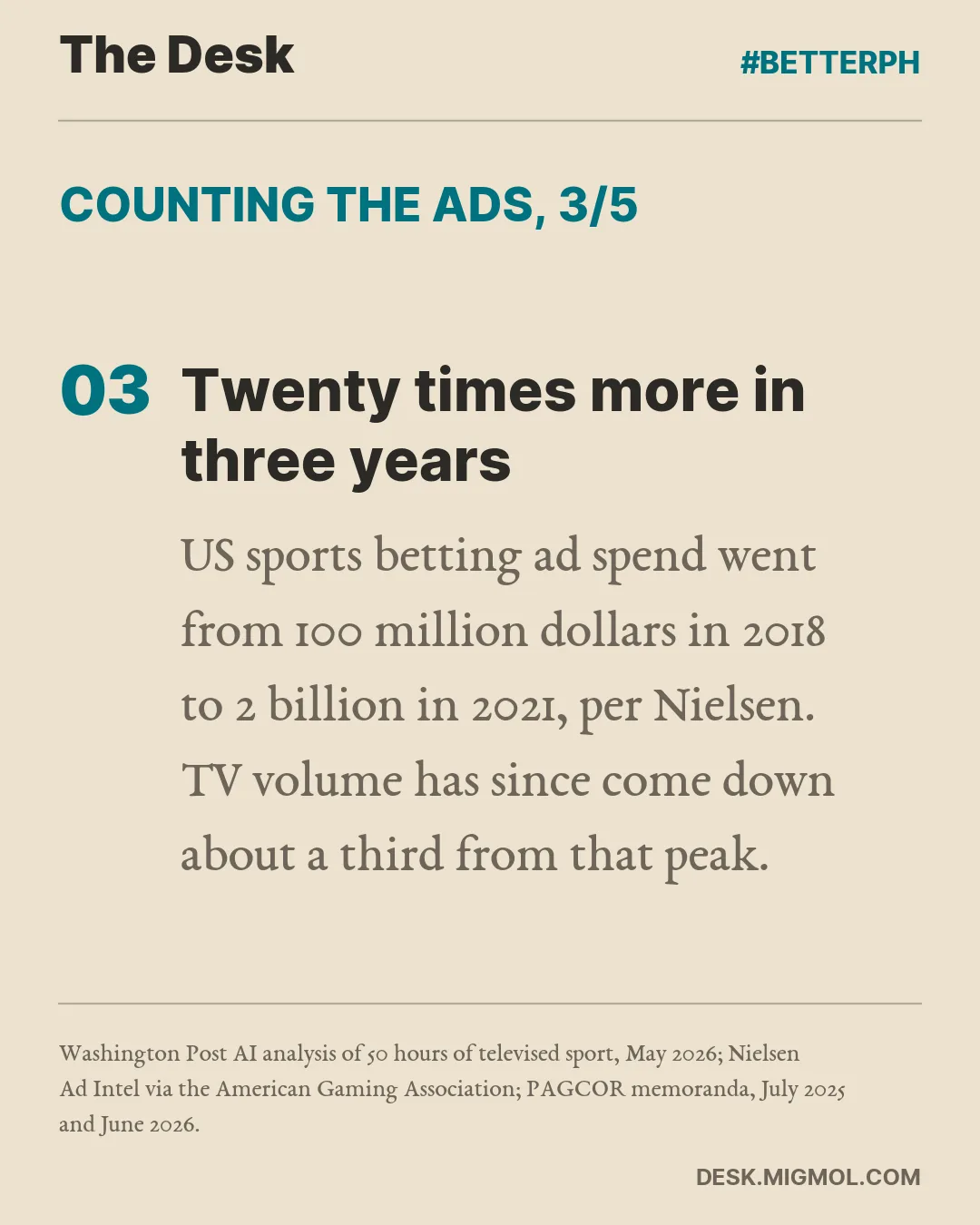
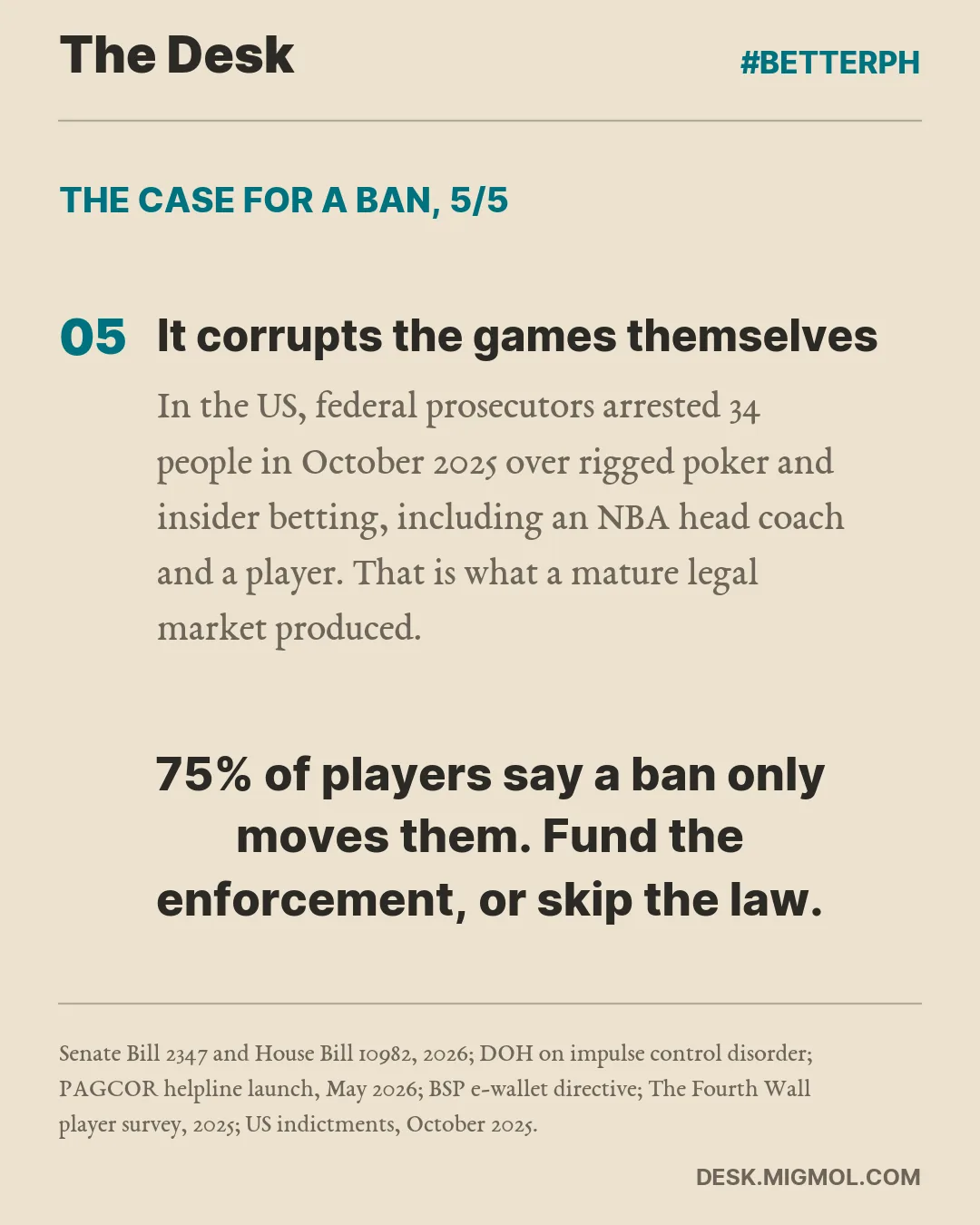
The Americans are no model for any of this, which is what makes the next part embarrassing. ESPN ran a sportsbook with its own name on it, then made DraftKings its exclusive official sportsbook the day that deal ended. DraftKings and FanDuel are the NBA’s co-official betting partners, which is why the odds sit in the broadcast graphic beside the score. When the Washington Post ran a model over 50 hours of televised sport this year, it found a betting reference every four minutes. And in October 2025, federal prosecutors arrested 34 people over rigged poker and insider betting, a sitting NBA head coach and a player among them.
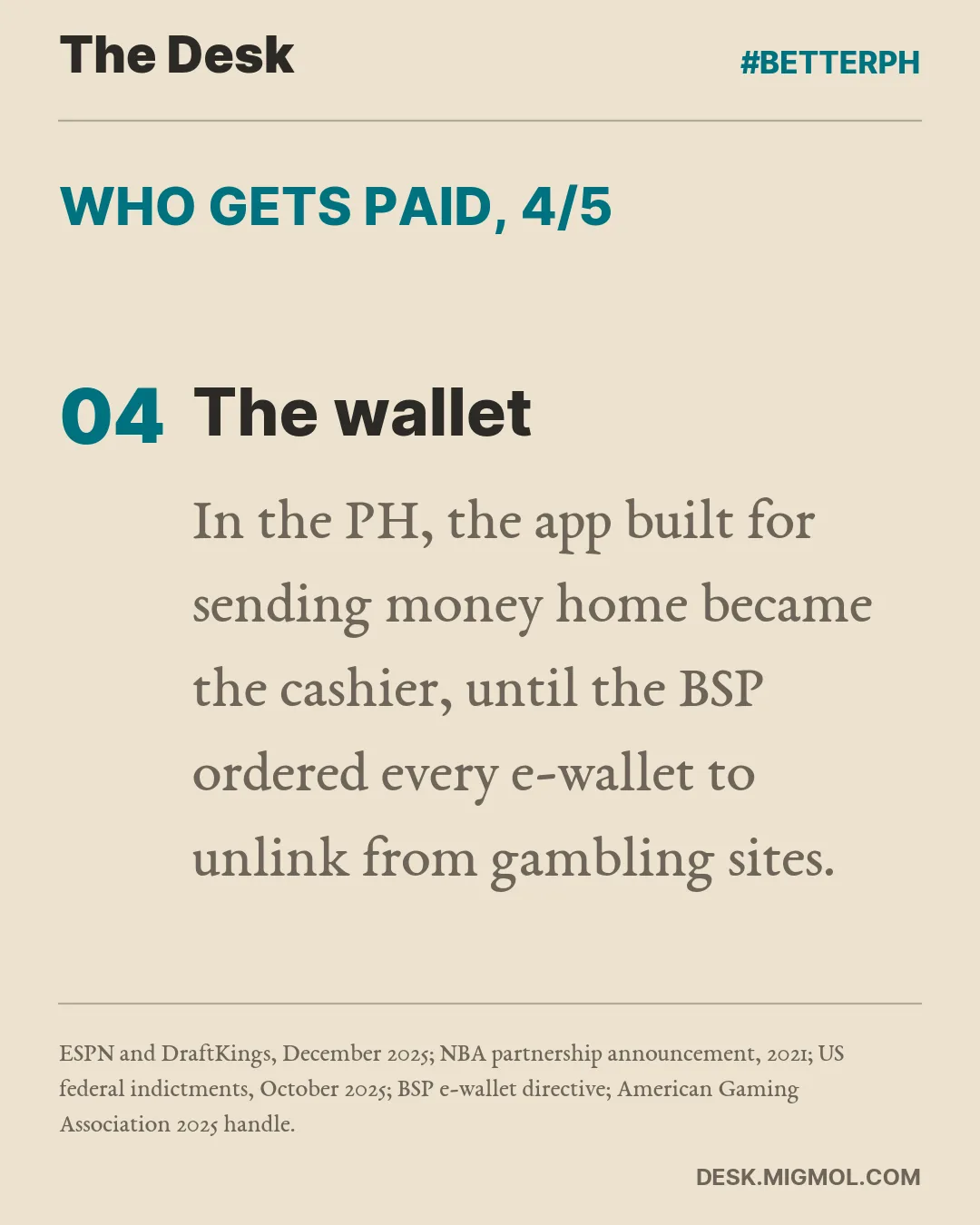
And yet in March 2023, the American Gaming Association, the sportsbooks’ own trade group, rewrote its marketing code to bar its members from college partnerships that promote betting, and from sponsorship deals with college athletes. The industry that pays ESPN and the NBA decided the college game was a line it would not cross.
We don’t have that line. Our collegiate league had to hold it by committee vote, and it lost anyway.
Why an ad ban works on kids when it doesn’t on adults
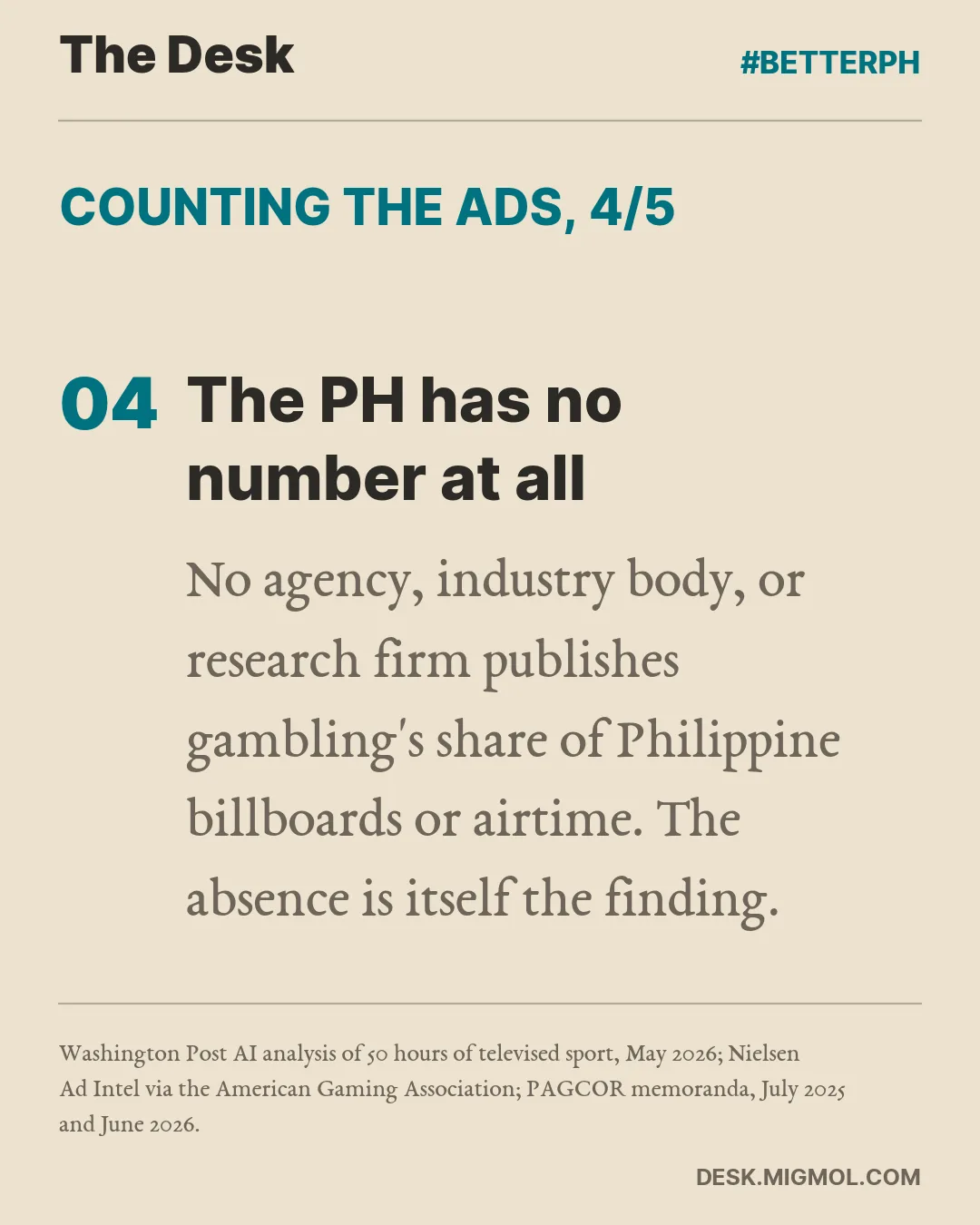
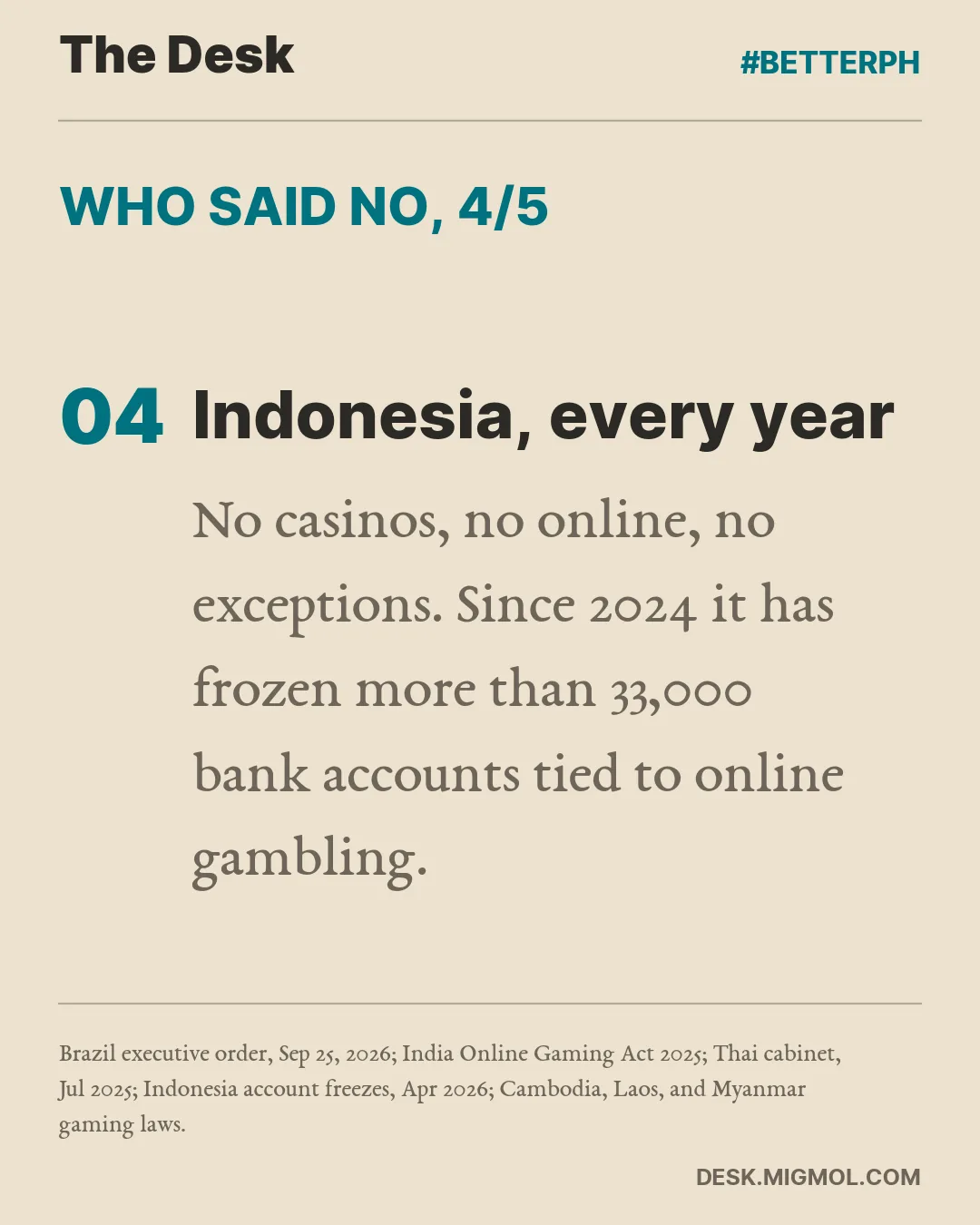
The usual objection to banning gambling ads is that it’s a discovery policy, and adults stopped needing to discover online gambling a long time ago. Only one Filipino in ten has never heard of it. That’s true, and it’s why a general ad ban does less than its sponsors hope.
But a ten-year-old hasn’t discovered it yet. For an adult, an ad ban arrives too late. For a child it is right on time. The one audience for whom advertising is still doing the recruiting is the audience the law currently leaves most exposed.
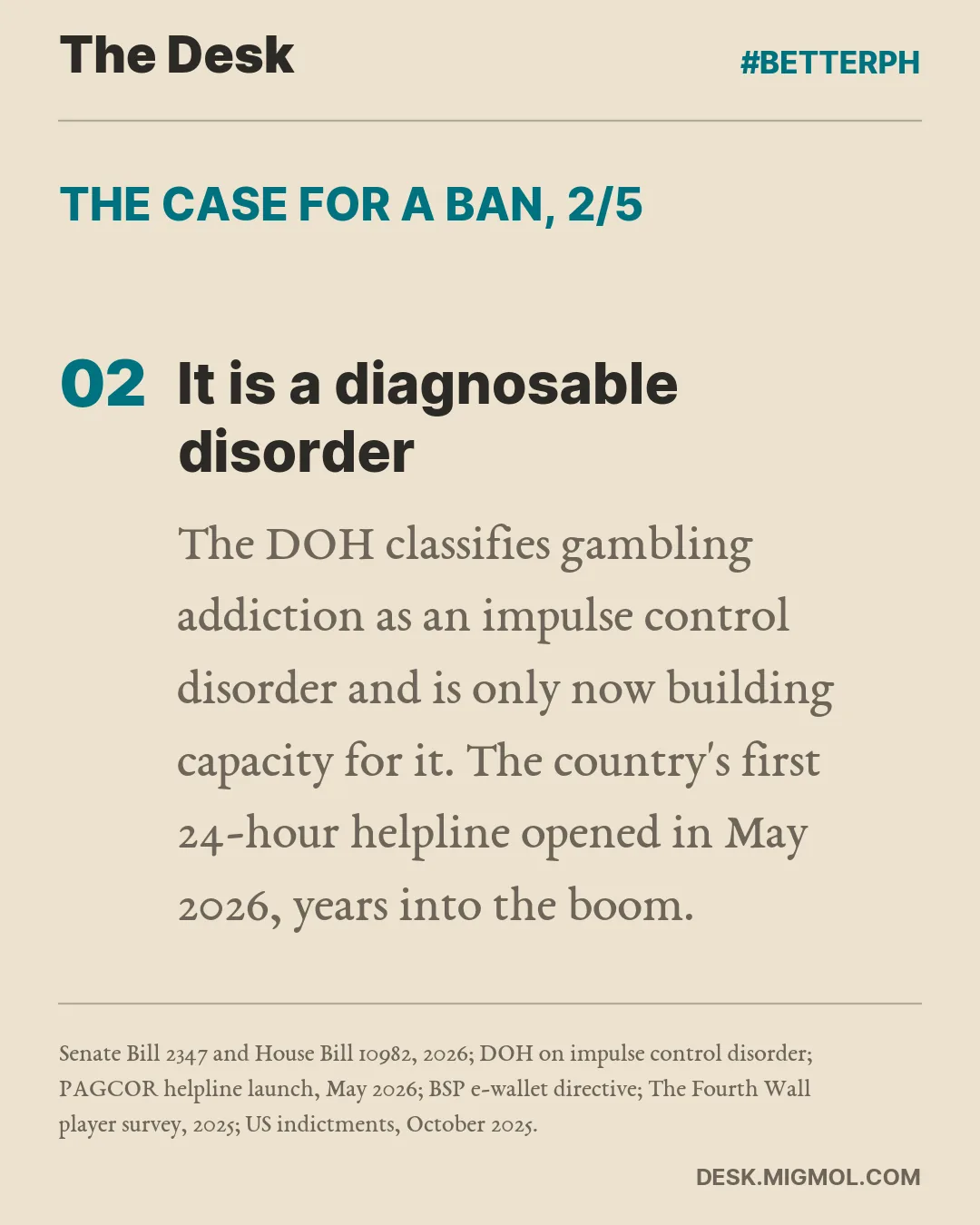
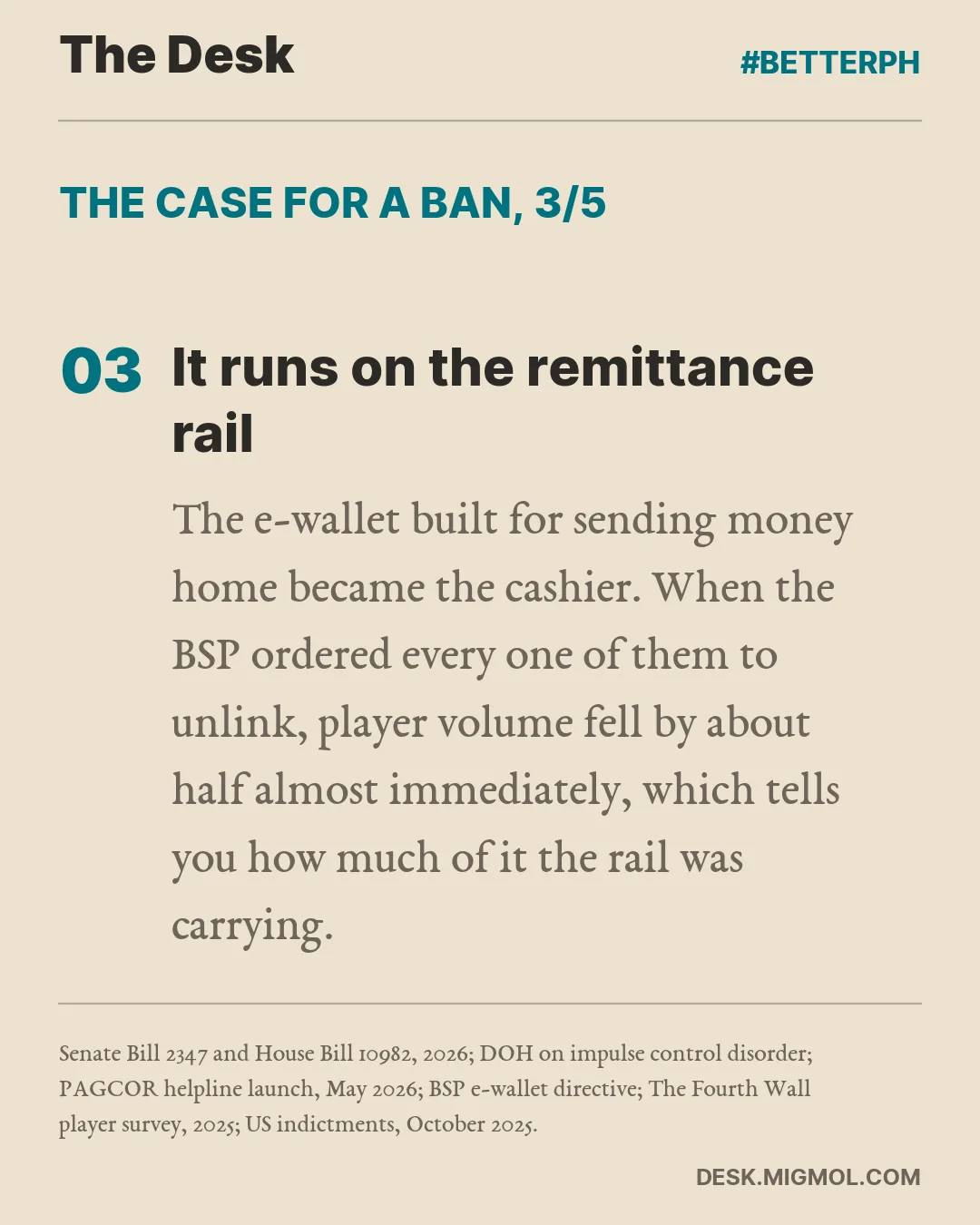
The tools also work when they are actually used. After PAGCOR pulled the billboards and the BSP unlinked the e-wallets, industry revenue fell 16% in the first quarter of 2026, and PAGCOR’s own e-gaming take fell 41.9% in the first half.
Two bills are filed, Escudero’s Senate Bill 2347 and Garcia’s House Bill 10982, and both would ban gambling advertising almost everywhere. A total ad ban is the kind of bill that stalls, and the industry has every reason to make sure it does. If it stalls, the youth provisions are the floor nobody should be able to vote against.
The rest of the region already decided
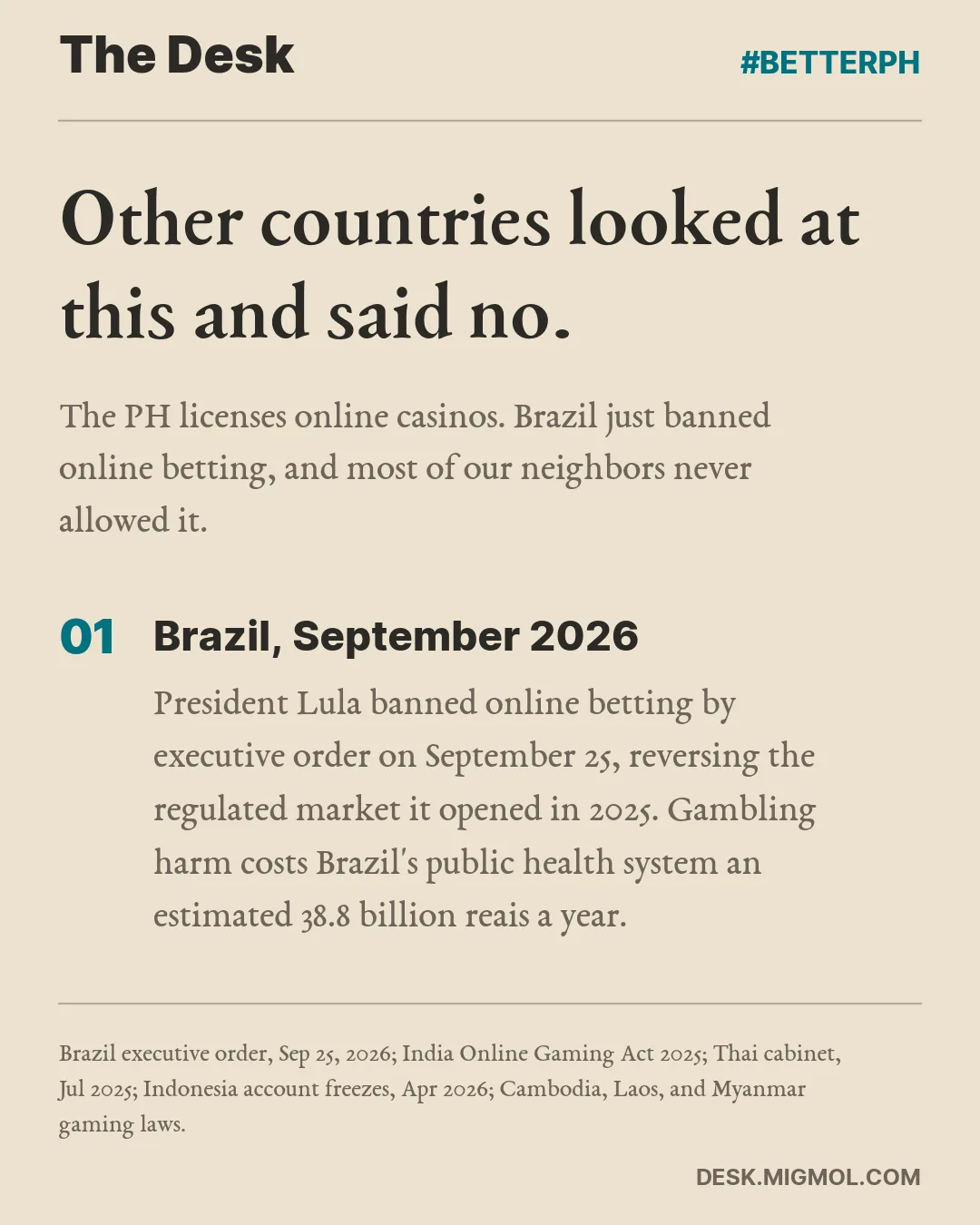
On September 25, Brazil’s President Lula signed an executive order banning online betting, nine days before the first round of an election he is fighting to win. Read the timing however you like, but the reason his government gave was public health: gambling harm costs Brazil’s public health system an estimated 38.8 billion reais a year. The order reverses the regulated market Brazil only opened in 2025, and Congress has to approve it within 120 days for it to stand.
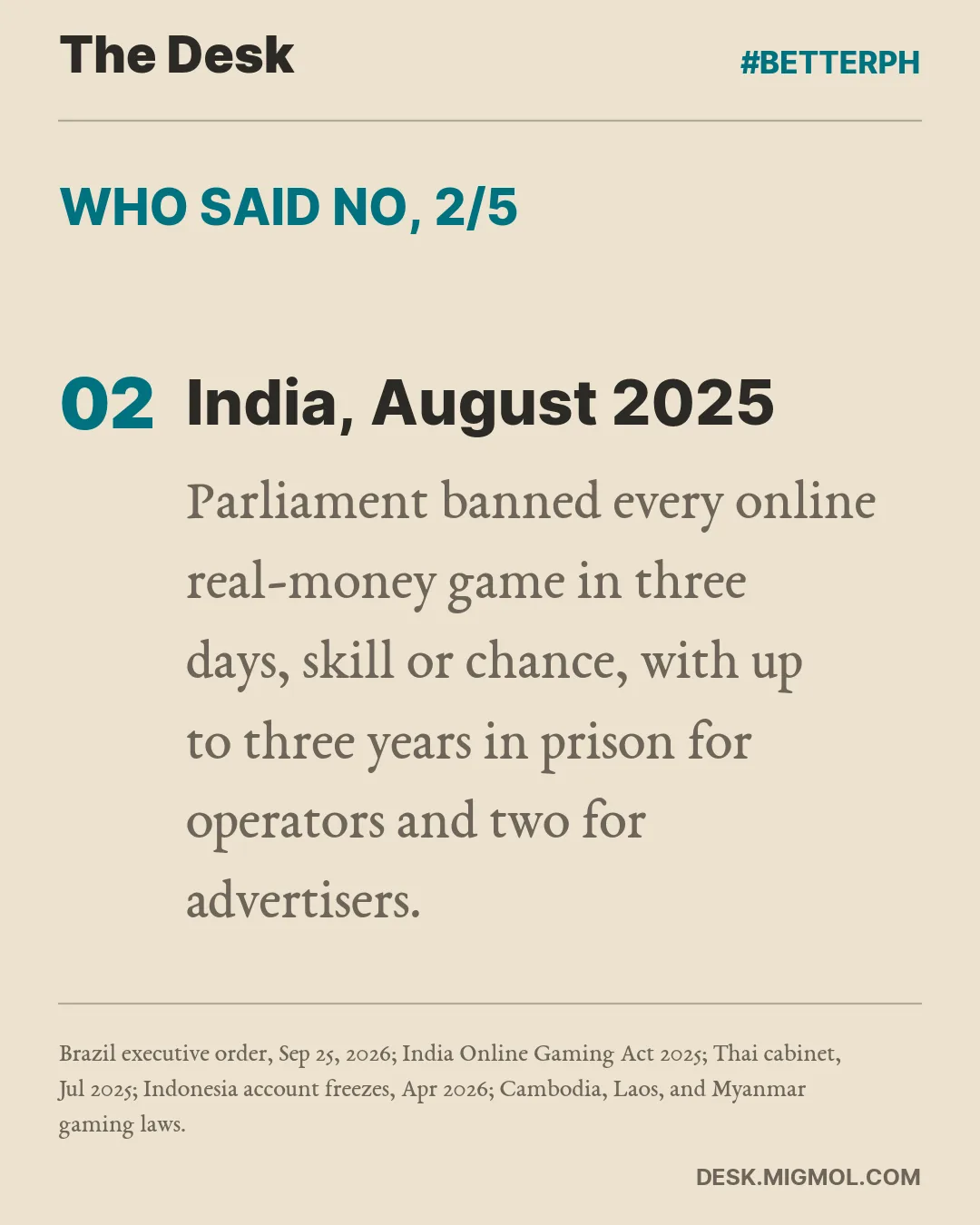
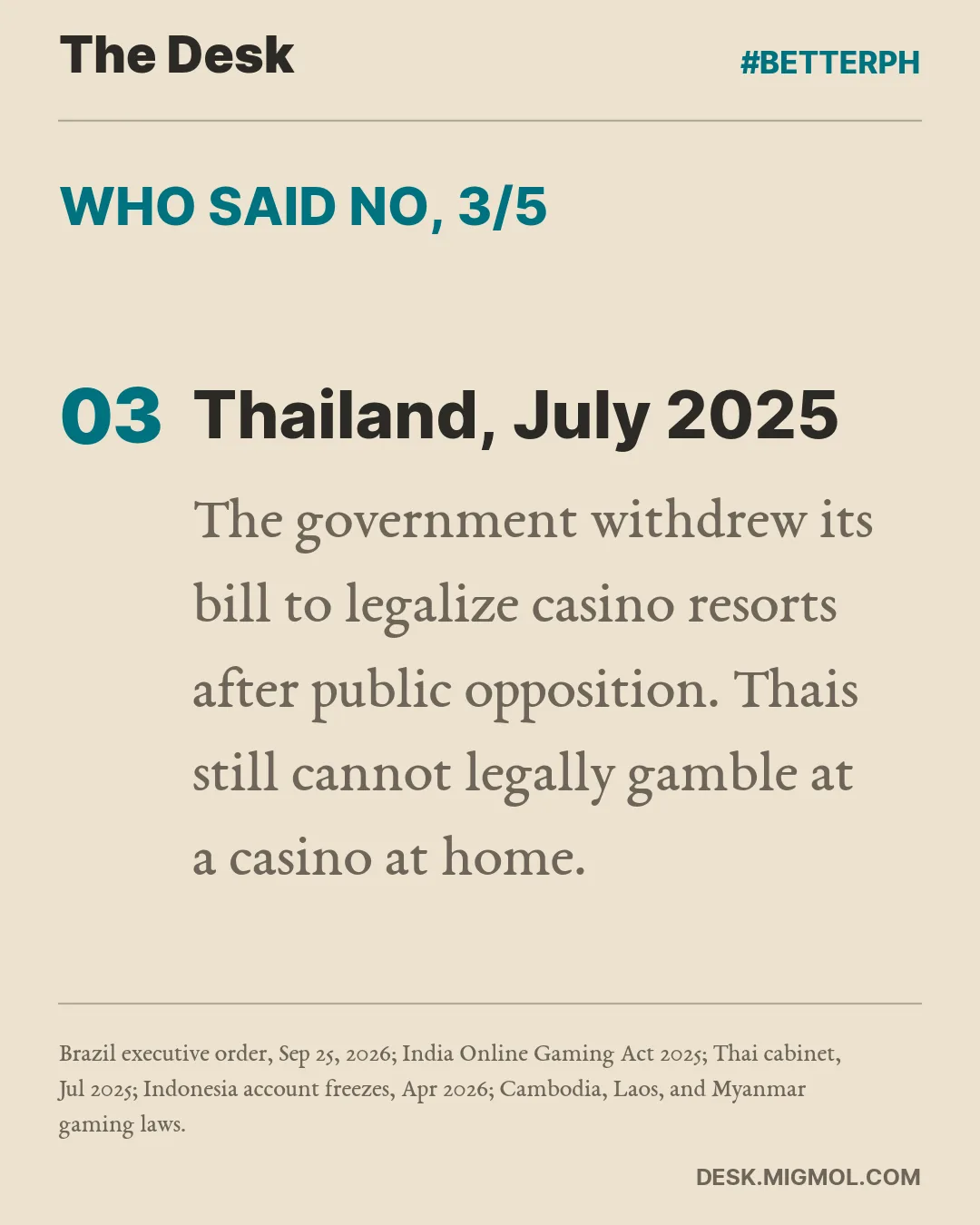
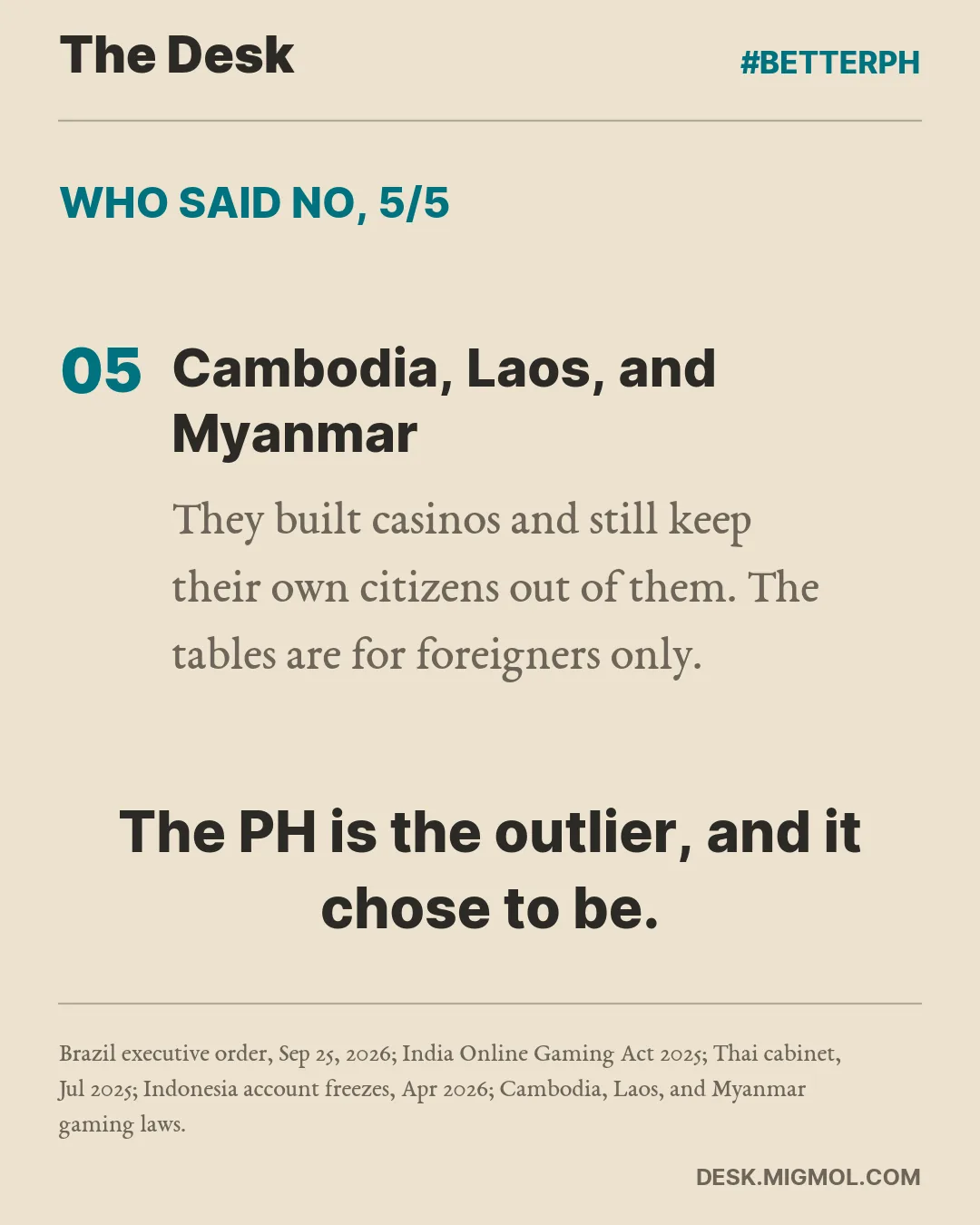
We don’t have to look as far as Brazil. Of 18 countries in our region, ASEAN plus Japan, China, Taiwan, Australia, New Zealand, India, and Pakistan, the Philippines is the only one where a citizen can legally play an online casino at home today. New Zealand opens a licensed market in December. India banned every online real-money game in 2025. Thailand pulled its casino bill after the public pushed back. Cambodia, Laos, and Myanmar built casinos and still keep their own citizens out of them.
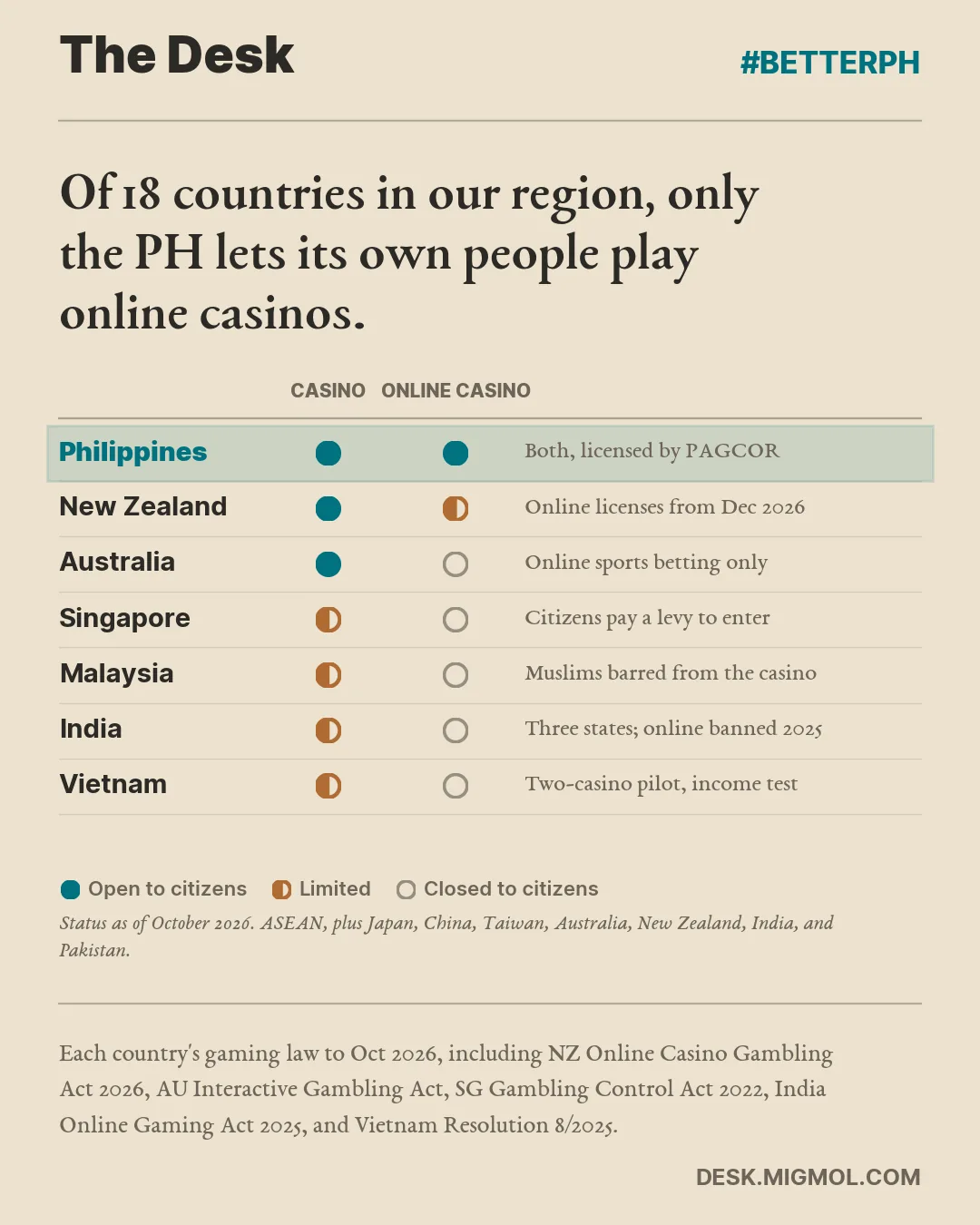
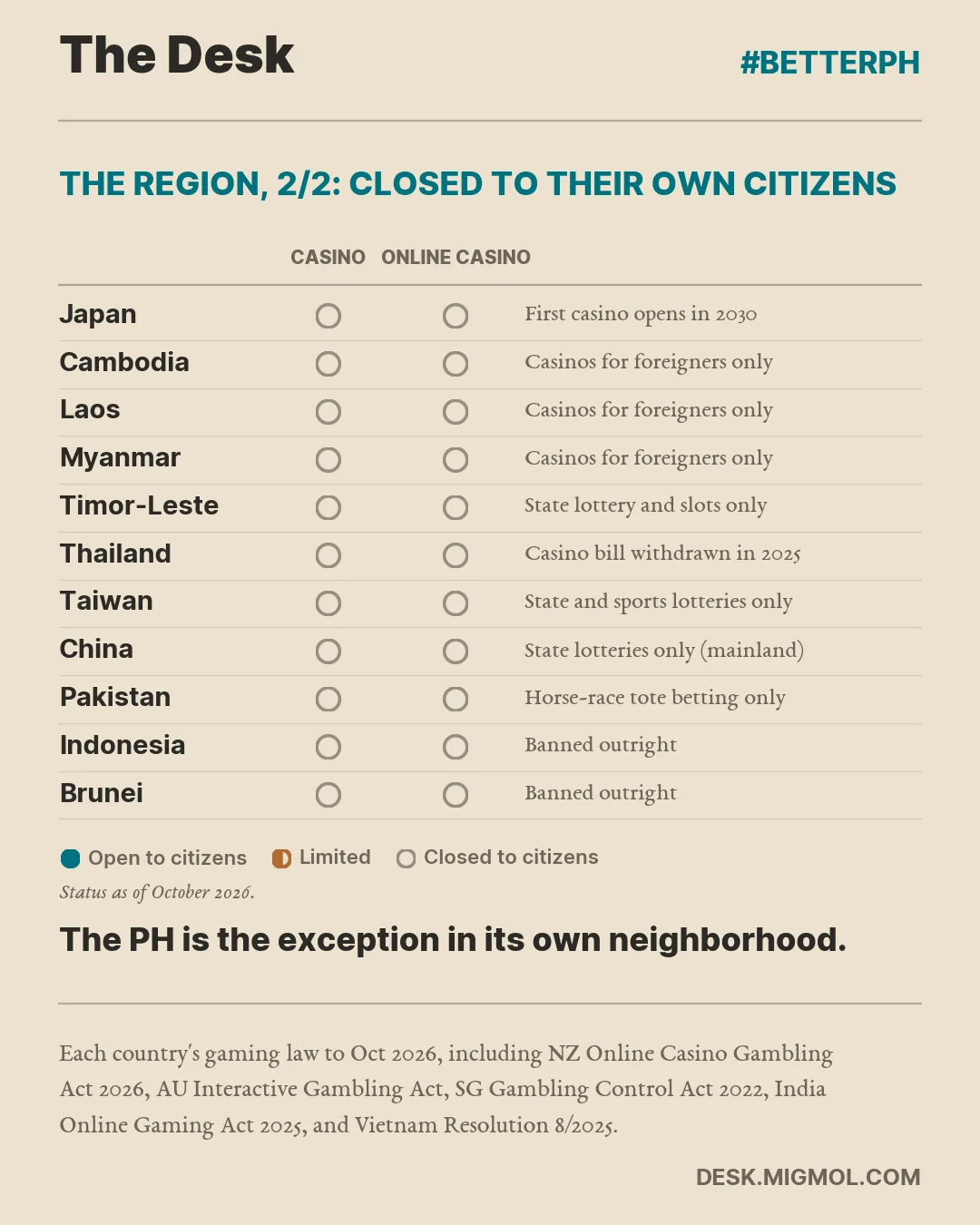
The PH is the exception in its own neighborhood, and it got there by choice, one PAGCOR license at a time.
The call
Laws should be passed that prohibit gambling advertising around schools and colleges, inside the apps and websites the youth use, and in sports programs, collegiate leagues and their broadcasts included.
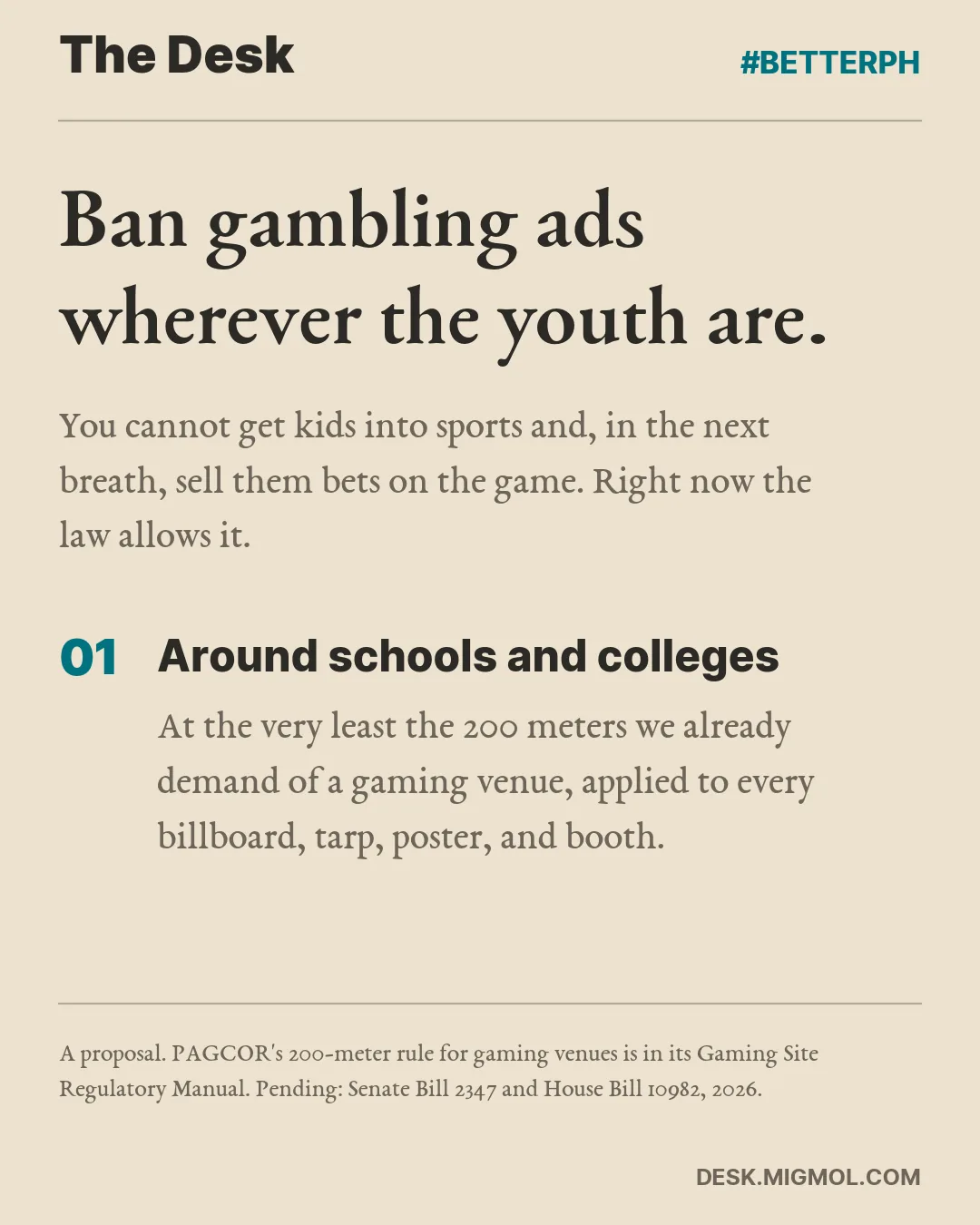
You cannot encourage the youth to get into sports and, in the next breath, encourage them to bet on the games. That’s absurd, and right now the law allows it.
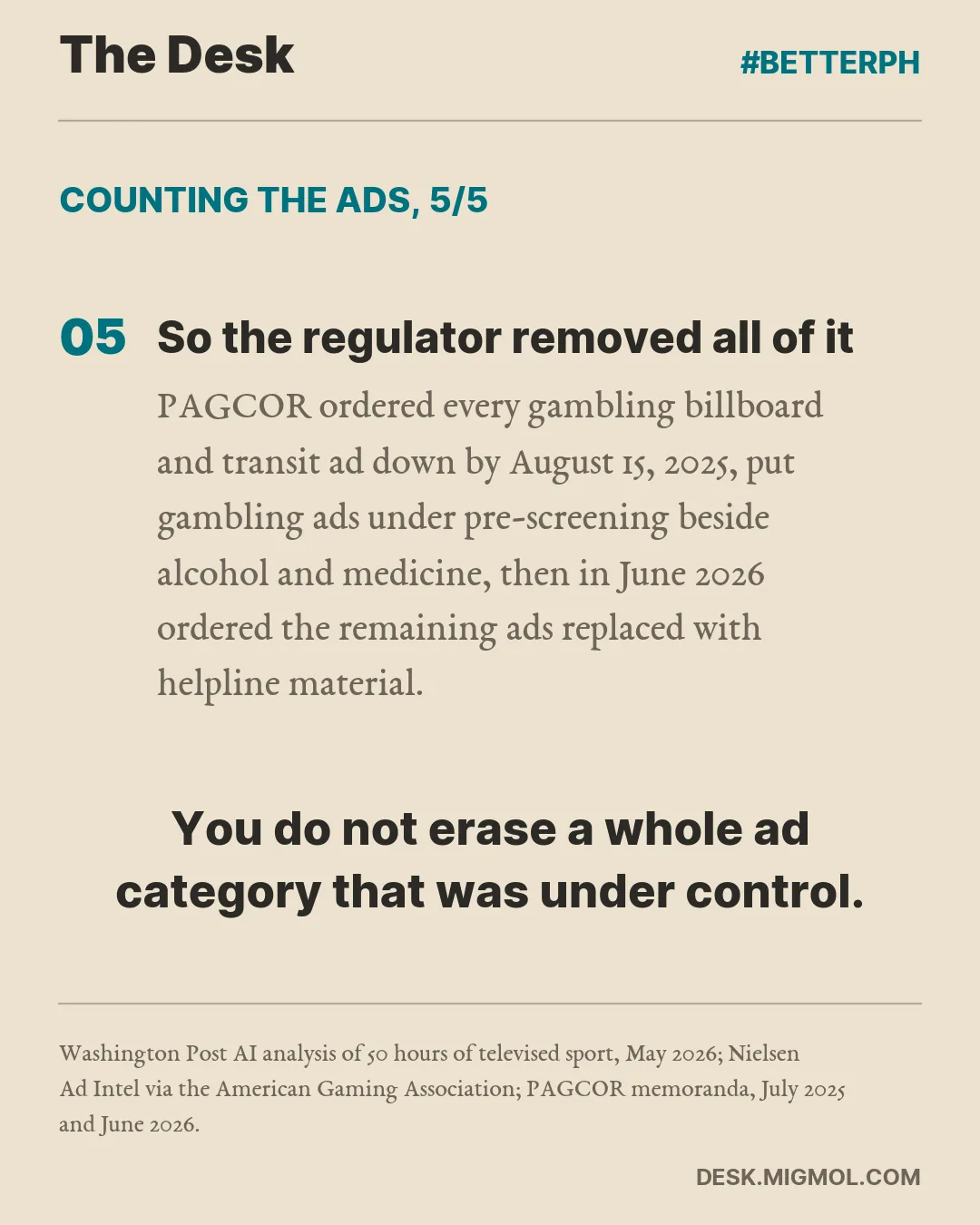
That means four places. Around schools and colleges, at the very least the same 200 meters we already demand of a gaming venue, for every billboard, tarp, poster, and booth. In collegiate and youth sports, meaning the leagues, the venues, the uniforms, the mascots, and the broadcasts. In the games, streaming apps, and social platforms with young audiences, with whoever sells the ad placement answering for where it lands. And in influencer and athlete promotion, where the gambling brand is liable when it reaches minors, and not just the creator holding the phone, because a fine smaller than the giveaway is not a deterrent.
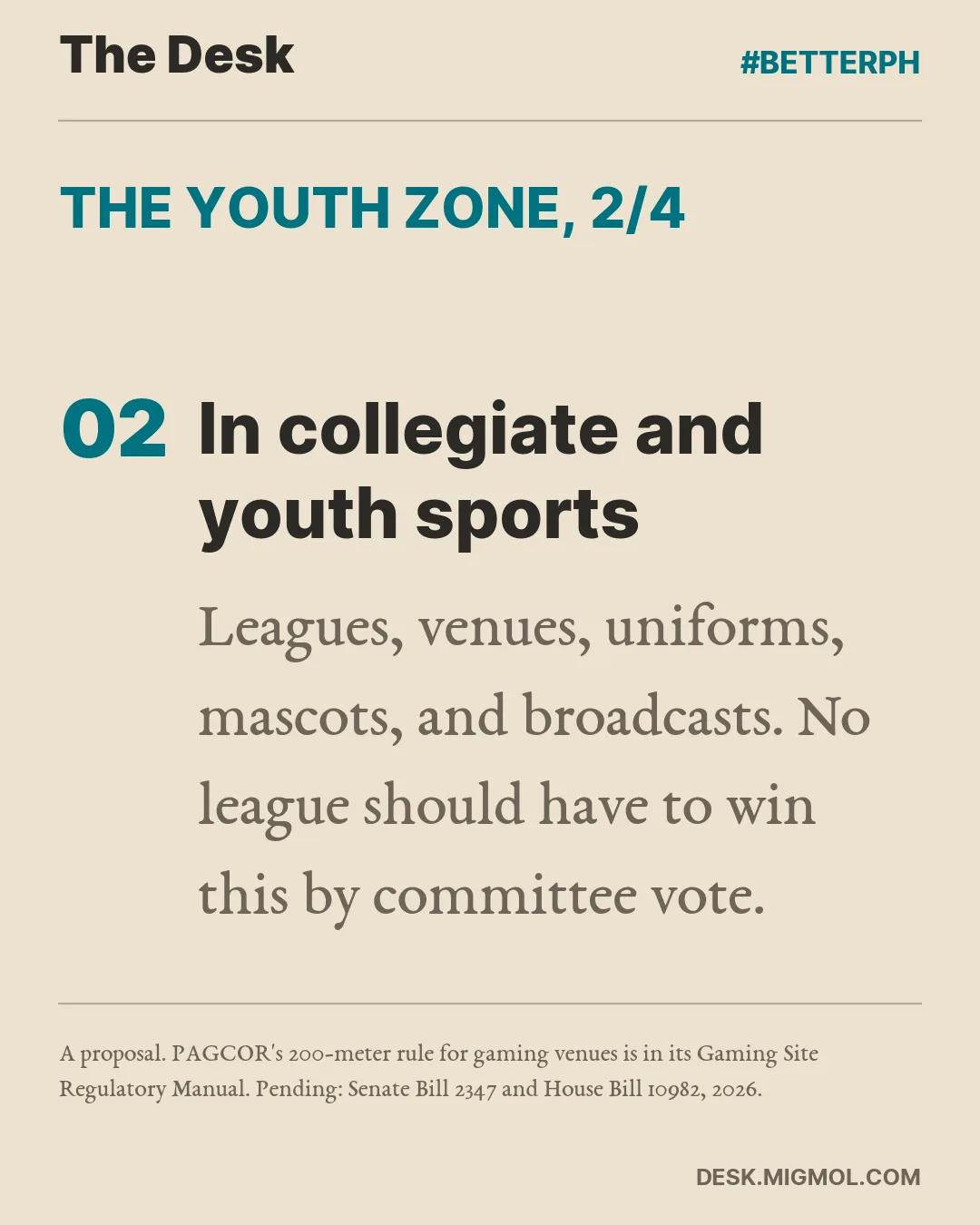
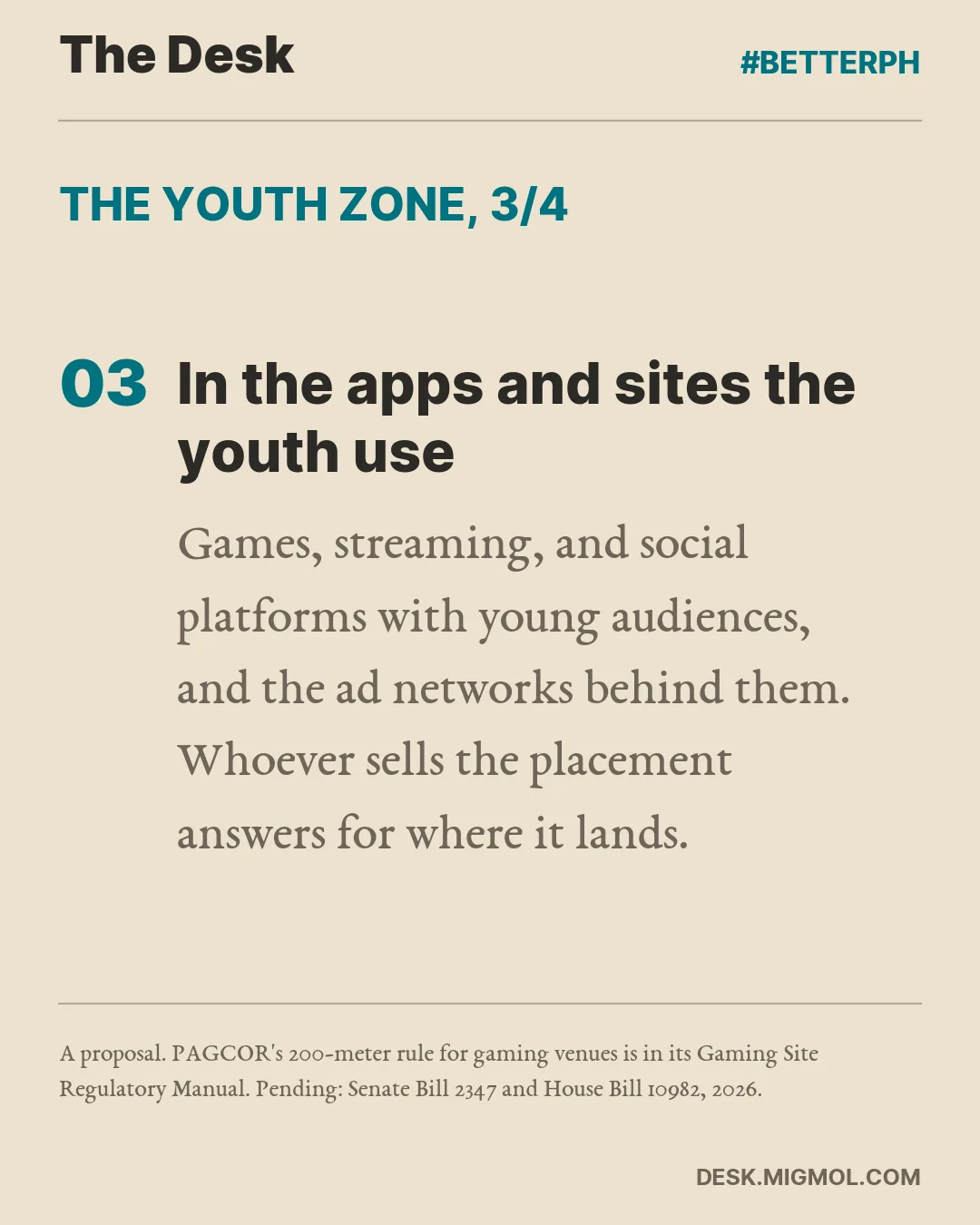
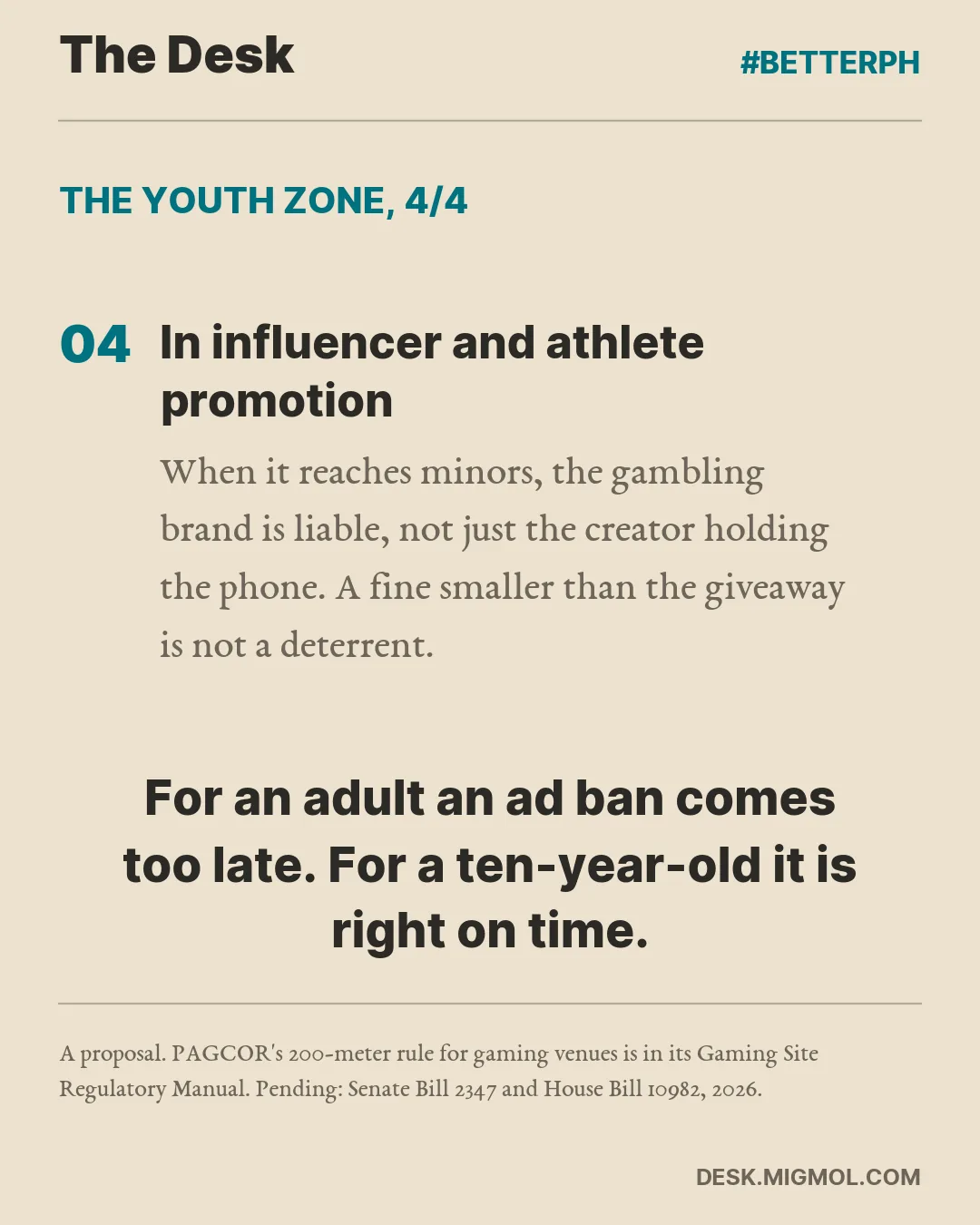
The NCAA already said no once, by committee, and lost to an agency and a mascot. It shouldn’t have to keep winning that vote.
PAGCOR’s National Problem Gambling Helpline runs 24 hours on (02) 8248-9568.

16,563 Ballots Were Shaded Before Anyone Voted
Nobody had to break a rule to reach the pre-shaded ballots in Maluso. The rule put them there. The Omnibus Election Code was written two months before EDSA, and Comelec's 963-page fix is still waiting.
Read more →
₱457 Million in Cash, and Nobody Asked
The bank filed the report. The AMLC said it had too many to read. Part 4 of 4 on anti-corruption with teeth.
Read more →
If you're above 40, this is the 2nd Iran Oil Crisis in Your Lifetime.
In 1980, a crisis in Iran pushed oil to $149 a barrel in today's dollars. Saudi Arabia had warned that prices that high would push the world to find something else, and it did. In 2026 it is Iran again, and this time the something else is already in our driveways.
Read more →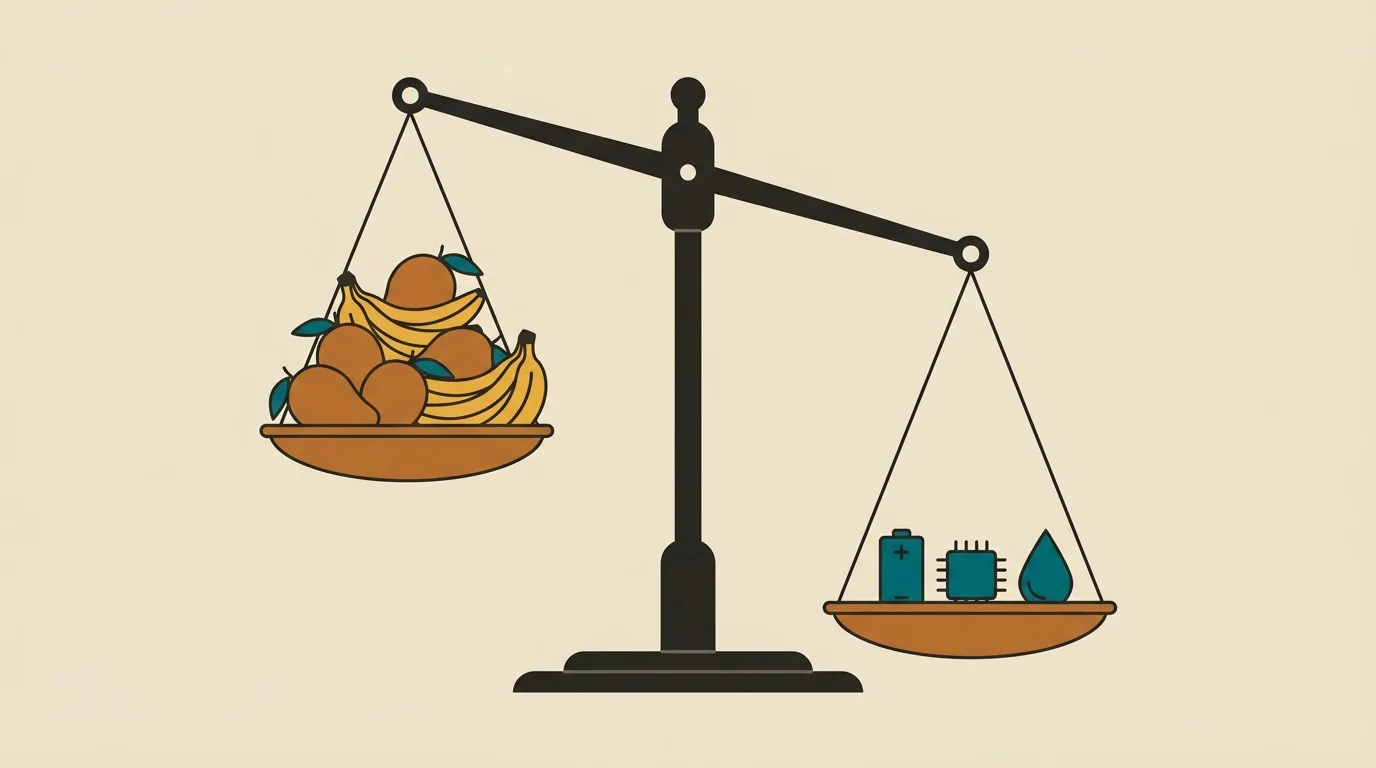
What does the world need from the Philippines? Right now, nothing it can't get somewhere else.
China refines 91% of the world's rare earths. Taiwan makes over 90% of its most advanced chips. We import 98% of our garlic and ship our nickel out as raw ore. What could the Philippines own that the world can't do without?
Read more →