How many Filipinos gamble online? Nobody in charge knows, and the harm is showing up on the police blotter instead

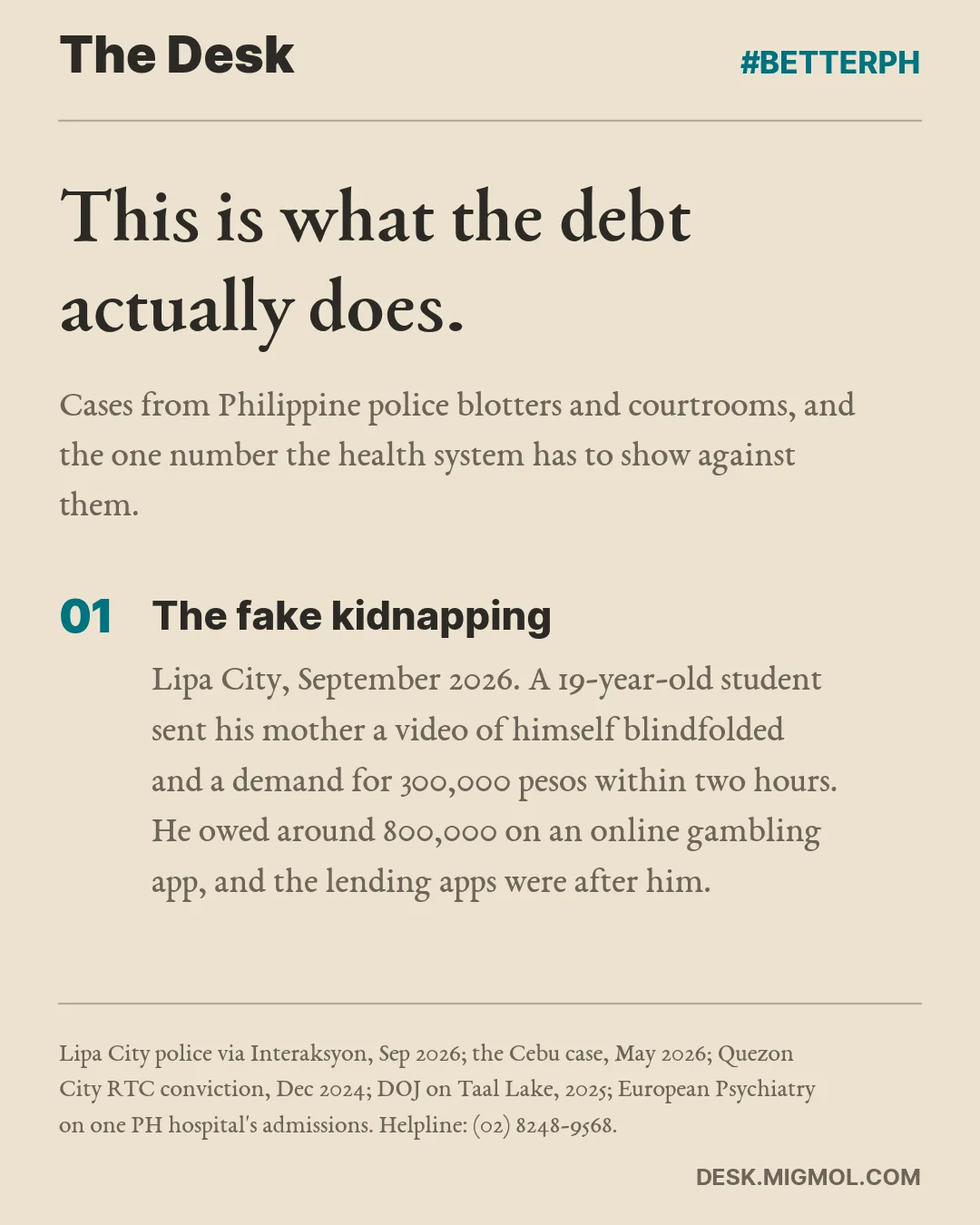
On September 3, a 19-year-old second-year college student in Lipa City was charged for faking his own kidnapping.
He had sent his mother a video of himself blindfolded and crying. A message followed, demanding ₱300,000 within two hours in exchange for his life. The family went to the Lipa City police, who found him at a hotel in Calamba, Laguna, where the CCTV showed he had checked in alone. He owed around ₱800,000 on an online gambling app, having lost about ₱500,000 playing it, and the lending apps were already after him. His own account: “Nabaon ako sa utang gawa ng lending app and sobra akong natakot na hindi bayaran.” Then, to anyone watching: “Sa mga kabataan po diyan, ‘wag na ‘wag po kayo gagaya sa akin. Kumapit po ako sa patalim.”
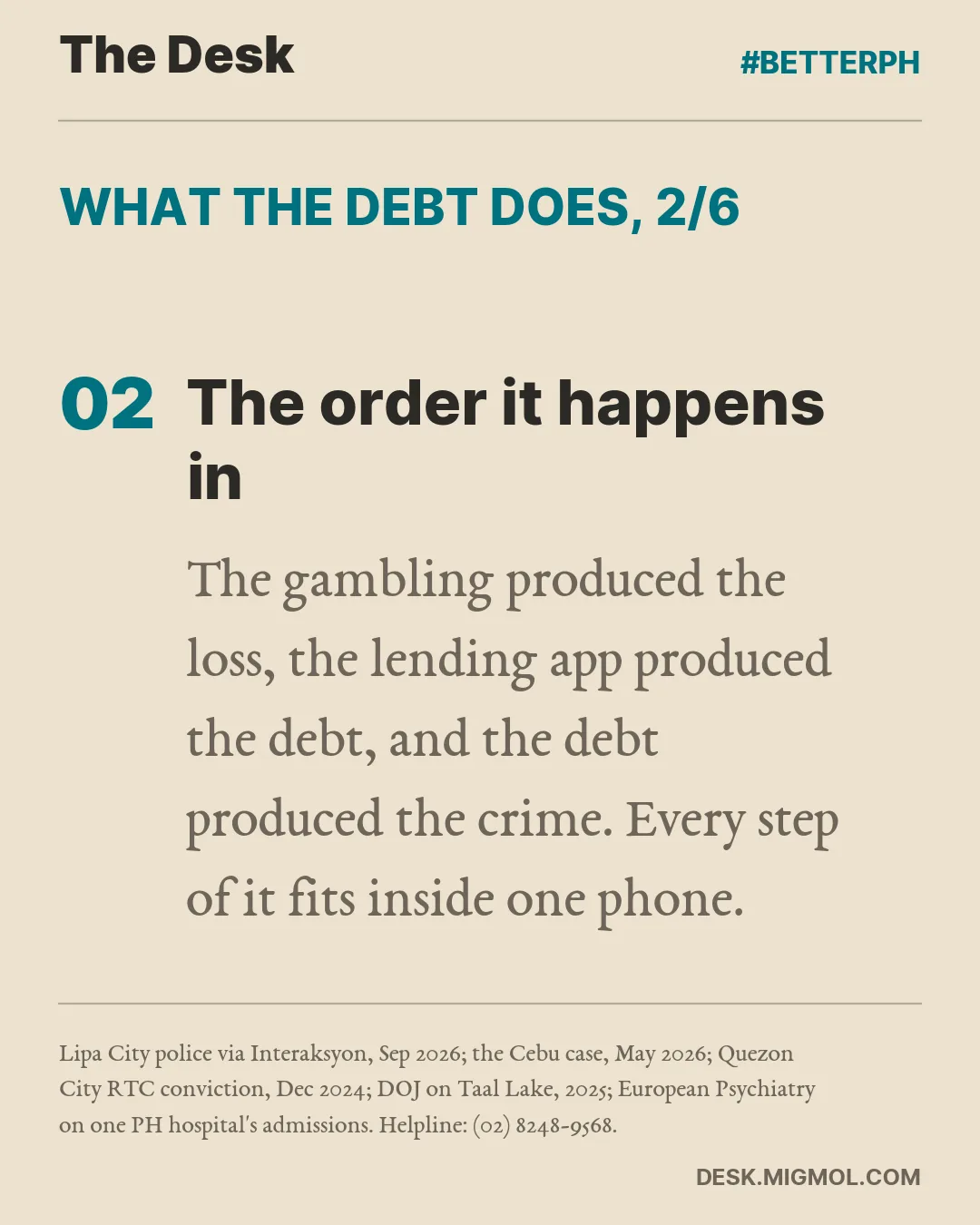
The gambling produced the loss, the lending app produced the debt, and the debt produced the crime. Every step of it fits inside one phone.
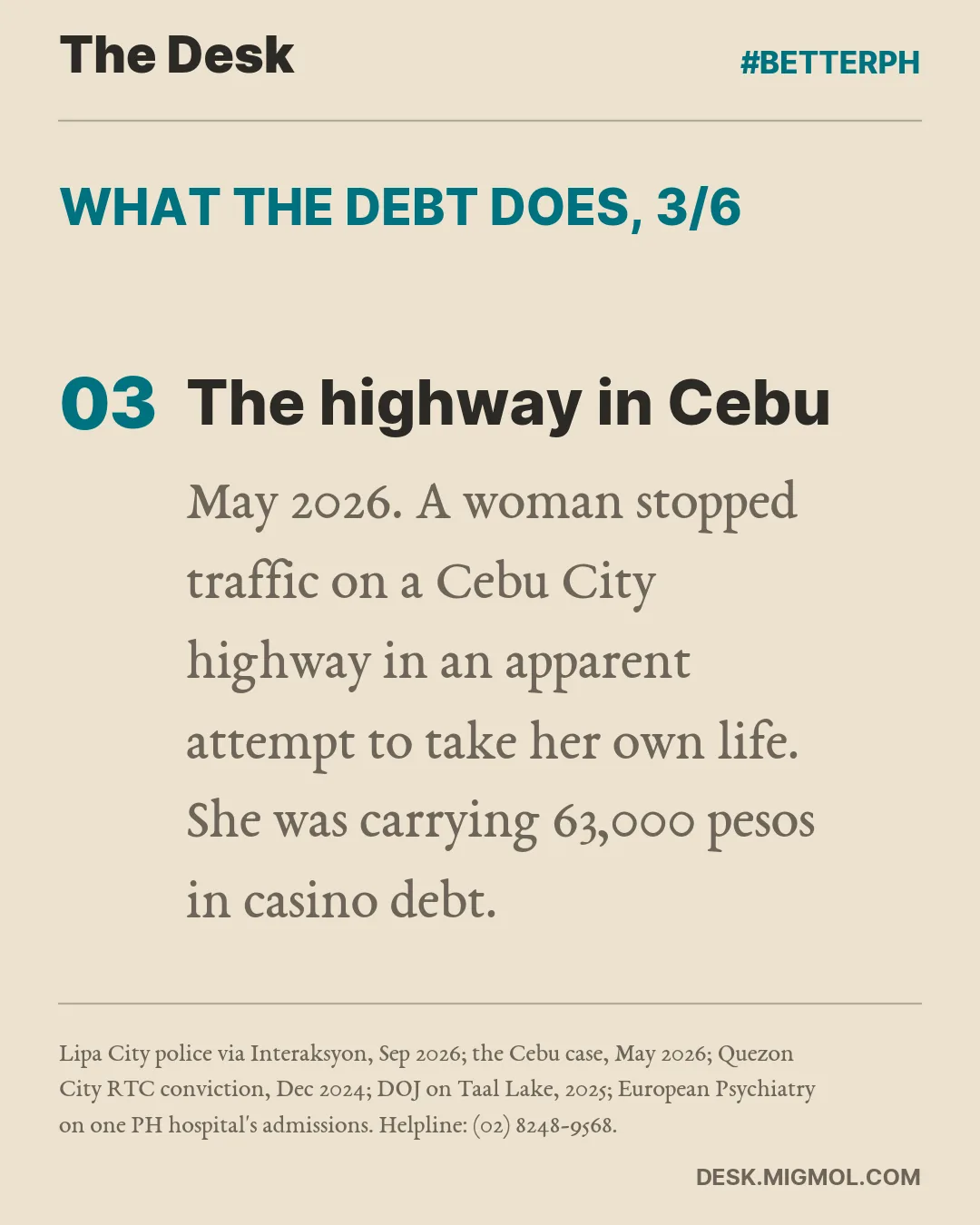
He is not an outlier. He is the one who got a news crew. In May, a woman stopped traffic on a Cebu City highway in an apparent attempt to take her own life, carrying ₱63,000 in casino debt. The Cybercrime Investigation and Coordinating Center logged 1,890 complaints against illegal gambling sites in the first two months of 2026 and called the figure alarming.
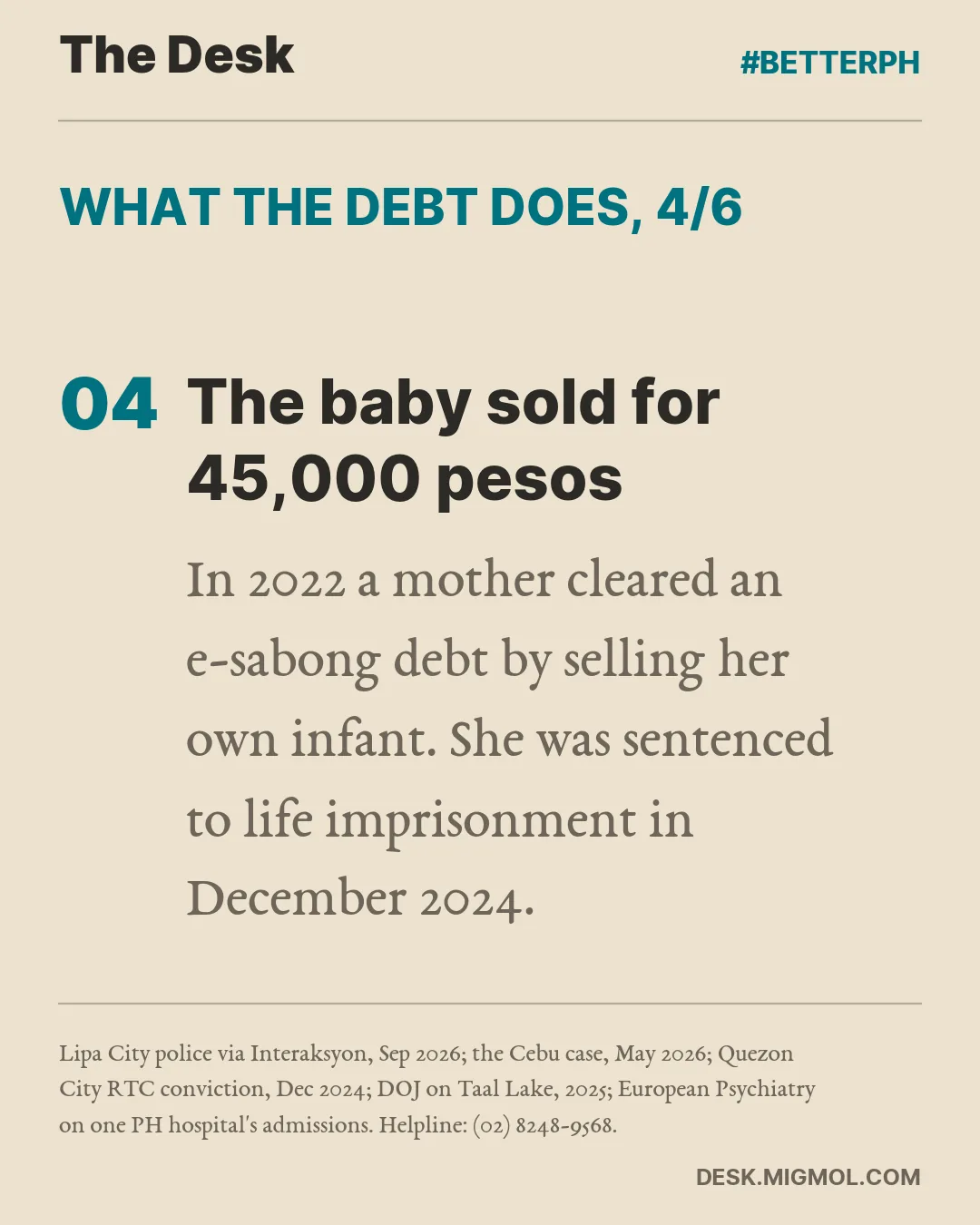
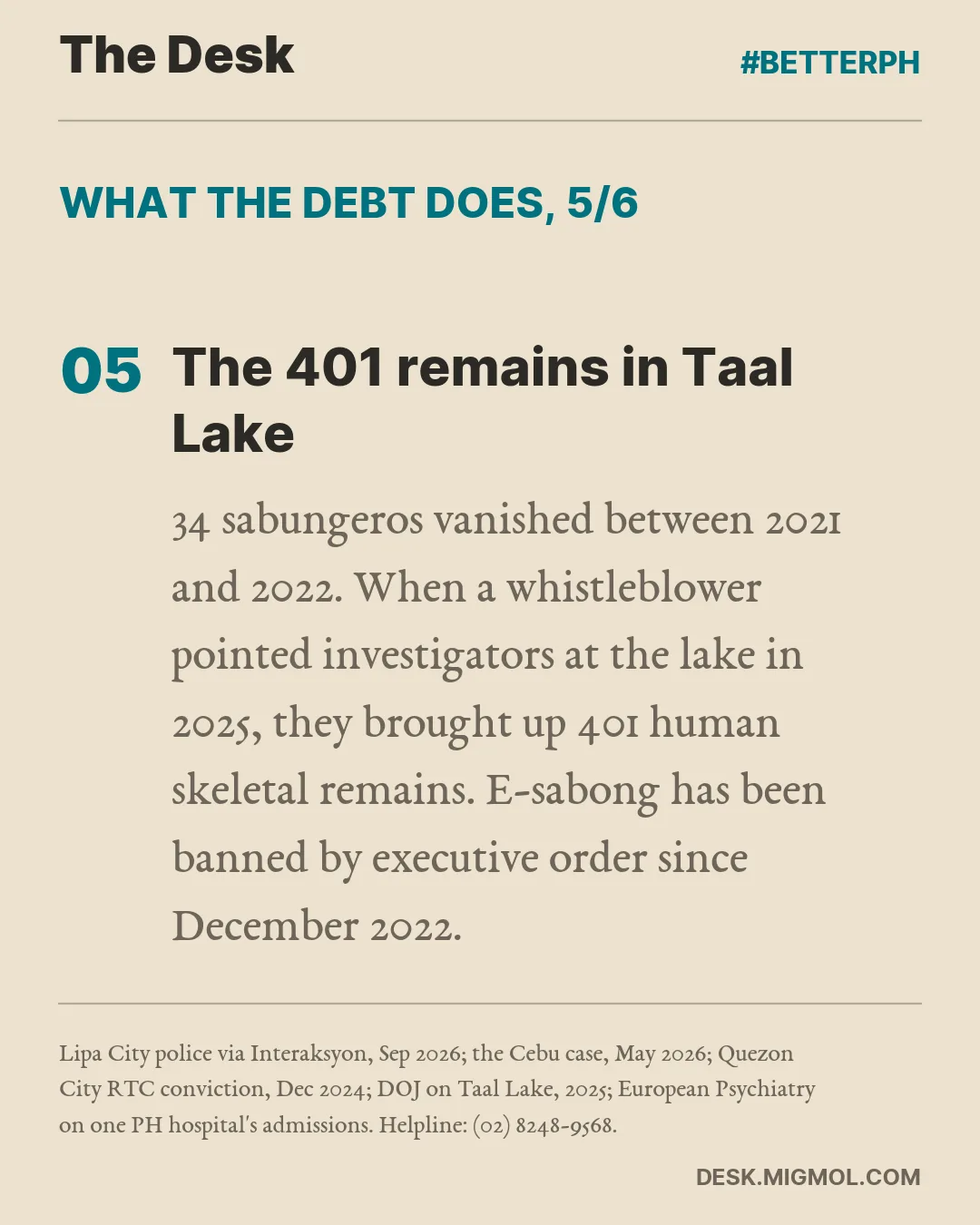
We have already run this experiment once, with e-sabong, and the results are on the record. In 2022 a mother sold her baby for ₱45,000 to clear an e-sabong debt, and was sentenced to life in December 2024. 34 sabungeros disappeared between 2021 and 2022, and when a whistleblower finally pointed investigators at Taal Lake in 2025 they brought up 401 human skeletal remains. E-sabong has been banned by executive order since December 2022, and the PNP was still announcing a crackdown on its resurgence in February 2026.
Nobody knows how big it is
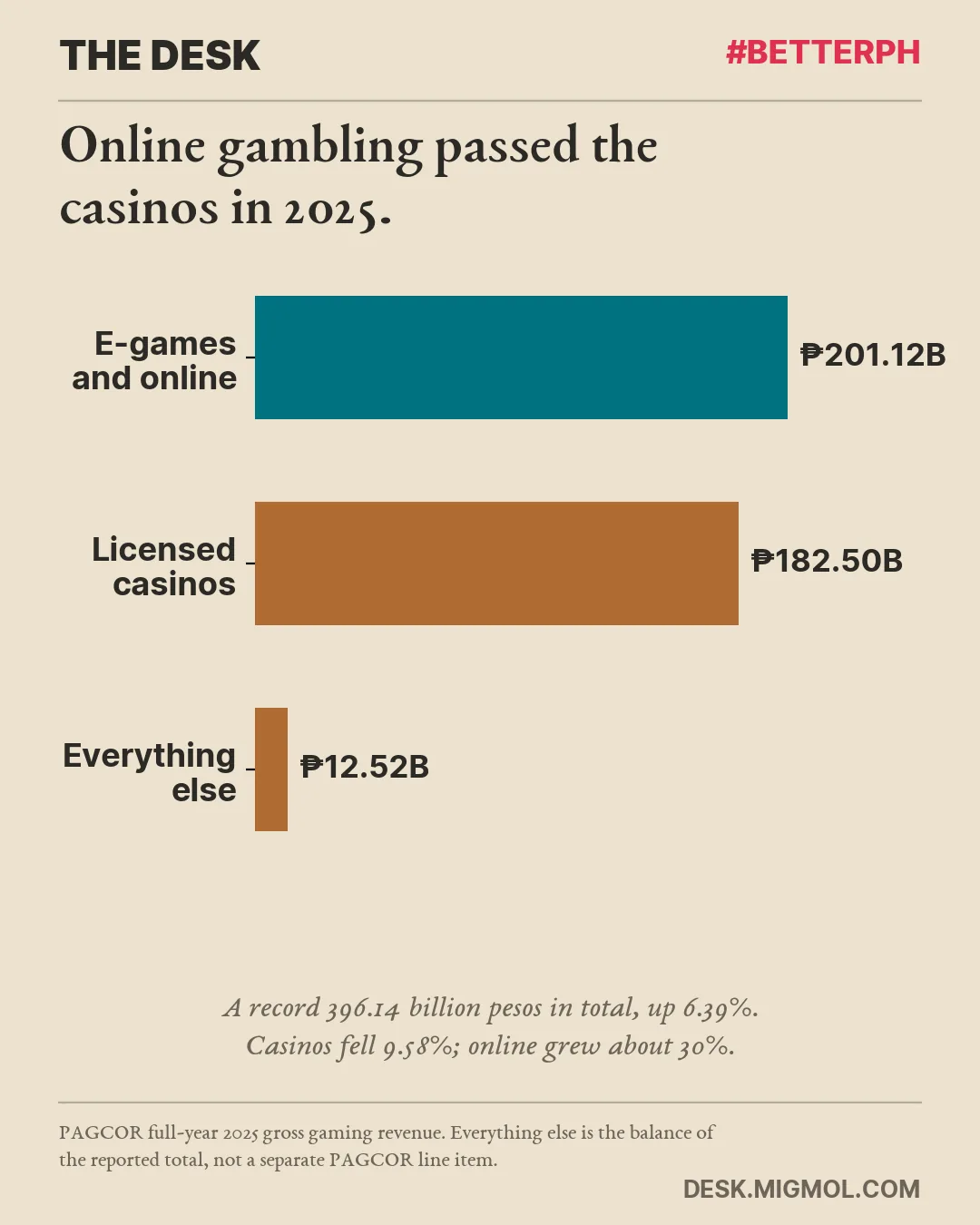
The money, at least, is counted. Philippine gross gaming revenue hit a record ₱396.14 billion in 2025, and for the first time online gambling passed the casinos, at ₱201.12 billion against ₱182.50 billion.
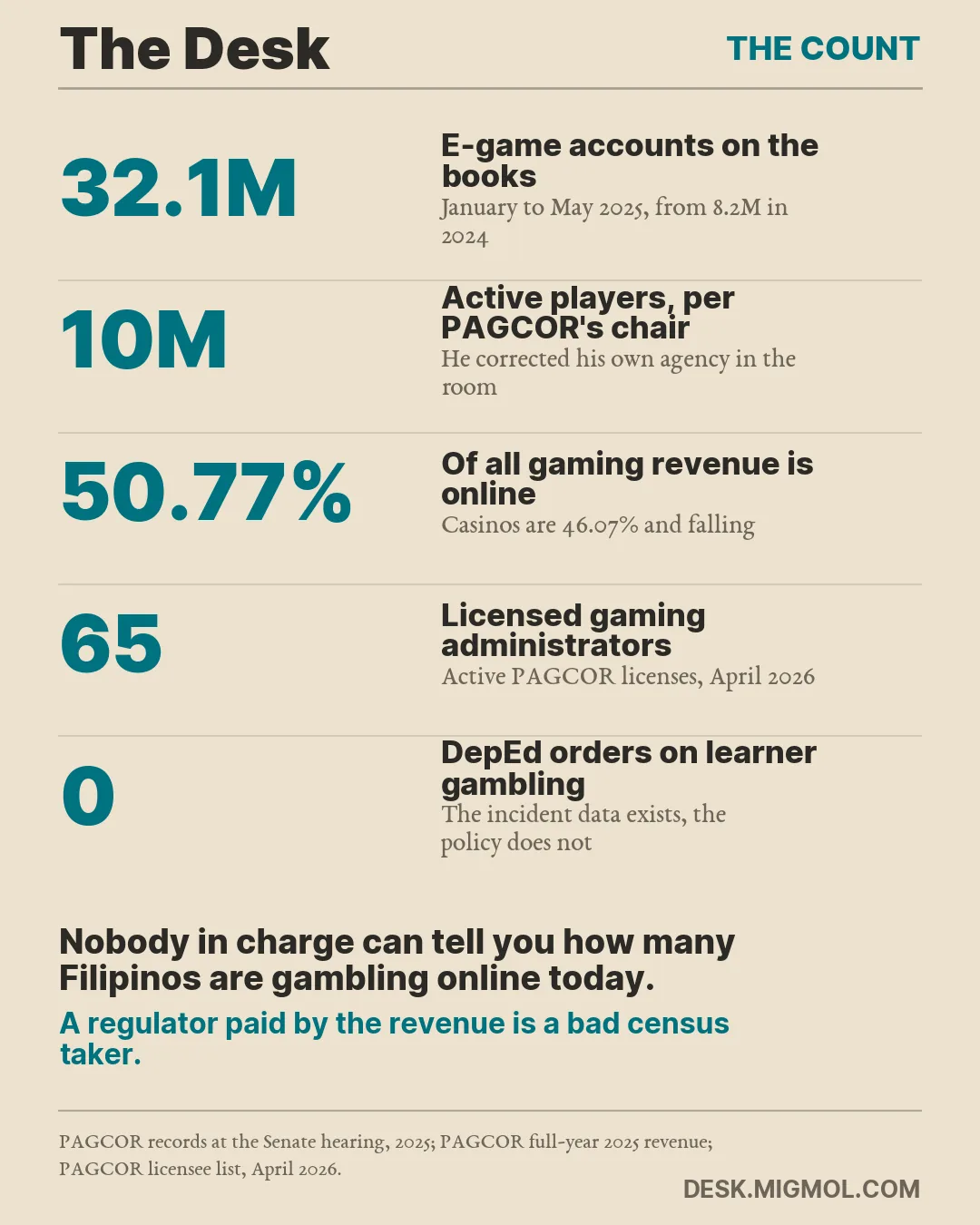
The players are not. At a Senate hearing in 2025, Senator Sherwin Gatchalian presented PAGCOR’s own records: 32.117 million e-game players from January to May 2025, against 8.2 million at the end of 2024. That is roughly half the adult population in five months.
PAGCOR’s chairman then corrected his own agency’s number in the room. Those are registered accounts, he said, and active players are closer to 10 million, because people hold several accounts each.
Take either figure and the position is bad. If it is 32 million, we have a national emergency. If it is 10 million, the regulator has been publishing a number three times its own estimate of reality, and it still cannot measure the problem. A regulator that collects the revenue is not a body with any incentive to produce an honest count, and the one it did produce fell apart under a single follow-up question.
Now look for it in the health data
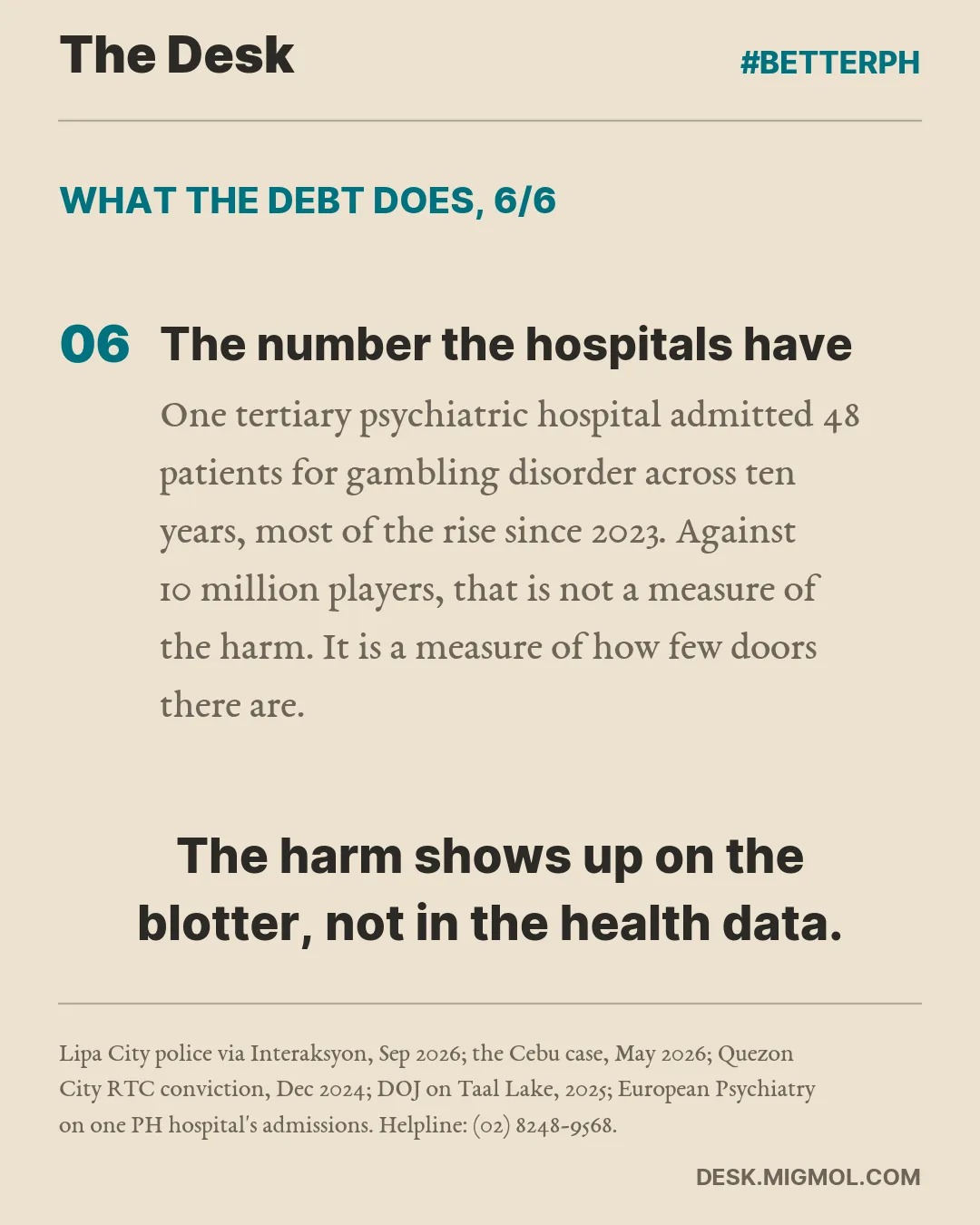
One tertiary psychiatric hospital admitted 48 patients for gambling disorder across ten years, 2016 to 2025, with the rise concentrated in the last three. Against 10 million players, 48 is not a measure of the harm. It is a measure of how few doors there are.
PAGCOR’s National Problem Gambling Helpline runs 24 hours on (02) 8248-9568.
16,563 Ballots Were Shaded Before Anyone Voted
Nobody had to break a rule to reach the pre-shaded ballots in Maluso. The rule put them there. The Omnibus Election Code was written two months before EDSA, and Comelec's 963-page fix is still waiting.
Read more →
₱457 Million in Cash, and Nobody Asked
The bank filed the report. The AMLC said it had too many to read. Part 4 of 4 on anti-corruption with teeth.
Read more →
If you're above 40, this is the 2nd Iran Oil Crisis in Your Lifetime.
In 1980, a crisis in Iran pushed oil to $149 a barrel in today's dollars. Saudi Arabia had warned that prices that high would push the world to find something else, and it did. In 2026 it is Iran again, and this time the something else is already in our driveways.
Read more →
What does the world need from the Philippines? Right now, nothing it can't get somewhere else.
China refines 91% of the world's rare earths. Taiwan makes over 90% of its most advanced chips. We import 98% of our garlic and ship our nickel out as raw ore. What could the Philippines own that the world can't do without?
Read more →