Make Our Taxes Work: Reform the BIR
From 250,000 to 8 million pesos you climb five separate rate jumps. After that the ladder stops, and most real wealth was never taxed as salary anyway.
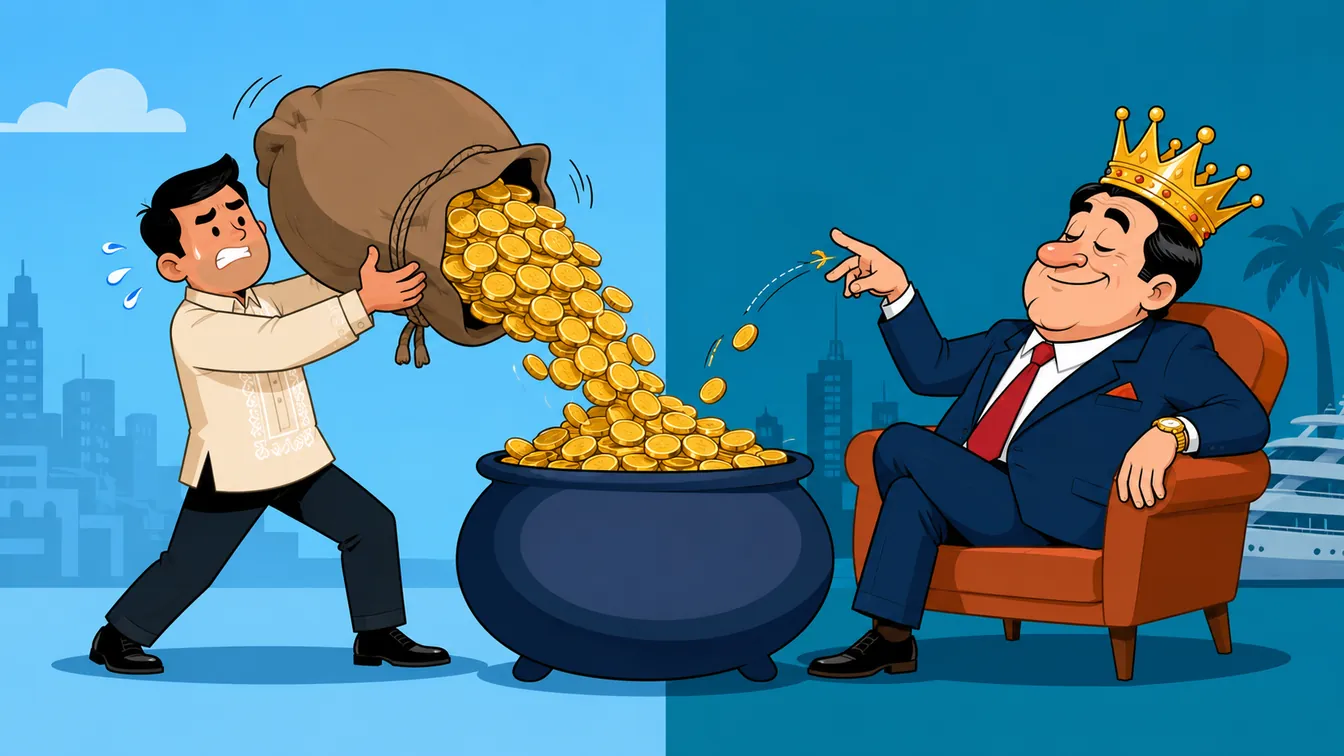
In my last job I sat three levels down on the org chart from one of the richest people in the country. Someone on the Forbes global list. A fortune I will not touch in ten lifetimes was at the top of that building, and my income was a salary that landed in my account already taxed, cut before I ever saw it.
One day I actually read the income tax table, line by line, and something about it stopped me.
Our brackets climb, and then they quit. From ₱250,000 to ₱8 million of annual taxable income, you pass through five separate rate jumps: 15 percent, then 20, then 25, then 30, then 35. Five rungs in a fairly short climb. After ₱8 million, the ladder ends. Whether your taxable income is ₱8 million or ₱8 billion, a thousand times more, the rate is the same flat 35 percent.
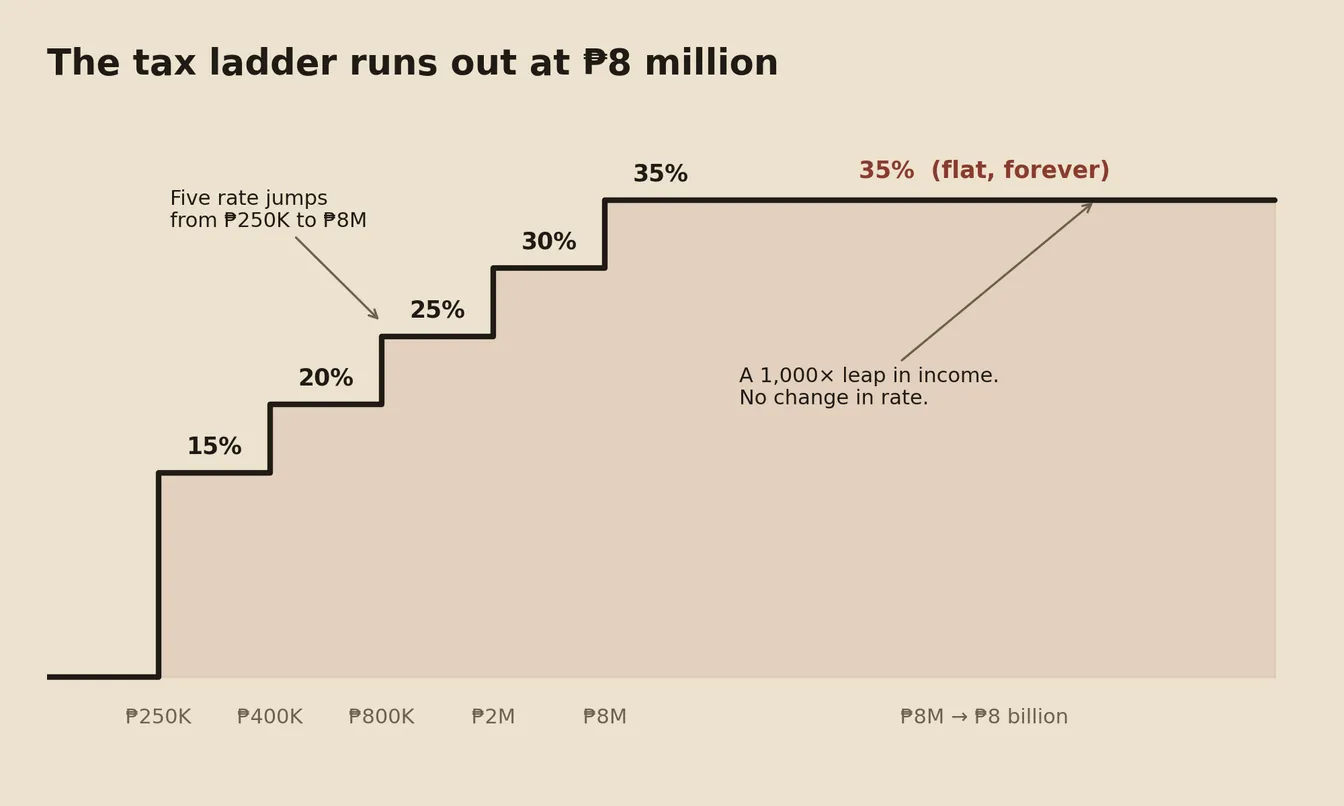
So a senior professional who crosses ₱8 million pays the same top marginal rate as a Forbes billionaire. The code stops telling the merely successful apart from the astronomically wealthy at exactly the point where the real distance between them begins.
That is the compression. And it is the polite half of the problem.
Wage income is taxed harder than wealth
The bigger issue is that most billionaire wealth is not salary at all. A fortune like the one at the top of that building does not arrive as a monthly payslip. It arrives as ownership, and ownership is taxed gently: a) dividends from a Philippine corporation, 10 percent final tax; b) gains on shares that aren’t listed, 15 percent; c) sale of real property, 6 percent; and d) the oldest move in wealth anywhere, don’t sell at all, borrow against the stock, because a loan is not income and income is what gets taxed.
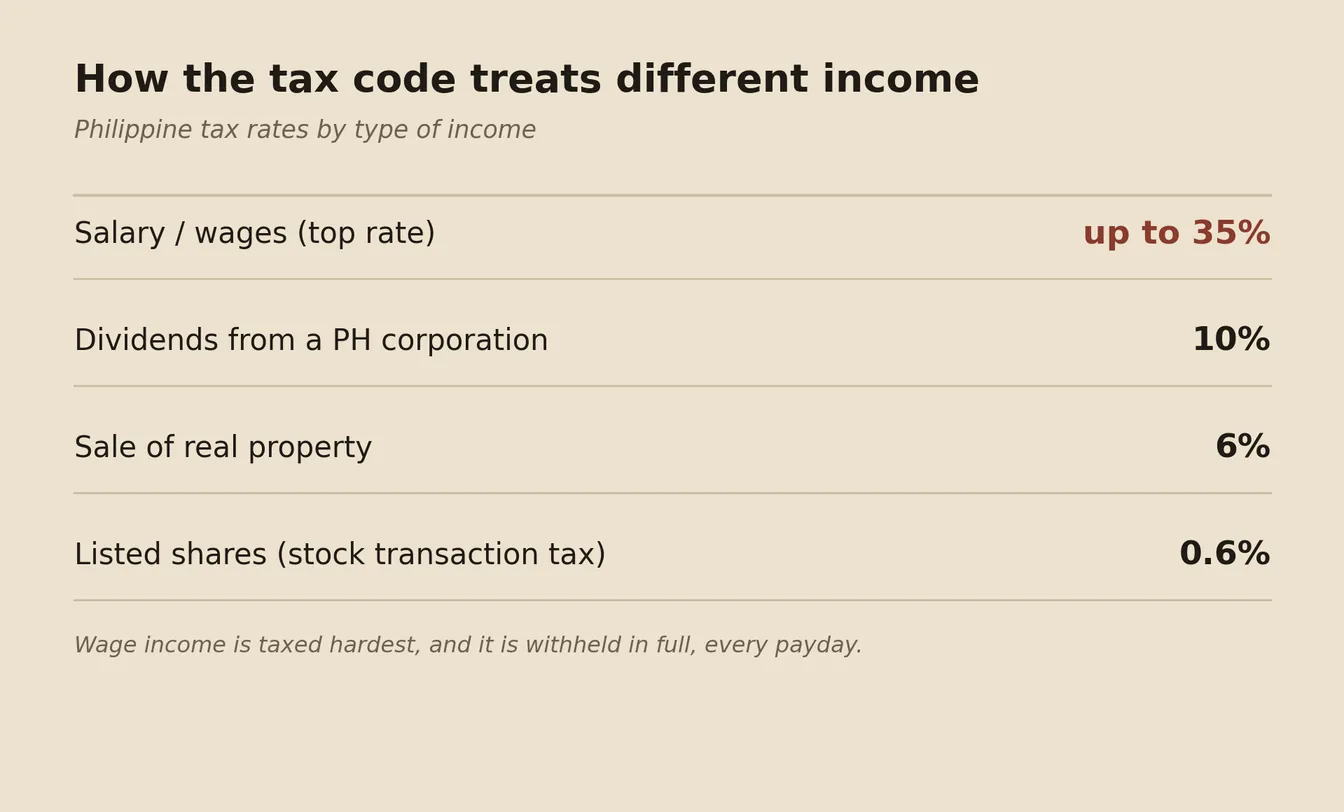
Now set it beside a payslip. Salaried income is taxed at up to 35 percent, and it is withheld in full, transparently, every single payday. No accountant, no structure, no timing. So a salaried professional can end up paying a higher effective rate than a billionaire pays on the income that actually built the fortune. The disproportion runs deeper than the ceiling. Wage income is taxed harder than wealth income, full stop.
Who actually funds the government
Widen the lens. Around 82 percent of the personal income tax collected in this country comes from salaried workers, the people whose tax is withheld before payday. Teachers, nurses, BPO team leads, engineers, brand managers. The middle class. Our income is the most visible kind there is, which makes it the easiest to tax and the hardest to route around.
Then add bracket creep. The brackets were set years ago under the TRAIN law and haven’t moved with inflation since. Prices climbed. Salaries crawled to keep up. But a raise that only covers the rising cost of living can still nudge you into a higher share, so you can feel poorer and get taxed richer in the same year. Nobody voted for that. It just happens, quietly, to the exact people who can least escape it.
Let me put it in my own language, because this is personal. Hindi masama maging mayaman. Medyo may kaya naman ako. Pero hindi dapat ang middle class ang nagbabayad ng pinakamalaking porsiyento ng kanilang disposable income para mafund ang mga mas mahirap o indigent.
This is part of what’s been on my mind lately. In my 40s, I’m strongly considering finally starting my own company. It’s not too late. And once you start weighing going out on your own, you read the tax code differently. Not as a wage earner whose taxes are quietly handled for him, but as someone about to step into a system that treats labor and capital as two very different things.
What we can realistically expect from the top
The reflex is to say tax the rich harder and be done with it. I feel it too. But look at how money actually behaves, and it gets complicated fast. Capital is mobile and well-advised. It restructures, it shifts where income is booked, or it just sits still, since unrealized wealth isn’t taxed until you sell. Countries that swung hard with pure wealth taxes mostly learned the same lesson: the very rich are the most mobile and the best lawyered, so the tax raises less than promised and the merely well-off end up carrying it anyway. Tax capital more, yes, we should. But if the whole plan is squeeze the billionaires, the middle class will still be standing there holding the bill.
Which is why the real leverage sits somewhere less satisfying: what we get for what we already pay, and whether the machine collecting it is honest and competent. That is the BIR question.
What the BIR has been fixing
Credit where it’s due, because 2026 brought real movement. For years a business could get hit by several overlapping audits, different offices, different Letters of Authority, same year, each one a door somebody could knock on. Under the new single-instance framework, a taxpayer generally faces one audit authority per year, and multiple electronic LOAs for the same year now get consolidated into one. The bureau launched an LOA Verifier inside its chatbot, so a business can check whether the officer at the door is holding a real order or running a shakedown. Audit selection is shifting to a risk-based, system-generated list instead of an examiner personally picking who to visit. Foreign digital platforms were pulled into VAT under RA 12023, and CREATE MORE reworked corporate incentives.
I’m for all of it. But consider what every one of these has in common. They are about collecting what’s owed more cleanly and with fewer human hands on the process, which is usually where leakage and corruption live. None of them change who owes it. The machine is getting better. The load is not moving.
Mon Abrea wants to rebuild the house
Mon Abrea, founder of the Asian Consulting Group and the man a lot of Filipinos know as “the Tax Whiz,” has been arguing for years that the BIR needs a structural overhaul, not another round of tweaks. His case, in short:
a) Compliant taxpayers are too often harassed rather than helped, and compliance itself should be made easier by cutting bureaucracy and needless documentary requirements.
b) The taxpayer base should be broadened and compliance improved among self-employed professionals, rather than leaning only on exemptions for low-income earners.
c) The BIR and the Bureau of Customs should be abolished and replaced by a single National Revenue Authority, to centralize collection, modernize administration, and reduce corruption and political interference.
d) VAT should be reformed, including lowering the rate if exemptions are stripped out, alongside aggressive simplification to lift compliance.
Cielo Magno wants it independent and comprehensive
Cielo Magno, an economist at the UP School of Economics and a former Finance Undersecretary for fiscal policy, comes at it from the administration and fairness side. Her case, in short:
a) The BIR is inefficient at refunding input VAT to MSMEs and businesses, which erodes its credibility, and she has floated an independent taxpayer advocate to speed refunds up.
b) The plan to merge the BIR and the Bureau of Customs into one National Revenue Authority should be revived, given persistent revenue-mobilization problems and digital-identity gaps that hamper collection.
c) Tax policy should be tied to access and social protection, not just higher rates, so VAT reform has to be paired with broader reforms that keep basic needs affordable.
d) Raising taxes alone will not fix the fiscal problem. The priority is a more efficient, honest, and politically independent tax authority.
Look at where two people who come at this from different angles end up: the same National Revenue Authority. That convergence is worth taking seriously.
What real reform actually means
When people say “reform the BIR,” or “abolish it,” they usually mean one of three very different things: a) administrative reform, keep the BIR but overhaul how it works, its audits, digital systems, staffing and anti-corruption controls, which is where almost all the 2026 changes live and the easiest to do because it can happen through regulation; b) structural reform, keep the agency but change what gets taxed and how hard, raise the exemption floor (live bills push it from ₱250,000 to ₱400,000, another to ₱600,000), index the brackets to inflation, add rungs above ₱8 million, close the gap between 35 percent on labor and 10 percent on dividends, and value property and inherited wealth honestly; and c) institutional replacement, the literal abolish-and-rebuild that Abrea and Magno point to, folding the BIR and Customs into a new National Revenue Authority with its own mandate, people, and powers.
My own read is simple enough. The fairness fix is mostly b). The loud fix is c). The fix you’d feel in daily business life is a). None of them cancel the others out, and there’s no law of nature that says we can only do one at a time.
So what do we actually push for
None of this moves because the BIR shipped a better chatbot, useful as that is. It moves when we decide, and then vote and lobby like we mean it, that a nurse’s withheld salary should not be taxed harder than a tycoon’s dividends. If you want the short version to carry around, it’s this: index the brackets so inflation stops quietly taxing us more; add rungs above ₱8 million so the code can tell a senior professional apart from a billionaire; tax wealth income closer to how we already tax wages; fund the daily fixes that make the BIR less of a maze; and take the National Revenue Authority idea seriously instead of treating “abolish the BIR” as a punchline.
The middle class has been this country’s most reliable taxpayer and its quietest constituency. We pay first, we pay automatically, we pay the most visible peso. The one thing we can start doing is refusing to stay quiet about it, because the ladder will not grow new rungs on its own.

None of Our Best Players Play Here
Sotto and Ramos play in Japan. Tamayo and Quiambao play in Korea. Four of our best players have all found somewhere better to work, and every reason why is structural.
Read more →
Do Our Basketball Leagues Make Sense?
China beat us by 44 points and ended our Asian Games title defense in the group stage. The reason has almost nothing to do with the twelve men on the floor.
Read more →
Yabang, High; Basketball IQ, Low
The last Philippine team to win the FIBA Asia Cup did it in 1985, coached by an American. We produce players at a rate no country can match. We have never produced coaches.
Read more →
Alex Eala Doesn't Owe Us Anything
But she showed up anyway.
Read more →