What 38 Billion Pesos a Year Could Still Buy
PhilHealth's benefits budget is ₱378.8 billion. A costed list of what a tenth of it could fund, what's already free and unused, and the one thing no amount of it can buy by July.

PhilHealth’s benefits budget this year is ₱378.8 billion. Here’s what a tenth of it could still buy, line by line, and the one thing on the list that money alone can’t fix.
None of what follows is about idle cash sitting in an account. PhilHealth’s payouts jumped 76% in 2025 and kept climbing, up 56% in the first four months of 2026. The fund isn’t doing nothing with the money. It’s doing the wrong things with it: hospitals took 80% of it in 2025, primary care gets about 2%, and the fix isn’t a bigger budget. It’s a longer list of what the existing one is allowed to cover.
Already free. Almost nobody knows.
Start with the part that costs nothing new, because it’s already funded and already law.
PhilHealth pays for a dental exam and cleaning, up to ₱1,000 a year, no co-pay at a public dentist. The 2012 Reproductive Health law guarantees pills, injectables and IUD insertion free at public health centers, and unmet need for family planning has sat at 12.5% for three years running, unchanged, while the coverage exists. There’s been an outpatient mental health package since 2023, up to ₱9,000 a year for general care and ₱16,000 for specialized care. And since August 2025, PhilHealth covers a stool-based colorectal cancer screening test for people past 50, a test that catches the cancer years before symptoms do.
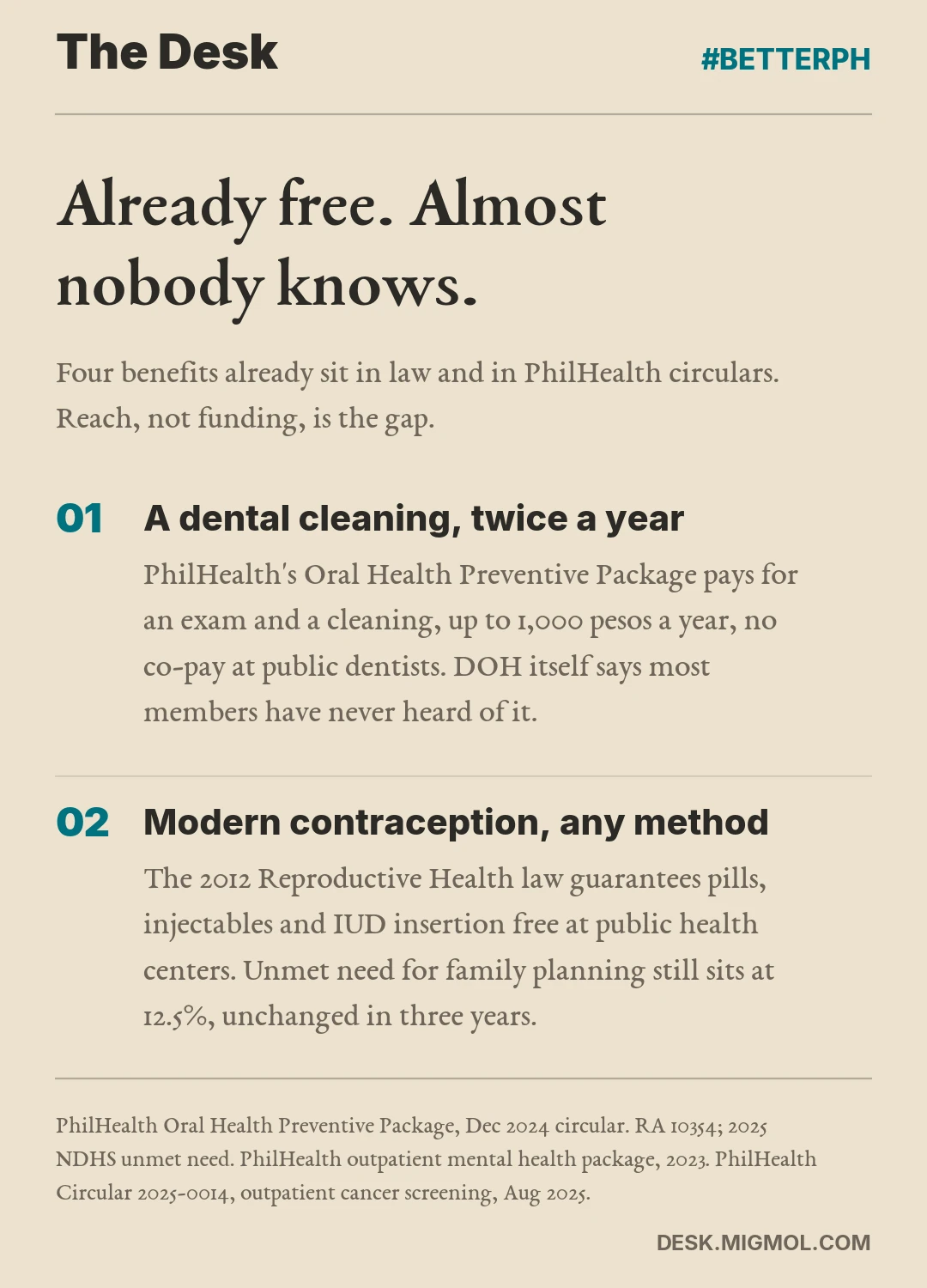
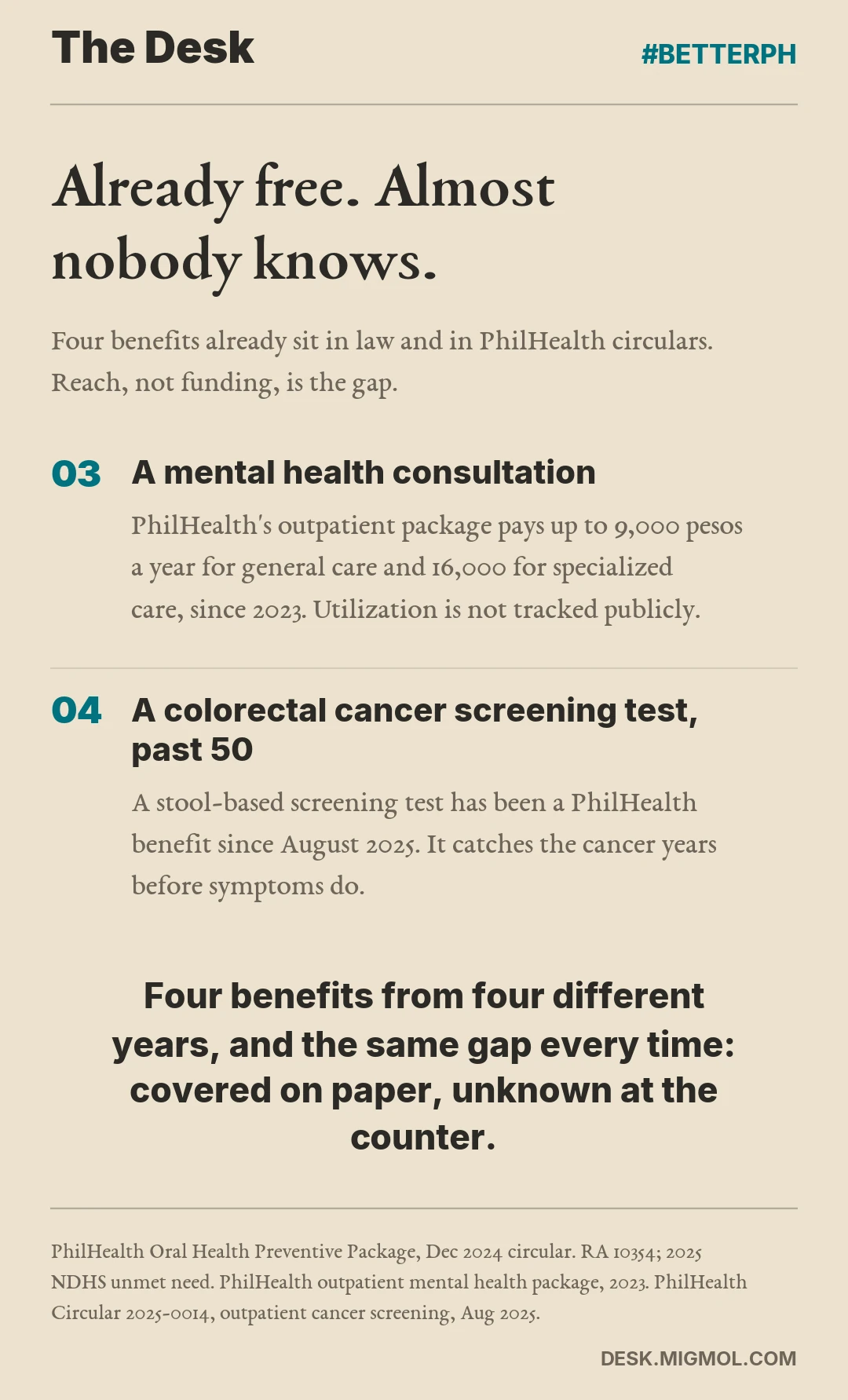
Four benefits, four different years. The same gap every time, between what got signed and what reaches a patient. Nobody sends a text message when a benefit like this goes live. It gets a press release, a circular number, and then silence. Konsulta went the same way: when the numbers finally came out, 6.37 million people had used it out of 27.8 million registered.
That’s the part of “universal” that’s a communications failure, not a budget one. The rest costs money, but not much.
What 38 billion pesos a year could still buy
DOH buys flu vaccine in bulk at ₱193 a dose, not the ₱850 a drugstore charges. At half the country taking it up every year, a flu shot for everyone runs about ₱11 billion a year. One blood panel a year for every adult over 30, blood pressure, sugar, cholesterol, the three slow killers, runs about ₱25 billion a year, and it catches disease before the hospital bill does. HPV for boys, not only Grade 4 girls, following the current WHO schedule, is ₱2 billion a year. Pneumococcal for every senior is ₱16 billion, once, for a shot that keeps people out of a pneumonia admission.
Two more belong on the list with a caveat attached, because a costed list that hides its weak entries isn’t honest. PhilHealth has covered eyeglasses for children since January 2025; adults get nothing, and a basic pair runs ₱1,000 to ₱3,000, so scaling it to working adults runs into the tens of billions, real money for a real gap. Vitamin D deficiency is real too, 48.7% of adults, but the current clinical guideline recommends against dosing healthy adults above the standard allowance. It’s the weakest ask on this list, so the ask is small on purpose: a discount pegged to the cheapest standard-dose supplement, nothing more. Inflating a shaky claim to make a stronger chart is exactly the kind of thing this piece is arguing against.
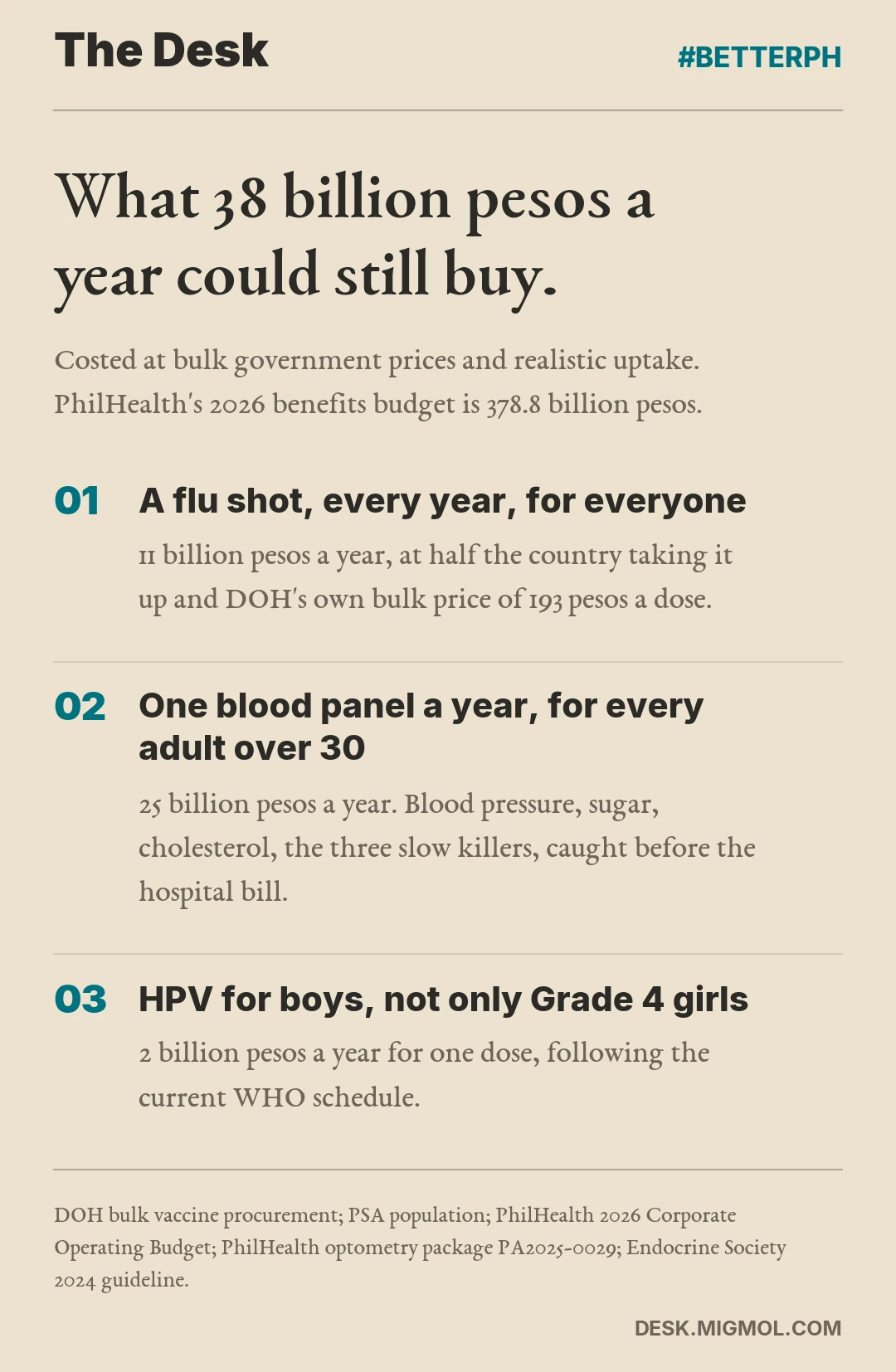
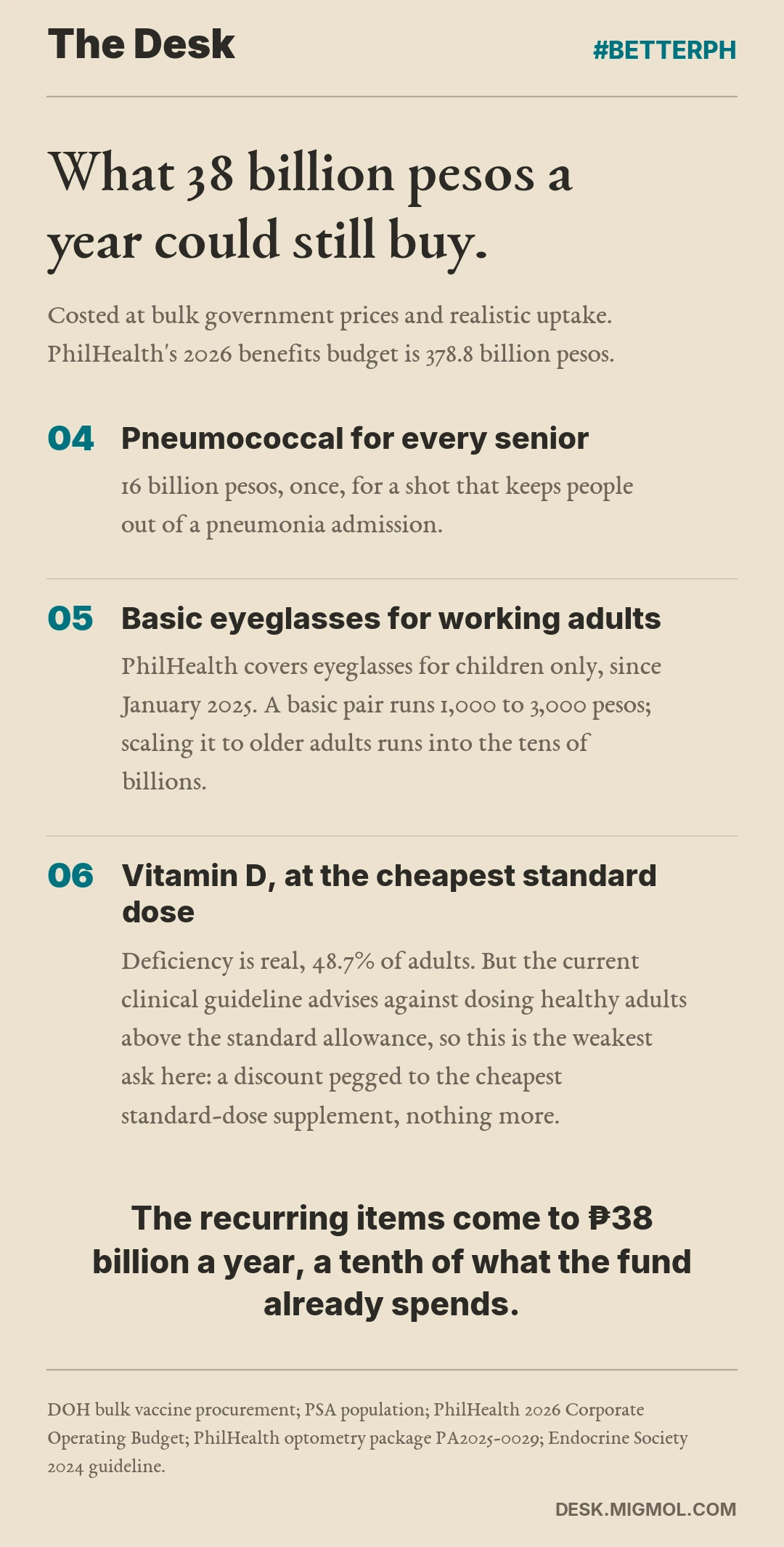
Add up everything recurring and it’s about ₱38 billion a year, against a 2026 benefits budget of ₱378.8 billion. That’s roughly a tenth of money the fund is already spending, for coverage that would reach every Filipino, not only the ones who end up admitted.
The two I couldn’t cost, and why that’s the point
I went looking for two more numbers I wanted on this list: a free sleep study for adults over 40, and ₱2,000 off every psychiatric consultation, sized against a 20% jump in people seeking one.
I couldn’t cost either one, and I’m not going to pretend otherwise. Nobody publishes a national count of accredited sleep labs in the Philippines. The closest I found is a named list of eleven hospitals that run one, nearly all private, nearly all in Metro Manila and Cebu. PhilHealth started covering polysomnography in 2024, at ₱21,060 a study, but nobody has published how many people have used it. And nobody publishes how many Filipinos see a psychiatrist in a given year, which means there’s no honest baseline to apply a ₱2,000 discount or a 20% increase to. Any number I built on top of that would be a guess wearing a peso sign.
That itself is the argument. If a fact-check can’t find out how many sleep labs exist or how many psychiatric visits happen in this country, a patient trying to use the system stands even less of a chance. The opacity isn’t a research inconvenience. It’s the same red tape that keeps people out of the system, just moved from the enrollment line to the data itself.
What money can’t buy by itself
What I could find is a workforce number, and it’s the reason a demand-side subsidy for psychiatric care runs into a wall no amount of funding moves by itself. The Philippines has 409 psychiatrists, 0.38 per 100,000 people, against a WHO recommendation of 10. More than half of them practice in NCR. The Bangsamoro region has zero.
It also answers something I wanted to know: why there are drug rehabilitation centers all over the country now, and so few places a psychiatric patient can go for free. There’s a real answer, and it isn’t flattering. The country has built 99 government-registered drug rehabilitation centers, and the number keeps growing every year. It has built three government psychiatric hospitals, total, for 113 million people: the National Center for Mental Health in Mandaluyong, plus one each in Bataan and Davao. NCMH itself runs 4,200 beds, 3.7 to 4.4 per 100,000 against a WHO minimum of 30.
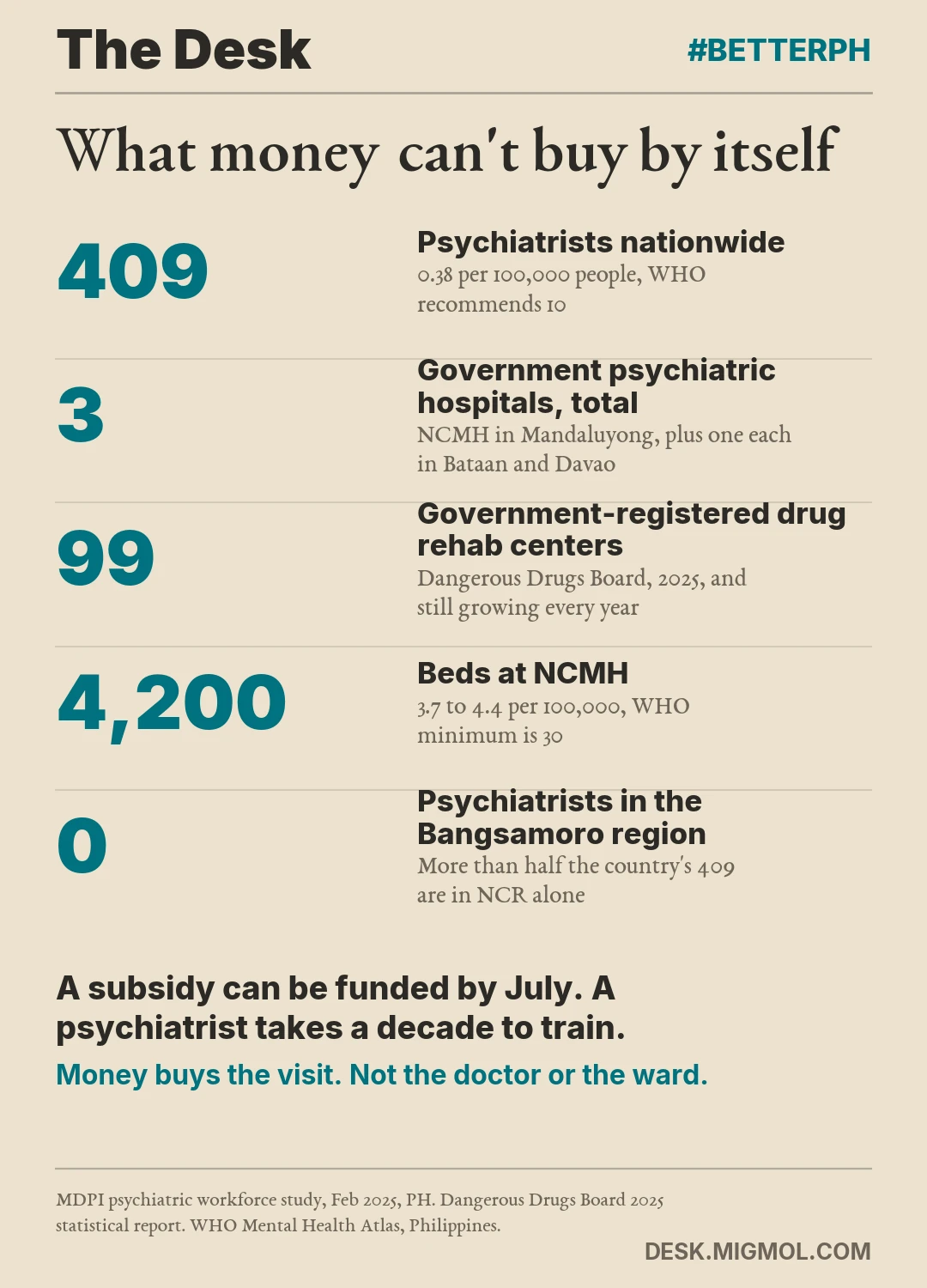
A subsidy can be funded by July. A psychiatrist takes a decade to train, start to finish, and it has to start now to be ready for anything. A hospital ward takes years to build and a budget line that has to survive more than one administration to see it through. None of that shows up on a costed list next to a flu shot, because it isn’t the same kind of problem. Money buys the visit. It doesn’t buy the doctor, and it doesn’t buy the ward.
The list was never the hard part
Everything in the first two sections of this piece could be signed into a circular this year, the way the colorectal screening benefit was, the way the mental health package was in 2023. The psychiatric workforce gap can’t be signed into existence, but it can be started, the way the ₱545.64 billion this country spent on flood control against a ₱351.72 billion plan proves there’s no shortage of money in this system, only a shortage of where it’s told to go.
Universal was never supposed to mean eligible in theory and unreachable in practice. It was supposed to mean what it says. The money for most of this list already sits inside a fund whose payouts grew 76% in a single year. The rest is a decade of training doctors nobody has started training yet. Both of those are choices, made or not made, by a health secretary and a PhilHealth president who both took their chairs in August.
16,563 Ballots Were Shaded Before Anyone Voted
Nobody had to break a rule to reach the pre-shaded ballots in Maluso. The rule put them there. The Omnibus Election Code was written two months before EDSA, and Comelec's 963-page fix is still waiting.
Read more →
₱457 Million in Cash, and Nobody Asked
The bank filed the report. The AMLC said it had too many to read. Part 4 of 4 on anti-corruption with teeth.
Read more →
If you're above 40, this is the 2nd Iran Oil Crisis in Your Lifetime.
In 1980, a crisis in Iran pushed oil to $149 a barrel in today's dollars. Saudi Arabia had warned that prices that high would push the world to find something else, and it did. In 2026 it is Iran again, and this time the something else is already in our driveways.
Read more →
What does the world need from the Philippines? Right now, nothing it can't get somewhere else.
China refines 91% of the world's rare earths. Taiwan makes over 90% of its most advanced chips. We import 98% of our garlic and ship our nickel out as raw ore. What could the Philippines own that the world can't do without?
Read more →