One Barangay Has 261,729 People. Another Has Two.
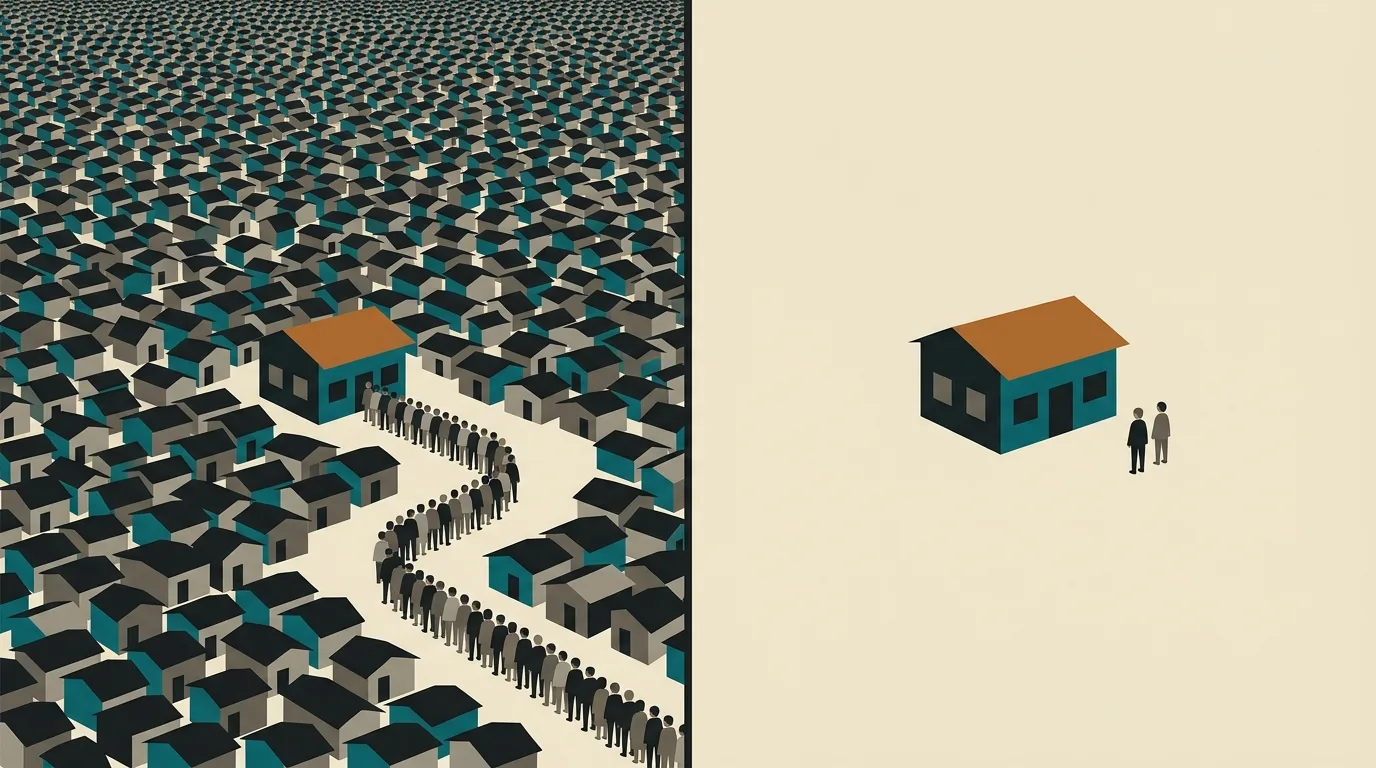
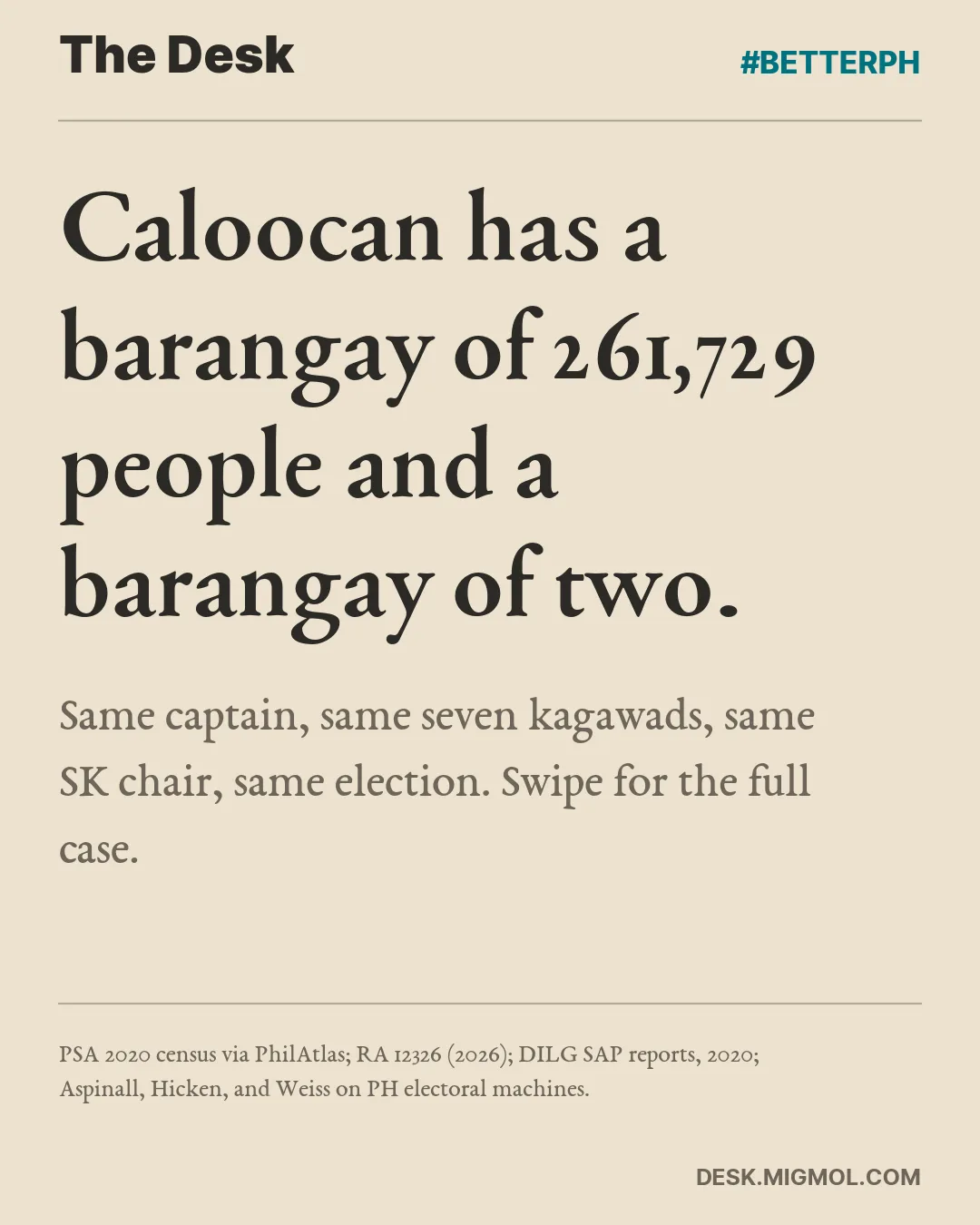
Caloocan has a barangay with 261,729 people and a barangay with two.
Barangay 176, Bagong Silang, was the most populated barangay in the country at the 2020 census, bigger than most cities. Barangay 76, same city, had two residents. Both had a barangay captain, seven kagawads, and an SK chair. Same structure, same powers, same election.
The barangay is a good idea for a village. It’s a strange one for a city of a quarter million.
Built for a village
The barangay makes sense where it came from. Far from the town hall, you need someone close by who knows everyone, settles the neighbor fight, signs the clearance, and knows whose roof leaked in the last typhoon. In a remote barangay, the captain is the government you can actually reach.
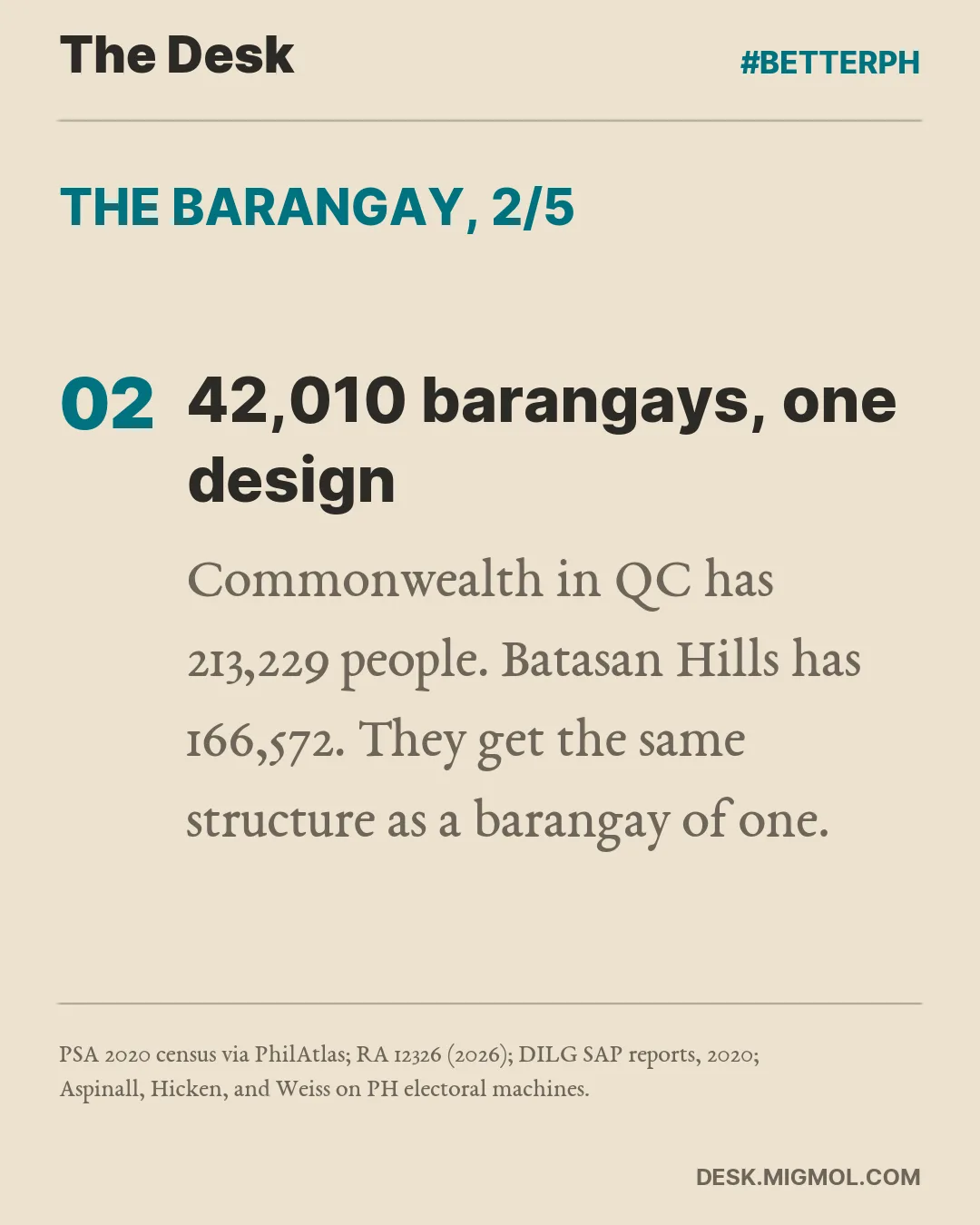
Now put that same structure in Commonwealth, QC, with 213,229 people, or Batasan Hills with 166,572. The captain stops being the neighbor who knows everyone. He’s running a mid-sized city on a village charter, wedged between residents and a city hall that already has its own engineers, health office, police, and social workers.
There are 42,010 barangays. Bagong Silang finally got split into six in 2024, which helps that one place and tells you how we handle the problem: one plebiscite at a time, once it gets absurd enough.
The election that keeps not happening
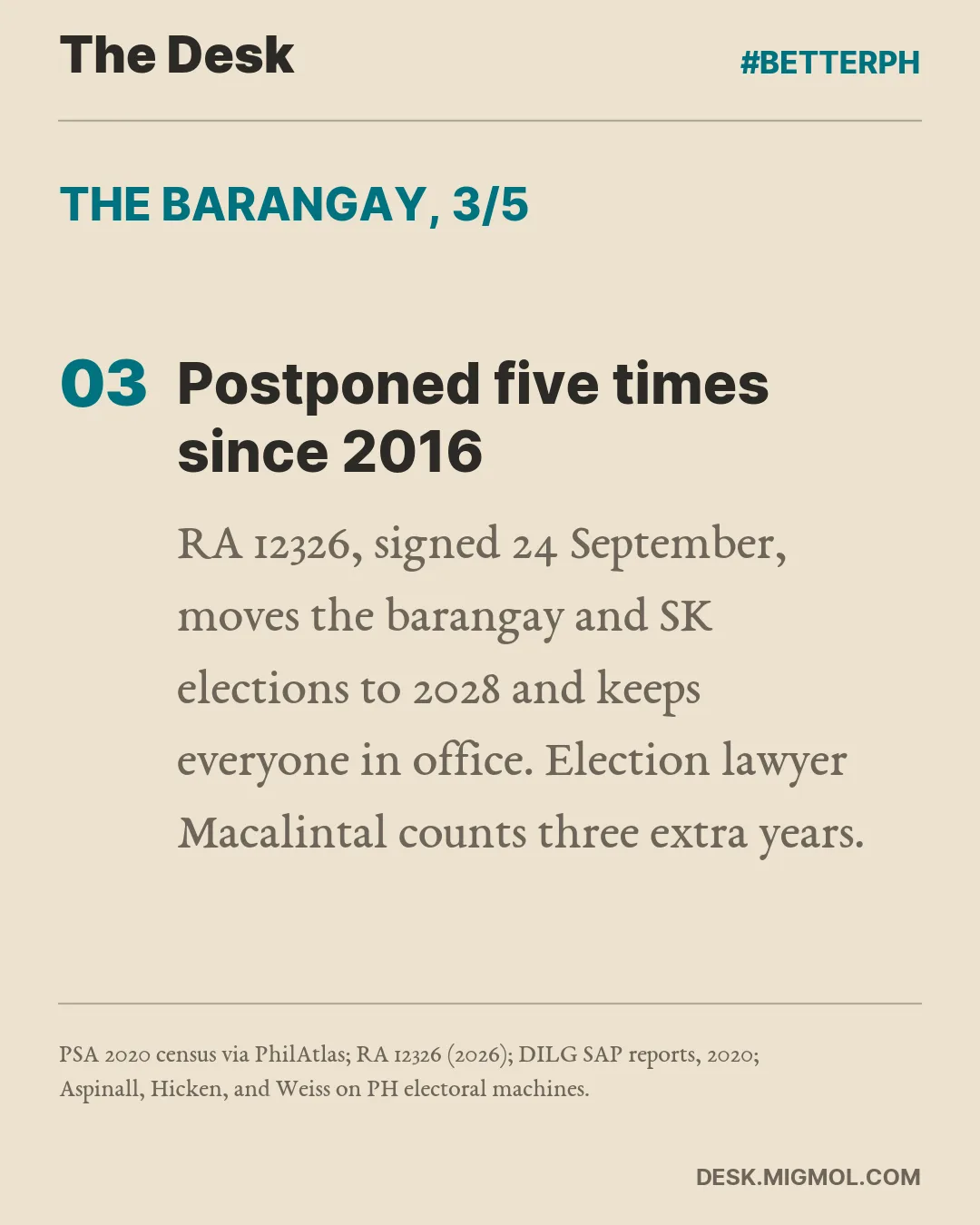
On 24 September, President Marcos signed RA 12326. It moves the barangay and SK elections from 2 November 2026 to November 2028, makes the term five years, and lets everyone currently in office stay until then. Filing of candidacies was supposed to open four days later. Comelec had to cancel it.
That’s the fifth postponement since 2016: 2016 to 2017, 2017 to 2018, 2020 to 2022, 2022 to 2023 (which the Supreme Court later called unconstitutional), 2025 to 2026, and now 2026 to 2028.
Election lawyer Romulo Macalintal has already gone to the Supreme Court. His count: incumbents get a cumulative three extra years, and voters lose three years of their vote. Philstar’s Ana Marie Pamintuan noticed the timing. Lawmakers rushed the postponement through on the same day the Court ordered them to pass an anti-dynasty law.
Five moves in ten years tells you how Congress sees the barangay: as something to keep, the way you keep an asset.
Why the barangay matters to everyone above it
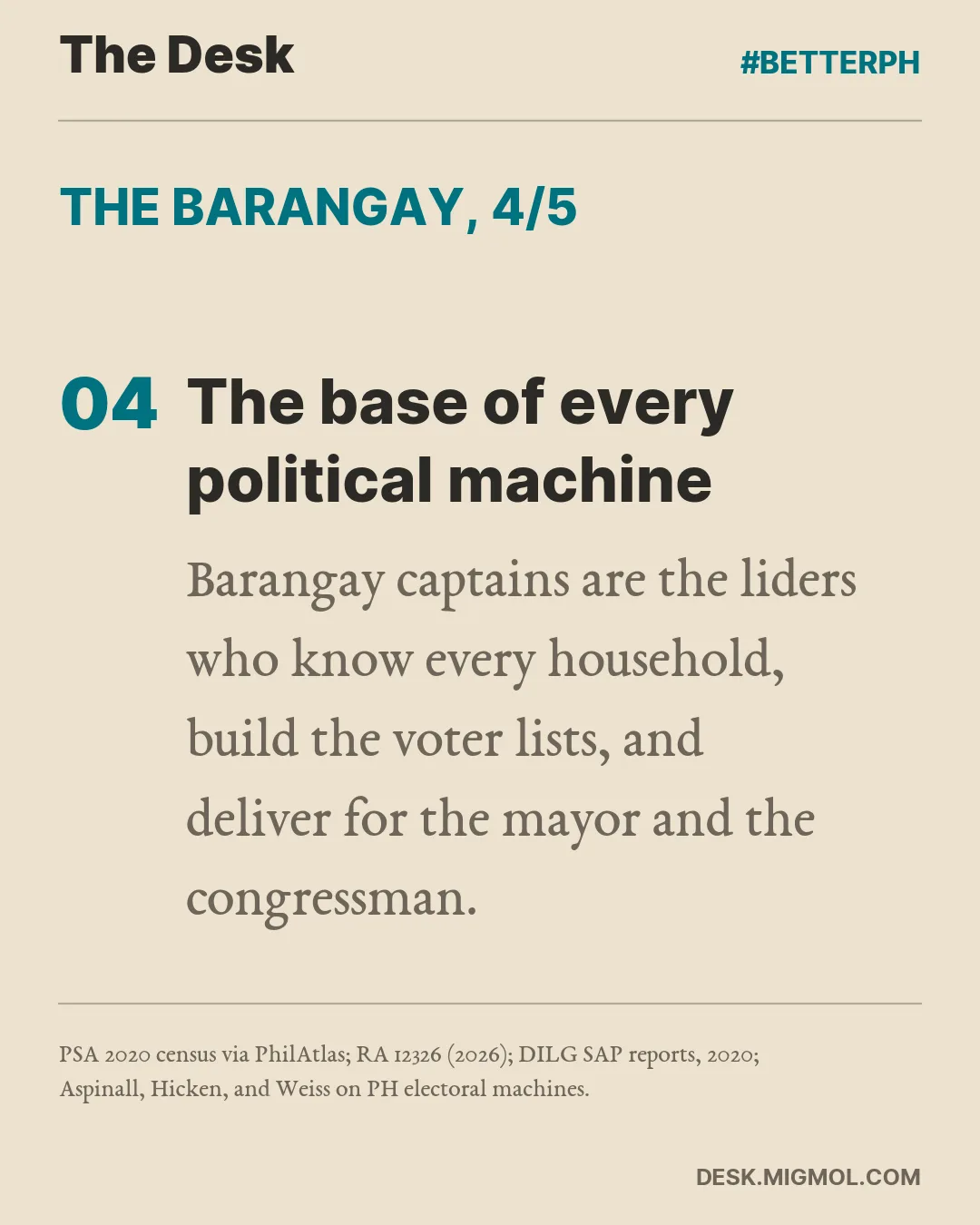
The barangay captain is the base of every political machine in the country. Political scientists Edward Aspinall, Allen Hicken, and Meredith Weiss describe the structure plainly in their work on PH elections: a candidate, an inner circle, and under them the “liders,” usually barangay captains, who know every household, build the voter lists, and hand out the money. The captain is nominally non-partisan. In practice he’s the ground game for the mayor and the congressman.
So when Congress keeps the incumbents in place for two more years, right through a presidential election, it keeps the machine intact for 2028. I don’t know if that’s the intention. It’s definitely the effect.
The kontratista
Jarius Bondoc described the barangay version of corruption in Philstar in September, and anyone who’s dealt with a barangay hall will recognize it. There’s one kontratista, a friend of the captain. He handles every purchase, from a new barangay hall to the snacks for council meetings, and overprices it 30% to 300%. The money gets split with the captain, the treasurer, and the council. The SK chair sits on the council ex officio and learns how it works. The captain terms out, a relative takes over, and in Bondoc’s words, “The kontratista stays.”
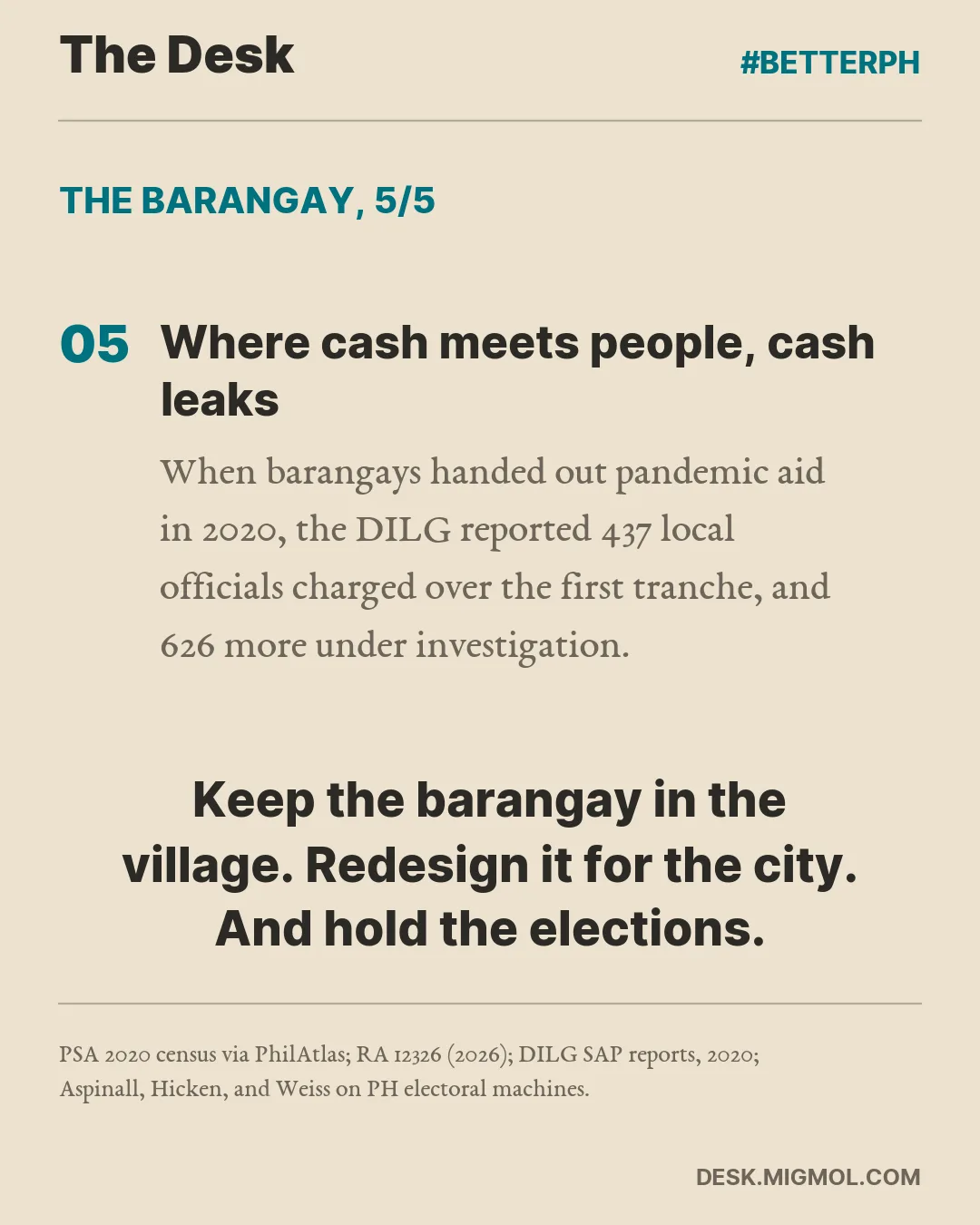
That’s an opinion column, so take it as a description. The record backs the pattern, though. In 2020, when barangays handed out pandemic cash aid under SAP, the DILG reported 437 local officials and co-conspirators facing criminal charges over the first tranche alone, with 626 more under investigation. The barangay is where cash meets people, which makes it where cash leaks.
What to do with it
Keep the barangay where it works. In rural and remote areas it’s the closest government people have, and it should get more support.
In highly urbanized cities, change the structure. A few options, from mild to drastic:
- Split the giants systematically, with a population ceiling, instead of one plebiscite per decade.
- Merge the tiny urban barangays, like Caloocan’s Barangay 76, into units that make administrative sense.
- For highly urbanized cities, turn the barangay into a city-run service office with an elected neighborhood council, so procurement sits with city hall, where COA and the Ombudsman already look.
And hold the elections, on time, every time. A government that can’t be voted out on schedule answers to nobody below it.
I Thought Those Nights Were Romantic
I remember the brownout nights as warm. On 13 May 2026, 1.9 million Meralco customers lost power again. Part 1 of 2: why we are bad at judging risk, and what forty years of avoiding the nuclear question has cost.
Read more →
What does the world need from the Philippines? Right now, nothing it can't get somewhere else.
China refines 91% of the world's rare earths. Taiwan makes over 90% of its most advanced chips. We import 98% of our garlic and ship our nickel out as raw ore. What could the Philippines own that the world can't do without?
Read more →
16,563 Ballots Were Shaded Before Anyone Voted
Nobody had to break a rule to reach the pre-shaded ballots in Maluso. The rule put them there. The Omnibus Election Code was written two months before EDSA, and Comelec's 963-page fix is still waiting.
Read more →
Over Your Dead Body (2026) No Spoiler Review: Samara Weaving and Jason Segel Make This Fun, Gory Comedy Worth Watching
Over Your Dead Body is fun, gory, and funny, it gets better as it goes, and Samara Weaving and Jason Segel are what carry it.
Read more →