PhilHealth Is Supposed to Be Universal. The Middle Class Can't Get to It.
A ₱728,000 delivery bill, a ₱34,000 benefit, and four offices standing between a working Filipino and care they already paid for.

In August, the GMA reporter Mav Gonzales posted her hospital bill. She’d given birth at Makati Med in May, normal delivery, with an epidural. The total came to ₱728,160.26. PhilHealth covered ₱29,000 for her and ₱5,119.50 for the baby. She was left with ₱694,040.76 and a joke about starting a GoFundMe.
PhilHealth paid 4.7% of it.
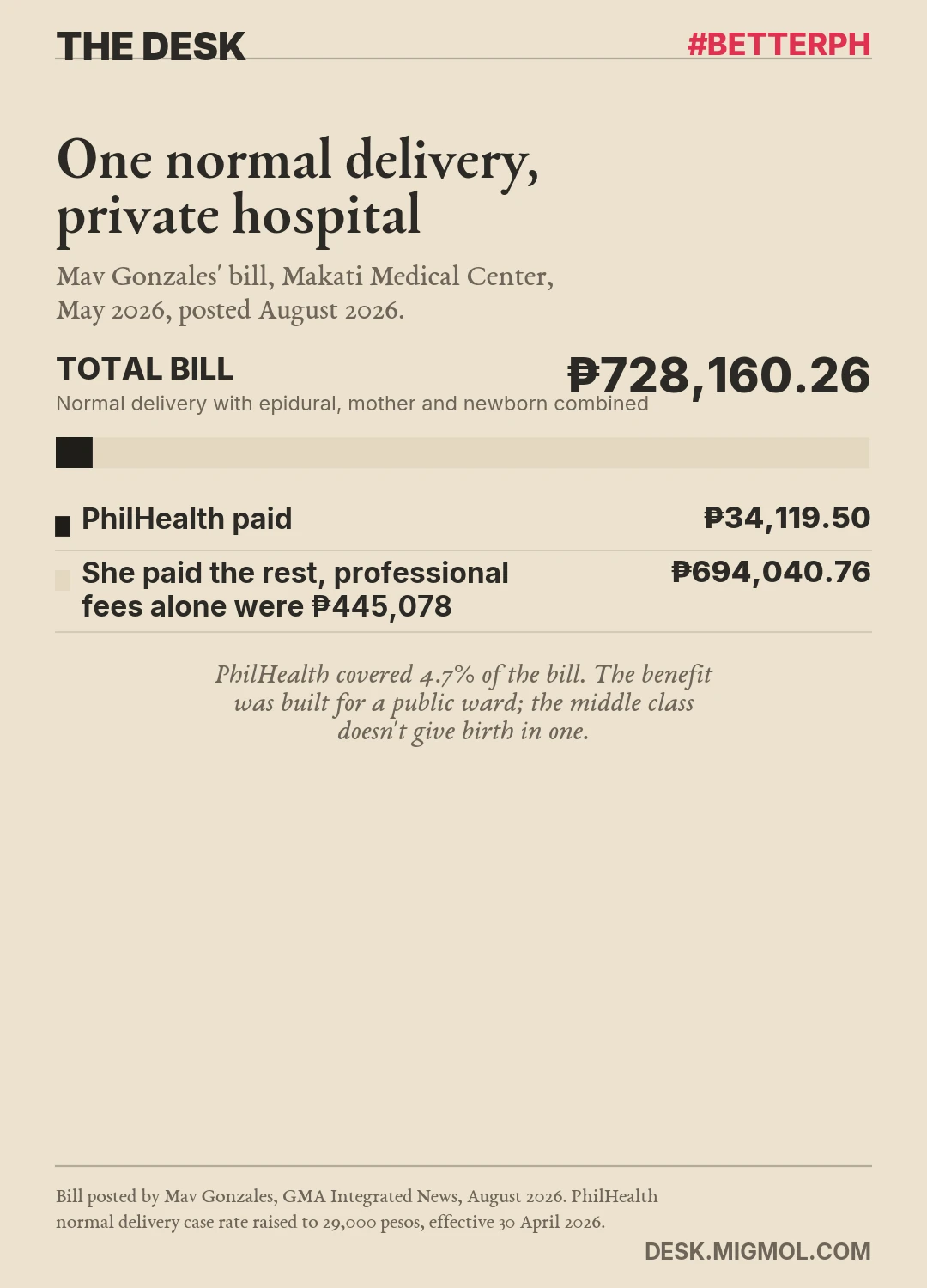
And that ₱29,000 is the good news. It used to be ₱9,750. They raised it in April, and in a government hospital it now covers close to the whole delivery. In a private one it’s a rounding error on the professional fees alone, which came to ₱445,078 of her bill.
That’s the whole problem in one receipt. The benefit was built for a public ward. The middle class doesn’t give birth in a public ward.
We fund it and we can’t reach it
I wrote a while back about how the tax ladder stops climbing at ₱8 million, and how 82% of personal income tax in this country comes from salaried people whose money is taken before they ever see it. PhilHealth runs the same way. Working members pay 83% of the premiums and draw 47% of the claims.
So we fund both, and neither one is built for us. Too well-off for the rescue programs, not well-off enough to absorb a ₱694,000 bill. There’s no line to fall into.
The strange part is that most of what we want already exists. The Konsulta package covers a CBC, lipid profile, fasting blood sugar, HbA1c, creatinine, urinalysis, chest x-ray, pap smear, mammogram. That’s the annual check, sitting in a circular. GAMOT went from 21 free medicines to 75 last August, up to ₱20,000 a year, and amlodipine, losartan, metformin and simvastatin are all on it. There’s been an outpatient mental health benefit since 2023.
Now the numbers. Of about 102 million members, 27.8 million are registered for Konsulta. The number who actually used it is 6.37 million. Konsulta paid out ₱3.59 billion against ₱164 billion in total claims, which makes primary care 2% of what PhilHealth spends. In 2025 hospitals took 80% of the money.
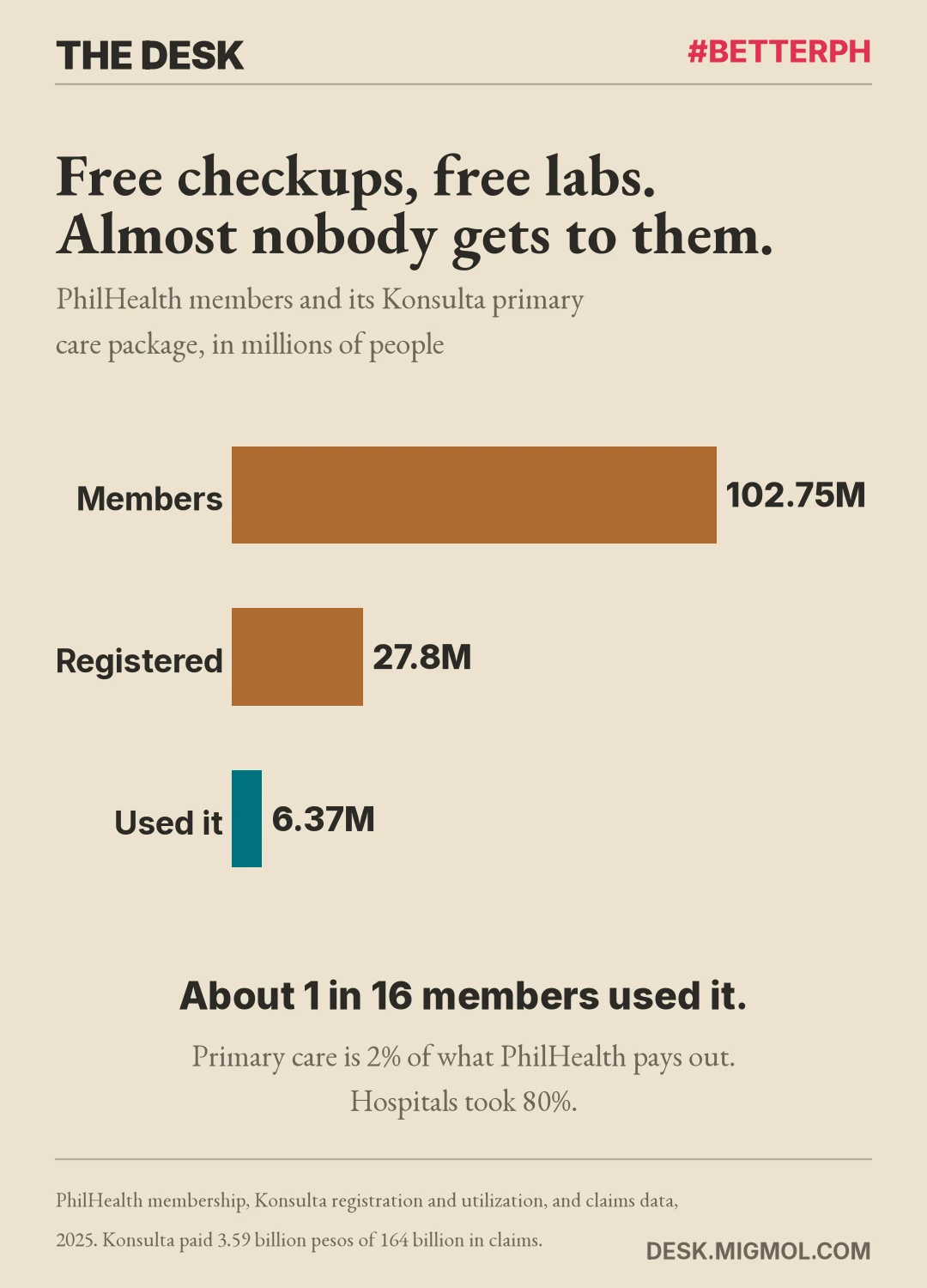
The benefits exist. Almost nobody gets to them.
The queue is the barrier, and the queue is the point
Getting to that free blood test runs like this. Barangay hall or the city social welfare office for certification. A PMRF at a PhilHealth local office to get your number. Then, separately, you register for Konsulta on the member portal by picking one accredited provider, and only if that provider still has open slots. Pick one and you’re locked to it.
Four offices, four queues, on weekdays, during office hours. And nobody tells you up front what to bring. The checklist changes depending on who you ask, you don’t know how long the line is until you’re in it, and one missing photocopy sends you home. Anyone who has stood in a government office feels that dread before leaving the house.
To be fair, the online part can go smoothly. My dad is registered for YAKAP, the new name for Konsulta, and GAMOT, and he’s done his consult and labs. He picked his provider online and says it was easy. For free medicines he brings an official prescription to any GAMOT provider. But to change providers, he has to go to the local PhilHealth office in person. Easy works when you’re already in the system and nothing changes.
Then there’s the doctor. Konsulta only works at an accredited provider. If the doctor you trust or the hospital you’d actually go to isn’t on the list, the benefit doesn’t follow you there, and most of us will go where we trust and pay. Accreditation means a facility survey, documents, and standards to meet. Doctors are busy seeing patients, most aren’t accountants, and nobody should expect them to run a government paperwork desk on the side. PhilHealth’s own CEO has admitted that the limited number of accredited facilities is one reason so few people use Konsulta.
The ones who do sign up have to ask the other question: when do I get paid? I used to work in pharmacies, and the government’s payment schedule was a real factor in whether we served a government account at all. In December 2023 private hospitals said PhilHealth owed them ₱27 billion in unpaid claims, and some talked about cutting ties. A clinic that does that math walks away, and its patients go with it.
Nobody in a full-time job is doing all that. We don’t have the leave credits to spend a Tuesday at the barangay hall and a Thursday at PhilHealth, and we’re not lining up at PCSO or outside a congressman’s office either. So we skip it and we foot the bill, which is exactly what the 6.37 million tells you.
And think about what we’re actually asking sick people to do. Take a day off, commute, queue, come back, queue again. Stress raises blood pressure. Stress is a risk factor for the same diseases this is all supposed to prevent. We built an obstacle course in front of preventive care and we made it stressful enough to cause the thing it prevents.
Why the gate exists
Back in 2023 I sat in on something I’ve never forgotten. A cabinet secretary was working out how to enroll millions of people under her department into the primary care program without any of them knowing they’d been enrolled. Not to give them care. The program pays providers a fixed amount per registered head per year, in tranches. The first 40% is released once a person has a “first patient encounter” on file, which is a form with their basic details, not a treatment. The rest gets checked against performance at year end. Paid out first, liquidated later.
Do the math on just ten million of them. At today’s ₱1,700 per head a year, that’s ₱17 billion. The first tranche alone is ₱6.8 billion, nearly double what Konsulta paid out to the entire country.
It had the same shape as a scheme someone pitched me years ago, back in my drugstore days: funded per head, spend on almost nobody, pocket the gap. Different agency, same arithmetic. Corruption in plain sight, in a meeting, on a whiteboard.
I don’t know if that particular plan went anywhere. What I know is that a per-head payment with an enrollment gate in front of it is an invitation, and the people running the program know it. So the gate gets tighter, and the paperwork gets thicker, and every honest person who just wanted a blood test pays for the dishonest ones in queue time.
Two places where it already works
In Isulan, Sultan Kudarat, the provincial hospital runs what the governor’s office calls a zero-billing policy. People go, they get treated, they leave. In 2022 it counted over 18,000 in-patients and more than 30,000 out-patients. No cashier is the part that goes viral, and I want to be careful here, because the provincial announcement describes it as covering indigent patients, and the hospital is Level 2, so no dialysis, no blood bank, no ambulatory surgery. Those patients still get transferred out. It also isn’t purely a provincial achievement. It runs on the province’s budget plus the Malasakit Center, which pools DOH, DSWD, PhilHealth, PCSO and PAGCOR money, and Sultan Kudarat gets 88% of its income from national transfers anyway.
Fine. It’s still the closest thing we have to the thing we were promised, and it exists, in Mindanao, right now.
Then there’s Makati. The Yellow Card gets a resident free consultations, free maintenance medicines, free labs, unlimited dialysis and chemotherapy, and any hospital bill under ₱5,000 covered outright, with a flat ₱500 co-pay above that at Makati Life. Since July 2025 you don’t even need the Makatizen Card first. You bring your voter’s certification and your PhilHealth record to one office, they do a home visit, you collect the card.
One office. That’s the whole difference.
Makati can do it because Makati collected ₱24.15 billion in 2024, half of it business tax, and generates 90% of its own revenue. Per resident it spends around ₱24,000 a year, the highest in the country. No other city has that base and pretending otherwise is dishonest.
But watch what that means. When the Supreme Court moved the ten EMBO barangays to Taguig, Makati ended Yellow Card coverage there on 1 January 2024, and more than 200,000 people lost free checkups, free medicines and hospital coverage overnight. They didn’t move. Nothing about their health changed. A line moved.
That’s the real state of universal healthcare here. Whether you can afford to get sick depends on which mayor’s jurisdiction your house sits in, and on whether you have a spare Tuesday.
The money was there
I’ve already written that this country isn’t poor, that ₱545.64 billion went into flood control against a ₱351.72 billion plan, and roughly ₱180 billion of it went nowhere. PhilHealth’s surplus sits next to that one. The fund isn’t idle and it isn’t underfunded. It’s misallocated, and misallocated is a choice, not a condition.
So the ask isn’t money. It’s this: one record, one card, walk into any accredited facility, nothing to prove and nothing to pay at the counter. Makati does it with one office. Sultan Kudarat does it with none.
Universal means universal. Right now it means eligible, and those are different words. The distance between them is measured in queues, and the people standing in them are the ones who paid for the whole thing.
Next: what that money could still buy, line by line, and the one thing on the list that money alone can’t fix.
16,563 Ballots Were Shaded Before Anyone Voted
Nobody had to break a rule to reach the pre-shaded ballots in Maluso. The rule put them there. The Omnibus Election Code was written two months before EDSA, and Comelec's 963-page fix is still waiting.
Read more →
₱457 Million in Cash, and Nobody Asked
The bank filed the report. The AMLC said it had too many to read. Part 4 of 4 on anti-corruption with teeth.
Read more →
If you're above 40, this is the 2nd Iran Oil Crisis in Your Lifetime.
In 1980, a crisis in Iran pushed oil to $149 a barrel in today's dollars. Saudi Arabia had warned that prices that high would push the world to find something else, and it did. In 2026 it is Iran again, and this time the something else is already in our driveways.
Read more →
What does the world need from the Philippines? Right now, nothing it can't get somewhere else.
China refines 91% of the world's rare earths. Taiwan makes over 90% of its most advanced chips. We import 98% of our garlic and ship our nickel out as raw ore. What could the Philippines own that the world can't do without?
Read more →