Salt is salt until someone decides it isn't. The Philippines makes world-class products and never gave them a name.
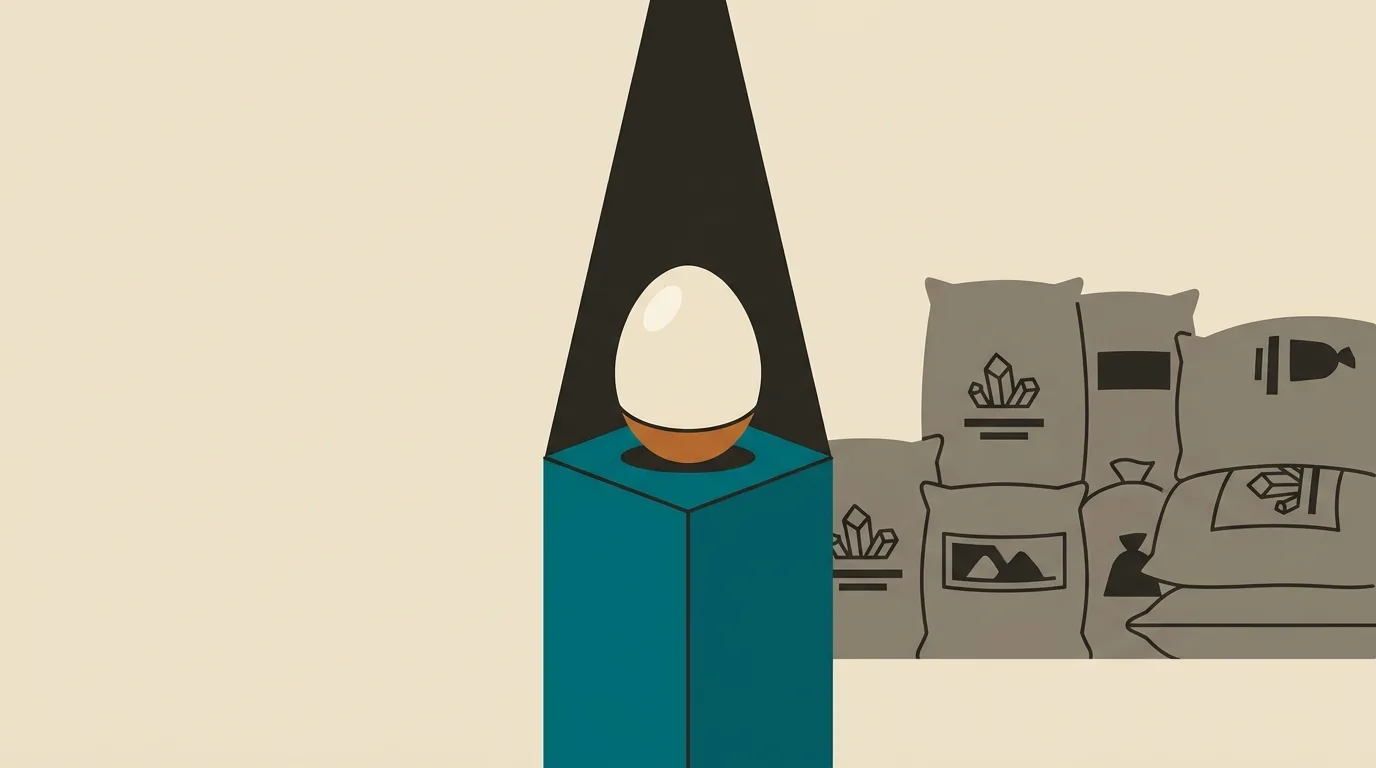
Salt is at the bottom of every commodity list, and a kilo of Korean bamboo salt sells for about $400. It’s sea salt packed into bamboo, sealed with clay, and roasted over a pinewood fire nine times over more than 50 days. It’s still salt, and Korea sells the craft, the story, and the packaging along with it.
In the first part of this, I looked at the big levers, the things the world can’t do without, and the one we’re giving away, which is nickel. This part is about the smaller things only we can make. They won’t stop another country’s economy, but they can move us from selling commodities to selling names.
We have the salt
The Philippines is an archipelago with one of the longest coastlines in the world, and we import about 80% of our salt, mostly from Australia and China. What we do make by hand is some of the most interesting salt anywhere:
- Asin tibuok, Bohol. Coconut husks soaked in seawater for months, burned to ash, and filtered, then the brine is boiled in clay pots until it sets into a solid egg. It takes three to seven months.
- Asin tultul, Guimaras. Driftwood soaked in the sea and burned, the ash filtered, coconut milk added to the brine, and the mix cooked into blocks.
- Asin sa buy-o, Botolan, Zambales. Sand soaked with seawater, strained, boiled, and packed in woven nipa containers called buy-o.
- Budbud, Miag-ao, Iloilo and Antique. Seawater sprinkled over and over on sand, the brine mixed with vine extract and dried on split bamboo poles, harvested by women.
- Sand salt and tedted, Pasuquin, Ilocos Norte. Sand showered with seawater, filtered, and boiled. Tedted is the rarer one: the leftover brine drips for months and forms salt stalactites.
- Irasan salt, Las Piñas, Parañaque, and Cavite. Sun-dried on clay-tiled beds, the old salt farms of Manila Bay.
- Sugpo asin, Pangasinan. Prawn ponds in the rainy season, salt beds in the dry season.
Almost all of them are in decline. Asin tibuok sold for ₱80 to ₱150 a piece for years, and by one count only two families still make it. In 2025 UNESCO put it on its list of heritage in need of urgent safeguarding because the makers are old, the young have left, and the work doesn’t pay. It is also only our second registered geographical indication (GI), after Guimaras mangoes.
That’s what small batch looks like with no system behind it. Every one of these salts is a craft story a luxury brand would pay a lot to invent. We have eight of them and a law, the Philippine Salt Industry Development Act of 2024, that is mostly about getting ordinary salt farms producing again. That’s needed, but nobody is doing for tultul what France did for its salt. Fleur de sel de Guérande is harvested by hand by salt farmers called paludiers from the same marshes their families have worked for generations, and it carries the European Union’s Protected Geographical Indication (PGI). The name is the value.
We have the honey
Honey is another commodity that sells on where it comes from, and we have bees and flowers most of the world doesn’t. The Philippine giant honeybee, Apis breviligula, is a species of its own that lives only here. The kiwot, our native stingless bee, is small enough to work coconut flowers that bigger bees can’t reach, and a farm in Bicol says its coconut yields went up by half once it kept them. Its honey is thin, tart, and made in tiny amounts, which is exactly what small batch should mean.
Then there’s the forest honey. In Palawan, the Tagbanua and the Batak still gather wild honey from giant honeybee nests, and the honey tastes of whatever flowered that season. Tanguile, a native hardwood, only blooms every five to ten years, and its honey comes out dark and creamy with notes of coffee. Narra, our national tree, gives a lighter, citrusy honey. There’s a dark coffee-forest honey from Dauin in Negros Oriental, and wild hunters in Mindanao bring down honey darker still.
The problem is that most of what’s sold as honey here isn’t. In 2020 the Department of Science and Technology (DOST) tested local honey with isotope analysis and found that about 82% of the samples had been mixed with sugar syrup. So the real thing competes on the same shelf as the fake, at a fake’s price. A tanguile honey with a legal definition, a lab test, and a protected name is a luxury product. Without them, it’s a bottle that looks like every other bottle.
The name is the product
Japan shows how far a name can go. A pair of Yubari King melons sold for ¥5.8 million at auction in May 2026. The world wants matcha, and only a few regions like Uji and Nishio make the real thing, so the price of tencha, the leaf ground into matcha, went from ¥5,678 a kilo in 2024 to ¥14,681 in 2025.
Calamansi, patis, ube, barako, pili, Ilocos garlic, tanguile honey, and every salt on that list could each have a legal definition, an authenticity test, and a label we enforce abroad. The Intellectual Property Code barely mentions geographical indications, and a proper GI law is still a draft. We have two registered names. We need the rules first, then the branding, the packaging, and the marketing on top.
We have the rum
Rum comes from the sugarcane belt, and heat and humidity age it much faster than a cold warehouse can. We already sell more rum than anyone: Tanduay has been the world’s best-selling rum for nine straight years in Drinks International’s annual ranking. That’s a real volume ranking, not a marketing line, but it’s a domestic one. Exports are less than 1% of Tanduay’s roughly 23 million cases a year. It’s the best-selling rum in the world because Filipinos drink it.
Don Papa shows what the other route looks like. Stephen Carroll, a former Rémy Cointreau executive, started it in Negros in 2012, took rum distilled in Negros, aged it seven years, and wrapped it in brilliant branding. It raised the value of a commodity into a premium product that stands shoulder to shoulder with the best rums in the world. I worked there, and more than 75% of the business was in Europe, with France, Germany, and Italy the biggest markets. In 2023 Diageo, the British company behind Johnnie Walker, bought it for €260 million, plus up to €177.5 million more if it keeps growing. The rum is still made in Negros, but the brand now belongs to a company in London.
We have more of these. Luisita Rum in Tarlac calls itself the country’s first single-estate rum, made from sugarcane grown on an estate whose sugar history goes back to 1881, and distilled on machinery from 1927. Kasama is a seven-year-old rum made in the Philippines from fresh cane juice rather than molasses, in small batches. Tanduay has its own aged premium lines and has started winning awards abroad. The quality is here. The only thing missing is scale, and a Philippine rum category with rules on where and how it’s made, the way Martinique and Jamaica protect theirs.
We have the coffee
We are one of the few countries that grows all four major types of coffee, including Liberica, our barako, which handles heat better than arabica as the coffee belt warms. We were the world’s fourth-largest exporter once. Today we import most of what we drink. Barako could be the Philippine coffee the world asks for by name, the way people ask for Kona or Blue Mountain, if we defined it, protected it, and grew enough of it.
A name takes a system
None of these countries got lucky. Korea turned roasting salt into a craft people pay for. France wrote rules for its salt. Japan built its matcha regions over centuries. Diageo paid hundreds of millions for a brand a Filipino company could have built and kept.
We already make the salt, the honey, the rum, and the coffee. Pick the products, protect the names, and build the brands here, before someone else does.

One Barangay Has 261,729 People. Another Has Two.
The barangay is a good idea for a village and a strange one for a city of a quarter million. It's also the base of every political machine, and its election keeps getting cancelled.
Read more →
I Thought Those Nights Were Romantic
I remember the brownout nights as warm. On 13 May 2026, 1.9 million Meralco customers lost power again. Part 1 of 2: why we are bad at judging risk, and what forty years of avoiding the nuclear question has cost.
Read more →
What does the world need from the Philippines? Right now, nothing it can't get somewhere else.
China refines 91% of the world's rare earths. Taiwan makes over 90% of its most advanced chips. We import 98% of our garlic and ship our nickel out as raw ore. What could the Philippines own that the world can't do without?
Read more →
Over Your Dead Body (2026) No Spoiler Review: Samara Weaving and Jason Segel Make This Fun, Gory Comedy Worth Watching
Over Your Dead Body is fun, gory, and funny, it gets better as it goes, and Samara Weaving and Jason Segel are what carry it.
Read more →