The Aide Goes to Jail. The Senator Goes Home.
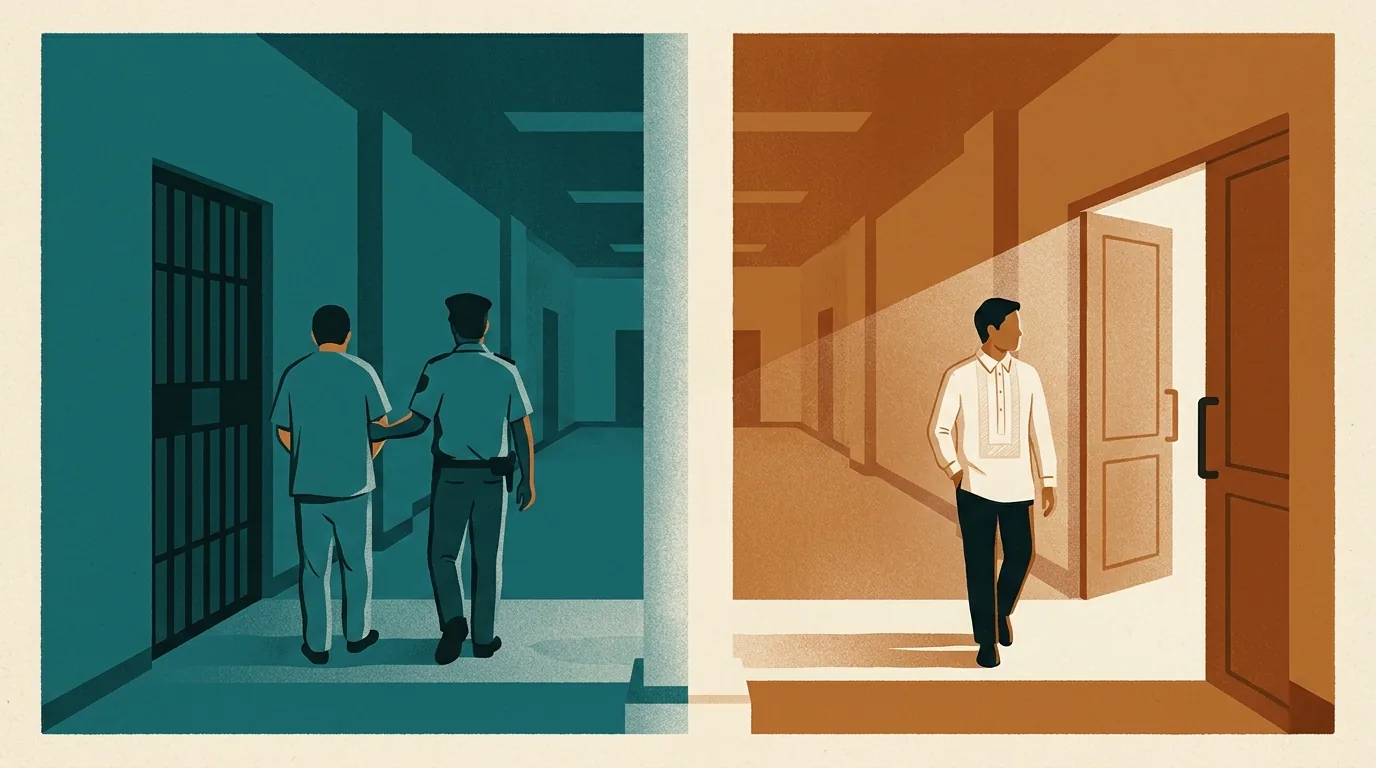
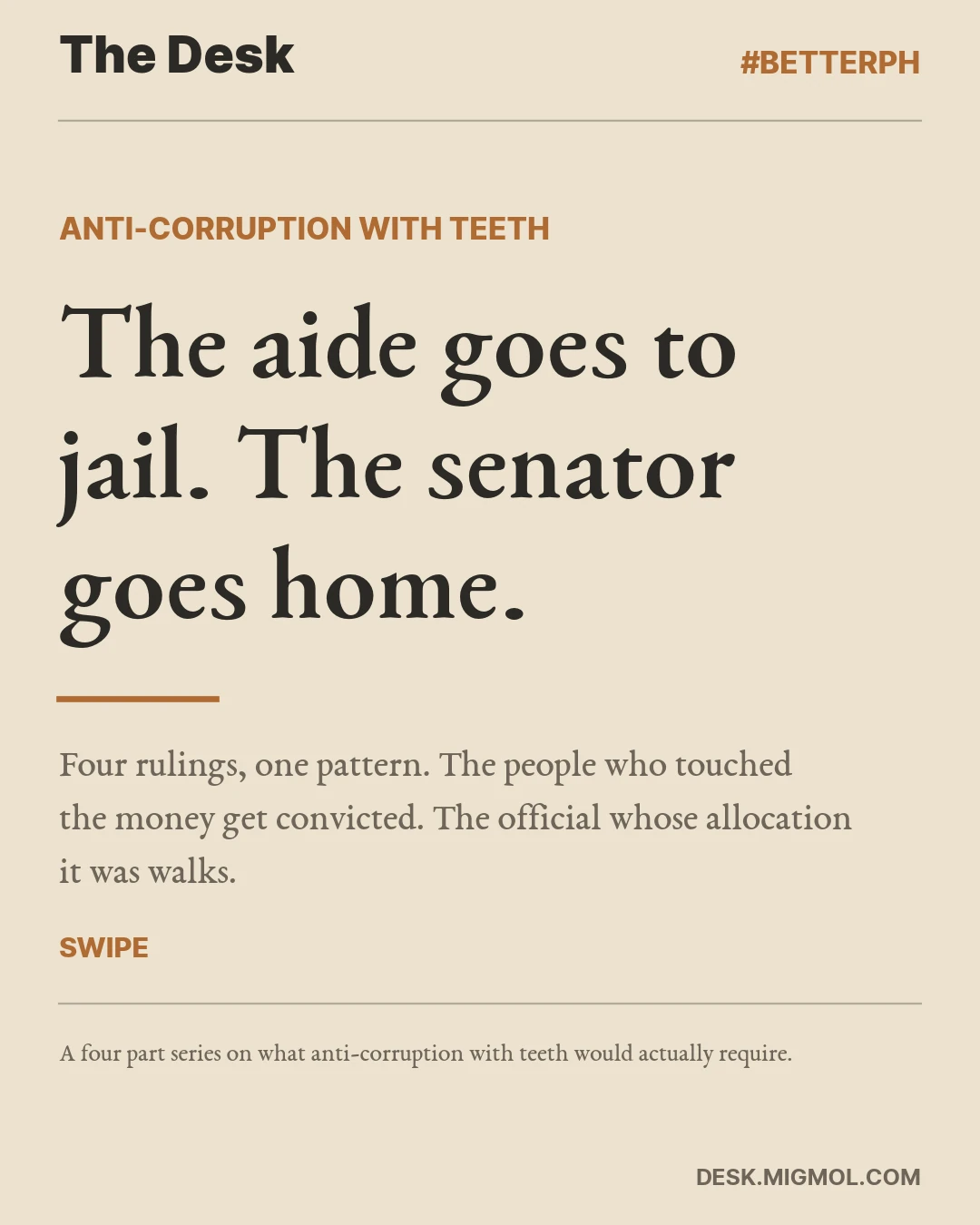
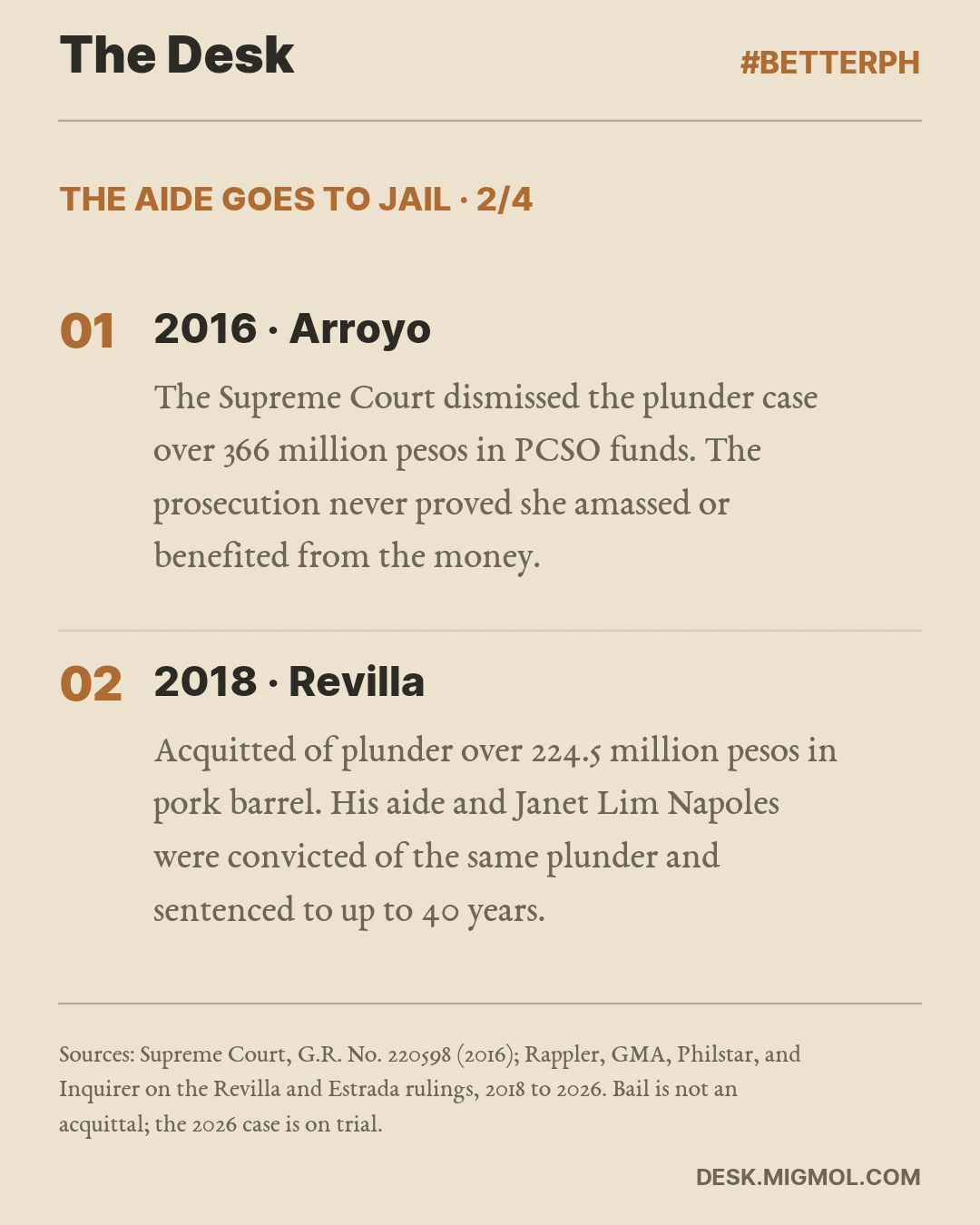
In December 2018 the Sandiganbayan sentenced Richard Cambe to reclusion perpetua, up to 40 years, for plunder. Cambe was Senator Bong Revilla’s aide. Janet Lim Napoles got the same sentence for the same ₱224.5 million. Revilla, the senator whose pork barrel the money came out of, was acquitted.
The court’s reason was that no witness had handed money to Revilla himself or put it into his account. The aide collected, so the aide went to jail. That the boss benefited couldn’t be proven beyond reasonable doubt.
It keeps happening
In 2016 the Supreme Court threw out the plunder case against former President Gloria Macapagal Arroyo over ₱366 million in PCSO intelligence funds. The 11-4 ruling said the prosecution never proved she amassed or benefited from the money, and never identified who the “main plunderer” was.
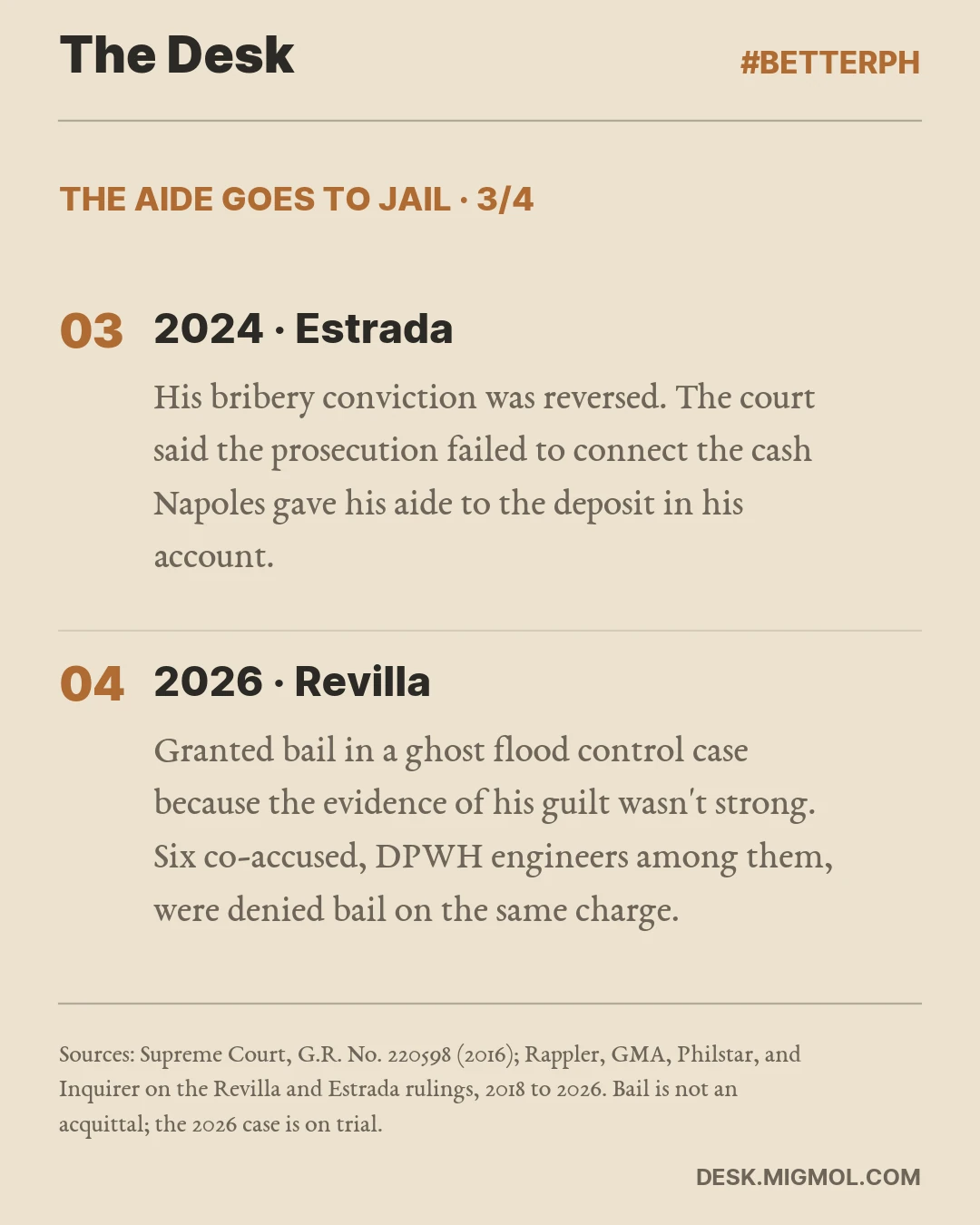
In August 2024 the Sandiganbayan reversed Senator Jinggoy Estrada’s bribery conviction from the pork barrel scam. Napoles had given cash to his aide. The court said the prosecution “failed to establish the connection” between that cash and the deposit in Estrada’s account.
In July 2026 the Sandiganbayan granted Revilla bail in a ₱92.8 million ghost flood control case in Pandi, Bulacan, because the evidence of his guilt wasn’t strong. In the same ruling, the same court denied bail to six of his co-accused, DPWH engineers among them, because the evidence against them “remains strong.” That case is still on trial, and the Ombudsman is challenging the bail. Bail is not an acquittal. But the shape is familiar.
The people who touched the money stay in. The official whose allocation it was goes home. In practice the court wants an absolute link: somebody has to have handed the cash to the official directly or put it into his account. If the chain runs through an aide, it breaks at the aide.
I don’t think that’s an accident. Anyone who has watched a few of these cases knows the rule, so a senator who wants the money never touches it himself. That is what aides are for.
The same names, again and again
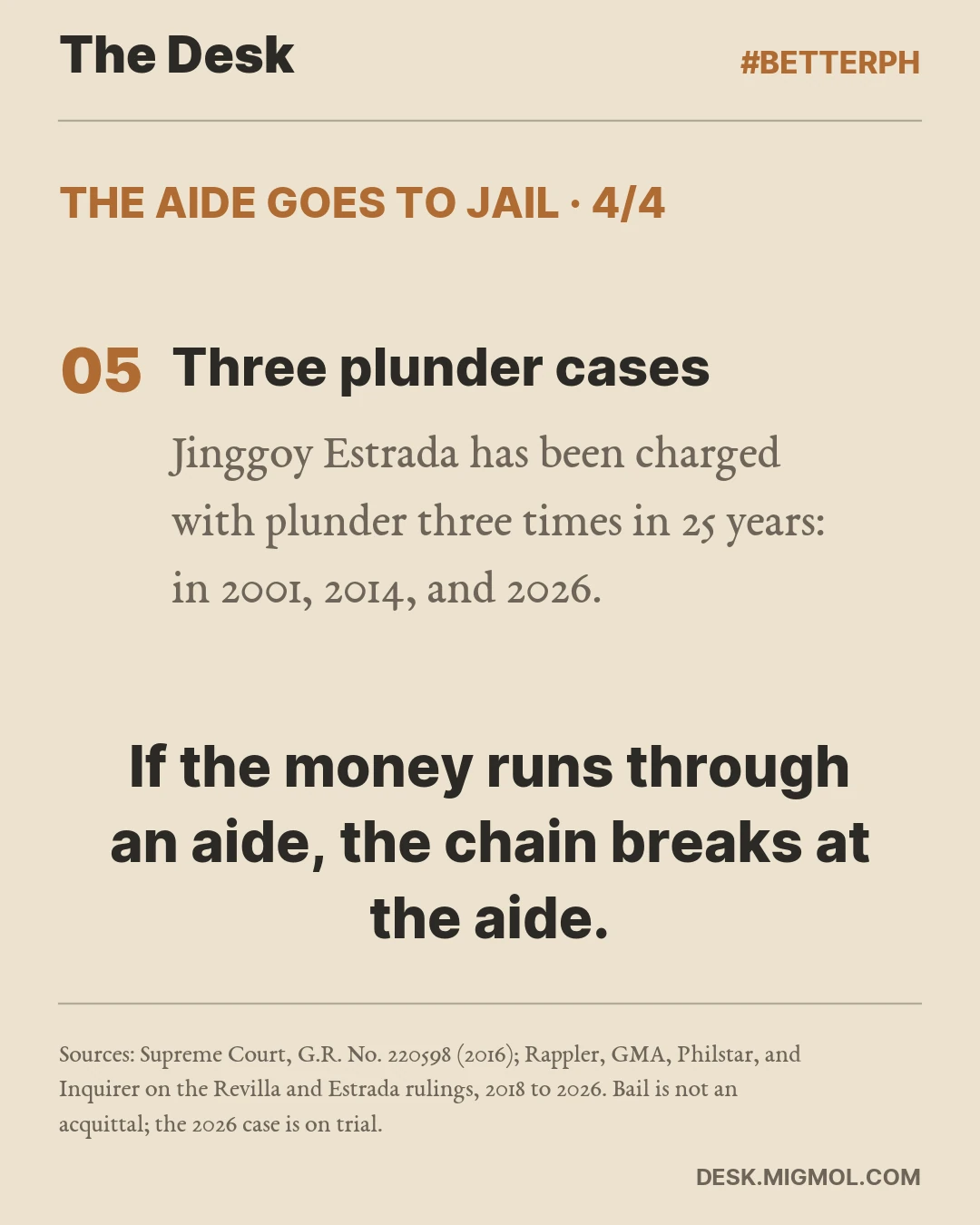
Jinggoy Estrada has now been charged with plunder three times in 25 years. Juetengate in 2001, acquitted. The pork barrel scam in 2014, acquitted of plunder, then of bribery when the court reversed its own conviction. The flood control scandal in 2026, where he was arrested on 1 June and is detained on non-bailable charges. Revilla went from pork barrel to flood control.
Every one of them is innocent until proven guilty, and I’m not saying otherwise. What I’m saying is that a system that keeps catching the same names and can’t finish the job isn’t working.
What the Sandiganbayan actually is
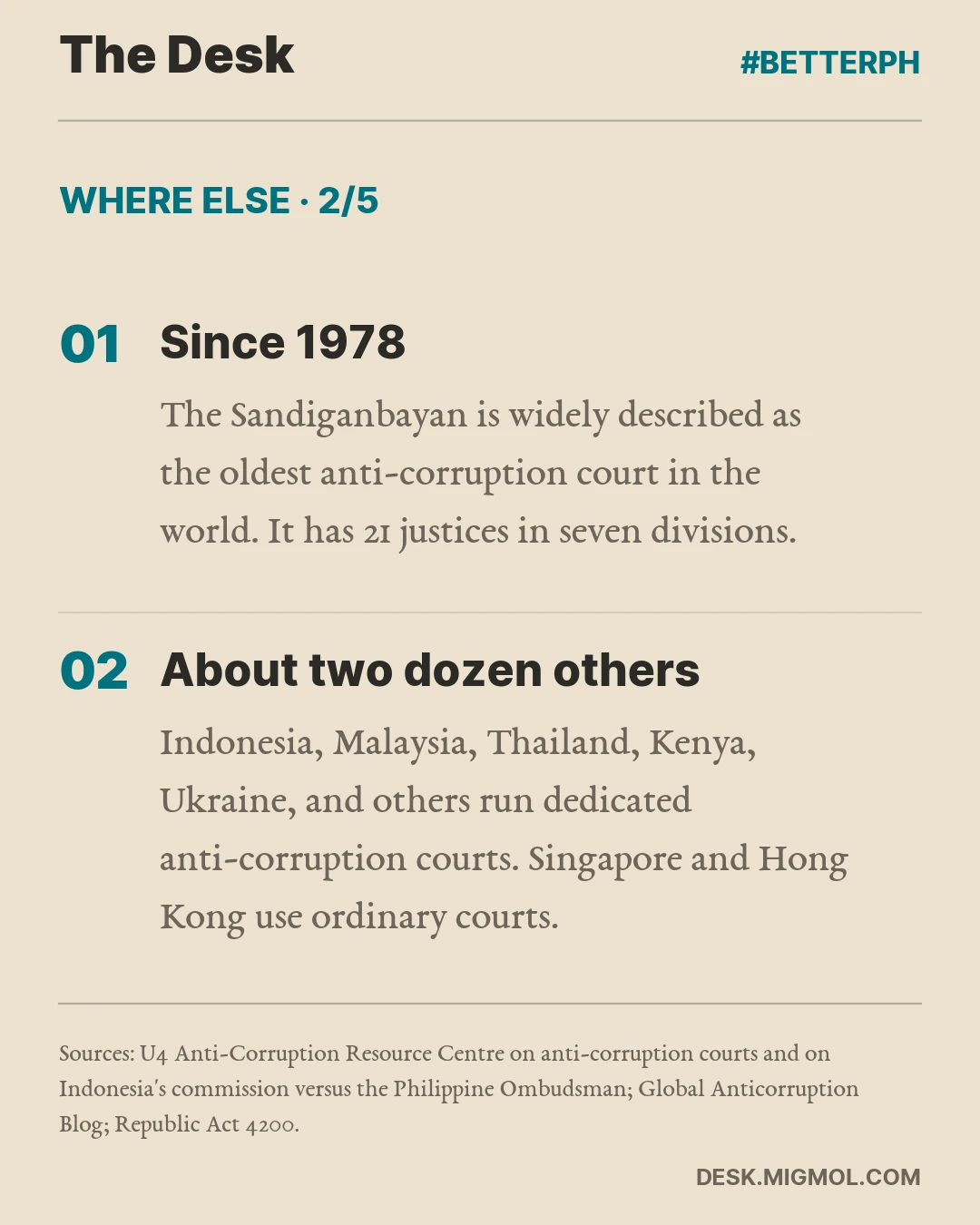
It’s a special court that hears corruption cases against senior officials. Marcos Sr. created it in 1978 and the 1987 Constitution kept it. It’s widely described as the oldest anti-corruption court in the world. Today it has 21 justices in seven divisions, all appointed by the President from shortlists.
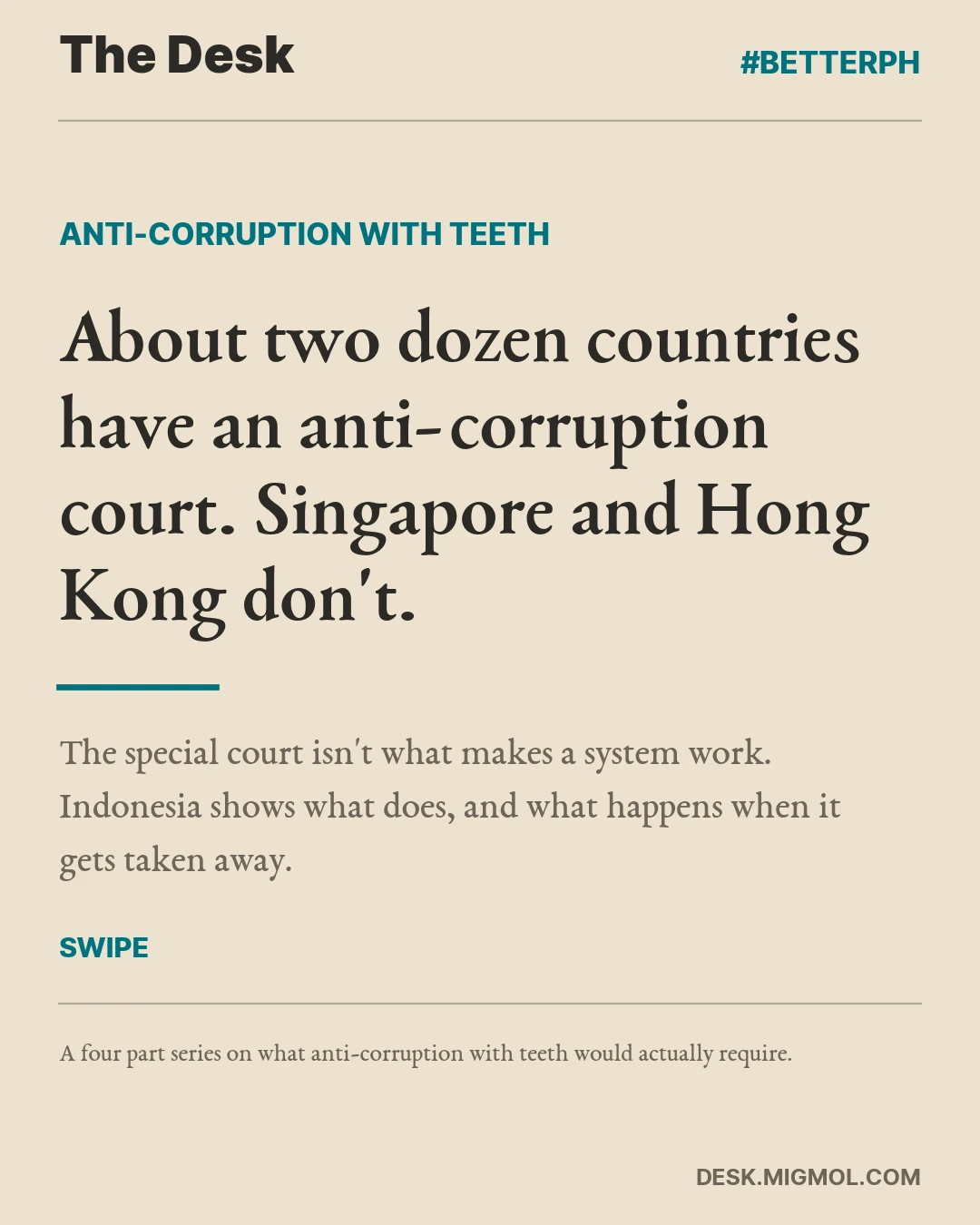
Other countries do have them. Indonesia, Malaysia, Thailand, Kenya, Ukraine, and about two dozen others run a dedicated anti-corruption court. Singapore and Hong Kong, the two places everyone points to, don’t. They try corruption in ordinary courts. So the special court isn’t the secret ingredient.
Credit where it’s due: the Sandiganbayan has been clearing its backlog. It closed 2025 with 805 cases, the first time in 47 years the number wasn’t in the thousands, down from 5,493 in 2017. But one court that hears every case against the powerful is also one place for the powerful to aim at. In 2014 the Supreme Court dismissed Sandiganbayan Justice Gregory Ong for gross misconduct over his ties to Napoles. One case, twelve years ago. It still shows the court can be reached.
And speed still kills cases. In August 2026 the graft case against Jed Patrick Mabilog was thrown out for inordinate delay. Somebody caused that delay, and nobody has to answer for it.
What Indonesia did differently
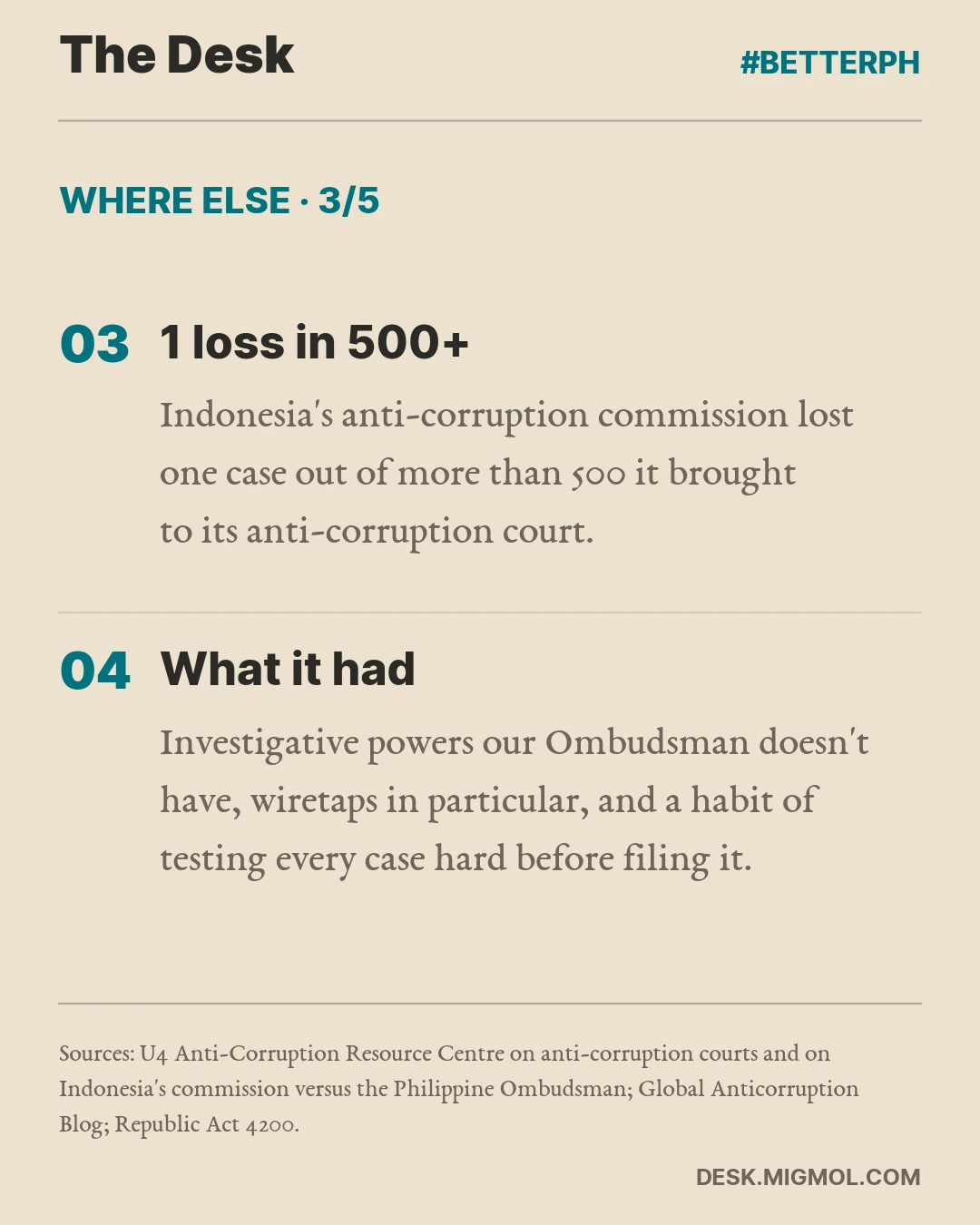
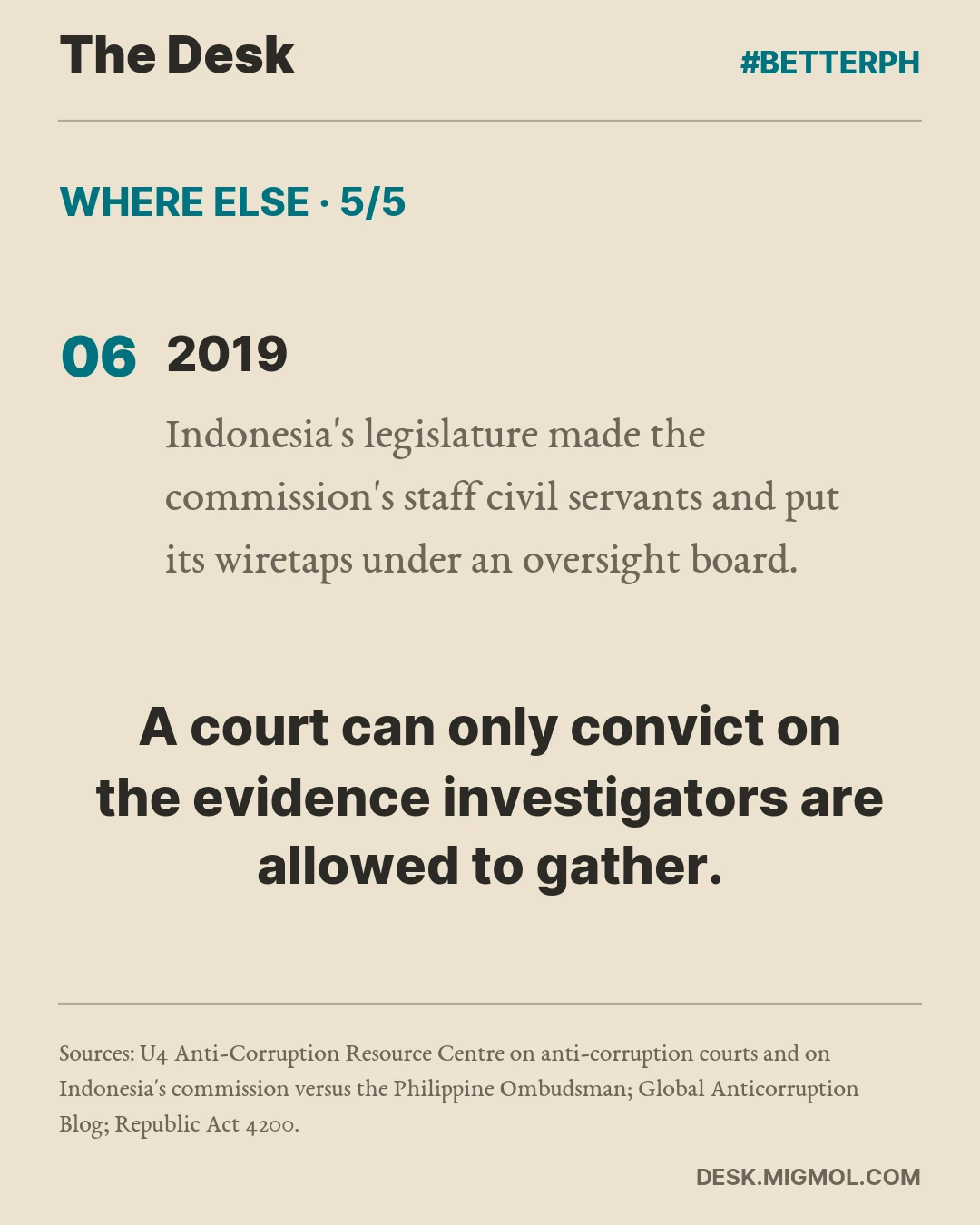
Indonesia’s Corruption Eradication Commission, the KPK, won nearly every case it brought to its anti-corruption court for over a decade, losing one out of more than 500. A U4 study comparing the KPK to our Ombudsman put a large part of the difference down to investigative powers our Ombudsman doesn’t have, wiretapping in particular, plus testing every case hard before filing it.
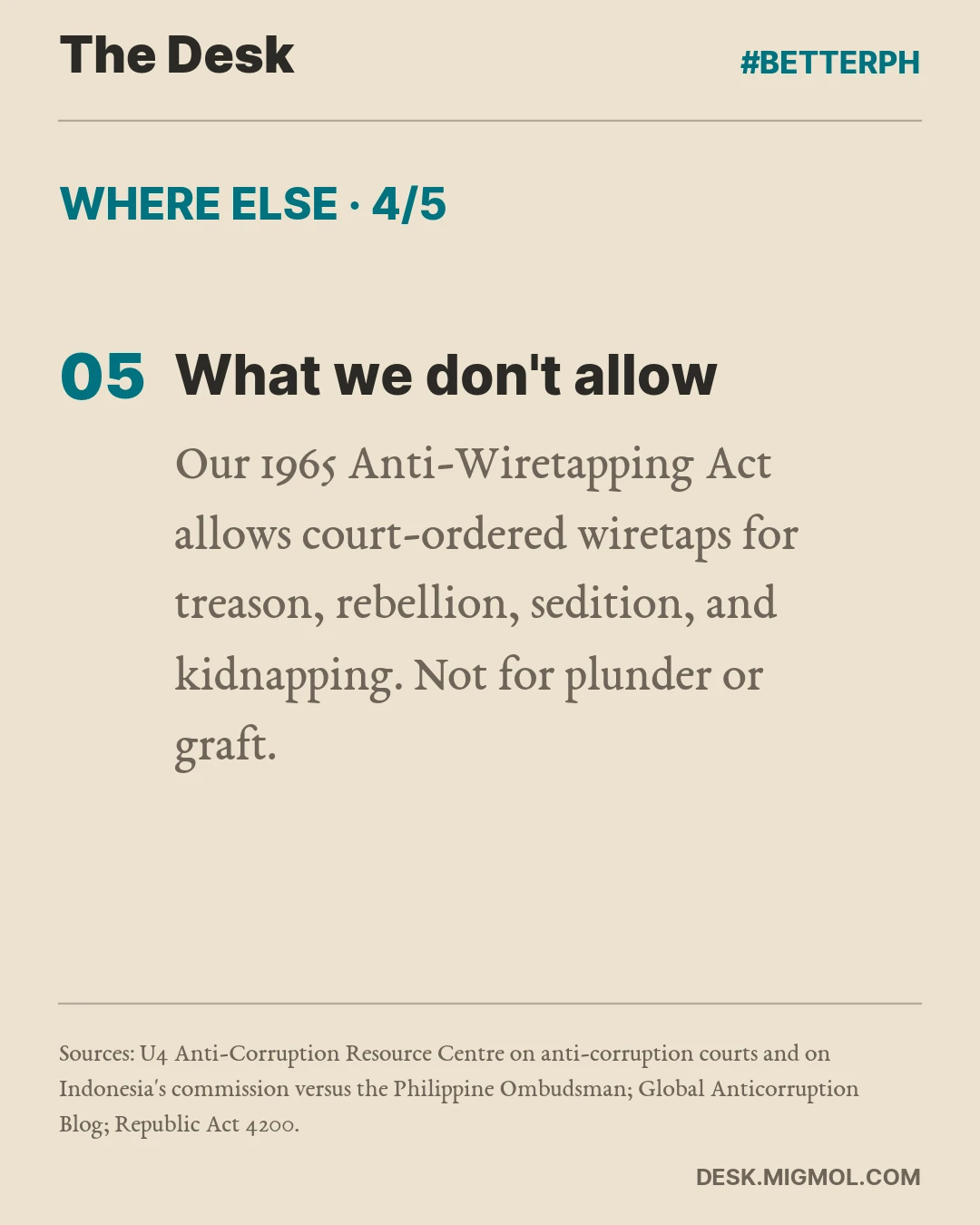
Our Ombudsman can’t wiretap. The Anti-Wiretapping Act of 1965 allows court-ordered wiretaps for treason, rebellion, sedition, kidnapping, and a short list of others. Plunder and graft aren’t on it. A cash kickback is designed to leave no paper. A phone call to arrange it does leave something.
Making it easier without making it dangerous
Holding corrupt officials accountable should be EASIER, not harder. So why have we made it so hard?
Part of the answer, I think, is that “beyond reasonable doubt” has drifted. It was never supposed to mean absolute, conclusive evidence. The Rules of Court say so in plain words: it doesn’t mean absolute certainty, only moral certainty. Circumstantial evidence can convict. What we’ve ended up with, case by case, is a standard where the chain has to be complete right down to the hand-off, and every link that runs through an aide is one the defense can break.
We don’t need to lower the bar for prison, and we shouldn’t. A government that can jail people on less can jail its critics on less. What we need to change is what has to be proven.
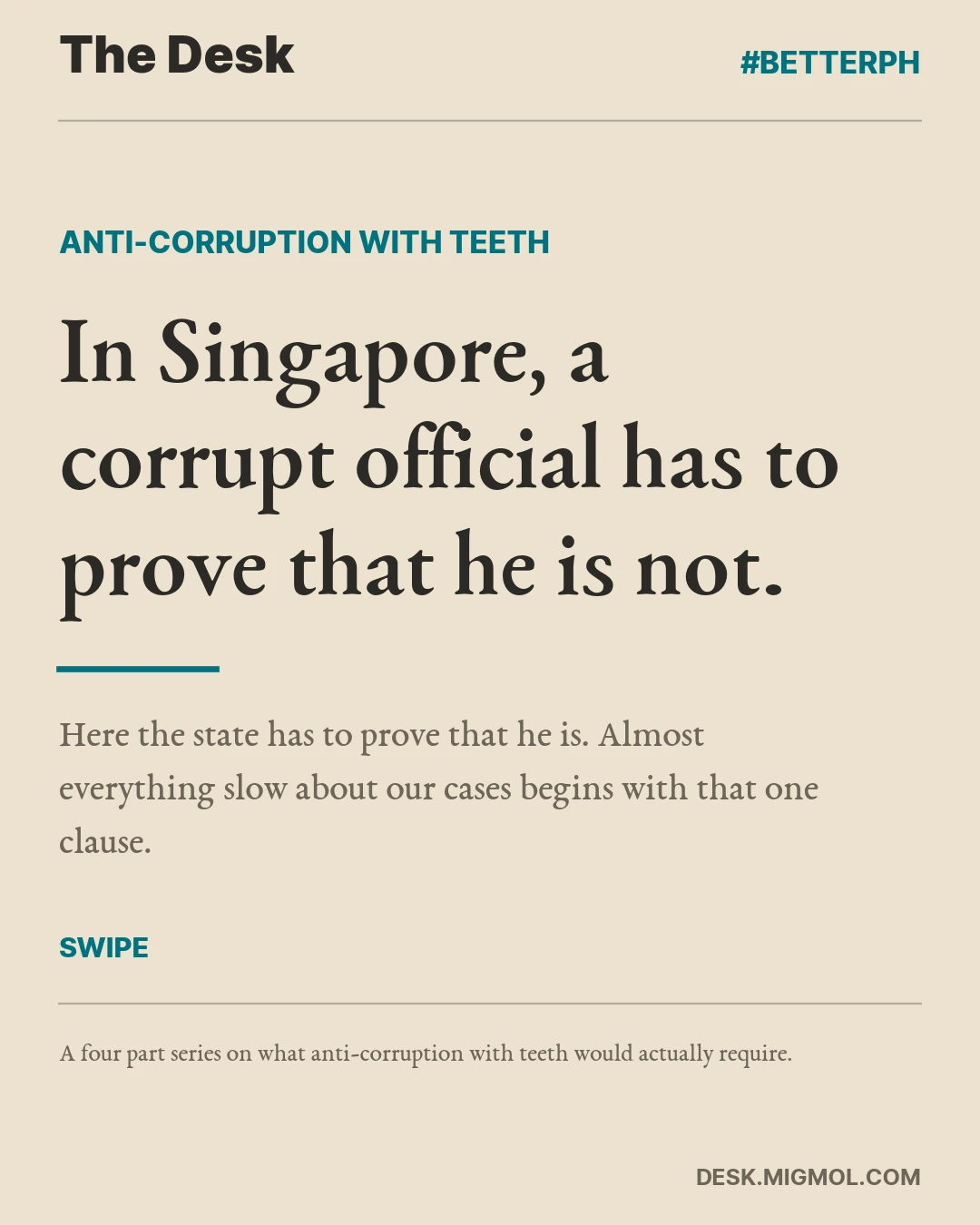
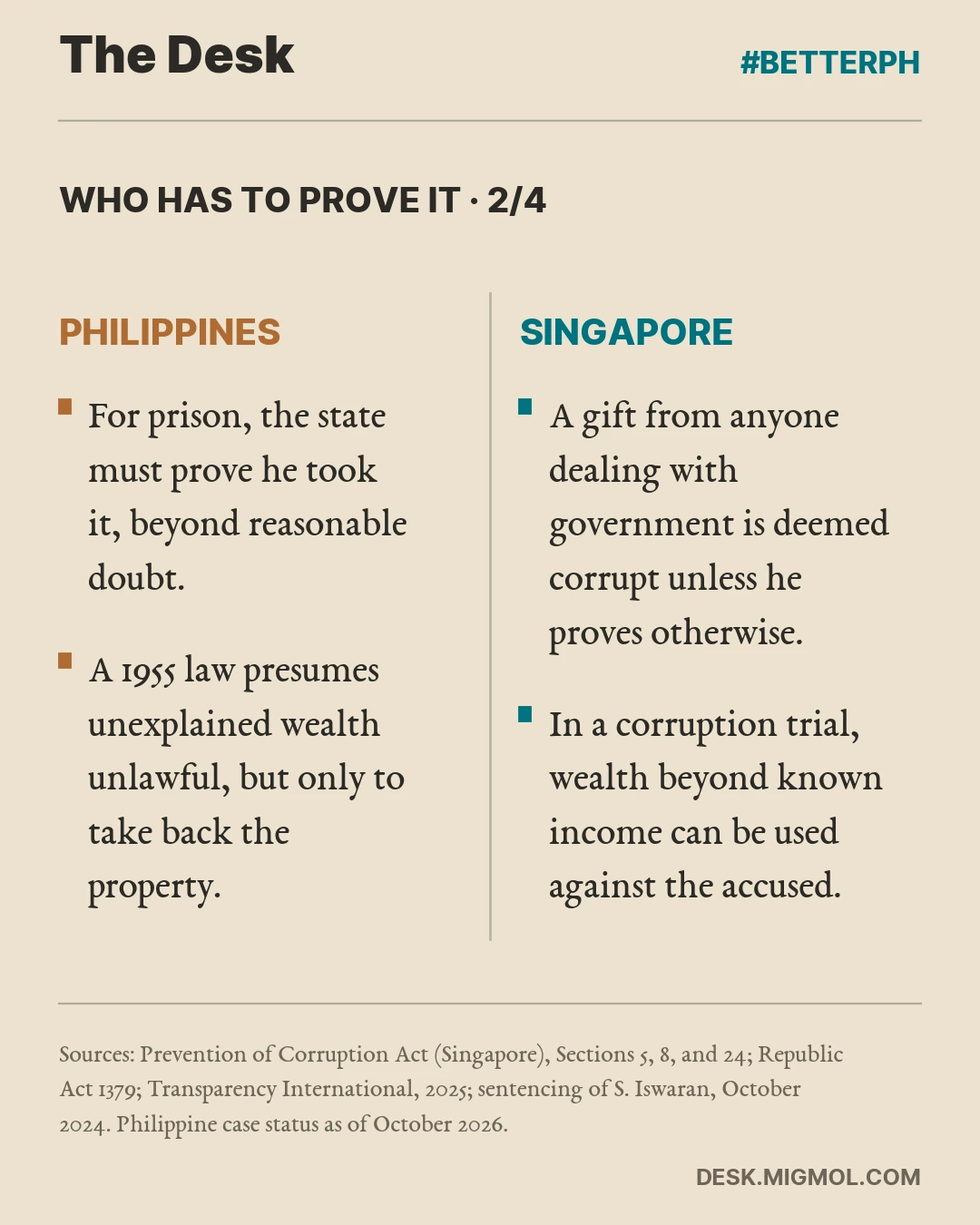
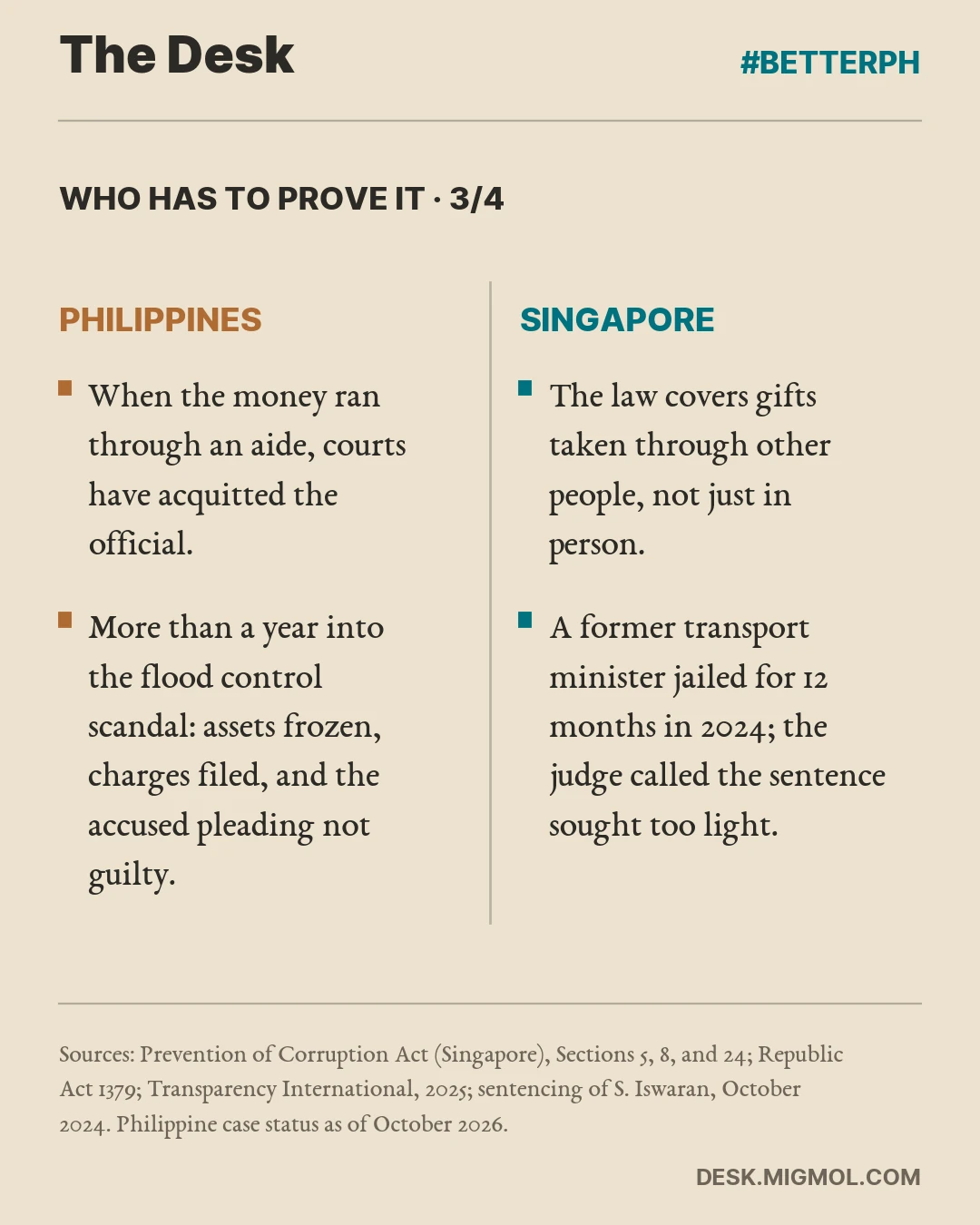
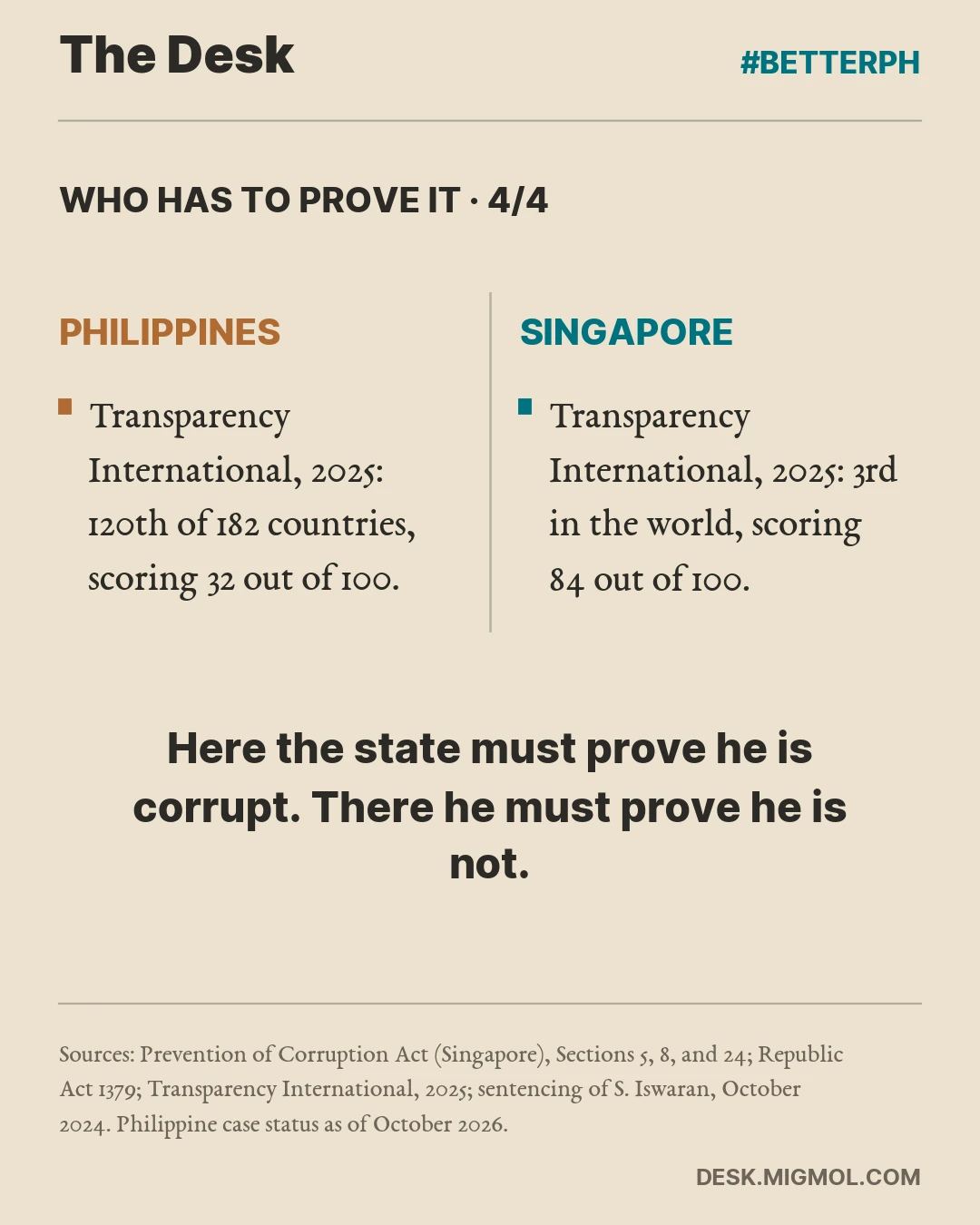
Singapore does it with one clause. Under its Prevention of Corruption Act, a gift to a public servant from anyone who deals with government is presumed corrupt unless the official proves otherwise.
We actually have a version of this already, and it’s 71 years old. RA 1379, passed in 1955, says property “manifestly out of proportion” to an official’s lawful income is presumed unlawfully acquired. The burden shifts to the official to explain it, and it reaches property held in the names of a spouse, relatives, or anyone else. The case is filed in the Sandiganbayan. It takes the property, not the person. But if the prison case fails on the link, the property case doesn’t have to.
So how do we fix it? Four things.
Close the aide gap. When an official’s own staff collects money tied to that official’s own allocation, presume the official received it unless he can show otherwise. He can still rebut it. He just can’t hide behind the person he hired to do the collecting.
Let investigators wiretap for plunder and graft. With a court order, the same way we already allow it for kidnapping.
File forfeiture beside every plunder case. Use RA 1379 in parallel, every time. Even when the court can’t put the official in jail, it can still take back what he can’t explain.
Put a clock on the clock. When inordinate delay kills a case, open an inquiry into who caused the delay. The right to a speedy trial is a real protection and should stay. But a delay that kills a case should have to be explained.
Right now the system is hardest on the people closest to the money and easiest on the people it was taken for. It should be the other way around.
Part 2 of Anti-Corruption With Teeth. Read Part 1: Who Funds the Watchdog? The People It Watches.. Next: The Paperwork Nobody Reads.
16,563 Ballots Were Shaded Before Anyone Voted
Nobody had to break a rule to reach the pre-shaded ballots in Maluso. The rule put them there. The Omnibus Election Code was written two months before EDSA, and Comelec's 963-page fix is still waiting.
Read more →
₱457 Million in Cash, and Nobody Asked
The bank filed the report. The AMLC said it had too many to read. Part 4 of 4 on anti-corruption with teeth.
Read more →
If you're above 40, this is the 2nd Iran Oil Crisis in Your Lifetime.
In 1980, a crisis in Iran pushed oil to $149 a barrel in today's dollars. Saudi Arabia had warned that prices that high would push the world to find something else, and it did. In 2026 it is Iran again, and this time the something else is already in our driveways.
Read more →
What does the world need from the Philippines? Right now, nothing it can't get somewhere else.
China refines 91% of the world's rare earths. Taiwan makes over 90% of its most advanced chips. We import 98% of our garlic and ship our nickel out as raw ore. What could the Philippines own that the world can't do without?
Read more →