The Paperwork Nobody Reads
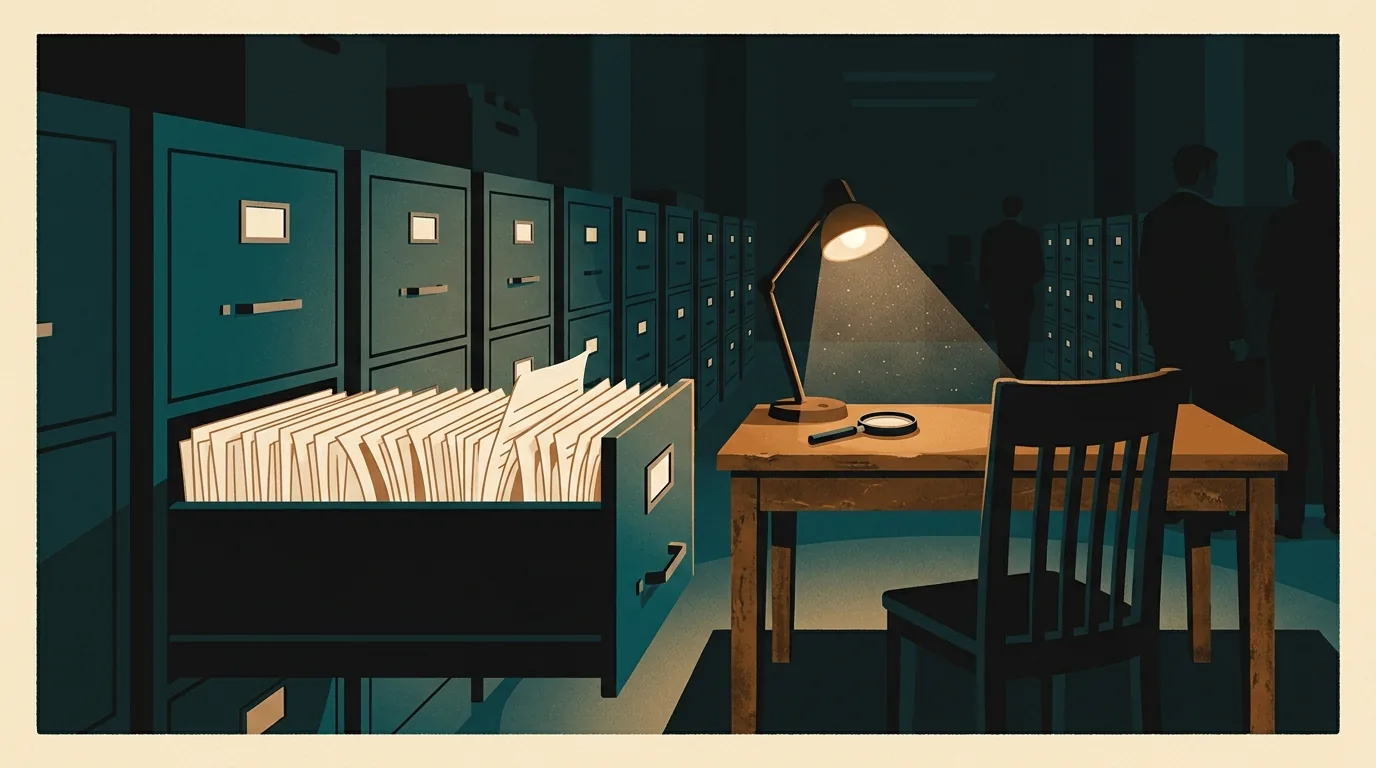
Lifestyle checks and SALNs are a thing. But if nobody sees them, nobody looks into them, and nobody does anything about them, they don’t really matter.
Every public official in the country files a Statement of Assets, Liabilities, and Net Worth every year. What they own, what they owe, what they’re worth. It is one of the oldest anti-corruption tools we have, and it is a good one, because a SALN turns a hunch into a comparison. You say you’re worth this much. Your house, your cars, and your kids’ tuition say otherwise.
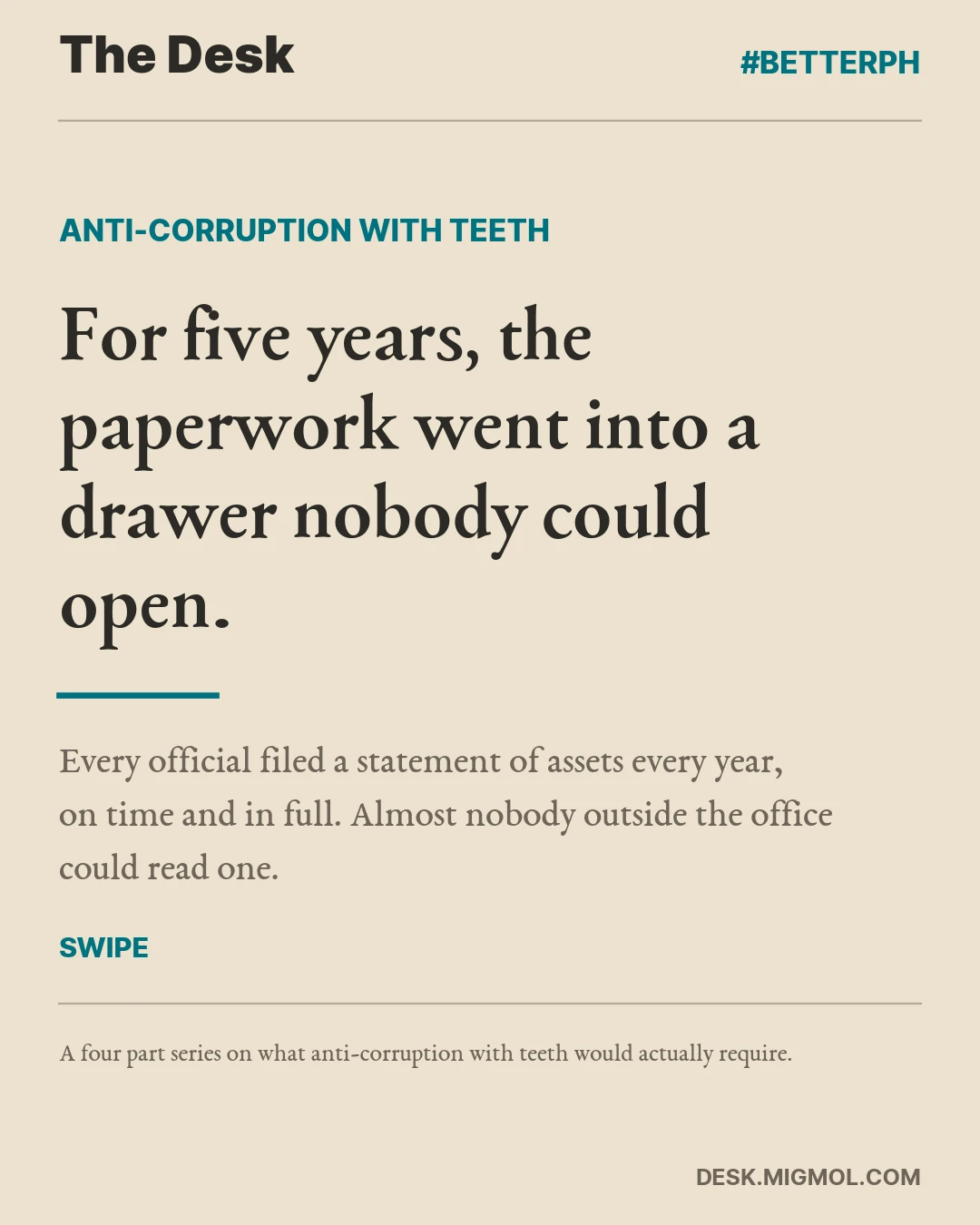
For five years almost nobody outside the Office of the Ombudsman was allowed to make that comparison.
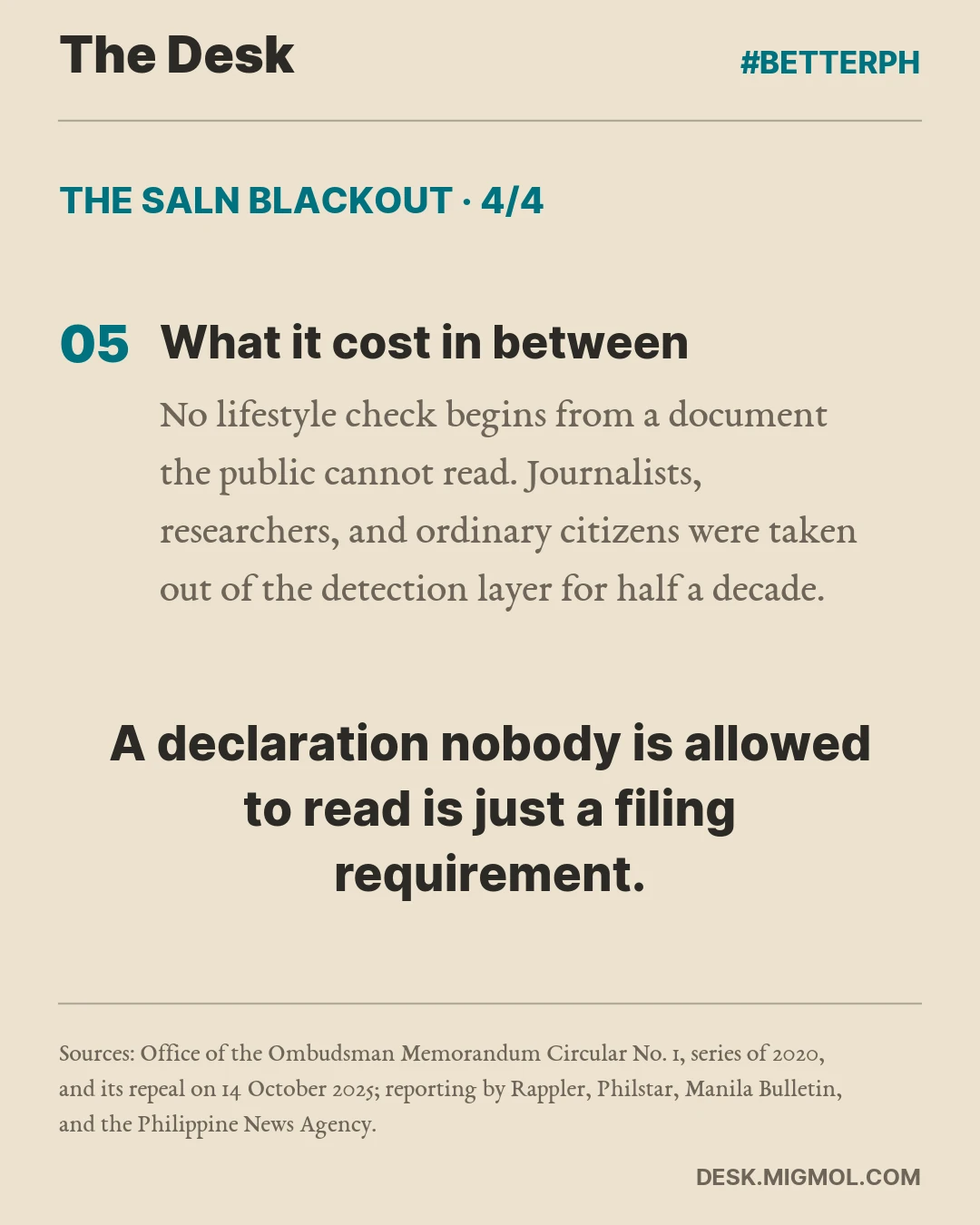
The drawer
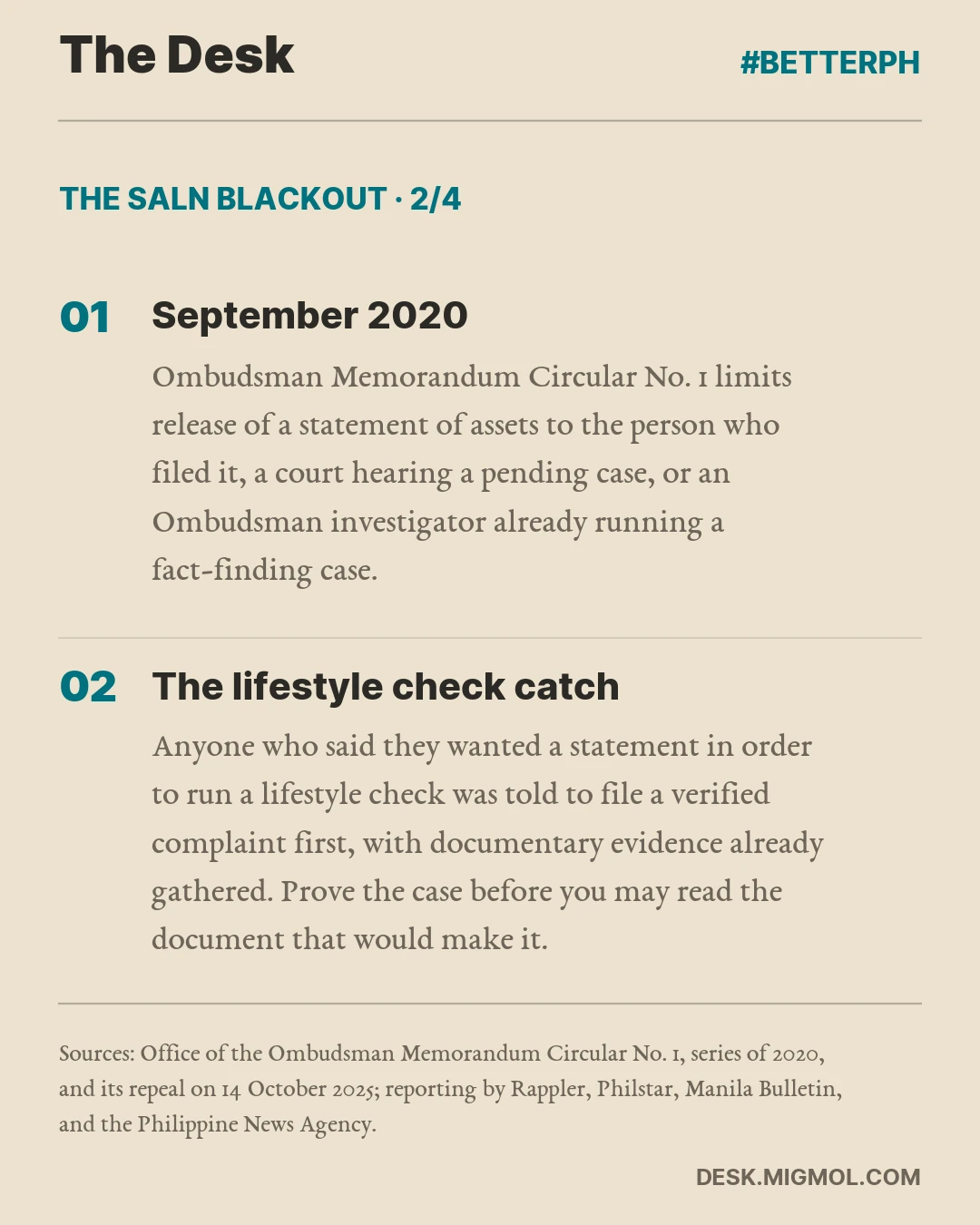
On 1 September 2020 the Ombudsman issued Memorandum Circular No. 1. From then on, a SALN would only be released to the official who filed it, to a court hearing a pending case, or to an Ombudsman investigator already running a fact-finding investigation.
Journalists couldn’t get one. Researchers couldn’t get one. A citizen couldn’t get one.
It got worse if you asked for a SALN to do a lifestyle check. The circular told the Ombudsman to advise you to file a verified complaint instead, together with the documentary evidence you had already gathered. So you had to prove the case before you were allowed to read the document that would let you prove it.
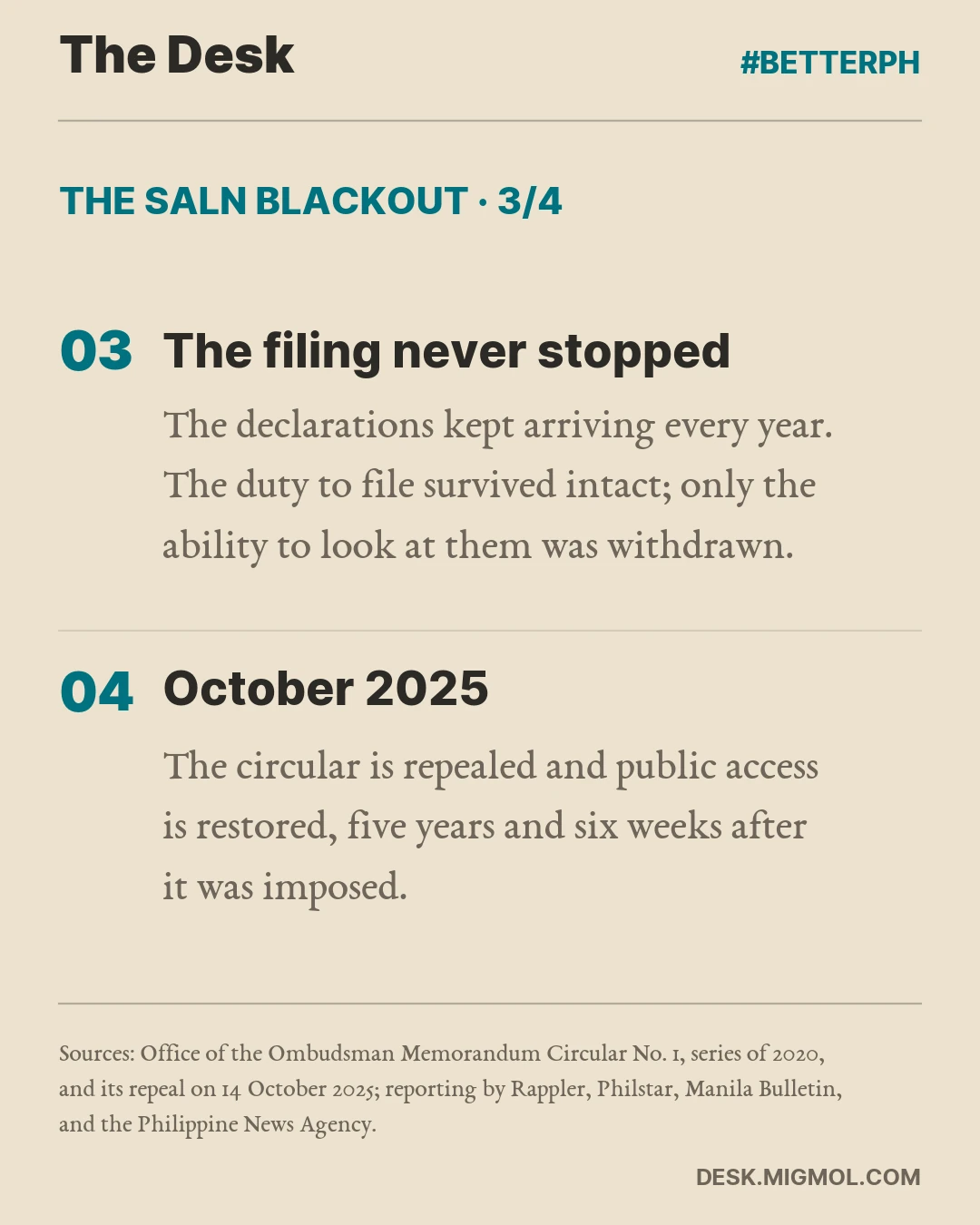
The officials kept filing every year, on time, in full. The duty to file never went away. Only the ability to look at what was filed did.
On 14 October 2025 the circular was repealed and public access was restored, five years and six weeks later. Good that it’s back. But a circular closed it and a circular opened it, which means the next circular can close it again.
We already have the punishment, too
And we don’t just have the declaration. We also have the law that is supposed to act on it, which frustrates me more.
RA 1379, passed in 1955, says that when an official’s property is “manifestly out of proportion” to his salary and other lawful income, it is presumed to be unlawfully acquired. The burden shifts to him to explain where it came from. If he can’t, the property is forfeited to the state, including property sitting in the names of his spouse, his relatives, or anyone else holding it for him. Under the Anti-Graft Act, the same finding is a ground for dismissal.
So a gap between what an official declared and what he visibly owns is already supposed to cost him his property and his job. The law has been there for 71 years. What’s missing is someone whose actual job is to look for the gap.
A lifestyle check is a comparison we never run
A lifestyle check sounds like detective work. It is mostly arithmetic.
The SALN says what an official owns. The Land Registration Authority knows what titles are in his name. The LTO knows what vehicles are registered to him. The BIR knows what income he declared. Every one of those records already sits inside the government. Put them side by side, and an official who declared a modest net worth while his family drives three luxury SUVs shows up on the first pass.
Nobody puts them side by side, at least not as a matter of routine. A lifestyle check happens when somebody files a complaint, or when a scandal is big enough to reach a Senate hearing. By then the money is usually gone, moved, or in someone else’s name.
Singapore built its system on the assumption that unexplained wealth is the official’s problem to explain, and its Prevention of Corruption Act says so. We wrote a version of the same idea into law in 1955 and then left it for someone else to use.
So how do we fix this? Three things.
Put SALN access in the law. Not a circular. A statute that says any citizen can get any official’s SALN, with only genuinely private details like home addresses redacted. Then no Ombudsman can switch it off again.
Give someone the job of comparing. A standing unit, inside the Ombudsman or COA, whose duty is to run every senior official’s SALN against land titles, vehicle registrations, and tax filings every year. A duty, not a discretion. If the numbers don’t match, the unit has to open a file.
Use the 1955 law. When the comparison shows a gap the official can’t explain, file for forfeiture under RA 1379. Publish how many were filed and how they ended.
A declaration nobody is allowed to read is just a filing requirement. We already collect the paperwork. We already have the law. We just need somebody to read it.
Part 3 of Anti-Corruption With Teeth. Read Part 1: Who Funds the Watchdog? The People It Watches. and Part 2: The Aide Goes to Jail. The Senator Goes Home.. Next: ₱457 Million in Cash, and Nobody Asked.
16,563 Ballots Were Shaded Before Anyone Voted
Nobody had to break a rule to reach the pre-shaded ballots in Maluso. The rule put them there. The Omnibus Election Code was written two months before EDSA, and Comelec's 963-page fix is still waiting.
Read more →
₱457 Million in Cash, and Nobody Asked
The bank filed the report. The AMLC said it had too many to read. Part 4 of 4 on anti-corruption with teeth.
Read more →
If you're above 40, this is the 2nd Iran Oil Crisis in Your Lifetime.
In 1980, a crisis in Iran pushed oil to $149 a barrel in today's dollars. Saudi Arabia had warned that prices that high would push the world to find something else, and it did. In 2026 it is Iran again, and this time the something else is already in our driveways.
Read more →
What does the world need from the Philippines? Right now, nothing it can't get somewhere else.
China refines 91% of the world's rare earths. Taiwan makes over 90% of its most advanced chips. We import 98% of our garlic and ship our nickel out as raw ore. What could the Philippines own that the world can't do without?
Read more →